patchwork shekou, 2016.10.28

New edges and older sections, urban tumescence overtakes low-lying hills and buries oceans. The strength of urban expansion, its righteous inevitability, shimmers and jiggles, impresses–even though eventually paths peter out and doors remain bolted.

Closed off closed out: enclosed.

This is not the city that I want. It is however the city that has shaped my dreams and fears, given form to what I think is possible, what I believe to be necessary.  Continue reading

luohu, dusk: 2016.10.27

Luohu as we knew it is changing. The recent announcement that urban renewal compensation has made billionaires of Shuibei villagers, the decision to selectively preserve and redesign Hubei as a “historic” public park area, and ongoing renewal of Caiwuwei fang (坊) or “branches”–individually, each of these projects entails demolition, evictions, and rebuilding and restructuring of particular neighborhoods, but taken together these projects entail through revision of the Old Special Zone. And yes, we’ve been watching this happen all along, but enough of the earlier urban tecture remained that we could feel where we came from, as we moved between and through adjacent neighborhoods. These new projects signal something else. Continue reading

baishizhou 2016.10.26

Walked Baishizhou yesterday with nine others, a group of tourists large enough to attract the attention of children who thought we were English. Sweaty and somewhat irascible, I countered, “We are German and Austrian, Indian, American, Chinese and Taiwanese.” Indeed. The attention that is paid to Baishizhou grows, even as both demolition and upgrading proceed, albeit in different parts of the neighborhood. So a walk through the eastern section of Baishizhou. The above photograph from the sixth floor building is aimed eastward, toward the OCT to contextualize the walk, and bring int into focus the vanishing act in play.

This slideshow requires JavaScript.

of influence and independence, power & game: thoughts on shenzhen 3.0

If memory serves (and it tends to serve some agenda), I first visited Huaqiangbei (formerly the Shangbu Industrial Park) in 1995, when it was still primarily a manufacturing and residential area, but didn’t know what I was looking at. The big ideas in my head had to with workers rights and feminism, and so I was aware of the factories, the state sponsored housing, the few department stores, including the then still operative Friendship store, and the iconic Shanghai Hotel with its surprisingly good Cantonese dim sum. I noticed that neighboring Gangxia and Tianmian were under construction, but glossed this new urban morphology as a “new village.” I didn’t realize that the scale of immigration and construction that happened during the 90s and defined “Shenzhen” for me would be different enough from the 1980s that friends who arrived during the Special Zone’s first decade laughing asserted that Shenzhen was changing so quickly that if they didn’t visit a neighborhood for several years it was easy to get lost; Shenzhen in 1989 and 1999 were two different cities. And that was almost two decades ago.

Continue reading

where’re you from?

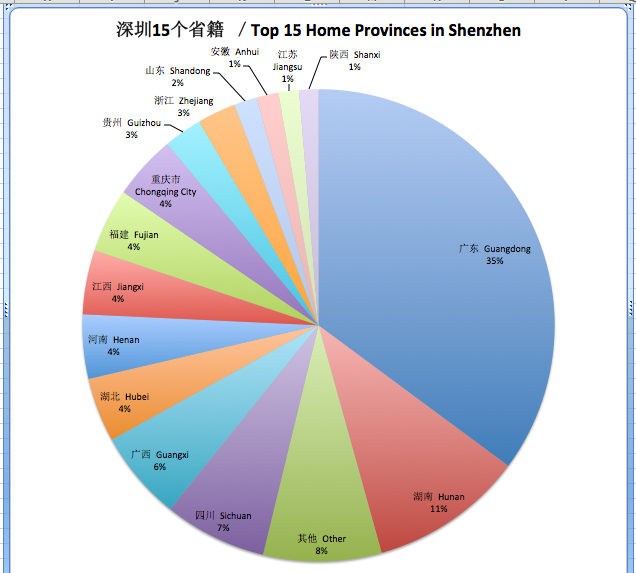
We know that Shenzhen is an immigrant city, but inquiring minds wonder: where do the immigrants come from? Based on the recent release of Shenzhen statistics (for 2015), I’ve come up with the following chart that gives a crude (very, very crude) approximation of where Shenzhen’s residents are from circa 2014. Of note, if Chongqing and Sichuan counted as one place, instead of as a city and province respectively, the area would be roughly tied with Hunan for second most common origin. And yes, this corresponds with my (again vague) impression that Guangdong, Hunan, and Sichuan/Chongqing restaurants dominate the city’s eating!

population

baishizhou demolition: the rising cost of shenzhen dreaming

Yesterday, I heard this story: A 30-something farmer from Lanzhou came to Shenzhen in 2013 in order to make his fortune. He started out working for a relative in a Lanzhou Noodle Shop, and then after a few months decided to open his own noodle shop. After looking around for a suitable place, he decided to purchase the rental rights to a noodle shop in Baishizhou, on the western side of Shahe Road. The shop had been recently renovated and came with a hefty transfer fee—180,000 rmb with a high rent. But the man was enthusiastic. So he sold his homestead land (宅基地) as an initial investment and moved his family to Baishizhou, where they worked. Only his youngest son went to school, while his oldest didn’t go to high school so he could work in the shop. As the last of the buildings in the Shahe Industrial Park are being demolished, he is being forced out without any compensation and no way back home. Continue reading

nanting village, guangzhou

On Friday September 9, 2016, I had the privilege of visiting Nanting Village, Guangzhou with Professor Chen Xiaoyang, from the Guangzhou Academy of Fine Arts. The occasion for the visit was a screening of Zhong Shifang’s film, “From Border to Border,” a documentary on the Chinese community in Tangra Calcutta. I will discuss the film in my next post. Today, I would like to contextualize the screening of the film with a brief introduction to Nanting Village. Continue reading

shenzhen comes out in favor of new attitude toward urban villages

It’s been a long time coming. Or not. Roughly a decade after Shenzhen targeted urban villages as “dirty, chaotic, and substandard” and less than five years after Gangxia changed how we thought about compensation, the official Shenzhen press has indicated its time for the city to change how it thinks about urban villages. Continue reading

The P+V Academy

So these past few months, I have been busy setting up a public arts education program at the P+V Gallery (虔贞女校艺展馆) in Dalang. We’re calling this series of events, the P+V Academy (虔贞女校学堂). This name, of course, is an updated rendering of Pious Virgins Girls’ School and the project to create a space for alternative, minjian (民间) histories.

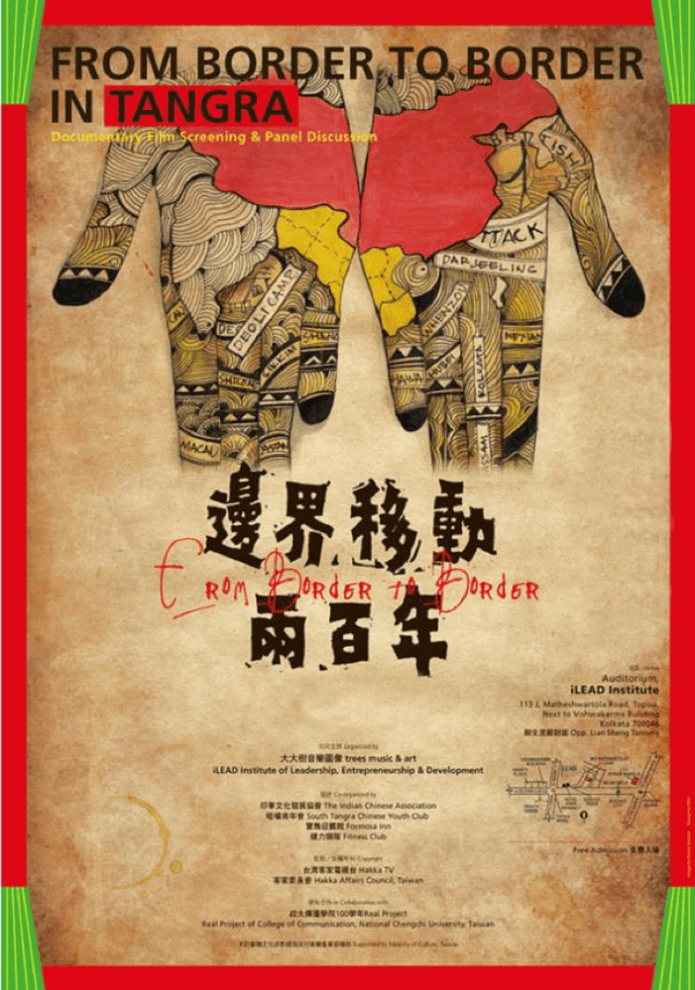
On Saturday, September 9, 2016 at 3 pm, we’re screening Shefong CHUNG’s “From Border to Border,” a documentary about the Hakka diaspora in India. The title, of course, alludes to the marginalization of the Hakka within both China and India. We are thrilled that the director will be joining us for the screening and discussion. If you’re in the neighborhood, join us.

Located in the middle of an urban village, the P+V Gallery is the only historically restored building in Shenzhen that offers public programing. It is truly worth a visit to experience both the city’s deep history as well as Dalang Street Office’s efforts to shape an alternative public culture. The “Children’s Art Sprouts” projects, which organizes a monthly arts course, including the sock puppets is part of the Academy’s offerings.

sock puppets!

There’s much I could say about why community art programs matter, but. Sock puppets! Incredibly cute kids! Everything that matters. Here.

This slideshow requires JavaScript.