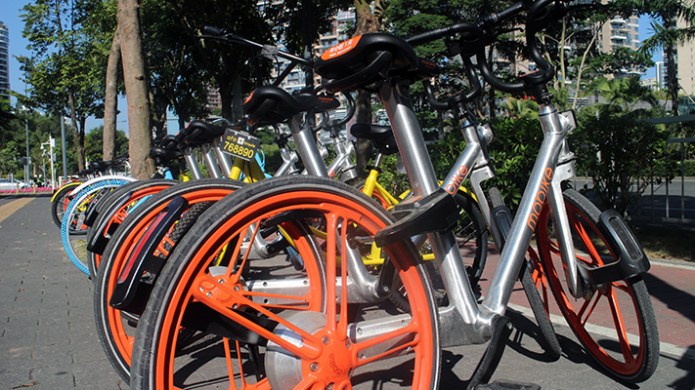
bikes. this time with feeling

When I first came to Shenzhen, bikes were so common it took me a while to notice them. However, by the time I did notice them, they (the bikes) were actually being pushed off the streets in favor of cars and the emergent commuter economy, which did not yet have a metro and so relied on cars. In turn, the number of motorized and electric bikes became prevalent, with motorbike taxis a common form of transport in parts of the city with inconvenient or no public transportation.

In November, the city (or at least the inner districts) went full on bike and now these rentals can be found throughout the city. Rental bikes are provided by at least four different private companies and for 1 rmb per half hour, one can pedal from subway station to home, or take a leisurely ride. These new bikes have disrupted two businesses that were once controlled by private entrepreneurs: site-seeing bikes in Mangrove Park and motorbike taxis. The most recent massive removal of motorbike taxies from the urban environment that took place in April of this year. Nevertheless, banning motorbikes and electric bikes has actually been an ongoing, decade-long project. See reports here (2003), here (2007)here (2009), and here (2011).

fuyong new village / bao’an road

It’s instructive to jump off the number 11 subway line, once its passed the airport station. In Bao’an District, the No 11 line runs parallel to Bao’an Road, which delineates the inner border between the older, historic village settlements and their industrial parks. East of Bao’an Road, one heads toward the Pearl River, land reclamation, and scattered reminders of this deeper history. West of Bao’an Road, one heads through large industrial parks toward National expressway G107, which was the road that first connected the original Special Zone to Guangzhou via Songgang (images of a 2008 walk, here). At Nantou Checkpoint, National Highway 107 becomes Shannan Road and a fast track to the inner district real estate boom. Continue reading

baishizhou housing update

This is just a short note on a conversation that I had a few days ago with an entrepreneur who lives in Baishizhou. She’s a millennial, runs a small business, earns over 10,000 a month, and lives in Baishizhou. Why? Because she wants to buy a house in Shenzhen and living in an urban village is the only way to save money for the down payment. It turns out she’s not alone. Her friends who want to purchase a home in Shenzhen are opting to live in a village, while friends and other millennials who have decided not to buy a home are renting in housing estates. On her account, even folks who are making upward to 20,000 a month are choosing a village if they want to buy a home, while their colleagues who aren’t saving for a home are paying three to four more times a month, traveling, and spending their money and time cafes, microbreweries, and music venues. These are, of course, first generation migrants. Most second generation migrants have houses through their parents, who migrated to Shenzhen before the 2004 housing price boom.

Takeaway? We’ve known for a while that many nearby firms provide dormitory housing in Baishizhou, while many architects and designers who work in OCT firms have opted to live in the village for convenience. It seems, however, what we hadn’t picked up on (or has only recently emerged) is the extent to which the desire to buy a house in Shenzhen is shaping the way that millennials are inhabiting the city and reshaping the urban villages.

there are places like this in ohio, too

The contrasts between the inner and outer districts are not immediately apparent because they are not juxtaposed in space, but rather through time; you need to travel (at least an hour, more by public transportation) from center city to its outskirts in order to viscerally experience the lived differences between here and there. Indeed, most people don’t make the trip (unless they live in one of the new gated communities along the subway lines that transport young managers and clerks and secretary types to their offices, most likely in Futian, because close examination reveals all subway lines–especially the high-speed and direct lines–converge in the city’s center) and even then, most don’t venture beyond the lines and malls because, well, there’s no time (true) and less interest (all too true).

Continue reading

seeing clearly

Yesterday, Marco taught “enlargement” at the P+V Art Sprouts program. The class itself had four components: a warm-up (taking pictures of each other jumping), a critique of last week’s photos, a treasure hunt for details that Marco had taken of objects around the P+V, and a lesson in enlarging images, including photos. Observing the class, I remembered how difficult it is to see clearly because we manipulate images–scale and intensity–in order to create responses in an audience. Sometimes, we’re going for “beauty,” but at other times we’re aiming for disgust and fear, lust and laughter. Confusion? Continue reading

be in but not of: hard practice

Hope takes work in the moment and grows through deep time. It is not over until all of us (including the screamers) are free from suffering; just as there is not one America, there is not one Hell, and certainly there is not just one apocalypse. If we look attentively we see how many lives in how many places are destroyed time and time again. The question facing each of us is: where can I work? What relationships, what changes allow me to help end suffering? And then we work, trusting that other bodhisattvas are also doing their hard practice in fields where we cannot, because (and this I believe) just as there is not one world, there is not one Paradise, and certainly there is not only one savior.  Continue reading

responding to american fascism

Meaningful dialogue it hurts because conversation needs two; everywhere we have refused each other. My mother and her friends prayed on the evening of the 8th, and anyone who joined them could have engaged. Unfortunately, if only one person shows up, it is a vigil, not a dialogue. And so maybe that’s our calling now: we show up. We show through our actions that we are willing to engage in peaceful, respectful dialogue. We will listen, and we will also be heard. Continue reading

today

I am sad, trying to figure out what can be done and what can help. Just after I learned that an admitted sexual predator and candidate endorsed by the KKK had won the US election, I had a meeting with my boss who told me that she would be recruiting a “higher quality of children” to participate in a public arts program. It seems that the children of migrant workers aren’t worth time and art and color.

When did the cruelty of the world swell up so high? It is possible that it has always been there (what is the greatness particular to the United States?) and I, white and middle class, well educated and joyful in the life of the mind and ever willing to find relief in a book avoided it. Or have we changed through all this privatization and a willingness to abandon the least among us because “that’s the way of the world” and so we turn our backs on water protectors and align ourselves with predators as if it would bring us home to safety?

I feel forlorn, distraught by this current celebration of anger that is not righteous but petty, and the abandoned children. We fail them regularly, both here and there, intentionally, too, but more likely simply because we are tired and compelled by fears of another abandonment. What if this is the best we can do? How might we extricate ourselves from wars that we started over oil? And yes Obama has been an elegant, beautiful president, and yes, Hillary Clinton fought with dignity against a small minded bully, but we’re still in Afghanistan and Standing Rock, and the Syrians are still without the security of permanent homes, while most Americans can’t afford healthcare; today, it seems we may be hunkering down for a protracted civil war.

Today, may each of us find ease, and may we cultivate the strength to shine despite and within and throughout our lives.

who “i” have become in an iPhone / WeChat world

My cellphone has changed me or rather it has changed how I experience myself, and this other me (the one that steps back and reflects on this experience) is coming to terms with someone I never imagined I would meet, let alone become.  Continue reading

people are like this

Many of you have already read Eileen Chang’s (张爱玲) The Rice-Sprout Song and Naked Earth. I only came to them recently, an undergraduate degree in Chinese language and literature, notwithstanding. (I did read Love in a Fallen City!) Both The Rice-Sprout Song and Naked Earth are political novels (and ostensibly anti-Communist); both are based on true stories; both suggest  how the institutionalization of revolution not only changed traditional landscapes, but also the emotional worlds of Chinese farmers and intellectuals (there is a sense in that the early cadres had already been transformed), and; both show compassion for the helplessness of individuals unprepared for the level of violence that the regime’s various movements would incite and possibly require, which is implied throughout the novels. To fall into the colloquialisms of my youth: “you can’t make an omelette without breaking a few eggs.”

Continue reading