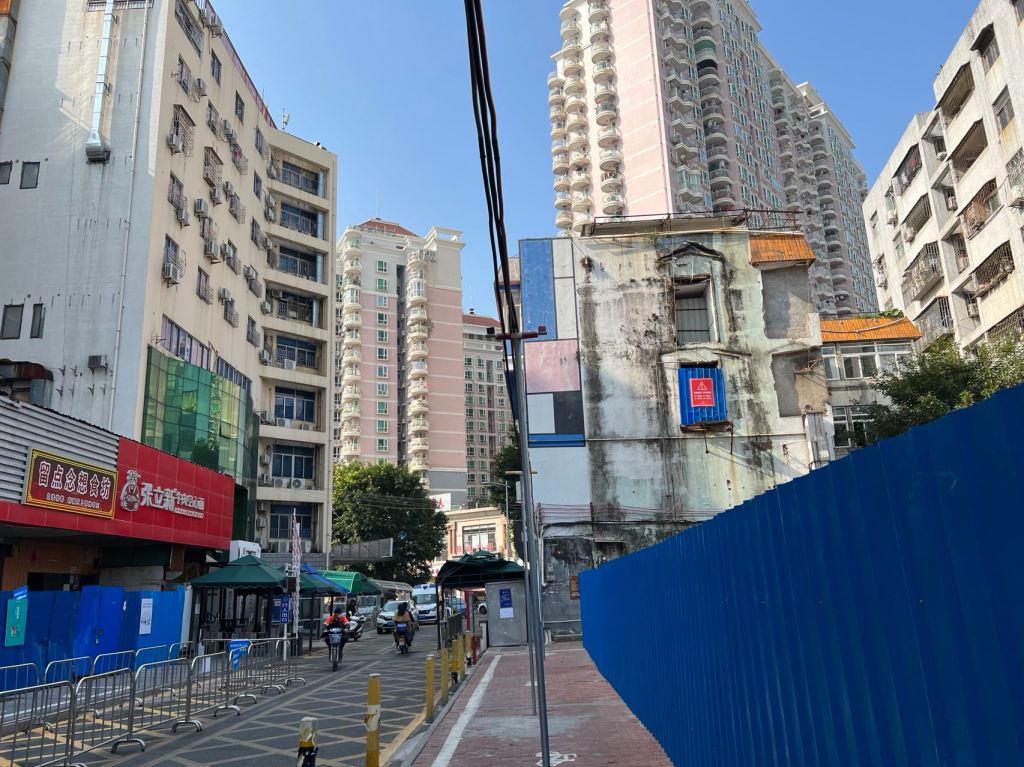
a baishizhou postscript–chen chusheng

Several years before he was champion of the inaugural and influential singing competition 快乐男声 (on Hunan TV), Chen Chusheng 陈楚生 lived in Tangtou, Baishizhou. Indeed, the first stop on his musical career seems to have been Shenzhen, which in the late 1990s, early 2000s was famous for its indie and rock music scene. The musicians lived in urban villages and performed in the city’s many bars and infamous nightclubs.

The above image Shenzhen (2000) by Yu Haibo 余海波 not only gives a sense of what the city’s nightlife was like at the turn of the millennium, but also the frantic energy that characterized that scene. Of course, Chen Chusheng took a more laidback and folksy approach. His song, Baishizhou sounds almost pastoral, in stark contrast to the world outside his Tangtou apartment. And yes, circa 2000, Baishizhou was not yet linked to the urban grid and Shenzhen was still the world’s factory, relying on the highly transient residents of the villages.

Continue reading
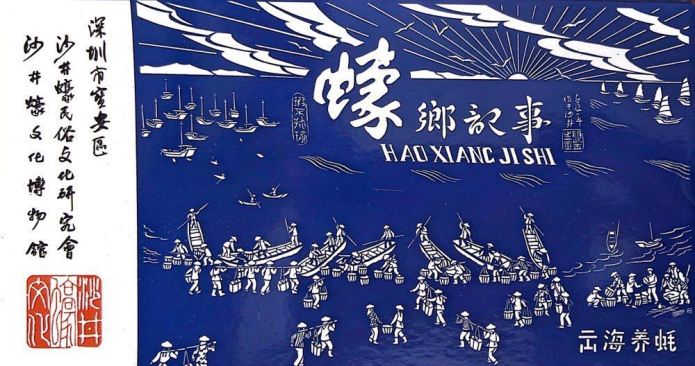
processing shajing oysters, the postcard edition

One of the purposes of this blog has been to document changes in Shenzhen’s cultural geography. A second purpose has been to observe changes in what is represented and how the representation aesthetic have also shifted. Sometimes it’s like we’re not seeing and talking about the same city. Postcards from a long-ago Shajing oyster culture museum give a sense of those discrepancies–what was thought valuable and who was able to transform cultural geography into what kind of story.

Continue reading

baishizhou village: a return of the repressed-what’s in a name mash-up

Most are aware that the area we once knew as “Baishizhou” was located north of Shennan Road, comprising four villages–Shangbaishi, Xiabaishi, Tangtou and Xintang. The neighborhood’s name derived from the “Baishizhou” subway station. In turn, the station was named for the historical Baishizhou, a mudflat or sandbank, which was located south of Shennan Road. Historically, our Baishizhou was a continuation of historic settlement patterns, while Baishizhou Village seems to have emerged more recently. Nevertheless, the demolition of our Baishizhou has led to the emergence of a new Baishizhou and this new Baishizhou has a telling (and frankly distressing) general layout. Below, I give a brief overview of the layout and then a brief history of the place name, Baishizhou. And yes, its more speculative than conclusive. Reader be warned.

Continue reading

baishizhou, January 2023

Photos from Baishizhou, Dec 31, 2023. Three notes: 1, the Baishizhou mural has been replaced with a Shahe mural, suggesting that the area’s rebranding is proceeding apace; 2, the covid regulation infrastructure was solid and expensive, even though the area was already being demolished, and; 3, there are still holdouts in the village, most closer to Shennan Road, however, the center area near Jiangnan Department store, where 302 used to be is difficult to reach because mostly razed and inside the current construction site.

Impressions of the walk, below.

are you part of the “herd” or are you a party cadre of exemplary character?

Many of the people around me have tested positive for omicron. In Chinese, the word for positive is 阳性 (yáng xìng), and the pun is with 羊 (yáng) or “lamb.” In keeping with the animated pandemic, this means that most memes involve 🐑 puns. During the lockdowns, one of the most popular phone games was 羊了个羊, a game that can be played on WeChat. The game is similar to a 3-tile puzzle and indeed, some say its a rip off of the original Three Tiles. At any rate, tens of millions have played, posted about playing, and analyzed the play while locked down. Now, that people actually have joined the omicron herd, there is more talk about how to convalesce and take care of oneself. And there’s the rub: party members are being asked to put their bodies on the line. Below, I’ve translated a recent article from the headline news app (今日头条). The gist: a true Party member puts their body on the line for the good of the masses:

Continue reading

quarantining at the vienna

So, I went back to the states and have just returned to Shenzhen. I did one covid test in Seattle and then flew to Shanghai, where I quarantined at a Vienna Hotel (维也纳酒店), where my quarantine was physically comfortable, if somewhat surreal because while I was in isolation, zero-Covid infrastructure was being dismantled. I had a window, a clean comfy bed and lots of hot water. The food was cafeteria-standard: never tasty, but never so bad it couldn’t be eaten. And here’s the rub: when I was sent out of the hotel to find a taxi, I was within a twenty minute drive to the airport and the hi-speed railway, all for roughly 400 yuan a night, including food and Covid tests. So, I got my money’s worth?

Here’s the rub: Vienna has been my favorite Chinese hotel chain for at least two decades. When given a choice (or when I have to pay), I stay at a Vienna Hotel. In fact, I’m such a fan of the chain, my cellphone wallpaper is me mirroring a Dafen painting in the hallway of the Vienna Hotel near Zhongshan U (Sun Yay-sen University) and has been my wallpaper for five or six years… possibly more? Sometimes I loose track of the timeline of my life…

Continue reading

thinking about what it means that Shenzhen must needs be constantly renewed…

Yes, this is another happy collaboration with Jonathan Bach. Chapter from Neue Städte: Vom Project Der Moderne Our Authentisierung, ed. by Andreas Ludwig.

did a campaign start when we were online for our daily corona test?

Throughout 2022, as corona testing has become normalized (常态), testing status and QR codes have increasingly been used to prevent possible political “outbreaks.” The most recent case involved depositors who were unable to withdraw money from their banks in rural Henan. This case broke over a month ago. It concluded several weeks later, when depositors went to provincial capital, Zhengzhou in order to make official complaints. As the depositors converged on Zhengzhou, their health codes turned red, which prevented them from using public transportation, getting rooms in hotels, or entering buildings with strict compliance.

Continue reading

where have all the young folks gone…

no time passing… The melody is Pete Seeger’s, but the context is Shenzhen. Last night I was talking with friends, older friends of many years who have lived in Shenzhen since the early 1990s. We ended up talking about China’s population crisis and how it has been manifest in Shenzhen as the aging of menial laborers, the ongoing removal of affordable housing stock as urban villages are razed, and the flight of young families to cities like Changsha, which are actively trying to attract young people using methods that range from housing policy to social media campaigns to create a hip and friendly city image.

The current situation in Nantou illustrates how these issues come together on the ground. The sanitation crews for the area comprise older people, many who had joined their children in Shenzhen to take care of grandchildren, but once the grandchildren started attending school full-time found themselves both with time on their hands and in need of supplemental income. Many of these crew members are past the age of retirement and ineligible for retirement benefits in the city, making them a vulnerable workforce. In terms of affordable housing, Vanke has upgraded many of the handshake buildings on the two main streets in Nantou, replacing family housing with transitional rentals for singletons. Indeed, last time I went to Nantou, the rates for upgraded housing stock was 5,500 yuan a month, while older housing was still priced between 2,000 to 3,000 yuan, depending on location and size. Moreover, over two years of zero-Covid enforcement means that many mom and pop shops have closed up with generational implications. On the one hand, older entrepreneurs have lost accumulated capital and income. On the other hand, that wealth can no longer be passed on to children who may have been raised in Shenzhen, but do not have city hukou.

So yes, restructuring with a vengeance.

Continue reading

rhythms of the bug

Yesterday morning between midnight and noon, 4 positives were reported in Shenzhen. One each in Pingshan, Xiangmihu, Nanhu and Dongmen Street Offices. So basically in the east, but citywide rapid response: neighborhoods went into lockdown, emergency corona testing was mandatory in those those street offices, and everyone in the city was notified that all day Sunday, June 19 access to public transport and spaces would require a 24-hour QR code, or green horse. Government sponsored events, including a planned Handshake guided tour of Shatoujiao were cancelled. Blink. The information was delivered to our phones.

I took the above photo while waiting online to get tested. For the first time in several months, we waited over half an hour. Fortunately, it wasn’t raining. Sigh.