Rumors, Rumors: What’s Bugging Guagua?

Two days ago, an open letter allegedly from a member of Bo Xilai’s family popped up on the internet, expressing the desire for a public hearing (“此信来自薄家亲戚, 希望公开发表”). Epoch Times – the media arm of Fa Lun Gong – broke the “story” saying that Bo’s son, Guagua may have written the letter. Maybe. Maybe not. Whatever else it may be, I believe that the letter is interesting for four reasons. First, in the absence of political opposition, satire formulates an alternative position. Second, the level of moral outrage that compelled the implied author to write seems genuine. Third, the fact that this letter is circulating as “news” reveals the extent to which the sentiments reflect popular dissatisfaction with the Center and its melodramatic backbiting political infighting Two Meetings. Fourth and relevant to Shenzhen, is the call that Chongqing might have been a Special Zone, like Yan’an and implicitly not like Shenzhen.

Translation of the Guagua letter below.

A FATHER’S TRAGEDY, A PEOPLE’S LAMENT – BO GUAGUA’S PUBLIC LETTER TO THE NETIZENS

In my last open letter to my father, I urged him to return the Chongqing Sing Red, Attack the Black back to the Yan’an years, making Chongqing the flag bearer for a democratic Party and the living spirit of Yan’an; to truly become a Special Zone for political reform. Unfortunately, my father has been too-long educated by the Party, ultimately prioritizing the Party and national power. I had hoped that through reflection and regret, the negative effects of the Chongqing model could be ameliorated. I had hoped that by sacrificing your political future, my Father could have restored the Party and the Country’s stability and harmony. Continue reading

Apparently, no one is clean…

Shenzhen seems engaged in a classical turn, not simply in terms of neo-confucian efforts to remake the citizenry into folks who know and are happy in their place, but also to shrug off the possibility that any official might be clean. “They’re all corrupt; it’s tradition [speaker’s emphasis],” I was told. The inevitability of official corruption was demonstrated with a phrase from the late Qing: 三年清知府,十万雪花银, which means “after three years in office, even a clean magistrate will have accumulated 100,000 taels of silver”.

dog (fucked) times

Last night, our downstairs neighbors locked their pooch out on the balcony, where it cried until well after midnight. I have noticed more and more pet dogs in Shenzhen. Feral cats have occupied greenspace on the Shenzhen University campus and  young children continue to purchase goldfish, turtles and rabbits, however, high status, well-dressed dogs ride in large handbags and appear with their owners in parks and on street corners, often joining them in restaurants and boutiques. Indeed, a good friend has a fluffy and quite friendly, brown bichon frise that is groomed weekly, eats from the table, and sits on his master’s lap at private teahouses.

The original scratched graffiti in the above photograph notes, “People who raise pets are abnormal [could also translate as perverted].” Someone then came along and added “don’t”, asserting that non-pet owners were the truly perverted.  Continue reading

The Shenzhen Model, 20 years after Deng Xiaoping’s 1992 Southern Tour

Reading a Shenzhen newspaper requires a sense of the absurd, a sense of the city’s history, and awareness of what’s up in Beijing. The front page of today’s Jing Bao (晶报2012年2月24日), for example, proclaims, “If the Special Zone doesn’t reform, it will soon disappear (特区不改革很快就消失).” The next headline is “In 2025, Shenzhen’s GDP will be the 11th largest in the world (2025年深圳GDP全球第11名)”, asserting that “The Shenzhen Model has Great Significance for the Country (深圳模式对中国意义重大).”

Inquiring minds want to know, well, which is it? Is Shenzhen not reforming fast enough to avoid extinction or is the Shenzhen Model stable enough to become the  world’s 11th largest urban economy over the next 13 years? Continue reading

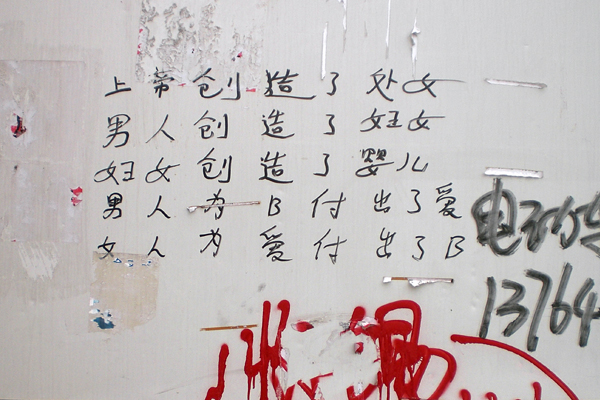
B; it’s more than a letter, much less than love

Couplets and rhymes circulate as text messages on Chinese cell phones and as scratched graffiti on walls. Although economic class and levels of education may separate texters from scratchers, nevertheless, the spirit of the message and the understanding of what it means to be human — especially and unfortunately about gender relations — is often the same.

The above poem reads:

God created virgins; men created women; women created babies; men give love to get cunt; women give cunts to give love.

Compare with earlier texts for a sense of how misogyny circulates in Shenzhen.

Changing Patterns of Rural Suicide (1980-2009)

Below, I have summarized Liu Yanwu’s article, The Problem of Rural Suicide (1980-2006) [刘燕舞:中国农村的自杀问题(1980-2006)]. The article responds to previous research on rural suicide, which had focused on the changing status of rural women, rather than on the modernization of village society as a whole. Liu argues that changing intergenerational family dynamics and the rising divorce rate of rural couples has caused the changing pattern of suicide in rural China. After the article summary, I make a few observations on what research in Shenzhen contextualizes the question of rural suicide.

The Problem of Rural Suicides (1980-2009)

Abstract [translated from text]: Based on a uniform survey of 34 villages accross 7 provinces and analysis of the suicides of 604 farmers between 1980 and 2009, this author believes that the suicide rate in villages continues to rise. There has been a significant decline in young people’s suicides and the marked rise of elder suicide in contemporary villages. The declining suicide rate of young women lowered the overall rate of young people’s suicide, however, the rapid rise of elder suicide has meant that the overall rate of villager suicide continues to rise. The analysis suggests that the determining factor in this complex situation is not the migration of village young women, but rather changing intergenerational relations and the increase of divorce. At root, the more obvious systemic cause of the complex transformation of rural suicide is that modernity continues to erode villages.

Keywords: sucide rate of young women (青年女性的自杀率), suicide rate of the elderly (老年人的自杀率), transformation of intergenerational relations (代际关系变动), divorce (离婚), modernity (现代性) Continue reading

The Cost of Business in Shenzhen

A translation of a 天涯深圳网 post, this time about a woman boss who set herself on fire to protest having her rental property revoked (罗湖文锦广场物管收回物业女老板自焚).

A Woman Boss sets herself on fire after the luohu wenjin plaza Property Management revokes her property by Nanfang Reporter, Feng Lei (南都记者丰雷 — 南方都市报)

Yesterday afternoon (January 12, 2012), Ms. Zou of Eastern Fengming Children’s Training, which is located on the 4th Floor, Building A of Luohu Wenjin Plaza set herself on fire to protest that the Plaza’s Property Management Firm had suddenly ended her rental contract, leaving her with over 2 million investment that cannot be recovered. At the moment of crisis, the Tianbei Fire Department and Plaza Management Firm came. According to the Management Firm, the contract stated that when the property owner needed to reclaim the property, then the renter would have to leave. According to Ms. Zou, the Property Management Firm was not the property owner and therefore has no right to evict her from the premiss. Continue reading

lament of generation 80

Opportunity in the post-Mao era — like all opportunity — has been a question of being in the right place at the right time. Below, I have translated a blog post, lamenting the fact that even if Shenzhen is the right place, it is no longer the right time; the opportunities are going, going, gone and if what remains are wage labor and education, even they are not enough for the poor.

Of note, the author uses the expression “poor second generation (穷二代)”, the direct opposite of the “rich second generation (富二代)”. More interestingly, he refers to “second generation farmers (农二代)”, as if the transition from farmer to urban resident was a natural progression. However, there have been generations of Chinese farmers — in fact, this is one definition of traditional Chinese culture. What then, we might wonder, is it about Shenzhen that gives rise to the expectation that each generation must do economically better than the last?

Shenzhen: Unfortunate Generation 80, Unhappy Workers, and the Hopeless Poor Second Generation

First of all, let me explain that my title refers to me. Perhaps you, who are reading this heading are one of the lucky Generation 80, the happy office workers. Or, maybe you’re one of the poor second generation or a second generation farmer but aren’t hopeless. If so, congratulations. My opinion isn’t going to be yours, its only representative of my thoughts.

Why is Generation 80 unfortunate? Continue reading

Who’s in charge?

As the biennale approaches, many documents have to be translated and I’ve found myself doing on the spot translations by text message. I mentioned to a friend that I had finally figured out that if I gave two possible translations – one more or less literal, the other more or less poetic, my interlocutor was usually satisfied with the translation. However, if I only gave one possible translation, then my interlocutor inevitably came back with questions and challenges to my understanding.

My friend nodded and asked, “Haven’t you heard the popular saying, ‘Leaders love multiple choice questions’ (领导最喜欢选择题)?”

I noted that this strategy also works with recalcitrant eaters as in, “You can eat your cornflakes with milk or without milk” because the child thinks she’s in charge even as she eats the cornflakes.

If possible, my friend’s smirk deepened.

1995-2005: Keywords in Shenzhen real estate

Much of Shenzhen’s informal history is, unsurprisingly perhaps, being written on blogs and weibo. However, websites dedicated to real estate, ranging from analysis to agency offerings are not usually considered to be history writing. Nevertheless, these websites provide insite into the negotiation of value as people transform labor and desire into homes and family life. To give a sense of the historical content of these websites as well as how they produce knowledge about the city, I’ve translated a sampling from a real estate purchasing and rental keywords post by 王猴猴.

Just an editorial note: when reading these keywords it is important to hear what has not been said. Policy criticisms and social problems remain implicit in Wang Houhou’s explanations and evaluations. I have thus added a few exegetical notes, which do not exhaust possible interpretations, but rather point to other readings. I encourage readers to add their own interpretations and thereby enrich the keywords.

盘点1995~2005深圳地产十年关键词 Inventory of Shenzhen Real Estate Keywords, 1995-2005 (Wang Houhou)

1995 购房入户 (Buy a house, get Shenzhen hukou) In order to stimulate citizens to purchase homes and also to further economic development in a slow house market, Chinese local governments promulgated real estate development policies and measures. The prime example of these policies came in 1995, when the Shenzhen government approved a measure that allowed anyone who bought a house outside the second line [in Baoan or Longgang District] was eligible for three Shenzhen hukous. [In 1995 Baoan and Longgang were still under rural administration and the Second Line was still enforced. Consequently, this law stimulated building at Second Line checkpoints, notably Buji and Meilin, where people could buy a Shenzhen hukou and still get to work easily.]  Continue reading