Balancing Act: Notes on Translating for Future Relevance

Future Relevance / 明天,谁说了算? opened today. I translated the exhibition catalogue. Below, I’ve uploaded my thoughts (and translation of said thoughts) on the importance of learning to listen across unsaid assumptions, even when we don’t depend on a translator.

In our native languages, we speak with the expectation that we will be understood and if not, that misunderstandings can be easily fixed. Moreover, we often emphasize speaking as the sign of linguistic competence, rather than listening, reading, or writing, or more generally, an ability to navigate shared histories and cultural assumptions, political exigencies and economic conditions; in short, we take for granted all the unspoken social infrastructure that enables communication. Indeed, we are often so oblivious to the contexts of meaningful dialogue that cross-cultural exchanges often degenerate into fumbling searches for the “right word”.

Take for example a simple comparison of cultural associations with the English word, translation and its Mandarin counterpart, fanyi (翻译). Continue reading

the modern woman. . . what can’t she do?

more fun with cellphone couplets, this time about the skills of the modern woman:

现代女性“十项全能”:上得了厅堂,下得了厨房;写得了代码,查得出异常;杀得了木马,翻得了围墙;开得起好车,买得起新房;斗得过二奶,打得过流氓。

The Modern Woman’s “Ten abilities”: She can entertain guests and cook up a storm; she can write a computer program and ferret out irregularities; she can kill viral Trojan horses and scamper over the firewall; she can drive a good car and buy a new house; she can take on a second wife and defeat a hooligan.

yes, we’re grumbling . . . (about recent web closings and what not)

It’s been a while since I’ve translated a text message, but as those at the Center scramble for power and internet access became extremely dodgy three days ago, text messaging has become more a more reliable source of information. Sigh. Indeed, the long text that follows speaks to the dissatisfaction and resignation that often creeps into daily conversations; it certainly hints at the extent to which non-compliance and minor sabotage may characterize administrative and business life throughout Shenzhen, and Shenzhen I’m told, is one of the “easiest” places in China to achieve one’s goals in the public sphere.

中国特色“解决”大观

领导问题靠书记解决,政治问题靠经济解决,外交问题靠呼吁解决,军事问题靠和平解决,党外问题靠党内解决,思考问题靠忽悠解决,道德问题靠运动解决,文化问题靠管制解决,市场问题靠行政解决,亏空问题靠印钞解决,社会问题靠城管解决,面子问题靠盛会解决,建设问题靠强拆解决,生育问题靠计划解决,前途问题靠拼爹解决,致富问题靠中彩解决,医疗问题靠伪劣解决,饮食问题靠掺假解决,办学问题靠排污解决,科技问题靠山寨解决,学术问题靠剽窃解决,明星问题靠上床解决,军衔问题靠唱歌解决,公安问题靠黑道解决,升职问题靠买官解决,反腐问题靠贪官解决,股市问题靠圈钱解决,舆论问题靠封锁解决,疑虑问题靠“我信”解决,和谐问题靠糊弄解决,民意靠对付解决。。。保持联系靠短信解决!

Principles of “resolving the issue” Chinese style

The Secretary resolves leaders’ problems, the economy resolves political problems, appeal [to others] to resolve foreign relations, peace resolves military problems, the Party resolves non-Party problems, scams resolve problems of understanding, political movements resolve moral problems, supervision resolves cultural problems, policy implementation resolves market problems, printing money resolves the debt problem, municipal administration resolves social problems, banquets resolve face problems, forced razing resolves construction problems, planning resolves birth problems, “my father is more important than your father” resolves future problems [qiantu puns “road” and “future direction”], the lottery resolves problems of getting rich, low quality resolves the medical situation, adulteration resolves food and drink problems, discharging waste water resolves education problems, shanzhai production resolves science and technology problems, plagiarism resolves education problems, sleeping together resolves movie star problems, singing songs resolves military rank problems, gangsters resolve public safety problems, buying a political appointment resolves promotion problems, corrupt officials resolve anti-corruption problems, expropriation resolves stock market problems, blocking the internet resolves public opinion problems, “I believe” testimonials resolve doubts, muddying the waters resolves harmonious society problems, weapons of the weak resolve problems of realizing the people’s will. . . and to resolve problems of staying in touch, let’s text!
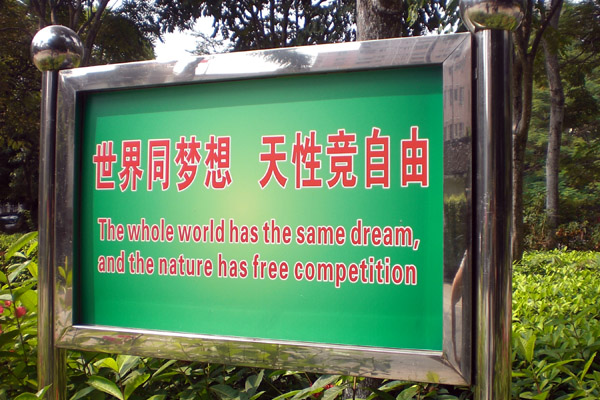
Translation question: 天性竟自由

I’m having difficulty figuring out what this sign actually means. Clearly, the English is off. My sense of the Chinese, however, is to attribute all sorts of neoliberal interpretations to the line 天性竟自由; no matter how I cut it, I come up with a slice of economic pie. Nevertheless, I recognize that there are important nuances even within forms of neoliberal essentialism. Hence my question: How would you translate this sign? Please share translation and rational.

What is the purpose of cross cultural art exchanges?

This has been a season of cross cultural art because I’m participating in the SZHK Biennale and have been translating for the OCAT International Artists Residency Program. I have had opportunities to talk with artists not only from the United States, but also Europe and heard questions and comments that are interestingly different from those of Western academics and business people, until recently my usual non-Chinese interlocutors.

Other than the fact that good, deep cross cultural artistic collaboration takes time and patience and a willingness to let go of preconceptions and even values, what have I learned?

Short answer: philosophically, we’re all of us still carrying way too much baggage and practically, translators are seriously underpaid for the work we do facilitating communication despite break downs therein.

Long answer: As a form of social praxis and value structure, art functions very differently in China and the West. I have written about these differences with respect to theater (here and here). Briefly, in the West, artistic praxis has been a means of overcoming four forms of capitalist alienation (as identified by Marx): Continue reading

Thoughts on certain questions since Maoism was overturned…

The “Resolution on Certain Questions in the History of Our Party since the Founding of the People’s Republic of China《关于建国以来党的若干历史问题的决议》” was a key document in the political re-evaluation of Maoism and subsequent reforms. On Aug. 27, 2011 in Beijing, a group of influential scholars, political scientists, lawyers, and journalists convened to talk about questions still facing the Party. And yes, I found out about the Beijing meeting as I find out about most political and social events in China – text messages and weibo. Below, I have translated a selection of quotable quotes from a circulating collection of quotations from the meeting. The key message remains – ask not what you can do for the economy, but what the economy should be doing for all of us… 

It is not easy to deny the influence of Reform and Opening, it is possible to broaden democracy within the Party and to have a constitutional government under Party rule – Ma Licheng (马立诚) Continue reading

千里求缘 – desperate fates

Text of a personal add that I discovered stuck on a building wall outside the second line:

Seeking Shared Destiny

158 XXXX XXXX

The [principals in this] advertisement are represented by a lawyer’s office, they have already notarized [documents], the lady has already deposited 1.3 million rmb in escrow. This information is true, reliable, and guaranteed by a lawyer.

Commercial registration number: 08778955     Document number: 09121206

JIANG Xiaoyan, 28 years old, 1.65 meters, white skin, married to a wealthy Hong Kong businessman. Due to her husband’s infertility, she is unable to conceive a child. Worried that there is no one to inherit her extensive property and in order to avoid disputes, she is using the pretext of visiting relatives [in the Mainland] to find a caring, healthy, and upright young man to impregnate her. If she and the man reach an agreement during a phone negotiation, she will transfer a 300,000 rmb deposit [to your account], arrange a meeting with you, and then send 1 million rmb to you upon having a positive pregnancy test. This will not adversely influence your family, and lawyers will be responsible for maintaining secrecy. (You must call yourself, text messages will not be answered, don’t bother replying if you’re not sincere).

158 XXXX XXXX

the real reason behind the proliferation of shaxian snack bars

Franchises of the Fujian based chain, 沙县小吃 (Shaxian Snack Bar) have sprouted up all over China, and Shenzhen is no exception. However, Shaxian Snack Bars aren’t upscale, in fact, the standardized fast food chain veneer notwithstanding, each Snack Bar seems your ordinary mom and pops dive. Moreover, with all the razing and rebuilding going on, the small restaurants and stalls suddenly appear and just as easily vanish. Currently burning up the web, this bit of satire about the real reason for the success of Shaxian Snack Bar brings together two of my favorite things — political satire and food (中文版).

“The war is over.”

The Snack Bar owner had a cigarette hanging from his mouth and his ass in the chair in front of me, as his eyes darted this way and that. A wisp of smoke came out of his mouth.

I was no longer happy. I had been enjoying a basket of steamed buns and a large portion of wonton, thinking about ordering another drumstick. Actually, I wanted a large rib from the large rib set meal, but it couldn’t be purchased independently, so I was thinking about my options. That was when this middle aged man plopped his ass on the chair in front of me, a lone customer with a smile on his face, and said that meaningless sentence. And he was smoking.

“What war? Also, how much is a large rib from the large rib set meal?” I asked patiently. Continue reading

cui bono? state power, urban village rights, and the vanishing of affordable housing

Recent events in Dachong draw our attention to how news coverage and debate about Shenzhen urban renovation projects focus on conflicts between the real estate developers and urban villages, effectively rendering invisible the growing lack of affordable housing for Shenzhen’s migrant workers.

Shenzhen’s mandatory urban renovation plans benefit developers and the government because villages must negotiate a transfer of land use rights. This means that even though compensation packages enrich villagers, long-term, successful project developers and the municipal government end up making more. In this sense, villager complaints that they have been underpaid have a certain legitimacy.  However, in return for their landuse rights, villagers receive compensation packages that include standardized reimbursement for extant housing, moving costs, and compensation for loss of livelihood. Villagers with multiple holdings and savvy negotiating skills become very rich; published reports indicate that as a result of development, Dachong villagers have joined the ranks of millionaires and several are now billionaires.

Huarun (China Resources)  has been negotiating with Dachong since March 2009. Indeed, banners calling for early decisions to sign transfer contracts were draped throughout Dachong and construction walls have been painted with slogans that sing the benefits of urban village  renovation. A sample — Scientific urban planning, collective transformation; Harmonious renovation, civilized relocation. New Dachong, New Life, New Development.

Nevertheless, as of April 15, there were still ten holdouts. The Dachong Stock Holding Corporation wrote an open letter to those holdouts, asking them to sign contracts immediately. A translation of the letter: Continue reading

threats against land transfer holdouts in buji?

In Shenzhen, village renovation and urban renewal involve transferring land use rights from villages and housing rights from homeowners to developers, which have won project bids from the government. Importantly, the developers must negotiate compensation packages both with village corporations (if transferring collectively held property) and with individual homeowners. Compensation packages include monetary compensation for housing and land, compensation for moving expenses, and compensation for livelihood losses. Here’s the point – even though compensation for housing type and land use is standardized, compensation for moving expenses and livelihood losses are negotiated, opening a space for differential treatment and corruption. Continue reading