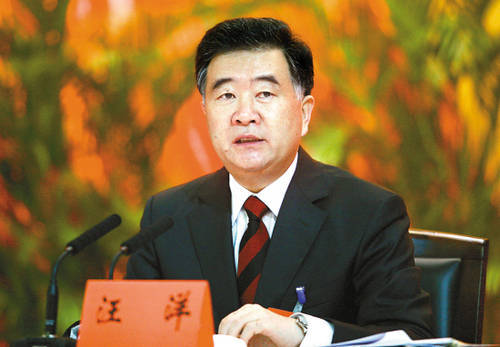
of floods and politics, or how the beijing disaster helps wang yang

The official death tole for the Beijing floods is 77 people. Weibo reports however, that in Fangshan District (房山区) alone over 800,000 people have been affected. In response, Mayor Guo Jinlong resigned yesterday, acknowledging his failure to be responsible for the people’s well-being. Today, Beijing Party Secretary Guo Jinlong went to Fangshan to show solidarity with those suffering. Yes, that is correct. In one of the more off the wall moments of Chinese politics, Guo Jinlong was both the Mayor and as of a month ago, also the Party Secretary of Beijing. Even in Chongqing, Bo Xilai was only able to act as Party Secretary, while the Mayorship was held by Huang Qifan.

Here’s the beauty of Guo Jinlong’s gesture. As a government functionary, Guo Jinlong could legally resign. However, as the holder of a Party appointment, Guo Jinlong can only loose his position as Party Secretary if the Party leadership decides to remove him from office — hee!

Now, Guo Jinlong is of interest to those of us in Guangdong who are following Guangdong Party Secretary Wang Yang’s career because like Bo Xilai, Guo was one of Wang Yang’s key rivals to become either Secretary General of the Chinese Communist Party or President of the Country. To be appointed to one of the top two positions in China, Wang Yang must first be appointed to the Standing Committee of the Political Bureau, CPC Central Committee during the 18th NPC. These nine hopefuls will be chosen from provincial level appointees, which includes the Secretary Generals and Mayors of the four independent cities (Beijing, Shanghai, Tianjin, and Chongqing) as well as provincial secretary generals and governors.

In January this year, Wang Yang’s top rivals for one of the nine positions in the Standing Committee were Chongqing Party Secretary Bo Xilai and Beijing Mayor Guo Jinlong. Whatever one thinks of Wang Yang’s “three attacks and two establishes” campaign, notwithstanding, as a recent text message reveals, the Beijing floods may have given Wang Yang the push he needs to get one step closer the highest positions in Chinese politics. So the country may flip neo-liberal even faster than expected, not because privatization works, but simply because recently several political high-fliers are crashing and with them, alternative models of development.

Insights from the Beijing Floods (北京水灾几点启示):

1。The water in Beijing is deep;2。In Beijing, having a house and car is nothing, you also need to have a boat;3。All Beijing subway stations have the same name — Drainage Pool (a pun on the actual station 积水潭);4。Car owners finally understands the government’s great efforts to collect “car and boat taxes” from private citizens;5。The South to North Water Diversion Project (南水北调工程) is finally seeing results (this massive engineering project will be completed in 2013, connecting northern provinces to the Yangtze River);6。The Northern Drifters finally have a correct footnote (artists who go to Beijing to make a career are known as “northern drifters (北漂)”;7。As soon as Wang Yang enters the capitol he will have a job (because both characters in Wang Yang’s name have the water radical: Wang (汪) is a surname that means an expanse of water and Yang (洋), his given name, means ocean).

entitled: the demise of comrade and ritualization of inequality

The other evening northern friends of a certain age lamented the demise of “comrade (同志)” as a form of address. They weren’t so much distressed by the Cantonese queering of the term, as they were by the fact that Chinese forms of address no longer assumed (or aspired to) equality between comrades. Instead, etiquette now demanded that social fields be charted and hierarchical relations marked. Officials, for example, are called by their bureaucratic position. Not surprising in the case of higher ranking officials — the City Party Secretary and Mayor, for example — but somewhat excessive in the case of neighborhood heads.

Even if they chafe at the ritual acknowledgement of political hierarchy and concomitant social inequality, nevertheless, they also remarked that official status does simplify the question of how to address someone. In contrast, they noted that the real awkwardness lay in deciding how to address someone without either a clear social role or a defined relationship to the self. They addressed professionals by their job (Lawyer Chen, Teacher Dong, Doctor An, Theatre Director Yang, and Engineer Liang come to mind), but often blanched at calling rich acquaintances “boss (老板)” or the more refined “executive (总)”. Friends were addressed by nicknames and fictive kin terms, while new friends could be called “Mr. (先生)” or “Ms. (小姐)”, but workers, including waitstaff and other service workers posed a problem because they could also be hailed as fictive kin or just young people. Moreover, gender and age play an important role, and in conversation my friends often call working men “craft master (师傅)” or “boy (小伙子)” and working women “auntie (阿姨)” or “younger sister (小妹)”.

In anticipation of the 18th National People’s Congress and to give a sense of just how complicated is the system of Chinese bureaucracy and relevant titles, I have translated the fifteen official levels of government from a Baidu entry. Positions are listed in order of ranking within a category. Hence, the General Secretary ranks higher than the President, who in turn ranks higher than the Chair of the Military Commission. When making introductions, most people will qualify a title with the appropriate administrative status, as in City Level Vice Mayor, after which however, they will use the full title “Mayor” unless the actual Mayor is around. These rankings also matter because they map the bureaucratic journey that ambitious functionaries must make. Shenzhen is a sub-provincial level city, for example, and so its Mayor cannot be directly considered for a national post, but must first obtain a provincial or ministerial position. In contrast, a the same position in an independent city, like Beijing or a full provincial ranking, would be a rank higher, placing the office holder in contention for national assignments.

Should your eyes not glaze as you read the list, you’ll get the hang of assigning rank and how using titles has ritualized inequality by reiterating the Chinese bureaucratic system from the General Secretary all the way down to a functionary in a community or village office.

First level, national level (国家一级):General Secretary, President, Chair of the Military Commission, Chair of the National People’s Congress, State Council Premier, Vice General Secretary, Standing Member of the Political Bureau of the CPC Central Committee.

Second and third level, national government (国家二至三级):Member of the Political Bureau of the CPC Central Committee, Alternative Member of the Political Bureau of the CPC Central Committee, Secretary for the Central Disciplinary Commission, Vice Chair of the NPC Standing Committee, Vice Premier of the State Council, State Council Member, President of the Supreme People’s Court, Vice Chair of the CPPCC National Committee.

Third and fourth level, national ministries and provincial government (部级正职、省级正职三至四级): Provincial governor, Vice Secretary for the Central Disciplinary Commission, Standing Member NPC, Secretary of State, all sub-national administrative chiefs and enterprise heads (including Party organizations), leaders of all People’s organizations (including Party organizations) at the provincial, autonomous region, independent city level. These organizations include Party Committees, People’s Congresses, Government, and Chinese People’s Political Consultative Conference. Exceptions can be made to give provincial rank to leaders of sub-provincial organizations;

Fourth and fifth level, vice ministries and sub-provincial government (部级副职、省级副职四至五级): Vice Governor, Members of the Central Disciplinary Commission, all sub-provincial administrative chiefs and enterprise heads (including Party organizations), leaders of all People’s organizations (including Party organizations) at the sub-provincialand sub-autonomous region. These organizations include Party Committees, People’s Congresses, Government, and Chinese People’s Political Consultative Conference. Exceptions can be made to give sub-provincial rank to leaders of Office of the Council or Regional organizations [Shenzhen Municipality];

Fifth through seventh level, Council Heads, Regional Chiefs and Counsels (司级正职、厅级正职、巡视员五至七级);

Sixth through eighth level, Vice Council Heads, Sub-regional Offices and Assistant Counsels (司级副职、厅级副职、助理巡视员六至八级) [Shenzhen Districts];

Seventh through tenth level, Department Heads, County Commissioner and  Investigators (处级正职、县级正职、调研员七至十级);

Eighth through eleventh level, Vice Department Heads, Vice County Commissioners, and Assistant Investigators (处级副职、县级副职、助理调研员八至十一级) [Shenzhen Precincts];

Ninth through twelvth level, Section Heads, Xiang Heads and Chief of Staff (科级正职、乡级正职、主任科员九至十二级);

Ninth through thirteenth level, Vice Section Heads, Vice Xiang Heads, and Vice Chief of Staff (科级副职、乡级副职、副主任科员九至十三级) [Shenzhen Communities/Neighborhoods];

Ninth through fourteenth level, Staff Members (科员:九至十四级);

Tenth through fifteenth level, Office Workers (办事员:十至十五级).

reforming rhetoric 1: 摸论

“Feeling stones to cross the river” is one of the more famous sayings of early reform. Western pundits often interpret this phrase as a straight forward description of the uncertainties inherent in reforming the Maoist system and concomitant trepidation about moving toward – what? – xiaokang with capitalist features? However, this expression belongs to a rhetorical form called 歇后语 or two-part analogy, in which the first part is spoken and the speaker’s intended – and often critical – meaning is left unspoken. Paying attention to the unspoken response highlights how conflict and disagreement was handled within Party debate over the direction and scope of reform.

Chen Yun first raised “Feel theory (摸论)” as it became known during a Central Working Conference in December 1980. Importantly, Chen Yun used the two-part analogy to conclude an opinion on how to reform the Maoist apparatus, “…[I]n other words, we need to ‘Feel stones to cross the river’ (也就是要‘摸着石头过河《陈云文选》第3卷第279页)”. In conventional Mandarin, the unspoken critique in this analogy is “tread carefully (步步稳当)”. Later during the Conference, although Deng Xiaoping agreed with Chen’s unvoiced but present call for a more conservative approach to reform and opening, nevertheless, he shifted the discussion by emphasizing pragmatic action.

With “Cat theory (猫论)” and “Don’t debate theory (不争论)”, “Feel theory” became one of the three main principles guiding early reform.

population and hukou update, 2012

The decision to further loosen hukou requirements is once again front page news in Shenzhen (南方都市报). Interestingly, however, the municipal hukou system is only one reform target. Yesterday, the Municipality released its 2012 Reform Targets, which like hukou reform seem to be about rationalizing public administration, and include centralizing the City’s pension, philanthropy, credit, and prison systems. Nevertheless, hukou reform captured the headlines. Why?

Simple answer: Despite the fact that the children of both early migrants and Baoan locals, as well as the children of long-term residents now claim Shenzhen identity, nevertheless, the majority of the population does not have a legal claim to the Municipality, let alone an emotional sense of belonging. Indeed, the City’s statistics noticeably do not mention uncounted members of the floating population.

According to recent statistics, Shenzhen’s official population is now 15.1 million, of whom only 2.3 million have Shenzhen hukou. The Municipality’s other 12.8 million are in various states of limbo, which range from those who have overstayed a temporary residence permit through workers who have enough points to apply for a hukou to graduate students at Shenzhen’s University Town, who will be given hukou along with their diploma.

Nevertheless, even if we don’t know how many inhabitants actually identify themselves as Shenzheners, we do know that the Municipality is vigorously promoting the slogan, “If you come, you’re a Shenzhener”. To give a sense of how the Municipality strains to graft a sense of place onto deterritorialized bodies, I offer a loose translation of a recent bit of musical propaganda, the song, “If you come, you’re a Shenzhener (来了就是深圳人)” sung by Xu Qianya.

If You Come You’re a Shenzhener

(chorus) Wherever you’re from, you’ll hear your hometown language; It’s hard to distinguish between elsewhere and hometown; Wherever you’re from, this city opens its doors to you; If you come, you’re a Shenzhener; The earth has dreams to be harvested; The heart expands; Shennan Road is like a production line; Producing Spring after Spring; Clouds search for green mountains, mountains search for clouds; People seek opportunities, opportunities seek people; Heroes populate this world; You and I have the same heart; repeat chorus

Rap: There’s an immigrant town; Inhabited by youth and their dreams; Our latitute is 22 degrees north; Here a handshake means something; Here smiles last a little longer; Every day is young; The heart expands; Shennan Road is like a production line; Producing Spring after Spring; Clouds search for green mountains, mountains search for clouds; People seek opportunities, opportunities seek people; Heroes populate this world; You and I have the same heart; repeat chorus ad nauseum.

Lyrics:

不论你从哪里来 都能听到乡音,异乡和故乡很难分,不论你从哪里来 这座城敞开门,来了就是深圳人,土壤有梦多收获,胸襟开放多风云,深南路像一条流水线,流过青春又青春,云找青山山找云,人找机缘缘找人,天地间苍茫千万里,你我相知一颗心,不论你从哪里来 都能听到乡音,异乡和故乡很难分, 不论你从哪里来 这座城敞开门,来了就是深圳人

RAP:有一座移民之城,住满着青春和梦,这里刮着北纬22度季候风,这里的握手比较有力,这里的微笑比较持久,这里的每天都年轻,土壤有梦多收获,胸襟开放多风云,深南路像一条流水线,流过青春又青春,云找青山山找云,人找机缘缘找人,天地间苍茫千万里,你我相知一颗心,不论你从哪里来 都能听到乡音,异乡和故乡很难分,不论你从哪里来 这座城敞开门,来了就是深圳人 (Repeat)

winners of the “dare to upset” china prize

Today, I received a list of 10 winners for the “dares to upset China (敢动中国)” Awards. The Awards are a snarky spoof on the Annual “Touches China’s Heart Awards (感动中国奖)”, punning the words “dares to upset” and “touches the heart”. Heart awards are presented at the Spring Festival and given to persons whose heroic actions inspire us to be more than we think we are. A pervasive and not unimportant bit of contemporary propaganda, heart award presentations are highly stylized performances and broadcast nationally. To get a sense of the ideological packaging, view the tribute and award presentation to Liu Jinguo for his courage during a fire.

The dares to upset awards point to the emergence of China as a global player and public reception of that process in vaguely hawkish terms. Notably, the dare to upset awards have been presented Asian countries that involved in maritime disputes with China, especially in the mineral rich South China Sea. Of note, the word “dares” points to the point that the winners are “small’ countries that should not be giving China problems. The fact that so many little nations dare to upset China is consequently interpreted as a sign of national weakness and the snarky commentary on the list states, “China has used habitual responses: the enemy invades, I endure; the enemy retreats, I endure; the enemy is exhausted, I endure; the enemy occupies, I endure… this is called pretending to use Sun Tze’s Art of War (敌进我忍,敌退我忍,敌疲我忍,敌驻我忍。。。装孙子兵法).”

According to the latest text message, the 10 winners for the 2012 Dares to Upset China Awards are:

1. Japan (for the Senkaku or Diaoyu Islands Dispute);

2. The Philippines (for the Huangyan Island or Panatag Shoal dispute);

3. North Korea (for holding Chinese fishermen in a dispute over fishing rights, although there is no dispute over North Korean refugees in China because the PRC regularly repatriates them);

4. South Korea (for demanding that Beijing release a South Korean activist who has been detained in the PRC without legal representation. The activist works for democracy in North Korea);

5. Thailand (is the new coordinating country for ASEAN – China relations, inheriting the three-year term from the Philippines)

6. Palau (the location of another disputed island, Okinotorishima);

7. Indonesia (has persecuted Overseas Chinese, but in April signed a cooperation agreement with China);

8. Myanmar (is opening its economy and China and the US are rushing in, however, last year the Myanmar government halted Chinese construction of a dam because locals felt that Chinese petroleum interests were too hardnosed);

9. Nigeria (is host to one of the largest Chinese presence in Africa. More than 200 Chinese companies operate in Nigeria, more than 40,000 Chinese nationals live in Nigeria, and total Chinese investment in Nigeria is close to $US 8 billion);

10. Somalia pirates (have been targeting Chinese vessels since 2008 and there have been calls for Chinese military intervention);

the secret to happiness…

Yesterday, Guangdong Party Secretary Wang Yang (汪洋) addressed the 11th Guangdong Provincial Congress of Party Representatives, making five statements which have set him apart from other high-ranking leaders. Once a rival of Bo Xilai for a place in the 18th Naptional People’s Congress appointments, Wang Yang has also made his gesture to gain the support of the people. However, where Bo Xilai went poor populist, Wang Yang’s speech has me remembering the Province’s historic role in the 1911 Xinhai Revolution, when 100 years ago, with its links to overseas Chinese and relatively advanced economy, Guangdong was the cradle of China’s bourgeois revolution, in contrast to the rural uprising that Mao Zedong transformed into a socialist revolution. Wang Yang is a leader for China’s emergent and increasingly vocal middle class. And yes, many of them live in the Pearl River Delta.

Wang Yang’s Five Statements

1. The People are the agent that makes history, as well as the agent that constructs and enjoys Happy Guangdong. The people have the right to pursue happiness; it is the responsibility of the Party and the government to benefit the People. We must discard the mistaken idea that the People’s happiness is a result of the Party and government’s benevolence. (人民群众是创造历史的主体,也是建设和享有幸福广东的主体。追求幸福,是人民的权利;造福人民,是党和政府的责任。我们必须破除人民幸福是党和政府恩赐的错误认识.)

2. We need to discard unwritten rules and bad habits, creating a just, lively, and orderly social environment, where those who follow the rules don’t suffer, where talented people can take the lead, and can pursue and create their own happy life to the best of their ability. (破除潜规则陋习,创造公平公正、活力有序的社会环境,让守规矩的人不吃亏,让有本事的人有奔头,各尽所能地追求和创造自己的幸福生活.)

3. The greatest threat to the Party’s long-term political control is becoming too far from the masses. Our Party can only achieve eternal success to the extent that it comes from the People, is rooted in the People, and serves the People. (党长期执政的最大危险是脱离群众。只有始终坚持来自人民、植根人民、服务人民,我们党才能永远立于不败之地.)

4. We need the courage to use personal revolution to firmly destroy the interests that have turned their backs on socialist market economic reforms in order to resolve problems of government agents exceeding their function, absenting their function, and mistaking their function, making government into a provider of public goods and services. (我们要以自我革命的勇气,坚决打破背离社会主义市场经济改革方向的利益格局,解决政府职能越位、缺位、错位等问题,使政府真正成为公共产品和公共服务的提供者.)

5. Guangdong’s market society has already begun to change… If we take hold of this opportunity, we can breakthrough many difficulties and problems on the road ahead of us, smoothly entering the ranks of more modern areas; if we don’t take hold of this opportunity, we may be unable to escape “the middle income trap”, stagnating and retreating, and the advances we have already made could be lost.  (广东经济社会已经步入转型期……把握得好,我们就能破解前进道路上的各种困难和问题,顺利步入比较发达的现代化地区行列;把握得不好,我们就有可能跨不过‘中等收入陷阱’,出现停滞和倒退,已经取得的发展成果也有可能断送.)

The White Lady of Shiyan

Last week, I met Ye Enling, a 70-something Shiyan native. Mr. Ye worked in Overseas Chinese affairs for over twenty years, and his current interests include calligraphy, linguistics, architectural design, and social philosophy. Of note, Mr. Ye is a Hakka and has devoted much time and energy to promoting Hakka culture by collecting Shiyan mountain songs (石岩山歌), compiling vocabulary lists, recording Shiyan history, and composing essays on diverse topics. In fact, he has published three collections and a book of calligraphy.

Below, I have translated Mr. Ye’s retelling of The White Lady’s Temple on Yangtai Mountain (叶恩麟者《闲雅集》111-2页. Online Chinese versions, here and here). I find the story interesting because it places singing within the sentimental context of gendered yearnings, which continue to shape family life and personal desire. The fact that the story continues to circulate suggests that even if most Chinese professors have opted into modern academics and concomitant specialization, traditional intellectual life and knowledge production may be fading, but are nonetheless still kicking.

I also find the story interesting because when contrasted with Shenzhen’s contemporary arts or traditional culture fairs, the White Lady of Shiyan reveals the extent to which expressive creativity has been alienated from everyday life, an ongoing lament in modernist art. The living presence of this tradition dovetails with the Municipality’s ongoing promotion of Neo-Confucian mores as a strategy of governance. I had tended to think of Neo-Confucianism’s appeal in terms of an invented nostalgia for “good old days” sans hunger, warlords or opium. However, my meeting with Mr. Ye has me thinking that there may actually be a popular basis for Shenzhen’s decision to disseminate Confucian sayings at bus stops and other public places, cultural revolutions notwithstanding.

The actual content of the White Lady story is far more disturbing and has me thinking about structural analogies between the 1920s and contemporary Shenzhen. In Diary of a Madmen, which was published a mere ten years before the white lady’s story is said to have taken place,  Lu Xun gives a chilling representation of human desperation in which the only way to survive is to eat other people; the clearest Lu Xun overlap is, of course, Medicine. Similarly, today, we keep hearing stories of illegal transplants and the shady sourcing of human organs. Less than a hundred years separate workers of the south China diaspora from the neidi migration of workers to Shenzhen. And it seems that rumors of cannibalistic medical treatments continue to emerge out of the experience. Families are fractured, bodies broken, and loved ones vanish.

The White Lady’s Temple on Yangtai Mountain

All Shiyan elders remember that there was once a small temple on Yangtai Mountain and have passed on the following story about it.

In 1928, a Ye family lived in Shiyan Market. The man had gone to Indonesia and not returned. At the time, parents arranged marriages and in his absence he was married to another Ye. A year after their parents had organized the marriage, the wife prepared to go to Indonesia to be united with the husband she had never even seen. But the sea voyage was rough and the road long, and being afraid to travel alone, she looked for a companion. The Ye woman discovered that in another Shiyan village Liguang there was a white woman whose husband was also in Sanbaolong, Indonesia. The white woman was also preparing to join her husband. This white woman had skin the color of kneaded dough, with a hint of pink. No one knew if she had Caucasian blood or a skin disease. After so many years, we no longer know what her surname was or who her people were.

The white woman didn’t have a son and her husband had been overseas for many years. She decided to build a temple on Yangtai Mountain in order to pray for her husband’s safety abroad. While building the temple, she could also stand on the mountaintop and gaze toward Indonesia. It’s obvious how much she yearned for her husband! She said she would do it and she did. The white woman bought a load of bricks. Everyday, she shouldered four bundles of bricks on a carrying pole, and made the difficult trek from Liguang Village up Yangtai Mountain.

Whenever she paused to rest, she sang a mountain song in her beautiful, high-pitched voice, “Older Brother has drifted away on the sea, and hasn’t returned the years; I know the years of time and swallow them whole, no one understands how to open my heart. Standing beneath the mountaintop pines, tears, only tears. I have only one question of Heaven: When will my man return home? (阿哥出洋漂大海,三年五载不回来,线纱打结吞落肚,无人解得崖心开,崖在高山松树下,眼泪汗水落泪花,崖向苍天问句话,崖郎几时转屋家。)

When she reached the peak, she sang in a loud voice, “No one smokes these cigarettes, no seedlings growing in these fields. Younger sister dares climb these roads, younger sister dares view these skies” (无瘾唔食这支烟,无秧唔莳这块田,阿妹敢登这条路,阿妹敢看这重天。)

When the sun set in the west of the mountain, the hope of another day was extinguished. The white lady was deeply saddened and she cried while singing, “From dusk to dawn, I think of you, and my tears endlessly role down my cheeks, they water the mountain grass and drown the people below (黄昏想郎到明天,眼泪滴滴流不停,流到山上草变绿,流到山下浸死人).”

Her melancholy songs reverberated in the mountain valleys, startling birds and causing those who heard to cry. The white lady used her songs to relieve her yearning for her husband, and in this way, day after day, without any help she forced herself to shoulder the burden of bricks, ceramic tiles, lime, sand, and beams and carry them up the mountain. Only after bringing all the necessary materials did she hire a a builder. The temple was finally completed and although it was only several meters big, it brimmed with the white lady’s hard work, blood, sweat, and tears. The white lady also placed a censor and an idol in the temple. The first and fifteenth of every month, she climbed the mountain, undeterred by inclement weather, to pray to the gods and bow to Buddha, saying, “Every 15th or 16th the moon is full, I hope my heart is the same as my husband’s. I pray that the Lord of Heaven protects my husband, insuring that Older Brother makes a fortune (十五十六月光圆,崖同情郎心相连,崖求天公来保佑,保佑阿哥赚大钱).”

The white lady’s story spread throughout Shiyan, her spirit and will-power moving villagers, and many began climbing the mountain to see and burn incense. After many years, this place became rich with incense.

Later, the Ye woman received a letter from her husband saying that she should not go to Indonesia because he was returning to Tang Mountain. Accordingly, the Ye woman changed her plans and the white lady left alone for Indonesia. The white lady’s husband waited for months on the coast, but his wife had vanished without a trace and his heart was aflame with worry. He searched for her and finally got word that his wife suffered from motion sickness on the trip. As she thrashed unconscious, an evil person took advantage of the situation to kill her for her gallbladder because he had heard that white people’s gallbladders could be used for medicine. After removing her organ, he threw her body into the ocean. On hearing what had befallen his wife, the husband was overcome with grief.

To commemorate the white lady, the named the temple she had built “The White Lady’s Temple”. Unfortunately, during the Cultural Revolution, the temple was razed. Nevertheless, the moving love story of a devoted wife continues to be told.

neo-confucianist administration in guangming?

Today, I’m translating an open apology from Liao Tianye, a young official in the Guangming New District Management Committee (新区管委会) to his parents. In the letter, Liao Tianye expresses his remorse for abusing his parents. Frankly, the letter seemed to me a strange twist on Shenzhen’s ongoing Neo-confucian propaganda campaign; yes, the Municipality is striving to cultivate Neo-confucian ethics in officials and businessmen. But, public apologies for unfilial behavior? Caught me off guard. More prosaically, I’m wondering at the level of abuse, the context in which “abuse” was identified, and how it came to the attention of the Management Committee. Also, in the ongoing turmoil of Chongqing revelations, I’m also wondering about the political culture of holding meetings for self-criticism, which we all remember was one of the key features of Cultural Revolutionary tactics.

Letter of Regret

First, I want to use this letter to express my deep regret to the parents who raised me under such difficult conditions! To the school that formed me and the work unit that has consistently cared for me, I also apologize for any negative effects from my actions! At the same time, I also sincerely apologize for the emotional pain that my actions have caused the public!

I was born into a farmer household, but lived for many years outside the village to complete my studies. After graduating college, I immediately married and our child is now 9 months old. Pregnancy and birth debilitated my wife’s body and she became depressed. During the day, I went to work and at night I came home and still had to care for our child, exhausting both body and mind. In addition, my parents’ traditional ideas of childcare and my own are very different, and I don’t have enough experience handling family conflicts. Nor was I prepared for the contradictions between wives and mother-in-laws. Together it resulted in disputes with and anger at my parents, leading to serious consequences.

These past days, I have consistently engaged in deep reflection and self-criticism. This event has been a deeply painful life lesson, which also negatively impacted my household, work united and society. I will learn from my mistakes and become a citizen who takes responsibility at work and in society.

I hope that everyone will give me a chance to turn over a new leaf!


Shuiwei’s New Park: Commemorating Reform and Ancestor Zhuangzi

As part of its ongoing upgrades, Shuiwei has finished a small park dedicated to Zhuangzi. In fact, the village traces its genealogy back to the famous philosopher; according to the plaque, the village’s founder Zhuang Sen (庄森) was born into the 48th generation of Zhuangzi descendants. The commemoration, like others throughout Shenzhen villages, links the establishment of the village with its Reform era rejuvenation.

This slideshow requires JavaScript.

先祖立村六百载,幸福小康颂党恩,围昌万年是祈愿,和谐共荣新家园,改革开放越千秋,庄氏族系倍兴旺,水环四壁换新颜。承先启后永向前。

Our founder established the village 600 years ago, for happiness and prosperity we praise the Party’s magnanimity,

Our prayer is that our compound thrives 10,000 years, harmony, co-prosperity, a new homestead,

Reform and Opening surpasses 1,000 autumns, the Zhuang family descendants to flourish,

The moat and old walls have been replaced. We connect past and future generations, eternally going forward.

the tale of hotpot waters…

For a brief moment, the following bit of satire circulated on the Chinese web:

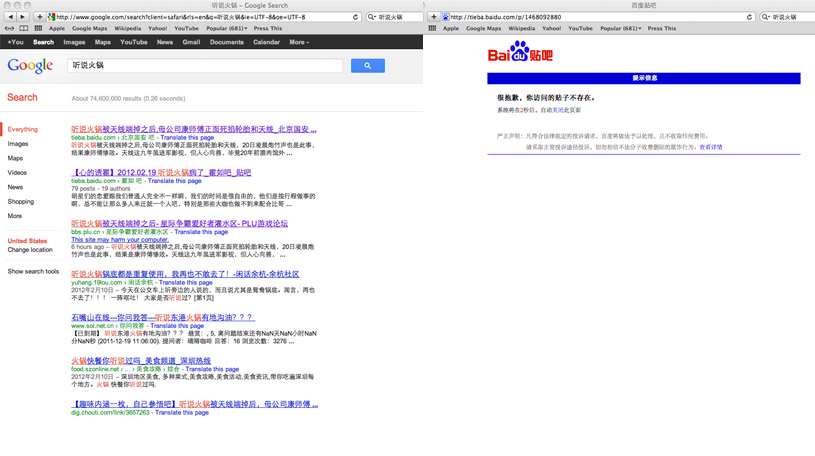
Rumor has it that after Hotpot was swept away by the Direct Line to Heaven, Noodle Master Kang of the Mother Company was openly fighting with Tire and Heaven Direct. The morning fireworks on the 20th were also part of this fight, with the result that the Noodle Master Kang took a serious hit. Even though these past nine years Heaven Direct has charged his way into the silver screen, nevertheless he’s well intentioned. After all, twenty years ago just outside the preserved ham shop, he was the man who stood behind Yangzhou Fried Rice. If y’all sing and eat hotpot again, his nine years of blood and sweat will be as nothing. Thus, it’s a good thing that Tire has the camouflage firmly in hand and soundly thrashed those instant noodles. [original: 听说火锅被天线端掉之后,母公司康师傅正面死掐轮胎和天线,20日凌晨炮竹声也是此事,结果是康师傅惨败。天线这九年虽进军影视,但人心向善,毕竟20年前腊肉馆外他是站在扬州炒饭背后的男人,你们再唱歌吃火锅,人家九年心血全没了,所以幸亏轮胎紧握迷彩涂装不放,才狠摔方便面。]

Traces of the passage remain in google cache but can no longer be accessed on Baidu (image below).

Why was the spoof so quickly removed from Baidu? Continue reading