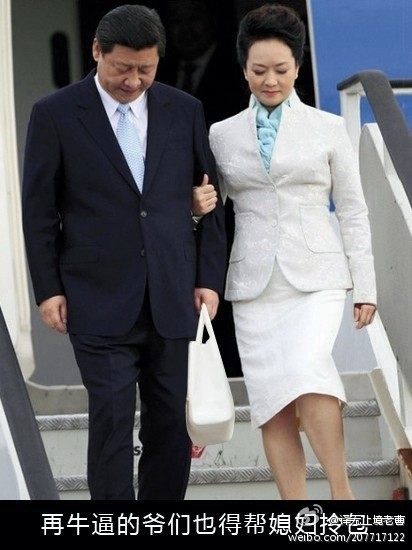
carry the purse, gentlemen!

5198cc4ejw1e326t05m2gjMeme du jour: Even the most impressive have to carry their wife’s purse (在牛逼的爷们也得帮媳妇拎包).

Yes, it’s true. Xi Jinping carryies wife, Peng Liyuan (彭丽媛)’s purse and the Chinese internet is gleefully sharing the news. I know that many westerners-in-China have been disconcerted by the fact during a Chinese courtship, men carry their girlfriend’s purse. After marriage,  many men — especially those “caring alpha” types — carry their wife’s purse. And now Xi Jinping and Peng Liyuan have brought this bit of intimacy to the international scene.

My friends have been thrilled by Peng Liyuan’s performance as China’s First Lady. Now, they’re ecstatic that she’s reminding their menfolk about what it means to be a gentleman.

what kind of pig are you?

This is one of those unscientific “he said, she said” illustrations of just how difficult it is to know what’s happening in China, or anywhere for that matter. The story also indicates that the US and Chinese social media are not as autonomous as we might think. Indeed, anonymous sourced information that circulates in either the US or Chinese social media seems to increasingly show up in other networks, much like pig carcasses that wash up on unexpected shores. More to the point, the chronology through which we experience the overlaps between US and Chinese social media networks creates stories that read as magic realism in which you, gentle reader, must ask yourself, “what kind of a pig am I?”

Here is the timeline through which I have experienced the pig story.

Two weeks ago, several hundred dead pigs were found floating in the Jiaxing River, a tributary of Shanghai’s Huangpu River.

Last week, an American friend uploaded this photo Pigs Swimming in Mud Cake to Facebook.pigs swimming in mudcake

Yesterday, a friend in Hong Kong, uploaded the same picture and what followed were a series of jokes about not eating pigs and pork products. The apparent prompt for forwarding the picture was another message that was also circulating:

 I don’t know if this is true or false, but it must be forwarded: eat less pork! Shanghai has claimed that over 8,000 pigs froze to death! In the middle of a bright South China Spring! I’m begging the relevant ministries – can’t you exert your brains and come up with a more believable reason? Don’t treat the people as if we were three year olds. One dead pig is a random occurrence. Two dead pigs is a random occurrence. But over 8,000 pigs dead is random? There must be a reason! Today, the truth has finally been revealed! – Where is the future of the Chinese People? We’re digging our own graves and anhilating our people! [Forwarded message: according to a pig farmer, there’s a chemical called 机砷. In ordinary language that’s 砒霜 or arsenic! This chemical is used in pig feed like “四月肥” [literally “Fat in April”- MA] that accelerate the maturation of pig and make their skin shiny, increasing profits from selling pigs. The downside to the process is that the arsenic accumulates in the pigs’ bodies, which have no way of breaking down the poison. The poison causes the pigs’ internal organs to rot, and after four or five months eating this pig feed, most pigs die. Consequently, farmers only use this pig feed three or four months before bringing their pigs to market. As long as the pigs are slaughtered immediately, there’s no problem. But this Chinese New Year’s season, it was mandated that there could be no more government feasting and banqueting. Suddenly, the bottom dropped out of the pork market. Pig farmers were forced to continue raising pigs that had already been eating contaminated pig feed for four months. A month or two later, a massive die-off of the pigs that had been prepared to sell during the New Year’s season started. This story couldn’t be revealed. However, no one dared to bring already dead pig meat to market [instead of living pigs that would be slaughtered onsite to guarantee freshness – MA]. Consequently, the pig carcasses were tossed into tributaries of the Huangpu River. Clearly, the problem was caused because on the one hand, too many pig farmers are using pig feed to accelerate maturation and on the other hand, the banquet ban was too effective. The floating carcasses were discovered by the media. So maybe a thousand, maybe more pig carcasses are drifting silently in the Huangpu River. This is the horrific story that they are telling.

In contrast, yesterday The Guardian posted an article that mentioned that the pig carcass total had breached 16,000, and attributed the reason to a crackdown on selling dead pig meat in markets. In turn, The Guardian was citing (circulating?) a story from Southern Weekly (of the China Dream censorship fiasco):

The state-controlled Southern Weekly newspaper, citing court documents, said three men were sentenced to life in prison in Jiaxing last November for procuring dead pigs to sell their meat. It says the men and their group bought 77,000 dead pigs in a period of more than two years.

So, reflective moment du jour: Who are you? A pig happily swimming in a mud cake, anticipating sugar highs? Or a pig drifiting in dark waters, fearful about what the Chinese government might be hiding and how this silence kills? Of course, it’s all evidence that China and the US are the same country. After all, processed white sugar may also be toxic.

Text of the Chinese weixin that I received:

不知是真是假,但是不得不转: 少吃猪肉吧】上海8千多头死猪死因公布了一一居然是冻死的! 在春花灿烂的江南三月! 拜托了有关部门,能否多动动脑子找个更可信点的理由,不要把民众当三岁小孩哄。一头死了是偶然,二头死了是偶然,8千多头是偶然事件?一定有其必然的原 因! 现在,真相终于大白天下了! 一一一中国人的未来在哪里??我们在自掘坟墓,灭绝民族! 【转:据猪农说,有种制剂叫有机砷,砷就是砒霜啦,用在四月肥之类的猪饲料添加剂里,可以促进猪性腺发育和毛皮红亮,改进卖相有利于卖个好价钱。 但副作用是有 机砷蓄积在猪体内会部分分解为无机砷,喂食四五个月后会大幅增加猪的内脏腐蚀、大批死亡的概率。所以一般是在预备出栏前三四个月开始用,反正负作用还没出 来猪就宰了出栏,规避了有机砷的风险。 然而熹兴年底眼看通胀要升腾,赶紧猛刹车大力禁绝国企和机关摆酒席过年,导致大量酒席突然被取消,相应 地酒席用肉也大幅低于预期。猪农已经喂好四月肥准备出栏宰杀的猪也被迫继续在栏里养着。可是有机砷已经用了,本来马上宰杀负作用还不会出来,现在拖了一两 个月还没卖出去,有机砷的副作用 上来了,猪们纷纷内脏腐烂而死。这死因见不得光,又不敢拿去市场上卖这样的死猪肉,养殖户只好打落牙往肚里咽,抛到河里了 事。孰料这么投有机砷的养猪户太多,年末禁酒席的影响又太普遍,大家都往河里一丢,猪尸们就在黄浦江大游行了,被媒体发现了。 成千上万的猪尸在阴冷的黄浦江上默默地飘荡,它们在讲述着这样一个可怕的故事。

what does china mean to you?

 Currently circulating on we chat, another of those punny jokes that do political analysis so well:

How do you pronounce the English word “China”? The single man says “Where’s my wife?” The lover says, “Where’s my sweetheart?” The beggar says, “Where’re to?” The poor man says, “Where’s the money?” The doctor says, “Where should we cut?” The businessman says, “Where’s the scam?” The official says, “Where’s the power?” The thief says, “Where’s the mark?” The developer says, “Where’s the site?” The government says, “Where do we raze?” And the lower class says, “Where do we migrate to?”

光棍念“妻哪?”,恋人念“亲哪?”,乞丐念“去哪?”,穷人念“钱哪?”,医生念“切哪?”,商人念“欺哪?”,官员念“权哪?”,强盗念“窃哪?”,开发商念“圈哪?”,政府念“拆哪?”,贫民念“迁哪?”

cancer village map

On May 6, 2009, Deng Fei (邓飞) published the “Cancer Village Map” which documented reports on villages where cancer rates were significantly higher than elsewhere in the country. Three days ago, the Chinese government officially acknowledged the existance of cancer villages.  Not surprisingly, most of the villages are located in in the prosperous areas of the country. Moreover, as in Shenzhen, these villages occuppy a grey area regulated and unregulated space. Below, I have translated the orginal post.

Cancer Village Map

cancer map

Jiangsu Province

Yangqiao Village, Guhe Township, Funing Coungy, Yancheng City (盐城市阜宁县古河镇洋桥村). According to a 2004 report in Jiannan Daily, between 2001-2004 more than 20 villagers died of cancer caused by a nearby pharmeceutical and two chemical factories. At night, villagers slept with a wet cloth covering their mouths and noses. The did not feed ducks near the water, but in the pigsties.

Dongjin Vllage, Yangji Township, Funing County, Yancheng City (盐城市阜宁县杨集镇东进村). According to a 2008 report in China Economic Report, between 2001-2006 over 100 villagers died of cancer because of pollution from a nearby chemical factory. All villegers took liver medicine. The villagers sued the factory, but were only given 70 rmb (a little over $US 10.00 today) per person compensation.

Xingang Village, Longgang Township, Yandu District, Yancheng City (盐城市盐都区龙冈镇新岗村). According to a 2009 China Youth Daily report, over the past 7 or 8 years, there were 57 reported cancer cases. All of those who died from cancer were between the ages of 50 to 60 years old.

Guangfeng Village, Guangyi Zhen, Wuxi City (无锡市广益镇广丰村). According to a 2003 China Consumer Report, the village was surrounded by liquid gas and chemical factories. Between 1999-2003, 24 people or more than one-third of village deaths were cancer related. Toxic gas and powder filled the small alleys and emited a strange oder, which fumigated relatives who visited for Chinese New Year.

Gaoqiao Village, Gaoqiao Township and Tumen Village, Huangxu Township in Dancong District, Zhenjiang City (镇江市丹徒区高桥镇高桥村、黄墟镇土门村). According to a 2004 China Environmental Report, beginning in 1997 the area showed a significant increase in tumors, with 71% of cases located in the relatively prosperous southern areas of Zhenjiang. Cases were attributed to a contamination of the  groundwater system.

Jiangxi Province

Huangxiken Nursery, Wangcheng Township, Xinjian County, Nanchang City (南昌市新建县望城镇璜溪垦殖场). According to a 2004 Jiangnan Metropolitan Daily, runoff from a chemical factory contaminated rice paddies, where the seedlings were covered in black liquid. That year, out of a total of 80 village deaths, close to 20 died of throat and lung cancer.

Guanshanqiao Village, Yanrui Township, Yushan County (玉山县岩瑞镇关山桥村). According to a 2006 People’s Daily report, 6 lime kilns located near the village emited grey powder and smoke that negatively affected over 100 mu of arable land. After a rain, vegetable leaves turned pale grey. That year of 60 village deaths, over ten were due to cancer.

Baiyefang Village, Xinsheng Xiang, Yugan County (余干县新生乡柏叶房村). According to a 2004 People’s Daily (Eastern China Edition), mercury in drinking water was 3 times greater than standard. Over ten years, at least 45 people died of mercury poisoning, while another 20 surffered from related dementia. Baiyefang is the most famous of China’s cancer villages.

Sichuan

Minwang Village, Jiancheng Township, Jianyang City (简阳市简城镇民旺村). According to a 2004 report in Democracy and the Legal System, the N-nitroso compounds of ammonia in drinking water was 30 times higher than allowed by law. The source of contamination were chemical factories that did not process runoff befor discharging into the Tuo River. Historically, Minwang was known as a Longlife village, however recently 5 beople died of cancer.

Tingjiang Village, Shuangsheng Township, Deyang Shenfang City (德阳什邡市双盛镇亭江村). According to a 2008 report in China Economic Daily, the village escaped the ravages of earthquakes but not contamination. As of 2008, fifty or sixty people had died of cancer. The mother of Yang Jia, one of the youth heroes of the Wenchuan Earthquake, committed suiced because of the pain from throat cancer.

Henan Province

21 villages including Huangmengying Village in Zhouying Xiang, Shenqiu County (沈丘县周营乡黄孟营村等21个村庄). According to a 2004 Xi’an Evening Report between 1990 through 2004, over one hundred people died of cancer, almost half of total deaths for the same period. Industrial and residential contamination of the upper reaches of the Shaying River seriously contaminated the groundwater system. Residents of all 21 villages in the area need to buy purified water.

Old North Guanzui Village, Ling County (浚县北老观嘴村). According to a 2002 report in Southern Weekend, since the 1980s, the fast development of paper factories resulted in extensive water contamination and rivers that looked like black ink. In a period of four years, 79 people died of cancer.

Qiancun East Village, Changcun Township, Changheng County (长垣县常村镇前孙东村). According to a 2007 Guangzhou Daily report, serious water contamination resulted in numerous deaths due to cancer over a period of five years. All of the fish and shrimp in the river died off and it became impossible to use river water to irrigate fields. The cause of the contamination was 21CN Science and Technology Company.

Guangdong Province

Five villages including Shangbei Village, Xinjiang Township, Wengyuan County, Shaoguan City (韶关翁源县新江镇(上坝村等5个村庄). According to a 2001 report in Legal Daily, runoff from mineral extraction contaminated the “fish and rice country” of Shangbei and Xiaozhen Villages. Arable land became a deep red color. Villagers report increasing cases of skin and liver cancer, if ducks went into the water they died within four or five hours, although some lived as long as three or four days after exposure.

Hubei Province

Cuiwan Village, Zhuji Township, Nangpan City (襄樊市朱集镇翟湾村). According to a 2006 Yangzte River Commercial Report, within a three year period, over 100 people out of 3,000 villagers died of cancer. Of these, the majority were aged 30-50 years old. Villagers claimed that deaths were due to industrial contamination of their river.

Hebei Province

Guxin Village and at least 6 or 7 other villages in She County(涉县固新村等至少6、7个村庄). According to a 2004 report in Xinmin Evening Report, since the early 1970s, this area of the Shannanpan and Ganhe river systems had higher cancer rates than other parts of the country. Statistics from the 80s, show rates of esophagus and stomach cancer 20 times higher than other parts of the country.

Xinanliu Village and 7 other villages along the banks of the Ci River (磁河两岸诸多村庄西南留村等8个村庄). According to a 2007 report by Law and Life, the eight rivers along the banks of the Ci River, the water system of over 20,000 villagers had been contaminated. Cancer related deaths accounted for almost half the deaths in the area.

Wuzhuang Village, Qianxi County, Tangshan City (唐山市迁西县吴庄村). According to a 2009 report in Science News, over a five year period, 10 members of this village with a population of less than 700 residents had cancer. All ten of the cancer patients lived within a 100 meter radius of a smelting factory.

Anhui Province

Liuzhuang Village, Shitai Township, Sheji District, Huaibei City (淮北市杜集区石台镇刘庄). According to a 2001 People’s Net report, this was a famous cancer village. In 2001, over 66 people died of cancer, and the water was as “yellow as cow piss”, earning it the name “killer water”.

Hunan Province

Quangu Village, Guangjiao Township, Nan County, Yiyang City (益阳市南县厂窖镇全固村). According to a 2008 report on China News Net, water quality in the village was so low that it would ignite when lit. It was a former bomb testing site and for over 10 years grass hadn’t grown in the area. It was suspected that chemical weapons were also tested there.

Jinhu Village, Longhui County (隆回县金湖村). According to a 2006 news report on Changsha Political Television, over a period of 20 years, that 29 members of the 285 member village died of sudden deaths, primarily spleen and lung cancer. Villagers suspect the cause was chemical fertilizers.

Hainan Province

Yinggehai New Village, Ledong Li Nationality Autonomous County (乐东黎族自治县莺歌海新村). According to a 2008 Hannan Daily report, as of 2008 118 villagers had died of cancer, resulting in high levels of concern from the Provincial Public Health Ministry and Center for Disease Control.

Xinqun Village, Wanning City (万宁市新群村). According to a 2008 by Nanhai Economic Report, rates of lung cancer death in Xinqun were 9 times greater than in other developed areas. Village drinking water was already seriously contaminated.

Shaanxi Province

Longling Village, Guapo Township, Hua County (华县瓜坡镇龙岭村). According to an undated report from Beijing Youth Weekly, since 1974, of 58 villager deaths, 29 were due to cancer. Professor Lin Jingxing and other researchers and the Chinese Geological Research Institute confirmed that flour and vegetables from this village were contaminated.

Hezuitou Village, Shangluo City (商洛市贺嘴头村). According to a 2003 Xi’an Evening News report, between 1991 and 2003, 46 villagers died of cancer, and during the highest point, there was one death a month. Before the factories were built in 1991, only one villager died from cancer ever two or three years.

Zhejiang Province

Wuli and Zhushanjie Villages, Nanyang Township, Xiaoshan District (萧山区南阳镇(坞里村、赭山街村). According to a 2004 Daily Business report, 80% of villagers had died from cancer. The 26 chemical factories had an estimated daily discharge of 2,000 tons of liquid waste.

Shandong Province

Xiaojiadian Village, Feicheng City (肥城市肖家店村). According to a 2007 report in the Chongqing Morning Report and a broadcast of the Central Economic Half Hour in 2006, 1/3 of the 90 deaths in this village were due to cancer. The average age was 48 years old, with one cancer death of a 4 year old. Dr. Wang reported these deaths, all cancer deaths were confirmed by County and higher level hospital personnel. Dr. Wang also said that these rates of cancer were definitely related to water contamination.

Inner Mongolia Province

Latehai, Baotou (包头打拉亥). According to a 2006 report from New People Weekly, hospital records show cancer deaths accounted for 70.9% of all deaths. Public documents classified water quality as level five, with particulates, sulphates, hardness, and chlorine all exceeded national standards. Further investigation linked cancer deaths to radiation contamination of water from Baotou steel production. In addition, runoff contaminated fields in neighboring villages which no longer could grow wheat. In a ten year period, 77 people had died of cancer.

Yunnan Province

Hutou Village, Laibin Township, Xuanwei City (宣威市来宾镇虎头村). According to an undated Xinhua Net “Focus Discussion” Column, since the 1970s, 6.5% of the population has lung cancer, which is over 1,000 times that of global average.

Tianjin Independent City

Xidi Village and Liukuaizhuang Village(西堤头镇西堤头村和刘快庄村). According to a 2009 China Quality 10,000 li Walk Report, in a period of five years, over 200 people developed cancer, reducing a “fish and rice” village to a cancer village. According to an investigation, over 100 large and small chemical companies surround the villages, discharging black smoke and water discharge, and toxic odors and loud noises permeate the area.

Chongqing Independent City

Huangqiao Village, Bishan Township, Liangping County (重庆市梁平县碧山镇黄桥村). According to a 2006 report in the Chongqing Daily, it seems that the villagers have been visited by the “Illness Devil”. Between 2003 and 2006, out of 500 villagers, 20 died of cancer, but know one knows what caused the deaths.

Taiwan

Wangtian Village, Dadu, Taichong County (台中县大肚乡王田村). Through 2007, since telecommunication wires were put in five years previously, over 100 villagers died of cancer, and villagers were in a panic. Villagers suspected that electro-magnetic currents had turned their village into a cancer village.

bao tong analyzes the southern weekend incident

baotongZhao Ziyang’s former secretary, Bao Tong has weighed in on the Southern Weekend Incident. And once again, his quirky take sheds all sorts of light into the dark corners of power at the top of China’s massive state apparatus.

Bao Tong suggests that the Southern Weekend Incident has raised three questions.

First, inquiring minds want to know, who’s actually opposing Xi Jinping? According to Bao Tong, all seven members of the Central Politburo Standing Committee of the Communist Party of China had to agree on Xi Jinping’s take on constitutionalism before he announced it. Thus, when the Southern Weekend decided to run “China’s dream, the dream of constitutional government”, they were doing their job, pushing forward the national agenda. Thus, what struck Bao Tong as abnormal wasn’t that an opinion piece was unilaterally changed, but that we don’t know who actually did it because none of the top seven have said, “I’m opposed to the national agenda.” In other words, on Bao Tong’s reading, we still don’t know who exactly is opposing constitutional reform. Is it someone in Guangdong? In Bejing? In the Ministry of information? Somewhere higher and deeper?

Second, inquiring minds want to know, why haven’t the seven just said, yes China has a constitution and it is the legal standard in the country? The seven announced that they would participate in reforming the constitution. They also announced that the constitution was the legitimating authority in China. But when the Southern Weekend encountered a force that was anti-constitution, none of the Standing members said anything. Surely, any and all of them could have said, yes, Constitution, good? So, Bao Tong wants to know, in this case where speaking was more natural than not speaking, what exactly does the seven’s collective silence mean?

Third and most seriously, at present, the role of the constitution is unclear. If the seven aren’t talking in support of the constitution, is it because the constitution doesn’t actually matter? Or if the opposition to the constitution is so strong, why not just admit that constitutional government in China isn’t really an option?  Bao Tong’s actual words go right to the point, “If China’s constitution doesn’t have legitimacy, then we should take the opportunity to tell everyone to stop hoping for constitutional government. This way we can avoid the people dreaming their way onto an evil road and blindly wasting their time (如果憲政在中國沒有合法性,應該趁早叫大家死了這條心,免得全國全民在夢中走上邪路瞎折騰).”

Last year, as Chongqing Turns became an international melodrama, Bao Tong provided one of the most interesting takes on Bo Xilai, arguing that Chongqing’s most infamous Party secretary was in fact Mao’s true heir because he was not afraid to use power to achieve political ends.

the chief eats a fish

So a translation of a story making the rounds, again. The Chief Eats a Fish first appeared at the end of 2011 and keeps circulating. Fish, of course, is a common pun for “extra, or too much”. Of note are the different ways that each of his subordinates addresses Chief Yu and the way that puns function, making the social body out of different parts of the fish. Nevertheless the satire speaks for itself.

 The Chief (局长) Eats a Fish

The weekend had come and as was their custom, the work unit staff gathered to dine. According to Chief Yu this activity was “going deeply into the lowest levels of society (深入基层)” and the best shortcut for connecting with the masses.

Chief Yu loved to eat fish, which was of course on the menu. They had drunk three rounds of wine and five different dishes when the fish was served. The waitress knew Chief Yu and so she made sure that the fish head was directly facing him. Without waiting for anyone’s input, he immediately drank three cups of wine (fish head wine is a colloquialism which means “delicious wine”). When he had put down his wine cup, Chief Yu began to allocate the fish.

Chief Yu used his chopsticks to pluck out the fish’s eyeballs with practiced ease. He gave an eyeball each to the people on his left and right. He said, “this is known as the far-seeing eye. I hope the two of you will act in concert with me.”

The two vice-chiefs smiled and gave the Chief their heartfelt thanks, saying, “Chief Yu we will not let you down and will completely support the work you have begun.”

Chief Yu removed the fish skull and presented it to the Head of Accounting, saying, “this is known as the axial column. You are the key worker in our department so of course I’m giving it to you.”

The Head of account was surprised to be treated so well, but said, “Thanks, boss.”

Chief Yu gave the pretty mouth to his “young cousin”, saying, “The lips and the mouth rely on each other (唇齒相依)”, which is a traditional proverb to express the idea that two people cannot get along with each other.

The Chief’s “young cousin” shot him a flirty glance and said, “Thank you older brother Yu.”

Chief Yu gave the fishtail (wei 尾) to the office manager, making a pun on the expression, the committee takes responsibility (wei 委以重任). The office manager was completely grateful and said, “Thank you, elder.”

Chief Yu gave the fish stomach to the assistant (fu 副) head of the planning department, again making a pun, “this is called treating others with sincerity (推心置腹 – fu is also the character for stomach).” The assistant head dipped his head and replied formally, “Thank you Chief.”

Chief Yu gave the fins to the administrative director, saying “open your wings an fly. You are the nearest to our Chief and so will definitely go higher everyday.”

The administrative director a huge smile saying, “I hope that the Chief will give me the necessary support.

Chief Yu gave the fish buttocks (ding 腚) to the union chair and said, “If you hold the course, there will be happiness in the end (ding 定有後福).”

At the end of the allocation, all that was left was a picked over slab of meat. Chief Yu smiled bitterly and shook his head, saying, “I should probably take care of the leftovers, after all that’s what a Chief does.”

policy by number

In anticipation of the 18th National People’s Congress (and possible trial and sentencing of Bo Xilai and concomitant rise of Wang Yang), I am offering a bit of policy by number — one country, two systems, for example. Chinese policies (at all levels of government) tend to come in easy to remember chunks, which in turn are parsed and memorized in politics class. Of course, in addition to politics classes taught in actual schools, all government organizations also unpack the latest phrase because as the ill-fated reception of Jiang Zemin’s “three represents” demonstrates, its possible to disseminate a catchy catchphrase without the larger public actually figuring out is being said.

A few examples, the author, and a few dates of Chinese policy by number:

One Country, Two Systems (一国两制; Deng Xiaoping, 1984) refers to the decision that Hong Kong would remain administratively separate from the PRC and was used again for the return of Macau, allowing both Special Administrative Regions to continue business operations as they had under colonialism, even as political authority shifted to Beijing. The phras also anticipates the return of Taiwan.

Three Represents (三个代表; Jiang Zemin, 2000) refers to which Chinese interests the Party represents, namely 1. the demand for progressive production capacity; 2. the cutting edge of progressive cultural production, and 3. the basic interests of the vast majority of the People. Unfortunately, even in Chinese the three represents are counter intuitive (1. 始终代表中国先进社会生产力的发展要求;2. 始终代表中国先进文化的前进方向;始终代表中国最广大人民的根本利益) and many thought that the phrase referred to three representatives of Marxism: Marx, Lenin, and Mao. But again, if we were talking about the people’s representatives in the post Mao era, where was Deng Xiaoping’s place in all this?

Four Modernizations (四个现代化;1st plenary session of the 3rd National People’s Congress, December, 1964) refers to the imperatives to modernize industry, agriculture, national defense, and science and technology research (工业现代化、农业现代化、国防现代化、科学技术现代化). The four modernizations where to be accomplished in two, 15 year steps (两步走), or to modernize over the course of 6 five-year plans. Step 1 was to establish a modern industrial base and economic system by 1979; step 2 was to bring China’s industry and economy to the world by 1995. In the 3rd plenary session of the 11th National People’s Congress, Deng Xiaoping memorably reestablished the four modernizations as the guiding policies.

After these first three, Chinese policy by number quickly deteriorates into farce because every level of government and many work units promote their goals through this system. Of note, however, is that Chongqing and Guangdong policy by number soundbites have entered into public discourse, not to mention Hu Jintao’s love of the genre. A few of the more prominent examples:

Three attacks, two establishments (三打两建; Wang Yang, 2011) are the current Guangdong Provincial government’s commitment to attack monopolistic markets, to attack piracy, and to attack corruption and establish systems of social trust and marketplace oversight (打击欺行霸市、打击制假售假、打击商业贿赂;建设社会信用体系、建设市场监管体系).

Five Chongqings (五个重庆; Bo Xilai, 2008) marked the beginning of the Chongqing Model of development, and referred to inhabitable Chongqing, smooth traffic Chongqing, forested Chongqing, safe Chongqing, and healthy Chongqing (宜居重庆、畅通重庆、“森林重庆、平安重庆和健康重庆).

Six Efforts, Six Actualizations (六个着力六个切实; Hu Jintao, 2009) are more ongoing efforts to fight corruption by changing the hearts and minds of Party members by striving to strengthen guiding principles and to actualize the Party for the public good and administering government for the people; striving to improve praxis and to actualize the Party’s praxis of scientific guidance; striving to strengthen responsibility and to actualize the responsibility to follow the Party and the People to be generous; striving to establish correct political positions and to establish objective development [which then has its own numbered list of how tos]; striving to establish a correct view of benefits and to actualize the People’s benefit as being primary, and; striving to strengthen  the Party’s discipline and to actualize Party unity [in four areas] (着力增强宗旨观念,切实做到立党为公,执政为民;着力提高实践能力,切实用党的科学理论指导工作实践;着力强化责任意识,切实履行党和人民赋予的责任;着力树立正确的政绩观,切实按照客观规律谋划发展,要察实情,讲实话,鼓实劲,出实招,办实事,求实效;着力树立正确的利益观,切实把人民利益放在首位;着力增强党的纪律观念,切实维护党的统一,在思想上,行动上,政治上与党中央保持一致,维护党的统一。)

Eight Honors, Eight Shames (八榮八恥; Hu Jintao, 2006) were promoted to cultivate the moral conscious of Party members; patriotism is an honor, while harming the country is a shame; serving the people is an honor, while turning one’s back on the people is a shame; respecting science is an honor, while stupidity is a shame; hard work is an honor, while sloth is a shame; solidarity is an honor, while the pursuit of self benefits is a shame; being trustworthy is an honor, while being opportunistic is a shame; upholding the law is an honor, while breaking the law is a shame; struggle is an honor, while arrogant greed is a shame (坚持以热爱祖国为荣、以危害祖国为耻,以服务人民为荣、以背离人民为耻,以崇尚科学为荣、以愚昧无知为耻,以辛勤劳动为荣、以好逸恶劳为耻,以团结互助为荣、以损人利己为耻,以诚实守信为荣、以见利忘义为耻,以遵纪守法为荣、以违法乱纪为耻,以艰苦奋斗为荣、以骄奢淫逸为耻).


bo xilai: true heir to the revolution?

Bao Tong (鲍彤) was Zhao Ziyang’s secretary. Zhao Ziyang, of course, was the Secretary General of the CCP who fell from power because he supported a non-violent resolution to the Tian’anmen protests. Yesterday, Bao Tong chimed in on the Bo Xilai scandal and how it relates to the upcoming 18th National People’s Conference — and yes, whether or not Gu Kailai killed Niel Haywood is a matter of secondary importance, rather than being a question of life or death for the Party. For Bao Tong and like minded CCP politicos, the question is still one of the absolute authority of the Party.

Here’s the rub: Bo Xilai has become a negative example of abuses of Party authority and power. However, like Deng Xiaoping before him, Bo Xilai is the direct heir of Marxin, Lenin, Mao and Stalin. If the Party removes Bo Xilai, they have rejected the justification for absolute power. If they continue with Bo Xilai, then they must deal with the fact that Bo Xilai has been discredited. Bao Tong thus provocatively and accurately raises the question: If Bo Xilai (or someone like him) is the heir to the revolution, what’s the Party to do? Translation of Bao Tong’s op-ed piece, below.

There are Two Choices at the 18th NPC

Bo Xilai has already become history. The reason he has entered the annals of history isn’t because of his wife, Gu Kailai was convicted, but because he pursued the “Sing Red, Attack Black [mafia] (唱红打黑)” campaign.

Some have slandered Bo Xilai by saying he isn’t a filial descendent of the Party. This is unfair. He really was immoral and lawless, but wasn’t Mao Zedong?  Lenin openly defined revolution as “only dependent on the direct action of the masses and not dependent on any law”, and is thus the even more immoral and lawless ancestor. Under Lenin’s strategy and leadership, the Bolsheviks brazenly dispersed the elected All Russian Constituent Assembly, starting the age of Red Terrorism. Mao Zedong delighted in bragging about his lack of conscious and lawlessness. He didn’t believe this was a source of shame, but rather a source of honor. All Chinese people are familiar with this history. Bo Xilai was merely the direct heir to this tradition. There is no possible discussion about Mao Zedong and Stalin’s personal morality. Thus, if we are to fairly evaluate Bo Xilai, we cannot say that he was the unworthy son of the Party, but must say he was the Party’s worthy son, its skillful and finest son, most worthy in the extreme.

If we are speaking of Party nature (党性), who is more truly of the Party than Bo Xilai. Singing red is to walk with the Party, and attacking black is to struggle against those enemies that the Party has identified. This is the highest essence of revolution and strongest discipline. Bo Xilai had a strong body. During his youth, he was bewitched by Mao Zedong into entering a life or death struggle with his father, Bo Yibo, who Mao had called a traitor. Who else has demonstrated this level of innocent and pure revolutionary spirit and loyalty to the Party?

It must be pointed out that by calling the Chongqing Model “Sing Red, Attack Black”, Bo Xilai had completely digested the marrow of the Party’s authoritative government. Standing in the position of a Party leader, to sing red is to respect only the Party, and to attack Black is to suppress anyone else (异己).

For the masses, singing red is the obligatory way to serve the Party, and attacking black is the willingness to fight on the Party’s behalf. Without exaggeration, we can say that the existence of a political campaign called “Sing Red, Attack Black” signals that the Party’s monolithic control of government has ended. [Within the State Party system] Anything that does not belong to the system is beside the point. Even if it is important, it cannot be a life or death conflict. For example, the difference between Mao Zedong and Deng Xiaoping’s respective policies or that between Stalin and Hitler’s policies is no doubt one of better or worse, but these differences were differences within the context of serving the absolute political power of the Party.

Consequently, when cutting up a cake, there is always the question of who gets the bigger slice. On the the issues of public housing and hukou, Bo Xilai was not rigid, in fact he was extremely flexible. This is one of the reasons he won the hearts of the people. However, he he could only tentatively hold his deep seeded “follow me and flourish, oppose me and perish” attitude (“顺我者昌逆我者亡”这条命根子). He blatantly raised his “Sing Red, Attack Black” banner, brandishing his sword, declaring his strength and prosperity, without giving any quarter. What was this? This was nothing other than the Bo Xilai Model, or we could call it Bo-ism. It was also Maoism for the 21st century. Bo Xilai didn’t invent “follow me and flourish, oppose me and perish”. However, in order to call corruption a miracle and to paint cruel and inhuman philosophy as miraculous revolutionary truth, Bo Xilai needed extreme sincerity in order to succeed as he did.

Some argue that “Red is true! Black is crime!” Is this true? When were the “nine types of black” established in the legal domain? “The whole country is red” campaign was obviously an unprecedented catastrophe. Governance depends upon clear legal ideas, and does not require romanticism or catchy slogans, and does not permit illegal gutting and rewriting the law.

The especially pernicious aspect of singing red was that it called an ass a horse, sedating the people and deifying leadership. In Bo Xilai’s Sing Red campaign a “power grab” was mystified as “the great victory of democratic revolution”. The ongoing impoverishment and alienation was mystified as “the great victory of socialism”. The widening gap between rich and poor was mystified as “Socialism with Chinese characteristics”. Human rights abuses were mystified as “stability”. And immorality and lawlessness was mystified as “the greatest glory”. Of course, with respect to Bo Xilai himself, he was the new savior of the world.

The especially pernicious aspect of attacking black was using law to solve problems that could not be solved through legal means. It made people crazy to attack wherever the Party pointed: attack rightists, attack anti-rvolutionaries, attack liberalization, attack vulgar values, attack those protest, attack those with power, attack lawyers, attack those with the courage not to submit to the Party’s leaders, attack the enemy in Bo Xilai’s eye; charge with out fear of death, attack! All that was necessary was to raise children who daily sang red and attacked the black, and everyone would be in crazy sedation. The highest power would then naturally pass from generation to generation, flourishing for 1,000 years, the establishment of an imperial house. This was the perfect strategy concealed in Bo Xilai’s four characters “Sing Red, Attack Black”.

Even if this campaign had entered high levels of Party debate, nevertheless early on some clear sighted people saw it was unfeasible. Those who sang red were “Party parrots (党八股)”. Lin Biao advocated reading Mao everyday, but Minister of Propaganda Lu Ding disagreed. Lu Ding contradicted Lin Biao with the colloquialism “even delicious Yunnan ham if eaten everyday will cause indigestion”. Clearly, Lin Biao didn’t have Lu Ding’s experience in propaganda. Attacking black everyday was the same as doing the Cultural Revolution everyday. Likewise, how could Bo Xilai be more knowledgeable than the General Secretary in determining the importance of harmony to social stability? Unsurprisingly, when Bo Xilai first appeared on the list of potential candidates for the Standing Committee, how hard it was for people of understanding to stand like pillars in flowing water. They didn’t make a pilgrimage, they didn’t chant sutras, and they didn’t cheer! (With all the drama for becoming General Secretary, the situation is extremely complicated. Those who had risen by attacking black and made their living singing red were probably a small minority.)

The 18th National People’s Congresses faces a choice: either tie itself to Bo Xilai or cut him loose. If they are unwilling to open the 18th NPC under Bo Xilai’s shadow, then it is time to quietly begin ending the “Sing Red, Attack Black” campaign. Of course, if they are willing to openly and properly join Bo Xilai in singing red and attacking black, this is even more commendable, more deserving of everyone’s welcome and support.

deng xiaoping’s inscriptions

Deng Xiaoping was born Deng Xiansheng (邓先圣) on August 22, 1904 in Guang’an, Sichuan (四川广安). To commemorate his birthday, below I have translated his calligraphic inscriptions, which suggest the contours of reform and its social terrain.    

October 1, 1983 for the Beijing Jingshan School: “Education must be oriented to modernization, the world, and the future (教育要面向现代化、面向世界、面向未来)”.

January 1, 1984 for the Shenzhen Special Economic Zone: “Shenzhen’s development and experience proves that the policy decision to establish Special Economic Zones was correct (深圳的发展和经历证明我们建立经济特区的政策是正确的)”.

February 16, 1984 for the then under construction Shanghai Baoshan Steel Factory: “To grasp new technology, one must not only be able to study, but also more able to innovate (掌握新技术,要善于学习,更要善于创新)”.

October 15, 1984 for the first Chinese exhibition to the South Pole: “Use the South Pole to contribute to humanity and world peace (为人类和平利用南极做贡献)”.

February 1986 for the Tianjin Development Zone: “The Development Zone has great hope (开发区大有希望)”.

May 30, 1987 a general inscription: “Unite Marxist truth with the actual situation of the country, so that China will walk its path (把马克思主义的普通真理和本国的实际情况结合起来,走自己的路)”.

May 11, 1988 for an anthology of essays on true standards that was published by Guangming Daily: “Praxis is the only standard for investigating truth (实践是检验真理的唯一标准)”.

October 10, 1989 a general inscription:”Nurture successors to the proletariate revolution who have ideals, morals, culture, and self-restraint (培养有理想、有道德、有文化、有纪律的无产阶级革命事业接班人)”.

September 5, 1990 a general inscription: “Project Hope (希望工程)”.

March 1991 for the 10th Anniversary of Arbor Day: “Green the Motherland, Create Riches for 10,000 Generations (绿化祖国,造福万代)”.

April 23, 1991 for a national meeting: “Develop high technology, realize industrialization (发展高科技,实现产业化)”.

lotus east: the horse gang village

Half an hour outside Weishan, Lotus East Village (莲花东村) stands apart from the surrounding villages, both historically and culturally. Unlike mountain villages, like those around Lushi, which cultivated Yunnan Red (滇红茶), Lotus East once supplied the horses and guards for the caravans that moved tea and other goods along the Tea and Horse Route (茶马道). Although small, the village was powerful and relatively wealthy. In fact, during the Nationalist era, the clan heads – brothers Ma Shiji, Ma Shiqi, and Ma Shixiang – were aligned with Long Yun, the former Party Secretary of Yunnan Province.

Culturally, the residents were and remain Muslims, who elegantly synthesized elements of Han and Bai traditions within the context of Islam. The couplet that graces the entrance to the village mosque exemplifies the hybrid cultures of Southwestern China. In Mandarin, the word for “mosque” is literally “clear truth temple (清真寺)”.  The author has taken those two characters and used them as the opening characters of a Mandarin style couplet:

清升浊沉万教终归一统

真诚不二宇宙同赞阿拉

The pure rises, the polluted sinks, ultimately 10,000 teachings return to one

Truth and piety are not different, the entire universe praises Allah

Today, the Mosque and former homestead of the Ma brothers are open to the public, as is a small museum that introduces horse caravan culture (马帮文化 – literally “horse gang culture”) and the cross cultural breadth of China’s southwestern trade in tea, horses, and other luxury items. Impressions, below:

This slideshow requires JavaScript.