resolutely believing in the party

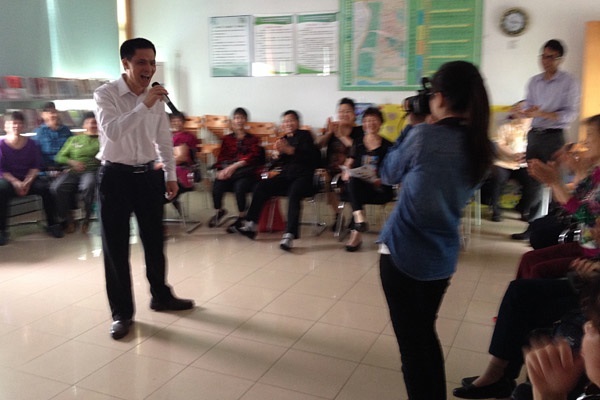
This morning I observed the Baishizhou Culture Station in action. Two groups of aunties were singing. The first group was singing Mandarin karaoke, the second group was singing an original Hakka composition entitled, “Resolutely Believing in the Party”. Later that morning the new Shahe Party Secretary came by, singing a karaoke song (“The Northern Spring”) and enjoyed the performance by the Xintang Hakka Mountain Song Chorus. Handshake 302 also presented our work to date.

The morning of community culture, including a Party Secretary karaoke moment reminded me that so much of Chinese political culture is making and maintaining good relationships between Party representatives and the represented. The pictures show the lyricist, the singing Secretary, and the Culture Center’s documentation of the event.

So here are the translated lyrics of “Resolutely Believing in the Party”. Note the definition of xiaokang–a basic material standard of well being. Note also in the picture that the lyrics have been written by hand.

Spring brings the fragrance of one hundred flowers, one hundred flowers
Everyone has a car and building, a house, a building and a house
Every kind of furniture
Three healthy meals a day, nutrition and health

Summer comes and the heat is hard to bear, the heat is hard to bear
Everyone has a fan or air conditioner, installed an air conditioner
No need to roast and sweat
We have electric slow cook pots for traditional soup, traditional soup

Fall comes and it turns cool, it turns cool
We wear fashionable clothes, fashionable clothes
Everyone carries a cell phone
Each home has internet and is linked to the world, linked to the world

Winter brings snowflakes to the mountain, snowflakes in the mountain
Reform and Opening is the promise of Spring, the promise of Spring
Resolutely believing in the Party
Beauty and happiness with the realization of xiaokiang, we’ve realized xiaokang

revising the classics, or confucius encounters neoliberalism

Shenzhen parents worry about education — it’s quality, content, methods, and test results. Indeed, I have yet to meet a parent unwilling to spend several hours discussing their child’s education, while activists raise social problems in terms of education.

I have recently received a revisinist version of the childhood classic, “Kong Rong Shares a Pear“. The rewrite is fun and illustrates one of the ways in which the United States (as a symbol) has been put to work in contemporary Chinese debates about the contradiction between a society that values an integrated whole at the expense of individual desire and a society that values individual desire at the expense of social integration.

Kong Rong Shares a Pear

For thousands of years, the moral tale of “Kong Rong Shares His Pear” has been told, becoming the standard for parents who want to teach their children manners. But how do American kids think about this story? Below is a transcript from a class of American students who are studying Chinese. The students range from 8-12 years old.

Teacher: When he was young, Kong Rong was an exceptionally bright student. When he was four, he could already recite many poems. He was polite and courteous. One day, his father’s friend brought a box of pears to the family. His father asked Kong Rong to share the pears with his brothers. Kong Rong took the smallest pear for himself, and the shared the pears based on age rank, giving the largest pear to the oldest, the second largest pear to the second oldest and so on. As he distributed the pears he said, ” I’m the youngest, so I should eat the smallest pear.” His proud father heard him and asked, “But you’re older than your baby brother. Why didn’t you give him the smallest pear?” Kong Rong said, “I am older than him, so I should give it to him.”

What do you think of this story?

Student: Why did the father’s friend give the Kong family pears?

Teacher: they were a gift.

Student: If it was a gift, then all the pears would be good. Why were there obviously big pears and small pears? Why weren’t they all the same size?

Teacher: Ahhh…

Student: Now, if there were big pears and little pears, why did the father put all that responsibility on a four year old’s shoulders? What would have happened if Kong Rong had made a mistake? Would the father have taken back the pears and distributed them correctly?

Teacher: Ahhh…

Student: Why did everyone have to eat a pear? Couldn’t alone leave the pears and let those who wanted a pear choose for themselves?

Teacher: That might have been unfair.

Student: But Kong Rong didn’t necessarily distribute the pears in a just manner. All the brothers had to accept whatever pear Kong Rong decided to give them. Their right to choose was violated. The brother who received the largest pear might have been the brother who hated pears.

Teacher: That’s correct. This story is based on the premise that everyone likes pears.

Student: Why did Kong Rong give pears to the oldest first? If he was going to use age rank, why not start with the youngest?

Teacher: He was being polite.

Student: But after he took the smallest for himself, he didn’t give anyone else a chance to be polite. Why didn’t he give anyone else a opportunity to share pears?

Teacher: So what do you think about Kong Rong?

Student: I don’t like him. What he did wasn’t fair to others, taking away their right to choose and their chance to be polite. Kong Rong isn’t sincere.

Teacher: Why?

Student: This matter is internally contradictory. What if Kong Rong didn’t like pears, so he chose the smallest for himself? Nevertheless, his behavior earned praise? This is hypocritical. On the other hand, if he really liked pears, he should have said so. Otherwise, giving the biggest pears away wouldn’t have made him happy. When we like something we should bravely say so.

I also didn’t like his father.

Teacher: Why not?

Student: He didn’t take responsibility and asked a four year old to do something he couldn’t do. Also, he had no standards, he praised Kong Rong for being polite, but we’ve already seen that Kong Rong was disinterested in sharing the pears.

Teacher: Ahh…

Student: This was a bad story. It encourages subjective standards and praises one for violating democratic rights. This kind of twisted logic story praises a child for developing unhealthy psychology.

Teacher: So what do you think Kong Rong should have done?

Student: Put the pears on the table and let people who wanted to eat pears take what they wanted.

Postscript: From the perspective of an American student, a Confucian classic becomes a tale of twisted psychological motivations. Where do you think the problem lies?
the winners of the mistress awards have been announced!

The results of the “National Awards for Mistresses (全国包二奶大奖赛)” spoof the time and money and presumably effort that some of China’s leaders have expended on accumulating mistresses. The results indicate that many have crossed that fine line between peforming masculine virility and paradoy, which in turn slides into corruption charges because no one actually believes these old men are achieving sexual satisfaction, let alone satisfying their young mistresses — the numbers are just too high. Indeed, the results seem more like baseball cards than gossip; we’re trading statistical representations of performance, rather than vicariously participating in the realization of desire (or actually enjoying a sunny afternoon game). I’m also wondering about how many of these leaders were simply pimping their way to business deals and higher political ranking because these statistics are invariably linked to corruption charges and convictions. Consequently, when available I’ve also linked the offenders’ names to English language reports about these cases.

Results of the National Mistress Awards

1. Quantity Award: Jiangsu Province Department of Construction, Xu Qiyao Director, Xu Qiyao (徐其耀) who has had 146 mistresses;

2. Quality Award: Chongqing Municipal Party Committee Department of Propaganda Director, Zhang Zonghai (张宗海)for having kept 17 beautiful co-eds in five star hotels;

3. Scholar’s Award: Hainan Province Textile Bureau Chief Li Qingshan (李庆善) for his collection of 95 sexual diaries and 236 illustrated guides;

4. Youth Award: Leshan Mayor Li Yushu (李玉书 Sichuan Province) for keeping 20 mistresses between the ages of 16 and twenty;

5. Management Award: Xuancheng Municipality Party Secretary Yang Feng (Anhui Province) for using his MBA to effectively manage 77 lovers;

6. Expense Award: Shajing Credit Union Manager Deng Baoju (邓宝驹 Bao’an District, Shenzhen), also known as the “5 mistress youth” for spending 18.4 million yuan over 800 days on mistresses, this averages to 23,000 perday or almost 1,000 per hour;

7. Solidarity Award: Zhouning County Head Lin Feilong (林龙飞 Fujian Province) for organizing a dinner for 22 mistresses and awarding a 300,000 prize for best mistress;

8. Harmony Award: Lingao Municipal Administration Chief Deng Shanhong (邓善红 Hainan Province) for having 6 children by 6 mistresses and a wife who says she doesn’t believe the gossip;

9. Effort Award: Hunnan Province Telecommunications Bureau Chief Zeng Guohua (曾国华) for guaranteeing that before he turns 60, he will have sex three times a week with each of his 5 mistresses.

dishing on sino-american relations

There is a current blurb flitting through virtual space about a fictional meeting between Xi Jinping and Obama, who has just finished watching an episode of CCTV’s popular 舌尖上的中国后 (A Bite of China). A friend described this parody of bi-lateral mis/understanding as hilarious, another called it an example of literary talent, and yet another as nugget of cultural truth so Chinese it could not be translated!

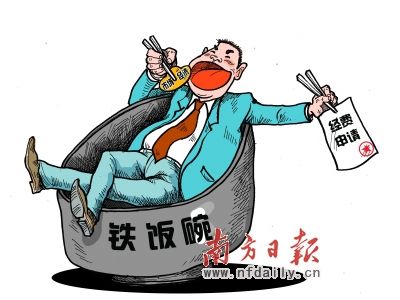
High praise for a political side dish. So, I decided to create a taste challenge for bi-lingual readers, adapting the piece from Chinese to English. Four political facts might enhance appreciation of the spoof: (1) Obama is just Obama, but Xi Jinping is always, “General Secretary”; (2) there is an important role for overseas Chinese figured by US Ambassador to China Gary Faye Locke (骆家辉); (3) subtitled episodes of A Bite of China can be viewed on Youtube, which remains off menu for those of us dining chez Cafe le Firewall, and; (4) General Party Secretary Xi never mentions the iron rice bowl (铁饭碗), an expression used to described the difficulty of removing officials from their posts. Also of note, the expressions emphasize the acting of eating, not food. Consequently, more colloquial English would use variously use “take” or “swallow” or “suck up” or “eat” to translate 吃 — and therein, perhaps, is an experiential entry into cultural differences structuring Sino-American misunderstanding.

After viewing “A Bite of China [literally China on the Tongue]”, Obama said to General Secretary Xi Jinping, “I’ve realized that although Chinese culture consists of extensive knowlege and profound scholarship, it is really an eating culture. Consider: a job is called a rice bowl, working is called living from hand to mouth (糊口); to be employed is called getting enough to eat (混饭), getting by in style is called eating with gusto (吃得开), and things that are liked are said to whet one’s appetite(吃香); to be taken care of is called eating from the little stove (吃小灶), to spend your savings is called eating your principle (吃老本) to take advantage of a woman is called eating tofu (吃豆腐); to depend on your parents is called gnawing on the old (啃老); a man who spends a woman’s money is said to eat soft rice (吃软饭); to overwork is to eat without digesting (吃不消), to take advantage of someone is to eat an advantage (吃亏), jealousy is called eating vinegar (吃醋); to dither is called to eat indesively (吃不准), to do substandard work is to eat dry rice (吃干饭), to take advantage of anyone is also to eat tofu (吃豆腐), to be taken advantage of is to have swallowed the disadvantage (吃了亏), to be afraid to speak up is called a mute eats coptis root (哑巴吃黄连). To have nothing better to do than make trouble for others is called overeating (吃饱撑), to make a decision is called Eight Wang eats the scales (王八吃秤砣), to ignore an order is not to eat soft or hard (软硬不吃), and to have reached one’s limits is called can’t swallow and slink off (吃不了兜着走).

General Secretary Xi interupted him and said, “We should speak about Sino-American relations. Are you talking about this because you’ve overeaten?”

Obama fainted at these words!

When Obama had recovered, General Secretary Xi earnestly said, “With respect to the importance of Sino-American relations, we will eat deeply and throughly, because we haven’t any principle to eat. The way of the world is that big fish eat little fish, but Cold War thinking is no longer appetizing, and cooperating for mutual benefit is the only way to eat with gusto. Only if China and the United States join hands will the benefits be eaten together. There are those who eat at our table and secretly help others; they eat from the rice bowl of harming Sino-American relations. We eat too much bitterness because they eat vinegar, making us eat with effort to establish a partnership. We have to learn from eating the moat (吃一堑长一智), and prevent them from eating from their bowls with their eyes on the pot. This will also let the world eat heart balls of reassurance. Mister President, are you still eating indesively about these matters? If not, I’d like to dine with you in this compound.”

Obama was speachless, and said after a pause, “It really is too deep to be predicted! Only the last idea could be expressed without the character for eating!”

Gary Faye Locke was standing nearby and couldn’t resist reminding Obama, “That’s because he was actually inviting you to eat!”

奥巴马看了《舌尖上的中国》,后对习近平总书记说:我发现中华文化博大精深,其实就是吃的文化。你看:岗位叫饭碗,谋生叫糊口;受雇叫混饭,混得好叫吃得开,受人欢迎叫吃香;受到照顾叫吃小灶,花积蓄叫吃老本;占女人便宜叫吃豆腐;靠长辈生活叫啃老;男人老是用女人的钱叫吃软饭;干活多了叫吃不消,受人伤害叫吃亏,男女嫉妒叫吃醋;犹豫不决叫吃不准,办事不力叫吃干饭, 占人便宜叫吃豆腐,被占便宜叫吃了亏,还不敢声张叫哑巴吃黄连。没事找事叫吃饱撑的,下定决心叫王八吃秤砣,不听劝告叫软硬不吃,收不了场叫吃不了兜着走。
习主席打断他说:我们应该讨论中美关系,你怎么尽说这些,是不是吃饱了撑的了?奥巴马一听,当即晕倒!
奥巴马醒来后,习主席语重心长地说:对中美关系的重要性,我们一定要吃深吃透,这方面我们没有老本可吃。世界的规则就是大鱼吃小鱼,但冷战思维已不吃香,合作共赢才吃得开。只要中美两强联手,一定赢者通吃。有些人吃里扒外,专吃破坏中美关系这碗饭,跟我们争风吃醋,让我们吃了不少苦头,建设战略伙伴关系更加吃力。我们一定要吃一堑长一智,不能再让他们吃着碗里看着锅里,也让全世界吃颗定心丸。总统先生,对这些你还有什么吃不准吗,如果没有,我很愿跟你在这个庄园里共进晚餐。
奥巴马目瞪口呆,半晌才说:果然深不可测!一席话只有最后一句没有吃字!骆家辉在旁忍不住提醒:总统先生,习主席最后这句话您听懂了吗,他是要您请他撮一顿!。。。

christmas in shenzhen

Yesterday on weixin, members of one of my livelier circles debated whether or not Christmas should be translated as “圣诞节 (shèng dàn jié )” or “耶诞节 (yē dàn jié )”. At stake in the debate is whether or not “Holy Birth Festival” — a literal translation of 圣诞节 — should refer to Jesus or to Confucius.

In Mandarin, 圣 (shèng) functions as both an adjective “holy” and also a noun “sage”. In contrast, 耶 (yē ) is a phonetic marker, appearing in Chinese expressions for Jesus (耶稣), Jehovah (耶和华), and the Book of Jeremiah (耶利米书). 耶 also appears in the transliterations of Yale, Jerusalem, the Church of Jesus Christ of Latter Day Saints, and Lamentations. Advocates for putting the “耶稣” back in the translation for “Christmas” had two culturally relevent points. (1) historically, Chinese have used the character 耶 to designate words and institutions from the Judeo-Christian tradition; and (2) the Chinese sage was and remains Confucius. Consequently, they believe that the expression “holy birth festival”, which also means “the Sage’s birth festival” should designate Confucius’ birthday, September 28. The Center may or may not agree with those in the cultural right, after all they recently decided to move Teacher’s Festival from September 10 to September 28 in order to honor China’s original teacher.

The 圣 or 耶 debate is a contemporary example of intellectuals attempting to rectify names (正名), a quintessentially Confucian endeavor. Confucius explained that when we clearly perceive reality we call things by their proper names. It followed that by misusing names, we muddy the perceptual waters and make it difficult for people to understand reality. Importantly, for Confucius, moral relations infused reality. Consequently, to rectify names was in fact an effort to bring the world into harmony through proscribed relations. For the Confucians there was a great deal at stake in the rectification of names — moral certainty, harmonious society and the proper administration of punishments, i.e good government. Nevertheless, the difficulty of rectifying names, even translated names and even when one holds the cultural linguistic high ground, is that language does in fact spin out of control because each of us lives and uses and experiences words and names in divergent contexts and for different purposes.

So what’s at stake in the contemporary 圣 / 耶 debates?

In Shenzhen, Christmas is an international holiday, celebrated by non-Christians. Lovers and friends exchange gifts and eat together. The shopping malls offer all sorts of discounts and there is a general sense of happy consumption without the angst of family reunions. In fact, a Shenzhen Christmas has a particular demographic — high school and college students, as well as young white-collar workers. They still go to school and must go to work, but they use the day to celebrate themselves and their non-familial relationships. In other words, Christmas and its commodification have been appropriated to celebrate young modernity.

In contrast, the older generation emphasized the winter solstice (冬至), which was marked this past Sunday with sweet rice ball soup and noodles. In the north, they ate dumplings. The solstice was not marked by the level of Christmas consumption. Certainly, the Santa Clauses, tinsel and trees, candles and presents had nothing to do with the actual gatherings that took place around family tables.

Thought du jour: At stake in the 圣 / 耶 debate may be the extent to which commodity and youth cultures overlap in these globalizing times. Indeed, the recognizable Christmas traditions — gifts and trees and cookies and candles — didn’t actually come from the early Church, which maybe why they have so happily adopted in Shenzhen.

monkey see…

IMG_5155

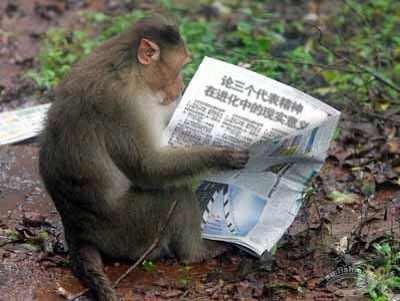
The monkey is reading about the “three represents“, a direct dig at former General Party Secretary Jiang Zemin. And, if weixin memes are to be believed — if not totally, perhaps partially — then current General Party Secretary Xi Jinping is targeting neibu, or inner circle folks.

In fact, online Xi Jinping’s talks are repeatedly characterized as “strict (严厉)”. The adjective, of course, emphasizes the current administration’s explicit task to broaden reforms. In the aftermath of mixed messages, we’re still trying to figure out what that means. A larger political role for civil society and public debate? Or are we simply talking about a new purge? Excerpts of “strict” talking suggest the both/ and muddling of the current political landscape.

Of note? The ongoing use of classical CCP rhetoric to make veiled attacks on opponents. There’s a fight going on, but who’s the actual target? Also of note, The fact that the “Talk on the meeting about development work” took place in September, but the memes are still circulating. I received these memes yesterday.

A picture (for a sense of the Xi Jinping meme aesthetic), three excerpts and translation:

20139619571399354Today some people are using reform like a tiger skin, [frightening] the people so they don’t speak or make judgments. In my opinion, this is using reform for anti-reform purposes.

We’re not not reforming, we’re actually reforming, actually satisfying the people, pursuing a reform that will increase and further reforms. And what has been the status of reform these past years? Handcuffing productive capacities, perverted models of economic development, and serious environmental problems; we’re killing the goose [reform] that lays golden eggs.
The gap between the rich and poor is too wide. This is not only a problem of individual abilities, but also a result of unequal access to opportunity and power. All along we’ve been saying that we want to empower society, that we want to liberate productive capacity, that we want to realize sustainable development and a stable society, but we haven’t done anything because within the Party there are small mafias (的利益集团的黑手) who benefit too much from the current situation. Is a tiger willing to spit out the meat in its mouth? All that can be done is fight the tiger.

There are many such memes and, whatever the actuall status of Xi Jinping’s reform efforts, the memes resonate. What’s more, the memes are online, which means they have tacit support from the Center. Have we truly entered virtual political world of “monkey see, monkey reform”?

the view from here…

On the face of it, this text message jokes about China’s cultural diversity:

To Beijing, the rest of the country is grassroots; to Shanghai, the rest of the country is countryside; to Guangdong, the rest of the country is poor; to Henan the rest of the country is inconsiderate; from Shandong, the rest of the country is unfair; to Jiangsu, the rest of the country is underdeveloped; to Zhejiang, the rest of the country is waiting to be developed; to Shaanxi, the rest of the country has no culture; to Xinjiang, the rest of the country is overcrowded; to Tibet, the rest of the country lacks belief.

1、北京看全国都是基层;2、上海看全国都是乡下;3、广东看全国都是穷人;4、河南看全国都缺心眼;5、山东看全国都不仗义;6、江苏看全国都欠发达;7、浙江看全国都待开发;8、陕西看全国都没文化;9、新疆看全国都太拥挤;10、西 藏看全国都没信仰。

The message, however, also suggests the geography of unequal value that structures migration to and opportunity in Shenzhen, where a migrant’s background (背景) increasingly determines opportunity. What happens, then, when instead of joking about the explicit other (grassroots, countryside, poor…), we make explicit the implied value hierarchy? Arguably, we feel the sting of a punchline:

Power is located in Beijing; sophistication is located in Shanghai; economic opportunity is located in Guangdong; traditional courtesy is located in Henan; a sense of fairness is located in Shandong; fast development is located in Jiangsu; fast development is located in Zhejiang; traditional culture is located in Shaanxi; low density population is located in Xinjiang; and belief (buddhism) is located in Tibet.

Indeed, as a straightforward list of values, the organization of the joke reproduces China’s territorial hierarchy: Beijing, Shanghai, Guangzhou-Shenzhen (“Guangdong”), before turning to neidi (the rest of the country), where traditional values are located. In the context of the Beijing-Shanghai-Guangzhou-Shenzhen rivalry, what catches my attention is the mediating position of sophistication (“Shanghai”) between power and wealth (“Beijing” and “Guangdong”). It’s not enough to be rich, but one must also be sophisticated in order to gain a certain legitimacy. In contrast, naked power still works.

With respect to neidi, the ongoing marginalization of tradition, non-economic values, and religious belief within and against Beijing-Shanghai-Guangzhou-Shenzhen is obvious. Also of note — this marginalization is simultaneously a ruralization and a racialization of the country. We might also see these “lesser” neidi values as weapons of weak, which James C. Scott defined as those tactics available to peasants within and against urban States. The important Chinese supplement to that story is not the insight that strong States produce peasants. But rather that current patterns of modernization and development continuously reproduce “peasants” even when people no longer live agrarian lives.

Thought du jour: In Shenzhen, of course, migrants have different access to power, sophistication, and wealth. Not unexpectedly, relative access to these values determine scope and scale of a migrant’s success. However, the role of “sophistication” as mediating between “power” and “money” means that many of Shenzhen’s second generation (officials and wealthy) are pursuing educations and careers that will (in theory) position them to transcend Shenzhen’s fourth position and bootstrap into China’s higher eschalons.

So yes, the Shenzhen Dream remains remarkably “American”.

as chongqing turns: the trial of bo xilai (abridged)

Bo Xilai. Gu Kailai. Wang Lijun. These are the main characters in China’s ongoing soap opera As Chongqing Turns or “The Bo Drama (薄剧)” as it is known in Mandarin. Bo Xilai, of course is the disgraced former Party Secretary of Chongqing. Gu Kailai is his lawyer possibly crazy wife, who confessed to killing businessman, Niel Heywood and is now in prison after her death sentence was suspended. Wang Lijun was his head of security, who was in charge of Chongqing’s anti-mafia campaign and convicted of all sorts of corruption charges.

The main event trial of Bo ended yesterday. The best part? Bo Xilai was his own lawyer and so interjected throughout the prosecution’s presentation of its case. Below, a translation of the Abridged Bo Trial (审薄精简版) and yes, although fictionalized, the account rings so true. Also, I’ve tried to find online links to the Chinese text, but they seem to have been blocked:

Day 1
Prosecution: Your wife accepted money.
Defendant grunts.
Prosecution: The person who gave the money is known to you.
Defendant: Known but not really close.
Prosecution: Did you give favors to this person?
Defendant: Business is business (公事公办 literally: business done according to business principles).
Prosecution: Did you know your wife and son took people’s money?
Defendant: No.
Prosecution: She never mentioned it?
Defendant: People with taste like ours would get together and talk about money?
Prosecution: Xu Ming, Did you give the Party Secretary’s wife and son money?
Xu Ming: Yes.
Prosecution: Did he know?
Xu Ming: No.
Defendant (interrupts and says to prosecution): What did I tell you?
Prosecution: You mother-fu… Court recess!

Day 2
Prosecution: This is the evidence… (closing testimony of 10,000 characters).
Defendant: Have you closed your arguments?
Prosecution: Yes.
Defendant: Where’s the evidence?
Prosecution: Mother fucker, this isn’t evidence?!
Defendant: This is just testimony. This is what they said. Is there actual proof that I knew about the villa in France? That my son was playing around?
Prosecution: … Legal testimony that has been confirmed and supported!!! This is not enough?
Defendant: Is it? Enough? (Defendant laughs).

Day 3, morning
Prosecution to Wang: Wang, you tell us. Did he incite you to give money to his wife.
Wang: It seems that maybe…yes!
Defendant: Did I ever call my wife while you were there?
Prosecution: Yes.
Defendant: Did I ever try to find out if anyone else knew?
Wang: No.
Defendant: Mother fucker, am I a stupid cunt? Would I really not know who knew I was on the take? Who are you? Are we so intimate that I would call my wife while you were there and tell her to take a bribe?
Prosecution: If you hadn’t told your wife to take the money, how did it end up in her account? You definitely told her to do so! You said so!
Defendant: You think this investor is so poor? That the investor’s wife isn’t talented and rich? That we actually need your 5 million?
Prosecution: You definitely took bribes!
Judge: Prosecution, please remember your role…

Judge: Please continue.
Prosecution: Your wife already testified that you knew. And now you’re denying it!
Defendant: My wife… (sighs) I’ll admit to you all that… well, I stepped out of line once, so you understand that my wife took our son and went to England. what happened after that, how could I know? What’s more, my wife committed murder, if she had economic troubles, of course she’d be up shit creek. So her saying that I incited corruption is a normal response (很正常). We still care about each other and I don’t blame her for any of this…
Prosecution: What the fuck does that mean? Earlier you testified that your wife was mentally unstable. Now this?!
Defendant: I don’t mean anything by it. I’m just speaking the truth for the judge’s consideration.
Judge: (speechless)

Day 3, afternoon
Prosecution: We call General Wang Lijun.
Prosecution: General Wang, what do you have to say?
General Wang: I have so much to say! How could I not? How many years were we sworn buddies? I protected his son when he went abroad. When his wife committed murder, I was the first to tell him. I gave my life and bled for him. Him. Him. Him. And then he actually hit me on behalf of his wife! He slugged me! I bled! I’m broken hearted!
Prosecution: See! Do you see?
Defendant: You’re talking out your ass. Mother fucker, I thought you were a bosom buddy, and if my wife wanted to kill someone, you should have either stopped her or helped her. But you did nothing and let her royally fuck up. And then, you let the investigation go forward, only telling me two weeks later, “I’m a Police Chief and I have to investigate crime, your wife murdered someone. Leader, you must face reality… Sheesh… You tell me, do you deserve a beating or not?!
General Wang: I took responsibility for you!
Defendant: Your character is questionable. You’re two-faced! You directed your subordinates to go after her and then you come to me and pretend to be a loyal official!
General Wang: You! (10,000 characters deleted).
Defendant: I have nothing more to say to you. Judge, I have only one statement, everything he said is bullshit. I hit him and he hates me, so then he muddies the water. You do what you have to.
Judge: Court recessed.

audience passivity in the yan’an talks

As preparations for the Bienalle start, I have found myself thinking again about the level of censorship over literature and art in China. Yesterday, I even went so far as to re-read the Talks at the Yan’an Forum on Literature and Art (在延安文藝座談會上的講話), which Mao began on May 2, 1942. Audience passivity and the ignorance of artists and writers were two key ideological assumptions structuring Mao’s arguments about the social functions of literature and art. Below, I have taken several key phrases in order to show the way in which the Maoist politicization of literature and art was concomitantly a disempowerment of the audience or reader of a work, even as artists and writers became tools — and I use the word deliberately — of the Revolution Party.

Mao opens the talks by greeting his comrades and outlining the social-aesthetic questions he sees facing revolutionaries: the question of standpoint, the question of attitude, and the question of the object of work. Mao’s interpretation of correct standpoint and attitude are unsurprising and straight-forward. The question of correct standpoint for Party members was unambiguously defined as being the Party’s position (對於共產黨員來說,也就是要站在黨的立場,站在黨性和黨的政策的立場). The question of correct attitude was then defined with respect to three types of people — enemies, allies, and one’s own people (有三種人,一種是敵人,一種是統一戰線中的同盟者,一種是自己人). The emphasis on “one’s own people” is important because in everyday Chinese, these are the people that one can count on no matter what. Mao then further defines “one’s own people” as the masses and their vanguard (這第三種人就是人民群眾及其先鋒隊). In short, on Mao’s reading, a correct attitude involved opposing one’s enemy, criticizing one’s allies when they were wrong, and “patiently teaching one’s own people, helping them with their burdens, and to struggle with their mistaken views in order to help them make great progress (我們應該長期地耐心地教育他們,幫助他們擺脫背上的包袱,同自己的缺點錯誤作鬥爭,使他們能夠大踏步地前進).” In turn, “our” literary and artistic works describe these struggles to overcome one’s mistaken views (他們在鬥爭中已經改造或正在改造自己,我們的文藝應該描寫他們的這個改造過程). However, when Mao turns to the long discussion of “the object of work” the discussion becomes interestingly convoluted.

The discussion opens with the line, “the question of the object of work, that is the question of who the literary work will be read/seen by (工作物件問題,就是文藝作品給誰看的問題)”. As I read it, the Mandarin defines the intended audience of revolutionary works as objects (物件) who will be given something to read/see (給誰看). In many translations of the Talks, this line is translated as, “The problem of audience, i.e., the people for whom our works of literature and art are produced”. This translation not only transforms the object of literary and artistic creativity into an “audience”, but also gives the writer and artist productive agency. However, neither of these subjectivities is implied in Mao’s language, a fact which becomes more explicit several lines later.

On the one hand, Mao contends that in Yan’an, the objects of literary and artistic work are the workers, peasants, soldiers, and cadres who are the “receivers of literary and artistic work (文藝作品的接受者)”. He emphasizes that the objects of literary and artist work in Yan’an were “completely different (完全不同)” from those in Nationalist-held Shanghai, where the primary objects were students, officials, and merchants.

On the other hand, he also stresses that “our literary and artistic workers (我們的文藝工作者)” who don’t understand the workers, peasants, soldiers, and cadres have a responsibility to learn about them. One of the more interesting examples of Mao’s designation of the object of literary and artistic work comes in this discussion of literary and artistic workers’ ignorance of the lives of workers, peasants, soldiers, and cadres. Mao states, “Literary and artistic works are not familar with the their descriptive object and product-receivers (文藝工作者同自己的描寫物件和作品接受者不熟,或者簡直生疏得很)”. In this line, we see that for Mao, “workers, peasents, soldiers, and cadres” were simultaneously the object of and receiver of descriptions. In other words, the purpose of literary and artistic work was to help the masses become self-conscious of their class position, without actually teaching them critical reading skills.

The discussion then turns to the question of education for both literary and artistic workers as well as for the masses, with the Party providing correct standpoints and attitudes for this work, which is based on Marxist-Leninism. At this moment, we see the rhetorical transformation of creative workers into tools of the State because standpoint and attitude have already been defined as being in line with the Party position.

Thought du jour: as someone who engages in literary and artistic work, I agree with Mao’s contention that many of our ideals and passions are class-determined. Where I part ways with his analysis, however, is in his characterization of audiences as passive object – receivers of creative work and writers and artists as vehicles for one standpoint and attitude on any question. It’s not only that I enjoy a good dose of whimsy in my art, but also that I have more faith in a variety of standpoints and attitudes than I do in one proscribed, formulaic interpretation there of. Indeed, I find the idea that all creative work must be immediately accessible to all audiences more in keeping with Hollywood goals than with creative exploration.

And there in lies a core paradox in doing creative work in Shenzhen: while I agree with Maoist analysis that we need to take economic inequality and class differences into account if we are to create a more just world, nevertheless, as both a writer and reader, I am nourished by a diversity of perspectives and interpretations.

politicized face masks

protests

On May 4 this year (more here), Kunming residents wore surgical face masks to protest the construction of a p-xylene factory. In response, the government issued a gentle reminder that clinics, pharmacies, and printers should use the “real name system (实名制)” to complete surgical mask sales and immediately report the transaction to the police.

IMG_2788

Gentle Reminder to all pharmacies, clinics and printing shops in Bianbanjie Village, Jitou Township: From this day forward, if anyone comes to you to purchase large quatitities of surgical masks or to print any of the phrases “human health, petrochemical project, Pengzhou [proposed factory location], or PX”, please take down their telephone number and identity card number, and then report the transaction to either the Jitou Precint or neighborhood police station. Thank you for your cooperation. Jitou Precint telephone number: 85369511 and neighborhood police officer cell phone number: 15828585968.  

Paraxylene is an isomer of xylene, one of the most produced petrochemicals in the United States. In the toxic daisy chain of polymers, xylene is a raw material used to produce terephthalic acid, which is used to manufacture polymers, which are used to make products ranging from pantyhose to take-out containers to baking tins. Paraxylene (or PX as it is being called in Chinese) is the most commonly used isomer in the production of terephthalic acid. The major producers of p-xylene tend to locate factories in poorer regions. One of the world’s largest producers, Chevron Phillips, for example, produces p-xylene at their Pascagoula, Mississippi plant. BP owns the world’s largest single factory in Texas City.

P-xylene is highly toxic:

In humans, overexposure to xylene can cause headache, fatigue, dizziness, listlessness, confusion, irritability, gastrointestinal disturbances (nausea and loss of appetite), flushing of the face, and a feeling of increased body heat. Exposure to xylene vapors above recommended exposure limits (100 ppm – TWA) can cause irritation of the eyes, nose and throat as well as tightening of the chest and staggering gait. Severe overexposure to xylene has been reported to cause irregular heartbeat or rapid incoordinate contractions of the heart, tremors, central nervous system depression, and unconsciousness. Lethality has resulted upon exposure to 10,000 ppm. The odor threshold for xylene is reported to be 1 ppm…Aspiration of this product into the lungs can cause chemical pneumonia and can be fatal. Aspiration into the lung can occur while vomiting after ingestion of this product.

Six years ago, protests against a PX plant in Xiamen caused local authorities to cancel plans to build a processing factory. Similar protests took place in Dalian (2011) and Ningbo (2012) also resulted in authorities withdrawing plans to build PC processing plants.

The levels of pollution in many Chinese cities have resulted in many residents wearing face masks. There are also reports of face-kinis to protect skin on the beach. To date, however, the Kunming protests and government response have been the most explicit politicization of face masks.