borders and corridors: one interpretation of the 2010-2020 shenzhen comprehensive plan

At first glance, Shenzhen’s 2010-2020 Comprehensive Plan seems a writhing mass of blue snakes and bright hotspots.
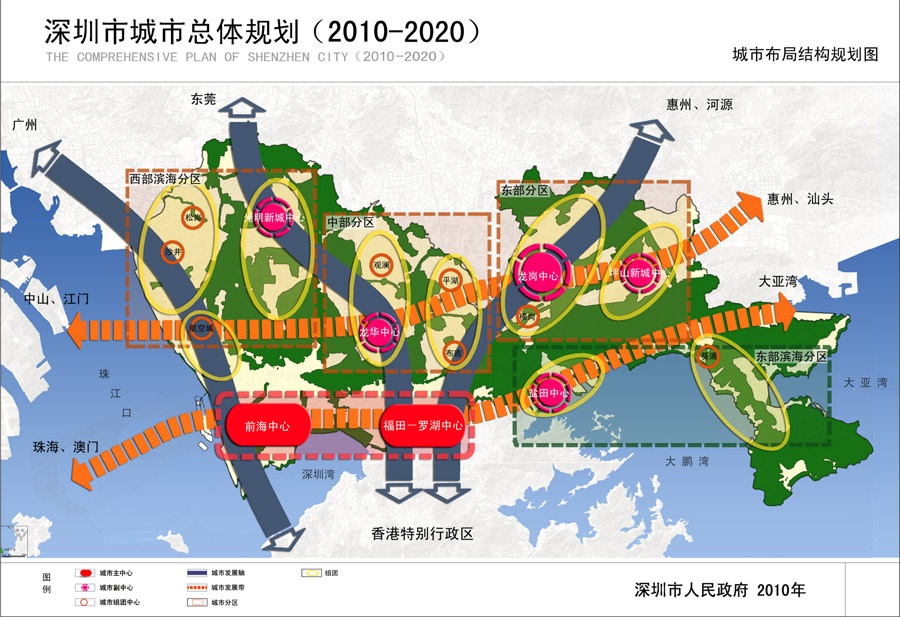
However, by simplifying the Comprehensive Plan in terms of the historical relationship between political boundaries and and early infrastructure in Shenzhen development, I came up with the following grid of borders and corridors, which explains the Plan’s horizontal flows, the connections to Hong Kong, and investment initiatives in New District hubs:

Three borders have enabled urbanization in Shenzhen: the border with Hong Kong, the second line, and the city limits, which abut Dongguan in the northwest and Huizhou in the northeast. Two economic corridors have facilitated Shenzhen’s growth: the Guangshen highway corridor and the Kowloon-Canton Railway. The Guangshen highway corridor parallels the area’s riparian trade routes, which were the means of Han expansion from Guangzhou southwardly on the Pearl River and its tributaries. The KCR, of course, was the British attempt to preempt and redirect the PRD’s extensive trade network.

This grid enters everyday conversation through place name protocols. For example, no one today refers to the “second line”, which evokes the yesteryears of early reform. In contrast, ever since the boundaries of the SEZ have been made coterminous with city limits, we now speak of guannei and guanwai, or “inside the gate” and “outside the gate”, respectively. Interestingly, however, I rarely hear people speak of the guanwai area well east of the railroad as “guanwai”, instead, it is more common to refer to that part of Shenzhen as “the east”.

In fact, the SEZ’s historically most important hubs are all located on this grid. Luohu/ Dongmen is the first stop on the Chinese side of the railroad, while Buji was the first stop on the guanwai side of the second line. Likewise, Shekou was the end of the old riparian trade network, activating Delta resources. Bao’an District government is found just over the guanwai side of the Guangshen highway corridor and Shajing Wanfeng Village, once called “the first village in the south” occupies the area just south of Dongguan on the Guangshen Highway corridor. Given the importance of political territorializations and infrastructure to development, it is unsurprising that the poorest areas in Shenzhen are either in (a) the guanwai area between the railroad and highway corridors (Shiyan and Guangming) or (b) the East. With the exception of Guangming, all of Shenzhen’s other three new districts — Pingshan, Longhua, and Dapeng — are located in the east, far from easy access to the railroad, let alone the Pearl River and riparian access to Guangzhou.

In the new Comprehensive Plan the old hubs appear renamed, but their functions unchanged. The Guangshen corridor has been resutured to the Pearl River through the Qianhai Center. The Luohu/ Dongmen railroad corridor has been interestingly diverted into two streams, one that enters guannei at Huanggang/ Lok Ma Chau and leaves guanwai through Guangming and a second that enters guannei at Luohu and then exits guanwai through Longgang. Meanwhile, Hong Kong has been absorbed/ extended into the Shenzhen administrative apparatus at both the Lok Ma Chau Loop and Qianhai Cooperation Zone, begging the question: will the next Comprehensive adjustment will be political integration of the two cities and the re-establishment of a first or second line at Shenzhen city limits? Indeed, the question doesn’t seem too far-fetched when we recall that for 5 months in 1997, the transition government for the Hong Kong Special Administrative Zone met in Shenzhen.

shenzhen history page

I have just finished a page that organizes 15 posts into 5 chapters which provide an overview of Shenzhen’s history. Chapters include:  a introduction Shenzhen’s “special” status, Urban Planning, Cultural Demographics, and the Shenzhen- Hong Kong border.I conclude with an assortment of conclusions by myself and others on this history.

Shajing Wanfeng Community learns from Wukan

Weibo reports that on the afternoon of April 8, 5-600 Wanfeng (万丰社区) community members/ villagers took to the street to protest Community Secretary and  Wanfeng Ltd CEO, Pan Qiang’en selling off collective lands for private profit. The protests began February 17, when 20-30 elder villagers gathered outside village offices and have continued until today.This afternoon, Epoch Times reported on the event, noting that villagers are calling for an accounting of the past twenty years. Currently, Wanfeng Community has an area of 6.8 sq km and a population of 2,067. Most are surnamed Pan. It is estimated that over 50,000 migrant workers also live in Wanfeng.

Thoughts on Shenzhen’s New New Districts: Longhua and Dapeng

This past week, when the Center brought the country’s 3,300 provincial, municipal, and county members of the Politics and Law Committee (政法委) to Beijing to learn “what to do and how to do it,” they did so to strengthen top-down unity, or the line from the Center (中央) to the “local (地方)”. Party control of the Politics and Law Committee means that it directly controls the writing of laws, their interpretation, and enforcement. As far as we know, Zhou Yong “Noodle Master” Kang remains the Chair of the National Committee. We hypothesize that Hu Jintao was critical to making the decision to convene a Politics and Law Committee meeting and what would be taught there. Ergo, we are waiting to see whose line actual becomes the standard that will be brought back to Local governments, like Shenzhen.

How does this administrative apparatus shape the possibility of progressive social transformation in Shenzhen?

One way to answer the question is to think of all the districting and redistricting and micro-districting and statutory planning that create what the Municipality spins as Shenzhen’s “Industry First” as ways of side-stepping Center intervention and oversight by giving investors in hi-tech manufacturing, logistics, finance, and cultural industry preferential policies without any kind of political reform. Continue reading

connect the dots: kk through caiwuwei to songyuan

Walked a stretch of Old Shenzhen yesterday, winding along shaded boulevards past work unit housing, 90s upgrades, and remnants of Caiwuwei finally arriving at the KK 100. Should you wish to retrace my steps, head north through the Caiwuwei entrance just behind Shenzhen’s latest landmark.

This slideshow requires JavaScript.

The Shenzhen Model, 20 years after Deng Xiaoping’s 1992 Southern Tour

Reading a Shenzhen newspaper requires a sense of the absurd, a sense of the city’s history, and awareness of what’s up in Beijing. The front page of today’s Jing Bao (晶报2012年2月24日), for example, proclaims, “If the Special Zone doesn’t reform, it will soon disappear (特区不改革很快就消失).” The next headline is “In 2025, Shenzhen’s GDP will be the 11th largest in the world (2025年深圳GDP全球第11名)”, asserting that “The Shenzhen Model has Great Significance for the Country (深圳模式对中国意义重大).”

Inquiring minds want to know, well, which is it? Is Shenzhen not reforming fast enough to avoid extinction or is the Shenzhen Model stable enough to become the  world’s 11th largest urban economy over the next 13 years? Continue reading

B; it’s more than a letter, much less than love

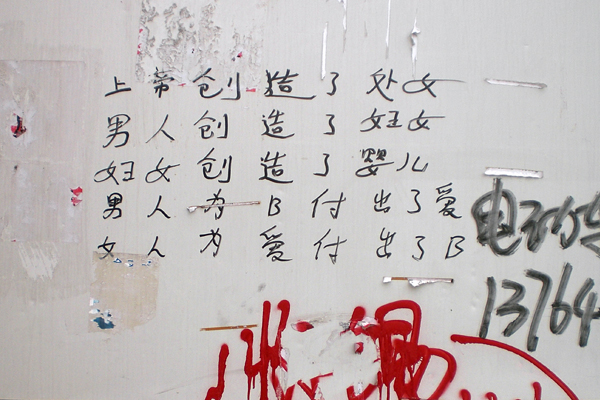
Couplets and rhymes circulate as text messages on Chinese cell phones and as scratched graffiti on walls. Although economic class and levels of education may separate texters from scratchers, nevertheless, the spirit of the message and the understanding of what it means to be human — especially and unfortunately about gender relations — is often the same.

The above poem reads:

God created virgins; men created women; women created babies; men give love to get cunt; women give cunts to give love.

Compare with earlier texts for a sense of how misogyny circulates in Shenzhen.

shekou upgrades continue

Walking Shekou today, I remembered that not only are urban villages subject to Shenzhen’s cultural industry inspired renovations. Older areas of Shenzhen, especially factories and housing estates are also being razed and/or remodeled to conform to different aesthetics and economic plans. Views on the process near Seaworld and the e-cool area, which used to be Sanyo factories (pictures of area, 2008).

This slideshow requires JavaScript.

Coaster Raid Biennale Retrospective

Last night, Gigi and Michael of Riptide Collective hosted the opening for Coaster Raid Shenzhen’s Biennale Retrospective. Witty and fresh the Retrospective will be up for the final week of the Biennale and is well worth a visit. Venue:

市民中心B区南门,多功能厅东侧, 地铁市民中心站B出口

Civic Center – East Hall – Area B South Gate, Subway: Civic Center Exit B

This slideshow requires JavaScript.

The price of a One Country, Two Systems cup of coffee

Today, I went to buy a cup of coffee in a Hong Kong Starbucks. I tried to use a Shekou Starbucks “buy one get one free coupon”, which is valid in any Starbucks throughout Guangdong and Fujian. Nevertheless, the HK Starbucks did not accept my coupon because Shekou is in neidi (the interior). So I asked if Hong Kong was part of Guangdong — after all, the SAR speaks Cantonese and is justifiably proud of its Cantonese cuisine. The barista politely asked for my understanding because with respect to these kind of campaigns, Hong Kong is different from neidi and thus not part of Guangdong. However, when I asked if I could pay for my coffee using Chinese yuan, the answer was not only yes, but also that change would be given in Hong Kong dollars based on a one to one exchange rate. Thus, not only would I loose the exchange rate for the price of the coffee, but would be literally short-changed in the transaction.

Now, those of us who live in the Pearl River Delta are no doubt aware of the One Country, Two Systems policy, which in theory is designed to give Hong Kong, Macau, and Taiwan (at some imagined future date) a certain level of autonomy under a Mainland (Party) government. In practice, however, One Country, Two Systems is and integrated economic system, in which territorial identities create another site of unequal exchange. The most obvious example has been wage differentials between neidi and HK, Macau, and Taiwan. However, as the price of cup of coffee shows, at the level of everyday consumer consumption, these differentials also come into play because every small shop in the Delta has the potential to become a money changer.

In a related update to an earlier post on transferring Chinese yuan into accounts outside the country, a friend told me that the easiest way to get money out of China by way of Macau was to purchase chips in neidi and carry them across the border, play a while, and then exchange remaining chips for Hong Kong dollars.