Here’s the link to CZC–Six Months in Baishizhou, an introduction to Handshake 302 and our projects there. The pamphlet includes a brief cultural history of the relationship between Baishizhou and Overseas Chinese Town.
Tag Archives: shenzhen identity
been there, but not here–dalang
Images from a recent trip to one of the earliest (circa mid 1990s) factory areas in Dalang. I had a déjà vu moment because when I came to Shenzhen, these factories could be found throughout within the second line (guannei) churning out all sorts of goodies for export.
The point of interest? Although still a functioning industrial park, this area is already consciously “historic”. The Dalang New District Government is in process of a “love the cage, change the bird (疼笼换鸟”” redevelopment. The area surrounding the park includes the Dalang Fashion Valley and a piece of land recently purchased by Vanke for another gated community. These comparatively quaint factories will be renovated for cultural production.
So a few before pictures as the transition to after begins.
paper crane tea #4 online!
This edition of Paper Crane, Animal City Rights looks at how abandoned cats and dogs are treated in Shenzhen, including the efforts of SZCat, a community organization that actively promotes animal welfare. In fact, just yesterday, CZCat protested at the Futian hospital because a security guard had abused an abandoned cat. The episode was recorded but the administration ignored it. So SZCat occupied the SARS monument plaza in front of the hospital, generating TV coverage of the plight of abandoned pets and urban feral cats.
paper crane 3 online!
And here’s the link, “Arrival Shenzhen”, episode 3 in the series.

to fill or not to fill…
…that is the question.
The lead article in today’s Shenzhen Evening Daily provocatively asks if the reader is for or against the China Petroleum plan to reclaim 37.9 hectares of Dapeng Bay. To date, Shenzhen has reclaimed 69 sq kilometers of coastline, an area six times larger than the Shekou Peninsula or 6.5% of Shenzhen’s total area. Moreover, of the Municipality’s 254 kilometer long coastline, only 40 kilometers remain undeveloped.
China Petroleum has proposed building a liquid natural gas (LNG) peaking power plant. Also known as peaker plants, and occasionally just “peakers,” these power stations do not run continuously, but rather provide additional energy during peak hours of demand, such as during summer afternoons when air-conditioning use is at its highest. They command a higher price per kilowatt hour than do base load plants, which operate continuously.
There has been a persistent buzz of protest against the proposed plan. The article goes on to say that in Shenzhen news net online survey, over 82% of respondents were against the plan. Moreover, there seems to be government support for the social push back. Last week, for example, a journalist friend said that Dapeng New District Government had no vested interest in the plant, but did have a interest in the coastline. Consequently, the government was using public disapproval as a means of countering China Petroleum, which is a national, state-owned enterprise.
Currently, Shenzhen is handling the stand-off through a hearing. The question facing the board, is whether or not the proposed station conforms to or is in conflict with Shenzhen’s environmental sustainability laws, which include protection for remaining coastline areas. Zhou Wei, a nature photographer and environmental activist has been at the forefront of bringing public awareness to the proposal and its environmental consequences. It is therefor notable that he is not one of the five members of the board that will hear arguments for and against building a Dapeng Peaker.
Of note. Today’s article phrased the question of “to fill or not to fill” in terms of the well-being of the City’s grandchildren:
We don’t know what the future of Dapeng Bay will be, nor do we know how you will view the decisions that we make today. Today we write this letter in the name of Shenzhen, in the hope that every choice we make will not harm our grandchildren.

innovate with china…
…was the slogan of this year’s Shenzhen Maker Faire. I attended on Sunday, and then Monday afternoon joined researchers from the Institute For the Future on a tour of BGI (Beijing Genomics Institute) or “China Great Gene (华大基因)” as the name translates from the Chinese.
What did I see and learn?
That children love playing with gadgets. That most of the “products” were in fact toys. And that the most popular booths had the greatest room for serious play. In other words, the successful objects themselves structured a particular–and somehow “first”–experience. Hence, the wow moments that attracted children and adults alike.
That BGI has concentrated a massive amount of capital and resources in order to further the production of data. Moreover, as the cost of mapping genomes has dropped from $US 3B to around $US 3,000 in a little over twenty years, the data has proliferated to the point where the challenge facing researchers is technologies for storing and analyzing the data. I’m not sure what this volume of data means in terms of life experiences, but it does strike me that our imaginations constantly seek material form. And I learned the expression human augmentation, as if we are not enough.
That the Shekou Relaunch campaign has brought in interesting cultural programs to the area. In addition, these programs have been popular and attracted residents from all over the city to Shekou. So notable that–again–we’re looking at the design of experience. And all this hinges on the promulgation of culture and creativity as both the means and ends of socio-economic development.

shuiwei kunstkammer
The CEO of Shuiwei Holdings Ltd, Zhuang Weicai loves collecting. He has been collecting rocks, calligraphy, traditional paintings, teapots and tea, trees and Han Dynasty tiles and figurines for over twenty-five years. He even has a dinosaur skeleton. The fruit of his passion is housed in the Shuiwei Rock Art Museum, which is not a museum per se, but rather a contemporary cabinet of curiosities that reveals as much about Zhuang Weicai’s eclectic taste as it delights visitors. As a social fact, it also reconfigures how we think of collecting in an era of corporate museums.
Historically speaking, Cabinets of Curiousities (and yes, we are talking about items, rather than the feeling of curiosity) appeared in Rennaissance Europe. Precursors to the modern museum, Cabinets were nevertheless characterized by the tastes, experiences, and unexpected encounters of elites, who expressed and sought knowledge, broadly defined. Simultaneously, these collections also demonstrated the magnificence and power of a given ruler. Thus, for example, Rudolf II, Holy a roman Emperor brought dignitaries and ambassadors to his Kunstkammer in a ritual display of all that he reigned.
Cabinets of Curiousities have been studied by cultural critics and repurposed by artists. There have been extended critiques of Anthropology’s vexed relationship to the impulse to and practices of collecting. After all, many of the world’s leading natural history, ethnographic, and archaeological collections were a direct result of colonial occupation and subsequent looting slash removal of local items and their display as “curiousities” or “artifacts” in Europe and North America.
Here’s what I’m mulling today: what is the significance of Shuiwei’s Rock Art Museum?
Chronologically, the Art Rock Museum appeared well after the Rennaissance transition from individual to public collections. However, it is not a private art collection. It is a natural history collection that celebrates a traditional aesthetic that many educated Chinese have eschewed in favor of science and contemporary art. It is open to visitors throughout the week. And it really is more fun to visit than many of the stuffy museums that show off expertise rather than passion; the collection makes it obvious that Zhuang Weicai really does love rocks.
I haven’t reached a theoretical conclusion. However, I do think the Rock Art Museum does give insight into the different cultural logics that inform urban village style urbanization and official state directed urbanization. So, take an afternoon to visit and the explore Shuiwei itself. The Rock art Museum is located in the heart of Shuiwei, which is itself one of the best eateries in Shenzhen. Impressions of the Shuiwei Kunstkammer, below.
volunteerism and possible civic identities in shenzhen
In the Summer of 2011, Shenzhen hosted the Universiade. At the time, we complained about the face projects and cost there of. In retrospect, it seems, however, that one of the more lasting effects of hosting what is basically an Olympics for college students was that volunteerism and u-stations took root and flourished.
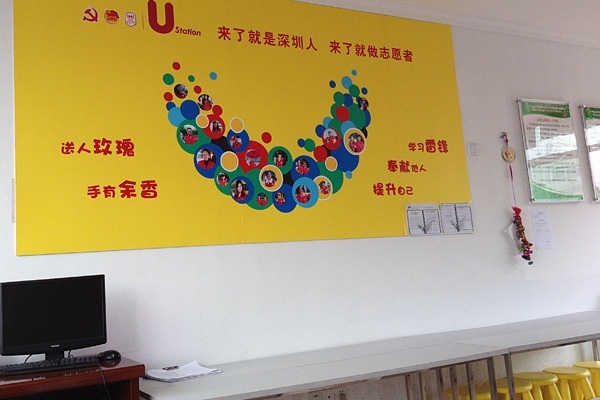
U-stations can be found throughout the city, and are staffed by young friendly and sufficiently bi-lingual folk, who hand out bike maps to the city and introduce nearby attractions. All wear the highly recognizable Shenzhen volunteer vest. In fact, this new emphasis on volunteer citizen participation may also have contributed to an interesting renaming–Shenzhen migrant workers are now officially called “those who have come to build Shenzhen”. The phase reworks the Shenzhen volunteer slogan, “if you come, you are a Shenzhener”. The Chinese wordplay is from 来了就是深圳人 to 来深建设者.
Several days ago, I met with the director of the Baishizhou Culture Center. We spoke in a comfortable, well lit library which was also a u-station! Other programs run by the Center included an after school program, which is staffed by those young and friendly red-vested volunteers. We were in the station to talk about opening a community learning center under the auspices of this collaboration between multiple levels of government. We would be another NGO sponsored by some level of government to work in Baishizhou.
This is where the administrative structure gets interesting. The culture station is housed in the Baishizhou Five Village corporation, which represents locals’ interests and manages Baishizhou properties, electrical, sanitation, and other municipal services. However, the culture station is funded by the street government, which is responsible for implementing district policy. The volunteers are a municiple level NGO.
So here’s the a-ha moment: u-stations and volunteers have permeated even urban village regulatory structures and may have an important role in redefining citizenship and the role of the city in financing not-for-profits.
gentrification with shenzhen characteristics
So hukou remains an ongoing problem. According to Dec 2012 Sanitation Bureau statistics, Shenzhen has a long term resident population of over 10 million and resident (hukou) population of 3.05 million. In order to bring some balance to the demographic, a 2014 regulation has dropped the education requirement from college graduate to associate’s degree. Apparently, they’ve also simplified the process.
The measures come about as both the rates of population growth AND turnover has slowed. It used to be that every Chinese New Year millions left, while after New Year a different batch of more millions returned. Now more and more temporary residents are making Shenzhen their primary home. These new migrants are different from earlier migrants in that they tend to be better educated, and have come to participate in Shenzhen’s new core industries–finance, logistics, culture, and high-tech, as well as the city’s strategic industries–bio-tech, internet, and alternative energy. So they are settling in and raising families without hukou.
In addition, the City’s second generation is starting to participate in Shenzhen society, and many are not actually legal residents. Along with new migrants, they are giving birth to the City’s third generation. In fact, there are so many children in the SEZ, the ongoing Shenzhen baby boom has become something of a marketing niche, despite the fact that young parents must return to their legal residence in order to receive subsidized neonatal care. In fact, Shenzhen has the highest birth rate in the country. The biggest economic beneficiaries of the boom are owners of homes with seats (学位) in the top schools. And real estate websites happily speculate (all puns intended) on the price of those houses over the next decade.
Inquiring minds want to know–what about the illegal floating population? And this is one of the interesting aspects of Shenzhen’s shifting demographic. As factory jobs have been moved elsewhere, we see a corresponding social restructuring–more white collar technocrats, fewer blue collar workers. At the same time, the City seems willing to formally claim these new migrants, even as requirements continue to exclude manual laborers, sanitation workers, and other low-end migrants from transferring their hukou to Shenzhen. Importantly, the social eugenics of this process dovetail with and reinforce the gentrification that the demolition of centrally located urban villages has brought about (Laying Siege to the Villages).
Dongguan is passing similar laws to manage its disproportionately large floating population, and one assumes its highly visible sex industry.
baishizhou: intervention and experience
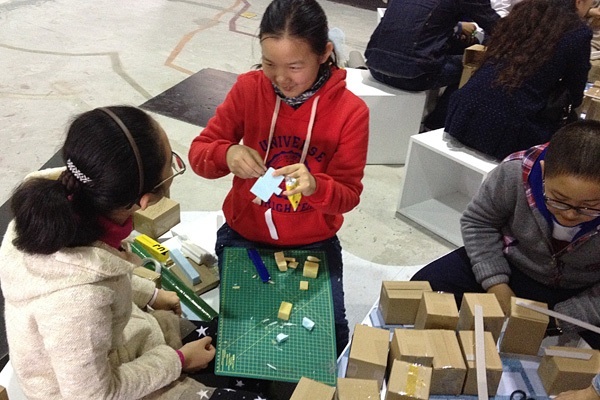
This weekend (Feb 22-23), two events organized for Shenzhen children focused on Baishizhou. On Saturday, ATU/观筑 held a “Young Architects” program in Venue B of the Biennale. On Sunday, CZC Special Forces and Ya Ya Theatre co-produced “Baishizhou Theme Park”, a 20-minute play that was written, directed, and performed by six of Baishizhou’s youngest residents in Venue A.
For the past two years, ATU has run the Young Architects program to teach architectural literacy through experience. They have intervened in the Baishizhou Tangtou row houses, building chairs and also built small spaces to spec, for example, a study room for one person that connects to another, but remains private. Saturday’s program was a urban renewal workshop for Baishizhou. Led by architects, Huang Jingjie and Feng Guochuan, six groups of pre- and teenagers took responsibility for one area. The requirements were, the total building area cannot change and improvements must be affordable so that rents will not increase dramatically. Each group had a professional consultant and 90 minutes to rethink urban renovation.
For over four years, Ya Ya Theatre has developed intimate performances that express unique experiences. Earlier in this year’s Biennale they produced a version of “One Person, One Story” in which members performed autobiographical and biographical monologues about a life-changing event. Lora Wang and Chen Lihua ran the two-month workshop that included exploration of Baishizhou and then developing a series of autobiographical vignettes. Sites visited included a dry swimming fountain, the Jiangnan Department Store plaza, and a video arcade.
So, the during the last official weekend of the Biennale, we had two events that developed the theme of the relationship that Shenzhen children have to Baishizhou, and by extension other urbanized villages. This in itself indicates that interest in the urbanized villages is spreading beyond commercial and academic enclaves. Moreover, we also saw community projects that assume urbanized villages as an important component of Shenzhen as an imagined community. This marks an important shift in the public awareness. Previously, urbanized villages existed outside Shenzhen representations of the city. The villages were (and to a large extent remain) glaringly absent from urban plans. Suddenly, the villages have emerged in public discussions about wither urban development and renewal?
These questions were at the heart of the post performance discussion “Learning from the Urban Villages” with Lora, Feng Guochuan and Zeng Guansheng. Audience members were not only interested in where the working class and young migrants would first settle in Shenzhen, but also in questions about the social value of street life and neighbors. This kind of conversation provided a glimpse into a larger, more general search for Shenzhen identity. This new identity reworks the version of high-speed development and red heroes that has been the previously ignored but not challenged vision of who Shenzheners are and what the city might be.
 Shenzhen Noted