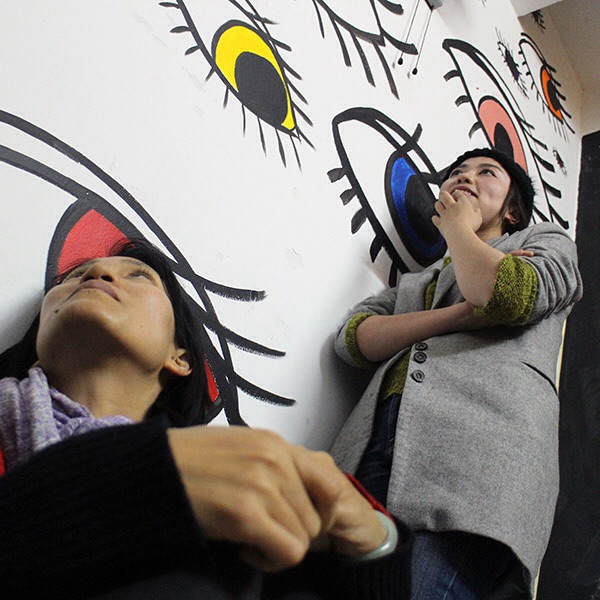
eyes

So yesterday evening at Handshake 302, we held our final independent salon for Zhang Kaiqin’s piece, “eyes”. Six projects now cover the room’s five walls, and so the exhibition “My White Wall Compulsions” is complete. We will be arranging an opening for and viewings of the exhibition over the next few weeks.

Yesterday’s conversation ranged from the meaning of a wall of eyes to the meaning of art, with a few rants along the way. The conversation, however, was respectful and mutually responsive. And this, I think, makes 302 a space of shared happiness. No small accomplishment, our grand ambitions, notwithstanding.

Images from the salon, below:

This slideshow requires JavaScript.

shajing oysters

Today I learned about cultivating oysters. I also visited Shajing, the town that oysters built even though oysters are no longer cultivated here. Instead the oyster babies are sent to Taishan where they are raised and returned to Shajing for processing. It’s almost like assembly manufacturing, except its agricultural production. Continue reading

floating desires

Desire ravages Baishizhou.

Last night at Handshake 302, Fu Honghong discussed her wall, “Floating Desires (漂浮的欲)”, the fifth installation of the series, My White Wall Compulsions (墙迫症). Fu Honghong is one of the few CZC Special Forces who lives in Baishizhou. She came to Shenzhen via a rural childhood and urban university, and now works as a graphic designer in neighboring Overseas Chinese Town. On her wall, Fu Honghong wanted to map Baishizhou in terms of the desires–to find a job, to meet a life partner, to buy a house and leave–that although immaterial, nevertheless are the reason that Baishizhou exists as it does. Continue reading

“evolution” in progress

Lei Sheng and I have worked together with a team of craftsmen from a Shenzhen factory to create “Evolution”, a site specific installation for the Shenzhen Public Sculpture Exhibition. The show opens tomorrow in Shenzhen central park, along side the Futian River. Comments and thoughts tomorrow, along with images of finished sculpture and other installations. To contextualize project, please click houhai, land reclamation and/ or oysters in the tag cloud. Below, pictures of evolutionary progress.

This slideshow requires JavaScript.

cultural economics 101: how do you find reliable workers in shenzhen?

The expression “a friend is a means of getting something done (一个朋友一条路)” is a concise description of the Shenzhen labor market. It is, of course, also a description of “relationship-ology (关系学), the social art of making full use of one’s relatives, friends and acquaintances. Given the importance of relationships to getting things done in China generally and Shenzhen specifically, relationship-ology manifests in some ugly ways. Nepotism is classic relationship-ology as is the art of making friends through wining, dining and bribing. Nevertheless, having friends help get things done isn’t as coldly instrumental as it sounds. Continue reading

观察| 城中村,拆迁还是握手?

A visitor’s thoughts on the Handshake 302 project.

观察| 城中村,拆迁还是握手?.

can renters become stakeholders in shenzhen?

I like meeting and talking with visiting urbanists because the conversation is refreshingly straight forward about constructing society (via environmental interventions). Who are the stake holders, they ask. Where can we find them? What should we ask them? These clear and solid questions help me think more precisely about Shenzhen because identifying stake holders entails (1) acknowledging competing rights to the city and also (2) mapping the fraught and unformed territory of Shenzhen identity; who does have rights to this city of immigrants? And how did might they claim them?

Today, I’m thinking about approaching these questions through the construction and allocation of rental property.  Why do urban village handshakes — despite constituting the demographically significant residence in the city — why don’t they transform migrants into stakeholders? Continue reading

the violence of rural (re)construction (5): lessons from shenzhen

So what am I learning about Shenzhen through my engagement with Meizhou forced evictions and the young people who are trying to figure out how to articulate new relations to their Hakka past and rural injustice? Continue reading

the kids really are all right

Last night I had dinner with Joe, a gen-90 recent college graduate. He and several friends have a start-up that helps businesses expand through the powers of we chat and Tencent’s remarkable level of cross platform integration. Very contemporary marketing firm. In his downtime, Joe organizes summer programs that teach creative thinking, collaboration, and courage of independent thought to other young Shenzheners.

Our conversation and Joe’s passion, like last week’s trip to Beijing reminded me that there are new ideas and start ups perculating throughout Shenzhen. Green Mango is a group of young mothers trying to change the education system. Bean is a Seattle-based group of volunteers who contribute to community projects. ECSSZ is a group of street artists who engage in community beautification projects. Not to mention the young hackers in residence at Baishizhou.

It is all too easy to dismiss these small and idealistic efforts as unrealistic. In fact, Chinese parents like their American counterparts complain that their children are “不现实.” But that’s not point du jour. Today I’m thinking, wow. Just. Wow.

落地: mapping Chinese creativity

So a few brief thoughts about Innovation Week.

First, many young people want to make the world better. They inspire and encourage and constitute hope.

Second, organizers brought in musicians, dancers, and screened documentary films to round out the conversation.

Third, the idea of “smart cities” resonated. Last night at dinner, for example, friends from Dali and Yunnan told the same story–explosive housing and building construction coupled with spiraling rent increases (as much as 30% in Dali and 15% in Beijing) has meant that even the upper middle class is being pushed out of central city districts. And here’s the rub, these new and improved spaces are neither new or improved. So as in Shenzhen and Hong Kong and London, New York, LA and Tokyo, we’re looking at the ongoing construction of stratified cities which exclude young people and working class families from participating and sharing in what our societies consider to be “good”. So we need to build smarter, so to improve the quality of life of every resident. Here, Citymart’s commitment to connecting municipalities and social entrepreneurs inspires.

Fourth, Shenzhen was well represented. Three Shenzhen projects were recognized for creatively engaging a constantly shifting world. In addition to Handshake 302 (current project 白鼠笔记/ Village Hack), which was included in the segment on how art is helping us rethink the social, the Green Tomato In Library (青番茄) and the Vizdan (维吉达尼联合) projects were both recognized. Zhang Lijuan started Green Tomato in order to bring library resources into coffee shops, train stations, and other public spaces. Instead of borrowing a book from a library, members can borrow a book at their nearest coffee shop. Or, they can borrow a book at their point of departure and return it when they reach their destination. Liu Jingwen initiated Vizdan in order to open Chinese markets to Xinjiang communities. Many of these villages and towns are located on part of the Silk Road, reconnecting what socialist plans severed. Both Zhang Lijuan and Liu Jingwen are 30 something Shenzheners whose social innovations exemplify the way young Shenzhen is searching for ways to redefine the economy of special economics.

Finally, in his Keynote speech Ashoka CEO Felix Oldenburg reminded us that we may be entering a world in which change is the issue–the ability to compassionately create, respond to, and understand change may be the most important skill we teach our children.