following deng’s footsteps in shenzhen

Red tourism is a thing in China, especially visiting revolutionary sites — Yan’an’s 400+ sites (which have been ranked); Shanghai’s revolutionary heritage, and; Beijing’s Red Trail. These pilgrimages tend to be excruciatingly pedagogical, but also fun because they usually mean a day off work or school to hang with friends and eat snacks. The ideological point of these tours lies in how before and after experiences structure moral sentiment. The meaning of these tours are more complicated that Mao was there and so was I! Instead, the expected experience includes visceral gratitude: When the elders 前辈 were here, life was hard. I am here, enjoying this (implied easier and better) life because they suffered.

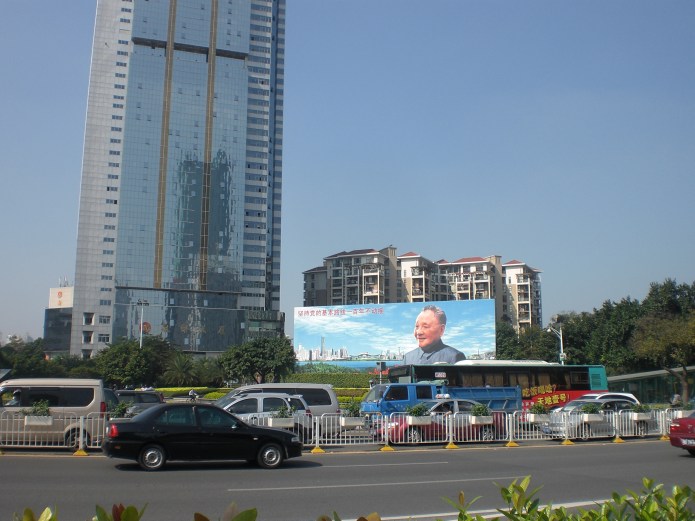
So what does red tourism in Shenzhen look like? It means exploring the sites that Deng Xiaoping visited in 1984 and especially in 1992. And yes, this is more or less the same trek that Xi Jinping made in 2012 during his first tour outside Beijing after becoming General Secretary. Let’s make the trip!

Continue reading

what’s the difference between a typhoon and reform and opening up?

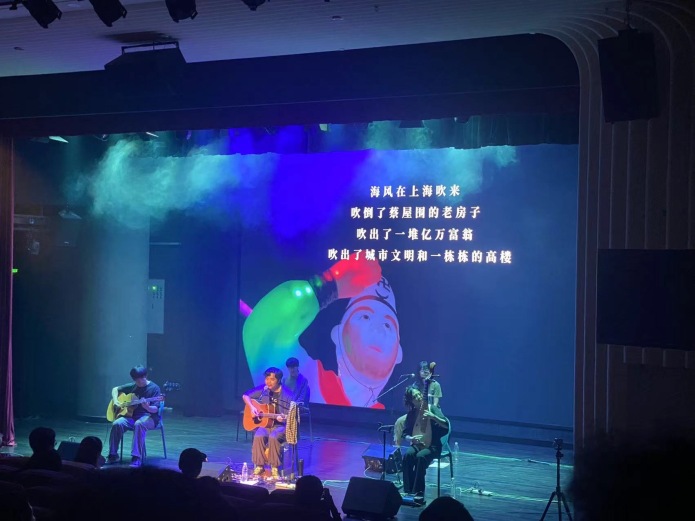
And this is not the opening to a joke, but a loose interpretation of a stanza from a new song celebrating the Shenzhen story. The stanza is:

海风在上海吹来;吹倒了蔡屋围的老房子;吹出了一堆亿万富翁;吹出了城市文明和一栋栋的高楼, which translates as: the sea breeze blew in across the seas; blew down the old houses of Caiwuwei; blew a pile of millionaires into existence; blew urban civilization and rows of high-rises into existence.

Continue reading

mayday, mayday!

Labor Day, May 1, 2022: Shenzhen official media celebrated Xi Jinping thought, while many on social media circulated stories of Deng Xiaoping visiting the city in 1984 and 1992. This interests me because it highlights increasing dissatisfaction with the New Era as a return to the problems that caused and exacerbated by the Cultural Revolution. This logical connection has three elements: First, old Shenzheners associate the laissez-faire governance (reform) and porous borders (opening up) with the city’s ‘true’ identity, implicitly emphasizing the city’s role in repairing the damages of the Cultural Revolution. Second, there have been ongoing efforts to make Shenzhen a symbol of Xi Jinping’s new era, and indeed, the city has become a symbol of zero-Covid success during the ongoing campaign to achieve zero-Covid. Third, to the ears of many who were born before 1970, the New Era emphasis on Xi Jinping as the core of the party and the great leader of the nation echoes the rhetoric of the CR, even as zero-Covid mobilization is increasingly likened to the CR.

So there’s this uncanny resonance between Red Guards and Big Whites that hovers at the edges of social media posts, and sometimes becomes explicit when friends chat over drinks. But, Red Guards were populist, organized on-the-ground in response to specific situations. In contrast, Big Whites are bureaucratic, organized through governmental systems that reach from Beijing into homes via subdistrict police stations, public health stations, and community offices.

Thought du jour: ten years ago, during the Bo Xilai–Xi Jinping struggle to secure the position of general party secretary, the country’s leaders choose between two variants of CR–populist and hereditary. The idea was even though Xi Jinping was clearly a product of the CR, nevertheless, he was seen as a ‘party man,’ so to speak, whose platform was to maintain stability while and by rooting out corruption. (Yes, this is the same kind of choice-no choice just that has characterized recent US American elections.) Today, I’m wondering what if? What if China had gone with a populist CR leader, rather than a leader who seems to have incorporated CR methods into everyday politics?

comrade xiaoping in shenzhen

The architect of Reform and Opening Up, Deng Xiaoping died on February 19, 1997, 25 years ago. It was dank and rainy week. Shenzhen was still very much a manufacturing town, still very much under construction, and that day, very much taken by surprise. After all, commonsense du jour held that Shenzhen’s patron would hold on at least another three and a half months until midnight June 30, when he and troops from the People’s Liberation Army would march from Shenzhen across the Sino-British border into Hong Kong, signaling the formal transfer of the British colony back to China. But he didn’t make it. Instead, Shenzhen along with the rest of the country went into mourning. All Chinese television stations broadcast the 12-episode documentary, Deng Xiaoping, only interrupting archival footage and recorded memories to insert national, provincial and municipal news reports about how China, Guangdong and Shenzhen would continue the hard and necessary work of reforming and opening the county, province and city in his honor.

Continue reading

shenzhen book of changes

I’ve started a new video project, “Shenzhen Book of Changes” with Marco Flagg. Our first episode is up on Facebook.

yumin village: changing meanings of “farmer housing”

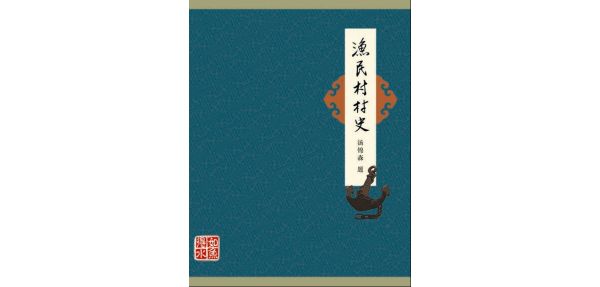
Just recently got my paws on “The History of Yumin Village (渔民村村史)”. Yumin Village, of course, was the village that Deng Xiaoping visited in 1984, during his first inspection trip to the SEZs. Xi Jinping followed up with a visit in 2012. So yes, this village has played an important symbolic role both in the ideological construction of post-Mao society and in representations of  pre-reform Shenzhen Bao’an County. What struck me as I flipped through the pages was how this transformation can be readily represented in the changing typology of “farmer housing (农民房)”. Continue reading

shen kong: flies, ants, termites, and locusts

In January 2014, anti-Mainland sentiment in Hong Kong resulted in protests calling for the “locusts” of Mainland smugglers to leave the territory and for border controls to be tightened against them. The expression “locusts” appeared again in a 2015 description of Mainland students studying at Hong Kong universities and “stealing jobs” from locals. A week ago, there was another burst of anger against “locusts”, this time against the small time parallel traders (“water guests or 水客“) who purchase goods in Hong Kong for resale in Shenzhen and other Mainland areas. In turn, pro-Mainland blogs have argued that “local termites harm Hong Kong more than locusts do (本土白蚁比蝗虫更损香港)”. Continue reading

a new year, a renovated seaworld

January 1, 2014. Shekou is preparing for the 30th anniversary of Deng’s 1984 visit to Shenzhen and Zhuhai, January 24-29. At the time, the tour was also an explicit celebration of Shekou, a different model of reforming and opening the Maoist apparatus. Images below are of renovations as of December 31, 2013. Yes, there is a light show. Yes, the transformers flash and when you ride the stationary bikes they blast a Beyond song that was popular in the mid-1980s. And yes, the Ming Wah is now in the water even as the coastline extends beyond Nuwa. Impressions of the upgrade, below:

This slideshow requires JavaScript.

more from jonathan bach

Open Democracy’s Cities in Conflict project has a posted “Shenzhen: Constructing the City, Reconstructing Subjects” by Jonathan Bach, a scholar who crafts elegant and insightful essays on Shenzhen. Here’s a taste:

Premised on exports and experiment, Shenzhen is a city stretched between high expectations and the unintended consequences of constant expansion. Great expectations lie in its DNA; from Deng Xiaoping’s conviction that the creation of Shenzhen in 1979 would spur China’s reform and opening, to his prodding in 1992 that the city not “act as women with bound feet,” to current leader Xi Jinping’s symbolic choice of Shenzhen for his first official visit in December 2012 to signal his reform agenda. Shenzhen did meet expectations, and then some. As one of our greatest contemporary urban experiments, the staggering growth that made Shenzhen synonymous with the rise of “Made in China” must be regarded as much as the result of massive improvisation as of master planning. And today, what started as a city of exception is a site of an ongoing struggle to define the rule.

Visit Open Democracy not only to read this essay, but also to contextualize what’s happening in Shenzhen with respect to other mega-city projects worldwide.

demise of the shenzhen youth herald

In April this year, Cao Changqing (曹长青 who now operates an influential Chinese language news source) posted “Bo Xilai’s Father Destroyed the Shenzhen Youth Herald (薄熙来父亲灭掉《深圳青年报》)” to commemorate the 25th Anniversary of the closing of the Shenzhen newspaper, where he began his career in journalism. The post was prompted by a conversations with Yan Jiaqi (严家其), who had been the Head of the Politics Department, the Chinese Academy of Social Sciences (中国社科院政治所长) during the 1986-87 student movement and was an advisor to both Hu Yaobang and his successor, Zhao Ziyang. Indeed, Yan Jiaqi himself would flee to Paris after his support of student protests in the 1989 democracy movement.

In the early years of reform, the Shenzhen Youth Herald was, along with Shanghai’s World Economic Herald (世界经济导报), one of the two most independent newspapers in China. Consequently, despite being a small newspaper, the Youth Herald had a national subscription base, providing Chinese intellectuals a platform for debating progressive ideas and evaluating ongoing experiments in reform Chinese society. On October 21, 1986, for example, the newspaper printed Qian Chaoying (钱超英)’s contraversial opinion piece, “I Support Commerade Xiaoping’s Decision to Retire (我赞成小平同志退休)”.

In the manner of traditional intellectuals, Shenzhen University professor of literature, Qian Chaoying’s writing style was sincere and humble, but the content was unmistakably radical. Moreover, the piece drew directly on and from Shenzhen’s experience, asking: Why must the People show our sincere and deep feelings for Deng Xiaoping by sacrificing further reform of the political system (为什么表达人民对小平同志纯朴深挚的普遍感情,就非要以延缓政治体制改革的进程为代价不可呢)? On Qian’s reading, Deng’s retirement would allow China to reflect on and establish a more just political system, a system that was more in keeping with the needs of reform, rather than a return to the cult politics, which had characterized the Cultural Revolution glorification of Mao Zedong.

Yan told Cao that Bo Yibo (薄一波, Bo Xilai’s father and one of the Eight Elders of the CCP) was not only furious about the opinion piece, but had also approached it as an attack the power of older and already retired leaders. During a meeting on political reform, Bo Yibo participated as a consultant. Zhao Ziyang was talking about the opinion piece with Peng Chong (彭冲). Upon overhearing the conversation, Bo Yibo became livid and is reported to have screamed at the younger leaders, “You are already fifty, sixty and seventy years old. We won’t die and you won’t rise (你们也五十六、七岁了吧?我们不死,你们也上不来).” Hu Qili (胡启立) was apparently so frightened that he immediately showed his support for the elders, wishing that the the old leaders of the proletarian revolution would live to a healthy old age (我们希望老一代的无产阶级革命家健康长寿). Importantly, at that closed meeting, Bo Yibo called for the Party to investigate who had written and the newspaper that had published the opinion piece. The word used, zhuicha (追查) meant to find out who Qian Chaoying was speaking for. Bo Yibo assumed that neither Qian Chaoying, nor the Youth Herald was acting as an independent voice, but rather was acting on behalf of one of the young reformers, most likely Hu Yaobang.

The opinion piece was published at a critical time in Central politics. Hu Yaobang and Zhao Ziyang, Deng Xiaoping’s “right and left hands” were pushing for further political liberalization. Less, than two months after the letter was published, students organized public protests across over a dozen cities in support of political and economic liberalization. Astrophysicist, Fang Lizhi (方励之) led the protests, calling for introducing political reforms that would ultimately end the one-Party system and the continuing use of government as an instrument of Party policy. Two other intellectuals, Wang Ruowang (王若望) and Liu Binyan (刘宾雁) also led the intellectuals. It is said that Deng disliked Fang, Wang, and Liu, directing Hu to dismiss them from the Party, but Hu refused. In the fallout, Hu was forced into retirement because it was said he had been too lenient with student protestors. The Shenzhen Youth Herald was also one of the victims of the 1987 crackdown. The Shenzhen Youth Herald was closed and Cao Changqing banned for life from working in journalism at the same time that Hu Yaobang was forced into retirement. Two years later, the Tian’anmen protests would begin when students gathered to eulogize Hu Yaobang. The now defunct World Economic Herald published an article supporting the students’ call to re-evaluate Hu’s legacy.