guagua has vanished, but his older half-brother splashes across the chinese media

At this point in As Chongqing Turns, Guagua has vanished, but intrepid journalists have reported that his famously low key older half-brother, Li Wangzhi (李望知 Brandon Li) is in business with a Japanese chain selling high quality black angus steaks. More to the gossipy point of our story, Li Wangzhi gave his investment company a snarky classical name and his mother, Bo Xilai’s first wife, Li Danyu is throwing operatic slurs!

Flashback: In the rough and tumble years of the Cultural Revolution, the Bo family was out in the political cold with the rest of the 8 elders. Nevertheless, their children were intermarrying, consolidating alliances, and falling in and out of bad romance.

In 1976, Bo Xilai married Li Danyu (李丹宇), the princess daughter of the high-ranking cadre, Li Xuefeng (李雪峰), who in 1960 became the first political commissar of the Beijing Military Region and subsequently took control of the Beijing party organization after the purge of Peng Zhen in 1966. His political star fell when he supported Chen Boda during the 1971 Lushan Conference named him a Lin Biao supporter. In 1976, when his daughter married Bo Xilai, Li Xuefeng still faced another 3 years of  internal exile in Anhui province and would not be rehabilitated until 1982.

Bo Xilai was working as a manual laborer at the Bejing Number 5 Machine Repair Factory when he and Li Danyu married and had a son, Bo Wangzhi. In 1978, the college entrance exam system was re-instated and Bo Xilai was admitted to the Law Department of Beijing University where he met Gu Kailai. Princeling preferences for marrying within red circles being what they were, there were no degrees of separation between the young lovers — Li Danyu’s older brother was married to Gu Kailai’s third older sister, making Bo Xilai and Gu Kailai in-laws by marriage.

Even as Bo Xilai and Gu Kailai’s romance escalated, Li Danyu publicly accused her husband of being Chen Shimei (陈世美), the infamous adulterer from the eponymous Beijing opera. Li Danyu also tried to have Gu Kailai convicted on the “Destroying a Military Marriage” law. Nevertheless, Bo and Gu persevered and were married in 1984, when (it is said), the scorned ex-wife’s father was instrumental in having the couple run out of Beijing to Jin County, Dalian, where Bo Xilai’s political career began a Vice Secretary. Indeed, until 2003 when Li Xuefeng died and his influence over the Beijing political apparatus finally ended, Bo Xilai was unable to find a political position in the capital.

After her divorce from Bo Xilai, Li Danyu had their son change his surname from Bo to Li. Over the years, Li Danyu made sure that everyone knew of Bo and Gu’s lack of virtue, making sure that the story followed Bo wherever he was assigned.

Flash forward: Li Wangzhi grew up, graduated from Beijing University’s School of Law in 1996 and went on for a Master’s in Finance from Columbia in 2001. On returning to Beijing, Li Wangzhi set up a company called Chong’er Investment Consulting Ltd (重耳投资咨询有限公司). Inquiring minds want to know — what’s the story?

During the Spring and Autumn period, Chong’er (重耳) was the given name of Duke Jin Wen, son of Duke Jin Xian. Duke Jin Xian’s concubine, Li Pei had a child, Chong’er’s younger half-brother, Xi Qi. In order to secure Xi Qi’s future, Li Pei hatched a plot to kill Chong’er, who fled for his life. But in a what goes around comes around moment, Li Pei and Xi Qi died in court infighting and Chong’er triumphantly returned to take power.

Today, as Guagua hides and his parents remain hidden, Li Wangzhi moves forward (under the pseudonym Li Xiaobai) with his beef export business, which supplies Japanese steak aficionados with tasty, massaged Snow Dragon black angus steaks at $US 600 a kilo from ranches in — yes, its true — Dalian (雪龙黑牛股份公司).

three class theory: speculating on the scale and possibility of reforming china

A while back I heard a princeling turned Shenzhen nouveau riche (and they do surface every now and again, entrepreneurs in their late 50s and 60s, who came to the SEZ to live well below the national political radar, but nevertheless take advantage of their status to reap economic benefits in the city that launched Reform) half-mockingly challenge a lunch table of intellectuals, saying:

China has three classes — high ranking officials (高干), national intellectuals (高知), and peasants (农民). Officials need help governing and are good to those who help them, but that’s not the important issue. The real question is: do you really want to share power with peasants?

That smug question provoked self-conscious chortles because most at the table were low-level national intellectuals, not peasants, no, but certainly ecclesiastes, who Gramsci defined as the category of intellectuals “who for a long time…held a monopoly of a number of important services: religious ideology, that is the philosophy and science of the age, together with schools, education, morality, justice, charity, good works, etc. The category of ecclesiastes can be considered the category of intellectuals organically bound to the landed aristocracy.”

The a-ha moment in “three class theory” is the emphasis on political, rather than economic power. Take a look at Chinese society and what becomes obvious is that high-ranking officials are, by and large, China’s property-owning class and national intellectuals are, by and large, members of the bourgeoisie. Within each of these classes, of course, exist various opportunities to confirm and strengthen social status, as well as opportunities to transfer and exchange socially valued goods, including money, but also including housing, medical care, and other social benefits. In contrast, peasants are those organically tied to the land, with all that the status has historically entailed: providing quota grain under Maoist collectivism to fund socialist urbanization, and presently being excluded from China’s urban boom except as members of the proletariat. The point, of course, is that in Chinese society economic opportunity is a function of political and social status, rather than the reverse.

The status of peasants and their ties to land are at the center of Shenzhen’s development.On the one hand, as rural areas urbanize, the question of land comes to the fore and in it we see how officials and intellectuals cooperate to expropriate land and justify its expropriation. In this scenario, the class struggle is over the terms of proletarianization and the creation of what are called “peasant workers (农民工)”. On the other hand, to the extent that villages retain control of their land and pursue capitalist projects, we see the stability of the three class system as local systems reproduce this hierarchy, producing “local emperors (土皇帝)”.  In this parallel scenario, the struggle is over the extent to which local emperors and local intellectuals might launch themselves into national politics. Obviously, although both historical trajectories transform individual lives, it is also clear that these changes are not bringing about a more just society, but rather using previous injustices to make and legitimate power grabs and the concomitant distribution of the spoils.

As China enters its fourth decade of reform, Gramsci’s call for intellectuals to theorize and provide alternatives to the present situation still haunts us. The fact that US and Chinese leaders continue to cosy up to one another and that US and Chinese intellectuals find so much in common makes salient the compatibility of US neoliberal ideologies and Chinese ideologies of socialist exceptionalism. However, this ideological compatibility has blinded many of us to a simple truth; the quality of life for Chinese nongmin remains the standard for evaluating the scale, possibility, and social forms of Reform and Opening, not the cross-cultural comfort level of high-ranking officials and national intellectuals, whatever their passport status may be.

Langxin: Impressions of Rural Preservation

I first walked through Langxin in 2006 and returned yesterday to discover that the area had been designated a historic preservation area in 2007. Unfortunately, this time, we were unable to talk our way into the Ancestral Hall, even though we did talk our way into several homes and up to the roof of a three-storey walk up. The higher perspective gives a broad impression of the former lay of village housing. During the Mao-era, the round buildings were used for grain storage. Of documentary note: the Shiyan Precinct Administrative Law Enforcement Building is located in the Together Rich Industrial Park (同富裕工业区), from the “Together Rich Project” that began in early 1997 in a first effort to ameliorate uneven development within Shenzhen. Impressions, below.

This slideshow requires JavaScript.

return of the bivalves

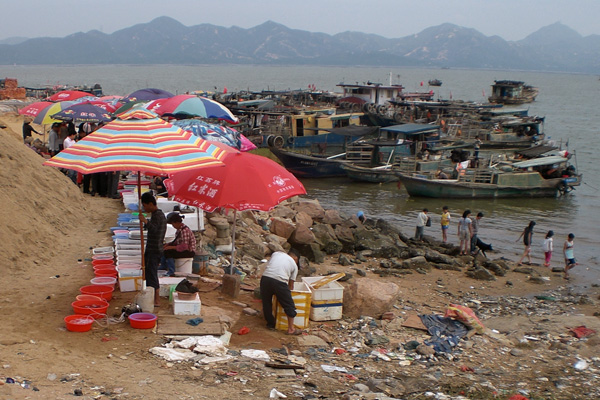
Yesterday, I walked around Dongjiaotou, which in days earlier served as a small port for building materials coming in from Foshan and other Delta cities. Pedestrians jumped the fence to get to the small strip of beach where several families were selling oysters. In 2007, Nanshan District removed all oyster cultivation and processing from the Houhai coastline, especially around the Seaworld area (pictures from 2003 and 2007, here).

This slideshow requires JavaScript.

hakka borderlands: xiawei and shiyan

On Thursday, I joined a group of architects and students from the Future Cities Laboratory on a rainy guanwai trek along Bulong Road, which parallels the second line. This particular trek interests because it hints at generations of ongoing cultural transformation both as industrial manufacturing has spread and as Cantonese and Hakka urban villages have renegotiated collectives identities over the past 150 years.

We departed from Huaqiangbei and crossed at the former Buji Checkpoint, which today has been partially cleared to make room for the Buji subway station (Longgang Line) although cars still lined up to pass through check booths. Directly north of the erxian boundary, Xiawei Village (吓围村) handshakes huddle tightly, giving the impression of an ordinary new South China village. However, the entry gate and main hall of Xiawei’s ancestral hall remain, suggesting that at some point the village had enough collective funds to erect a substantial building. According to an old worker who was organizing collected paper products in the compound plaza, villagers continue to burn incense for ancestors during the Spring Festival.

We then headed west to the precinct headquarters of Shiyan. During the Mao-era, this area also served as the headquarters of Shiyan Commune. Located between the Kowloon-Canton railroad and Guangzhou Shenzhen corridors, Shiyan has remained relatively poor when compared to precinct headquarters at Buji or Shajing, for example. Nevertheless, it has Mao-era flat housing, Reform era factories, and two generations of single-family homes and handshakes. More to today’s point about Hakka borderlands, Shiyan is also interesting because it is located along Baoan County’s traditional border between Cantonese and Hakka cultural regions. Thus, although the Ye Ancestral Hall boasts Hakka exhortations of Confucian morality, the structure itself, like many of the areas older flat buildings are Cantonese style.

Impressions:

This slideshow requires JavaScript.

borders and corridors: one interpretation of the 2010-2020 shenzhen comprehensive plan

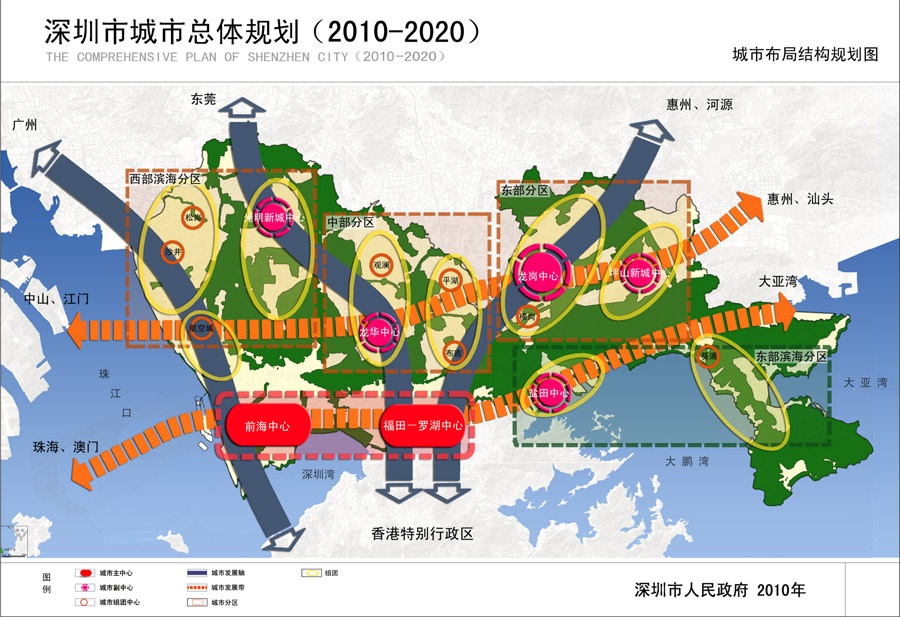
At first glance, Shenzhen’s 2010-2020 Comprehensive Plan seems a writhing mass of blue snakes and bright hotspots.

However, by simplifying the Comprehensive Plan in terms of the historical relationship between political boundaries and and early infrastructure in Shenzhen development, I came up with the following grid of borders and corridors, which explains the Plan’s horizontal flows, the connections to Hong Kong, and investment initiatives in New District hubs:

Three borders have enabled urbanization in Shenzhen: the border with Hong Kong, the second line, and the city limits, which abut Dongguan in the northwest and Huizhou in the northeast. Two economic corridors have facilitated Shenzhen’s growth: the Guangshen highway corridor and the Kowloon-Canton Railway. The Guangshen highway corridor parallels the area’s riparian trade routes, which were the means of Han expansion from Guangzhou southwardly on the Pearl River and its tributaries. The KCR, of course, was the British attempt to preempt and redirect the PRD’s extensive trade network.

This grid enters everyday conversation through place name protocols. For example, no one today refers to the “second line”, which evokes the yesteryears of early reform. In contrast, ever since the boundaries of the SEZ have been made coterminous with city limits, we now speak of guannei and guanwai, or “inside the gate” and “outside the gate”, respectively. Interestingly, however, I rarely hear people speak of the guanwai area well east of the railroad as “guanwai”, instead, it is more common to refer to that part of Shenzhen as “the east”.

In fact, the SEZ’s historically most important hubs are all located on this grid. Luohu/ Dongmen is the first stop on the Chinese side of the railroad, while Buji was the first stop on the guanwai side of the second line. Likewise, Shekou was the end of the old riparian trade network, activating Delta resources. Bao’an District government is found just over the guanwai side of the Guangshen highway corridor and Shajing Wanfeng Village, once called “the first village in the south” occupies the area just south of Dongguan on the Guangshen Highway corridor. Given the importance of political territorializations and infrastructure to development, it is unsurprising that the poorest areas in Shenzhen are either in (a) the guanwai area between the railroad and highway corridors (Shiyan and Guangming) or (b) the East. With the exception of Guangming, all of Shenzhen’s other three new districts — Pingshan, Longhua, and Dapeng — are located in the east, far from easy access to the railroad, let alone the Pearl River and riparian access to Guangzhou.

In the new Comprehensive Plan the old hubs appear renamed, but their functions unchanged. The Guangshen corridor has been resutured to the Pearl River through the Qianhai Center. The Luohu/ Dongmen railroad corridor has been interestingly diverted into two streams, one that enters guannei at Huanggang/ Lok Ma Chau and leaves guanwai through Guangming and a second that enters guannei at Luohu and then exits guanwai through Longgang. Meanwhile, Hong Kong has been absorbed/ extended into the Shenzhen administrative apparatus at both the Lok Ma Chau Loop and Qianhai Cooperation Zone, begging the question: will the next Comprehensive adjustment will be political integration of the two cities and the re-establishment of a first or second line at Shenzhen city limits? Indeed, the question doesn’t seem too far-fetched when we recall that for 5 months in 1997, the transition government for the Hong Kong Special Administrative Zone met in Shenzhen.

shenzhen history page

I have just finished a page that organizes 15 posts into 5 chapters which provide an overview of Shenzhen’s history. Chapters include:  a introduction Shenzhen’s “special” status, Urban Planning, Cultural Demographics, and the Shenzhen- Hong Kong border.I conclude with an assortment of conclusions by myself and others on this history.

even the beggars don’t want hong kong dollars…

Today, an elderly beggar approached me. I reached into my purse and pulled out a two-HK dollar coin. He took the coin in a soft, fingerless hand, and I wondered what had happened. Had he had an accident or had he mutilated himself? He squinted rheumy eyes at the coin in his palm and said, “I can’t spend HK dollars.” I fished a one rmb bill out of my bag and gave it to him. He wished me well, pocketed both the 2 HK dollar piece and the rmb, pivoted on his cane and walked away.

tianmian update

Has been a while since I last visited Tianmian. In the interim, the biggest changes have been to the relentlessly upgrading lay of the land. In the north, renovations to the outer factories have been completed and there are now higher end restaurants and several chains. In the west, the border between New Tianmian Village and the City of Design has been eliminated so that people now pass freely from one section to the other, even though the aesthetics suggest a clear distinction between office workers in Design and New Villagers. To the east, the former red line of the 1980 SEZ at the Shanghai hotel continues to transform itself higher and bigger as Tianmian rents remain higher than service wages in neighborhoods diners, convenience shops, and beauty parlors.

This slideshow requires JavaScript.

goldfish

We have skipped Spring and gone directly to Summer. We eat outdoors and feed the monstrous goldfish. Shimmering, lovely, and oh so greedy — golden, molten, liquid carp. There’s a lesson in there, but you already know.

This slideshow requires JavaScript.