jiaochangwei, or the coastal economy

For those who have been following Shenzhen’s expansion, you have noted the correspondence between the establishment of an administrative category, the announcement of an economic sector, and the full on government led reappropriation of folk investments and small scale development.

The opposition in play is the contradiction between 官方 and 民间 I’ve translated 官方 as government led because the appropriating entity is often government appointed or a state owned enterprise, but there is diversity and even discord therein, as will become apparent below. I’ve translated 民间 as folk because it captures something of the quaint and small and outdated notion of the public that seems to operate during these transitions. Moreover, the public is itself an important sphere of government led action.

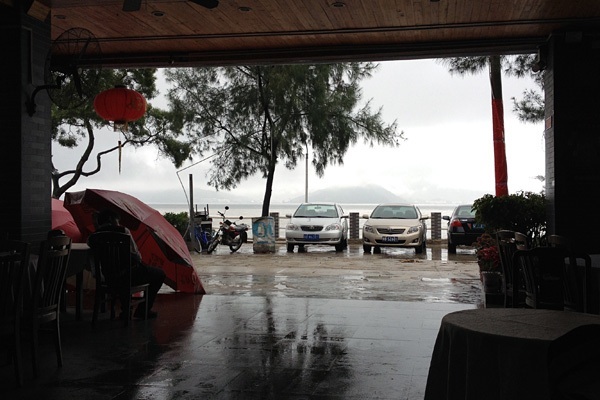
Dapeng constitutes Shenzhen’s one remaining strip of relatively undeveloped coastline. It has been a site of 民间 development. The forms of folk development, for example, have included seafood restaurants in Nan Ao, and the strip of cheap inns at Jiaochangwei (较场尾). Jiaochangwei is a coastal village, as is evident from the mash-up of various generations of what are colloquially known as “farmer housing (农民房). And yes, Jiaochangwei is technically an urban village, with an emphasis on village and nature, rather than urban a la Baishizhou). Previous large scale development has been undertaken by Vanke (万科) which opened Shenzhen’s first yacht clubs far, far from the city. Or so it seemed.

In theory the Dapeng Peninsula is a conservation area, but so was the original Mangrove Park. However, in 2011 the Municipality designated Dapeng a New District (discussed earlier). Since then, there has been all sorts of investment in roads and even a national level geological museum slash park. This has been part of a movement to encourage the development of the coastal economy, including government led real estate development, which (as in Shekou) involves infrastructural transformation and privatization of the coastline.

At the moment most of these areas are only accessible by car, but an express bus, the E 11 gets ordinary folk into the area and a subway line is being built. Impressions of Jiaochangwei, below. And yes, if you decide to go, go during the week. On the weekend, there can be road delays of more than an hour, and lines for restaurants and ubiquitous BBQ joints.
This slideshow requires JavaScript.

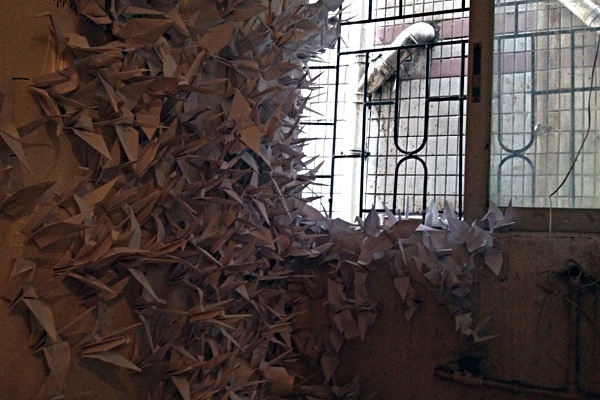
paper crane tea #2 is online

For the curious. “So why do foreigners go to urban villages?” is online. Please check it out and grow the conversation about Baishizhou and why it matters. For all of us.

paper cranes

The inspiration for Paper Crane Tea came from Wan Yan, an architecture student by way of the fine arts. Below, her statement on the current installation at Handshake 302:

We’ve probably all heard about paper cranes; if you fold 1,000 they will take flight and help you realize your aspirations. Children believe this story, but for adults it is. Nothing more than a pipe dream. And that transition–from hope to resignation and simultaneously from ignorance to understanding–is the journey of a human heart.

The repetitive task that is folding 1,000 paper cranes symbolizes an important truth about being human. We are constantly repeating some task to achieve some goal; in order to graduate, we memorize and review coursework; to earn a living, we go to work from 9 to 5; to master a new skill, we practice, practice, practice. Each of these repetitions is like folding 1,000 paper cranes–it embodies the hope and determination necessary to realize a particular goal.

In an urban village handshake building, renters come and go, but the spirit that haunts each cramped rental unit remains–the recurring struggle to realize a dream. Indeed, achieving a a goal by diligently repeating he same activities is like folding one’s life in order to realize the crane of freedom. And there is something exuberantly childlike in that image. However, there is no unambiguous desire. In an era of heterogeneous values, different desires and ambitions will create fierce conflicts and mental confusion. Hope can be simple and even pure, but to realize an ambition requires unavoidable complexity and sufficient flexibility.

The first time I came to Handshake 302, in addition to feeling how cramped and narrow it was, I also thought about the repetitive suffering and struggles that every inhabitant would have to undergo in order to move into a “respectable” home. I also thought about how difficult it would be to find oneself (as the expression has it) in that vexed space between desire and it’s realization. But ultimately, each of us must inhabit that mental crucible where relentless economic and social pressure smelt perseverance, inner voices, and anxiety into “me”.

Handshake 302 is our stage, where members of Urban Village Special Forces perform stories of and about Baishizhou and it’s 140,000 residents. For some people, however, Handshake 302 symbolizes he cage they are trying to escape, or the long ago first stop on thei Shenzhen sojourn. In this space, 1,000 folded paper cranes take on new meanings, not only drawing our attention to what it means to be human, but also reminding us that we strive to achieve our humanity in specific contexts.

And photos of the Paper Cranes Fly installation at Handshake 302.

This slideshow requires JavaScript.

gentrification with shenzhen characteristics

So hukou remains an ongoing problem. According to Dec 2012 Sanitation Bureau statistics, Shenzhen has a long term resident population of over 10 million and resident (hukou) population of 3.05 million. In order to bring some balance to the demographic, a 2014 regulation has dropped the education requirement from college graduate to associate’s degree. Apparently, they’ve also simplified the process.

The measures come about as both the rates of population growth AND turnover has slowed. It used to be that every Chinese New Year millions left, while after New Year a different batch of more millions returned. Now more and more temporary residents are making Shenzhen their primary home. These new migrants are different from earlier migrants in that they tend to be better educated, and have come to participate in Shenzhen’s new core industries–finance, logistics, culture, and high-tech, as well as the city’s strategic industries–bio-tech, internet, and alternative energy. So they are settling in and raising families without hukou.

In addition, the City’s second generation is starting to participate in Shenzhen society, and many are not actually legal residents. Along with new migrants, they are giving birth to the City’s third generation. In fact, there are so many children in the SEZ, the ongoing Shenzhen baby boom has become something of a marketing niche, despite the fact that young parents must return to their legal residence in order to receive subsidized neonatal care. In fact, Shenzhen has the highest birth rate in the country. The biggest economic beneficiaries of the boom are owners of homes with seats (学位) in the top schools. And real estate websites happily speculate (all puns intended) on the price of those houses over the next decade.

Inquiring minds want to know–what about the illegal floating population? And this is one of the interesting aspects of Shenzhen’s shifting demographic. As factory jobs have been moved elsewhere, we see a corresponding social restructuring–more white collar technocrats, fewer blue collar workers. At the same time, the City seems willing to formally claim these new migrants, even as requirements continue to exclude manual laborers, sanitation workers, and other low-end migrants from transferring their hukou to Shenzhen. Importantly, the social eugenics of this process dovetail with and reinforce the gentrification that the demolition of centrally located urban villages has brought about (Laying Siege to the Villages).

Dongguan is passing similar laws to manage its disproportionately large floating population, and one assumes its highly visible sex industry.

fuhua south road

Impressions of a walk along Fuhua South Road. This is one of the oldest areas in the city. Of note, the street is busy and vibrant and runs parallel to Shennan Road, which is wide and long and filled with vehicular traffic, but few pedestrians.

This slideshow requires JavaScript.

baishizhou officially slated for renewal

Yesterday, the Shenzhen Government online portal announced that Baishizhou is on the list of areas designated for urban renewal.

The plan to renew “the five Shahe villages” was submitted by the Shenzhen Baishizhou Investment Company Ltd. It calls for razing 459,000 square meters of built area. The area has been zoned for residential and commerce, with at least 135,857 square meters of public space.

Baishizhou is one of 18 projects announced. All plans take place at the street level, and all target communities and/or early industrial areas. All emphasize the planned public area, but do not mention plans for evicted residents or scheduled construction.

Of note, the urban renewal announcements were tucked away in the Bureau of Land, but the announcement of Shenzhen’s plans for its first village preservation project, Shayu (沙鱼涌古村保护项目) made the front page.

baishizhou: intervention and experience

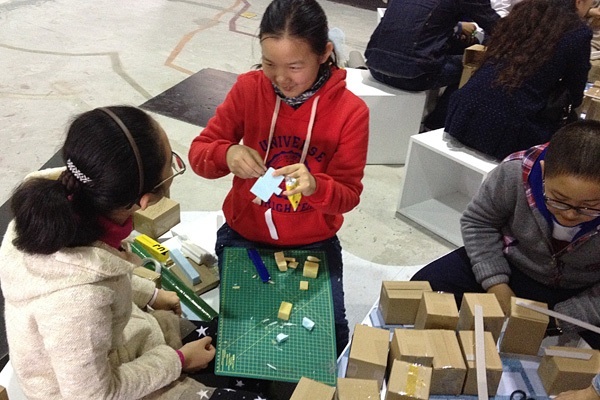
This weekend (Feb 22-23), two events organized for Shenzhen children focused on Baishizhou. On Saturday, ATU/观筑 held a “Young Architects” program in Venue B of the Biennale. On Sunday, CZC Special Forces and Ya Ya Theatre co-produced “Baishizhou Theme Park”, a 20-minute play that was written, directed, and performed by six of Baishizhou’s youngest residents in Venue A.

For the past two years, ATU has run the Young Architects program to teach architectural literacy through experience. They have intervened in the Baishizhou Tangtou row houses, building chairs and also built small spaces to spec, for example, a study room for one person that connects to another, but remains private. Saturday’s program was a urban renewal workshop for Baishizhou. Led by architects, Huang Jingjie and Feng Guochuan, six groups of pre- and teenagers took responsibility for one area. The requirements were, the total building area cannot change and improvements must be affordable so that rents will not increase dramatically. Each group had a professional consultant and 90 minutes to rethink urban renovation.

For over four years, Ya Ya Theatre has developed intimate performances that express unique experiences. Earlier in this year’s Biennale they produced a version of “One Person, One Story” in which members performed autobiographical and biographical monologues about a life-changing event. Lora Wang and Chen Lihua ran the two-month workshop that included exploration of Baishizhou and then developing a series of autobiographical vignettes. Sites visited included a dry swimming fountain, the Jiangnan Department Store plaza, and a video arcade.

So, the during the last official weekend of the Biennale, we had two events that developed the theme of the relationship that Shenzhen children have to Baishizhou, and by extension other urbanized villages. This in itself indicates that interest in the urbanized villages is spreading beyond commercial and academic enclaves. Moreover, we also saw community projects that assume urbanized villages as an important component of Shenzhen as an imagined community. This marks an important shift in the public awareness. Previously, urbanized villages existed outside Shenzhen representations of the city. The villages were (and to a large extent remain) glaringly absent from urban plans. Suddenly, the villages have emerged in public discussions about wither urban development and renewal?

These questions were at the heart of the post performance discussion “Learning from the Urban Villages” with Lora, Feng Guochuan and Zeng Guansheng. Audience members were not only interested in where the working class and young migrants would first settle in Shenzhen, but also in questions about the social value of street life and neighbors. This kind of conversation provided a glimpse into a larger, more general search for Shenzhen identity. This new identity reworks the version of high-speed development and red heroes that has been the previously ignored but not challenged vision of who Shenzheners are and what the city might be.

This slideshow requires JavaScript.

reports from caiwuwei

The research division of Urbanus has sponsored Fu Na and Chris Gee’s research in Caiwuwei these past three years. Just recently, they released three videos that take viewers on walks through what remains of Caiwuwei. Of note: Caiwuwei has been upgraded and polished into an exemplar of the potential of high density living that can be created through appropriations of handshake buildings. So commercial opportunities and low-cost conveniently located housing, with minimal investment in public spaces and amenities. Links:

CAIWUWEI: A WALKING TOUR

对话城中村_Conversations with the Urban Village

蔡屋围24小时 / Caiwuwei 24 Hours

moral grey zones and economic liberalization

Mary Douglass reminded us that dirt was merely matter out-of-place, and correspondingly that the work of cultural categories was to keep human beings in line. Moreover, these lines are not neutral, but like dirt in the kitchen, have all sorts of practical and moral implications for the organization of human life. In turn, border zones comprise sites of categorical breakdown, where border crossing creativity is possible, and also illicit transgressions.

This morning, I stumbled across The Politics of Cross Border Crime, a book that documents prostitution, smuggling, and gambling along and within the borders of Greater China. According to author, Shiu Hing Lo, patterns of regional cross border crime have been changing. During the 1970s and 1980s, the main types of China-Hong Kong, China-Macau, China-Taiwan crime included illegal immigration, cross border robbery, airline highjacking, and drug trafficking. Since the turn of the millennium, however, crime has become more organized, with kidnapping, human trafficking, money laundering, and transborder triads strengthening their control over these activities.

Shenzhen has been trying to shed its frontier town reputation for shady deals and immoral excess. Nevertheless, the city’s internal borders (urbanized villages, older neighborhoods) and restructured borders with Hong Kong and East Asia provide ambiguous sites, where the unsavory might thrive. The most distressing reports of Shenzhen’s role in cross border crime entail forced prostitution of minors and virginal rape. According to Lo:

Cross-border prostitution is a serious problem in Greater China, where supply and demand are both out of control. On the supply side, many children are smuggled by mainland criminals from poor provinces to Shenzhen, where there were 1,000 child prostitutes in June 2006. On the demand side, many unscrupulous Hong Kong men demanded that prostitution dens provide young virgins for them…The main factors contributing to the grave problem of transborder prostitution in Greater China are a lack of strict enforcement for anticorruption campaigns targeted at Guangdong police, especially in Shenzhen’s infamous villages, and the HKSAR government’s failure to cooperate with the mainland government to severely penalize Hong Kong men who solicit mainland prostitutes, especially children.

Lo concludes that:

Unlike the official rhetoric that underscores the mutual benefits of economic integration, the reality is that economic liberalization along the PRC–Hong Kong–Macao boundaries has generated an increase in criminal activity in the region. As economic relations between Taiwan and mainland China have become closer since the presidential election of Ma Ying-jeou in March 2008, cross-border crime between the two places is destined to increase further.

This kind of report distresses me for two reasons. On the one hand, the prostitutionalization of Shenzhen has been an ongoing theme in reports about the city. Indeed, finding prostitutes, establishing their level of willingness, and complaining about their mercenary tendencies have been common metaphors to describe reform and opening and what it has meant for social mores in the SEZ. A similar rhetoric is used within Shenzhen to describe and undermine urban village neighborhoods. On the other hand, as Lo notes, prostitution and human trafficking have increased because Shenzhen and urbanized villages do offer more spaces for unregulated commerce, which may be either an opportunity or a risk for society. In this sense, there is need for increased vigilance to protect children and vulnerable residents from triad members and traveling businessmen who have more in common than we like to think.

Sigh.

traveling impressions/ hong kong international airport

Marc Augé famously suggested that airports are non-places because they are too transient to have an identity. Other non-places include highways, hotel rooms, and waiting rooms. Augé used the idea of the non-place to describe the dislocations and standardizations that characterize super modernity.

Of note, our shopping mall cities, Shenzhen for example, offer few concrete (literally!) objects that have particular and recognizably distinct identities. At the MixC in Luohu and coastal City in Nanshan, for example, we see the same mix of chain stores, domestic and international arranged in a space that is more luxurious than the Rockaway mall of my teenage years, but in essence no different. The comparison, chez Shenzhen is with an imagined countryside and the urbanized villages. In other words, supermodern shopping malls are a place holder in the search for something better, but not interesting in and of themselves.

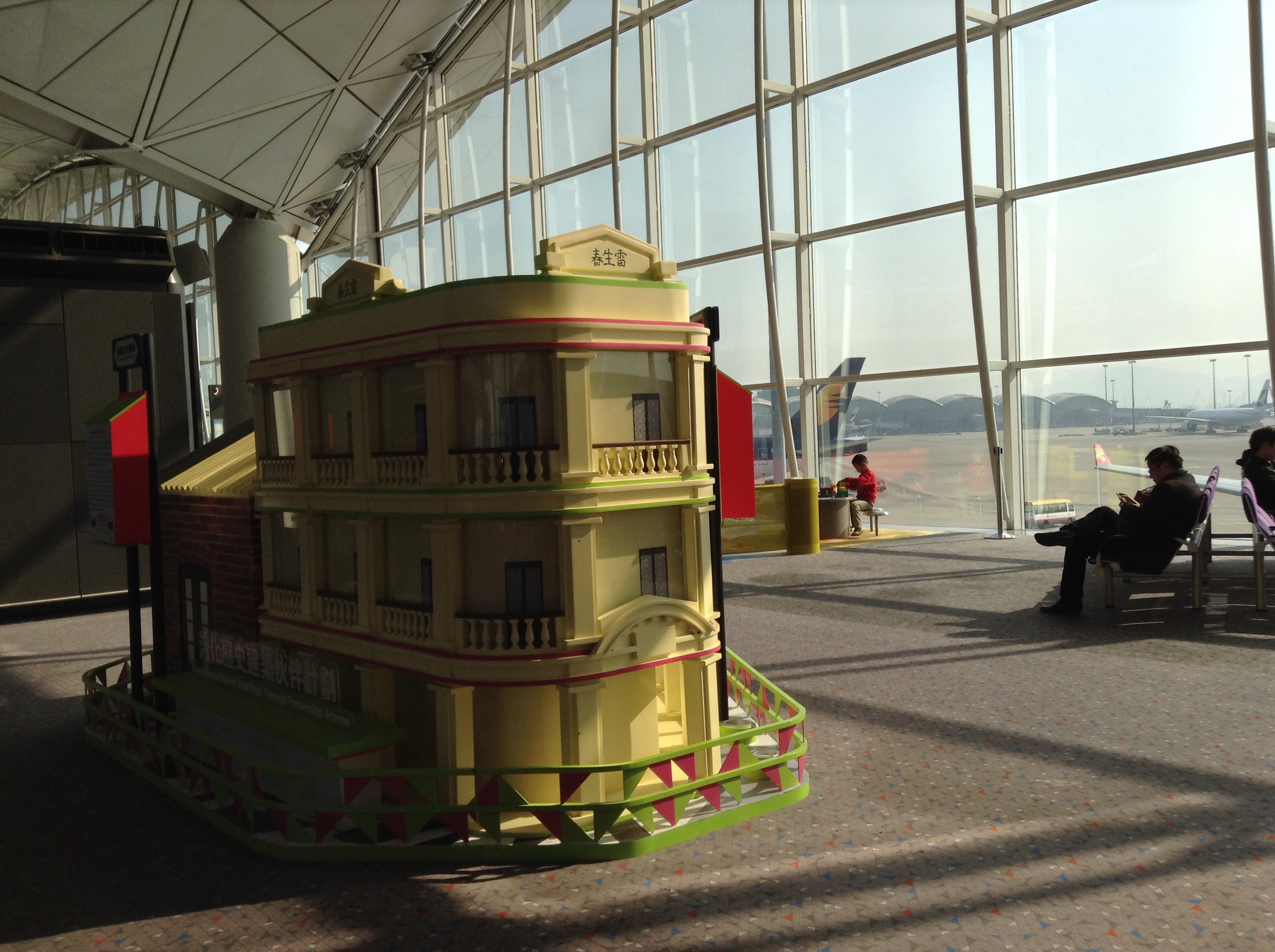
Today, I am in Hong Kong international airport and have noticed a few replicas of preserved buildings. Such is the anonymity of the super modern city that we even become nostalgic for colonial architecture — smaller and distinct from the airport, which dwarfs these toylike memories of a quaint accessible, familiar and endearing city that never was.

image