are there any shenzheners?

The Shenzhen Volunteer Association claims that “If you come, you are a Shenzhener (来了,就是深圳人). The claim itself is fascinating because it not only flies in the face of traditional hometown identities, but also because it implies that those who were already here aren’t Shenzheners.

There are three main labels for people in Shenzhen: 深圳人 (Shenzhener),本地人 (local),and 外地人 (outsider). As a general rule of thumb, Shenzheners are as much a construction of ongoing municipal campaigns to generate identification with the city as they are the rich second generation who grew up here. The point is that in addition to refering to an individual’s hukou status, the label “Shenzhener” also and importantly refers to a recognizable lifestyle and aesthetic that in the US we would call “middle class consumer”.

In contrast, locals and outsiders refer to the hometowns of people who live in Shenzhen. Locals have traditional roots here (through a historic village), while outsiders came from elsewhere to live and work in Shenzhen. Technically, everyone in Shenzhen is either a local or an outsider. However, as indicated above, the category of “Shenzhener” is an ongoing social construction that transvalues local and outsider identities, usually by smoothing out differences in the second generation. Thus, the children of both locals and outsiders frequently identify as Shenzheners, even when their parents have Shenzhen household residency but continue to identify with their hometown.

The distinction between Shenzheners, locals, and outsiders points to the overlap between traditional Chinese hometown identities and the reform policies that created Shenzhen. On the one hand, Chinese people identify with their hometowns, creating identity out shared language, food, and customs, such as Shanghai or Hakka people. On the other hand, Shenzhen identity has been constructed out of the transformation of Bao’an, environmentally, socially, politically, and culturally. Shenzheners are the people who have participated in and/or benefited from that process. In contrast, locals remain identified with their natal villages, while outsiders continue to identify with theirs.

The symbols through which individuals craft Shenzhener identities are vexed by contradiction and uncertainties for three reasons. First, less than 3 million people (or 1/6) of the total population have Shenzhen hukou, which means legally most inhabitants are not Shenzheners. Second, if locals are not considered Shenzheners, it is because identity remains rooted in policy, rather than history. And third, even second generation Shenzhen residents remain emotionally embedded in hometown relationships elsewhere because their were raised by outsider grandparents.

Of course, therein lays the rub. The debate about who is a Shenzhener not only raises the question of who has rights to the city, but also the question of who is willing to be responsible for the city. To date, these questions have not been explicitly addressed, begging the question: is it enough to define a Shenzhener through how an individual has used the city (to achieve political and/or economic goals), or do we need to re-imagine the Shenzhener identity in terms of contributions to society?

rural urbanization, santa rosa, sonoma county

It’s true, I’ve learned to see other landscapes by way of Shenzhen. This morning, for example, I walked settlements in Santa Rosa, a small city in Sonoma County, CA. What did I discover? That the patterns of rural urbanization are everywhere apparent — the abrupt shift in landscape, an underlying yet blurred grid, and holdovers from that earlier time. Indeed, the signs that China and the United States really are the same country continue to beg the question: if it’s all about the money, when is enough, enough? Moreover, as in Shenzhen, ultimately the trees and the quality of their flourishing inform the city’s vitality. Impressions, below:

This slideshow requires JavaScript.

laying siege to the villages: baishizhou

A FIVE-PART ESSAY, “LAYING SIEGE TO THE VILLAGES” HAS BEEN PUBLISHED ONLINE AT OPEN DEMOCRACY. HERE’S PART FIVE, WHICH DISCUSSES INFORMAL URBANIZATION AND THE CREATION OF NEIGHBORHOODS FOR AND BY THE WORKING POOR.

5. Baishizhou: Neighborhoods for the Working Poor

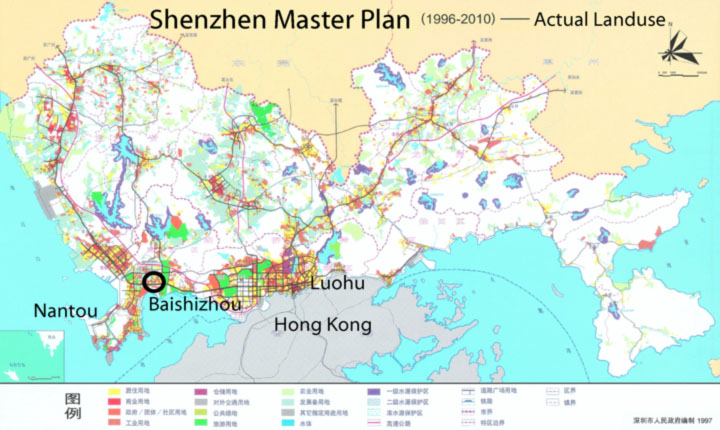
As of 2013, Baishizhou was the largest of the so-called urban villages in Shenzhen’s inner districts. With respect to the overall layout of Shenzhen, Baishizhou occupied both the southern and northern sides of Shennan Middle Road, at peripheries of both Luohu (moving west) and the Nantou Peninsula (moving north), making it one of the most centrally located transit centers in the inner districts (map 8). As of 2013, Baishizhou had a total area of 7.4 km2 and an estimated population of 140,000 residents, of whom roughly 20,000 held Shenzhen hukou and 1,880 were locals. The population density of Baishizhou had breached 18,900 people per square kilometer, more twice that of municipal average of 7,500 people per square kilometer, a statistic which in 2012 had made Shenzhen the fifth most densely populated city on the planet. There were 2,340 low and mid-rise buildings in the area, with an estimated 35,000 units. Monthly rents ranged from 700 to 3,000 rmb, which were significantly cheaper than in neighboring Overseas Chinese Town (OCT) or nearby housing estates, where a “cheap” apartment could rent for 4,000 rmb.

master plan

Map 8: Location of Baishizhou, 1996 Master Plan

Many of the garbage collectors for the area live in the cheapest rentals, rural Mao-era dormitories where it is possible for three workers to share a 30 m2 dorm room for 200 rmb a head, plus electricity and water. Old Cai, for example, was 65 years old, when interviewed. He came to Shenzhen after retirement because his monthly pension is 40 rmb per month, but he and his wife need 20,000 rmb annually, or about 1,700 a month to meet their expenses. In Baishizhou, he makes a living collecting and reselling cardboard boxes and other garbage. He says he can save money this way because although there’s no real profit, he makes enough to support himself and to bring a little home for Chinese New Year. However, the diversity of Baishizhou residents also includes working families who have lived in the area since migrating to Shenzhen over twenty years ago and young professionals who are sharing their first flat independent of their families. One family from Sichuan, for example, rents a 60 m2 two bedroom apartment for 1,700 rmb a month, which the husband, his wife, her mother-in-law, and their two children share. During the day, the parents work at one of the OCT themeparks, while the mother-in-law takes care of the children and housework. In addition, many of Shenzhen’s young designers and architects who work in the OCT Loft, a renovated factory area for creative industry live in higher-end handshake buildings, which sometimes include parking space for a car.

In addition to rental properties, the first floor of most Baishizhou buildings was used for commercial purposes and the area boasted several commercial streets, at least two night markets and entertainment areas, in addition to independent vendors and office space for independent carpenters, builders, and handymen. There was an elementary school and several nursery schools. Moreover, in between two of the abandoned factories of the Shahe Industrial Park enterprising migrants have set up the Baishizhou Pedestrian Street, which mimics the Dongmen Walking Street. There are food stalls and toy vendors, and several juvenile rides.

Clearly, using the term “village” to describe this level of settlement density and diversity is misleading – Baishizhou is a vibrant urban area composed of five neighborhoods – Baishizhou, Shangbaishi, Xiabaishi, Xintang and Tangtou, which under Mao had been organized into a state-owned agricultural collective, Shahe Farm. In the early 1980s, 12.5 km2 area of the Shahe Farm was partitioned into two enterprise areas – Overseas Chinese Town in the eastern section and Shahe Enterprises in the western section. In the mid-1980s, both OCT and Shahe built factories for assembly manufacturing. However, the management teams and access to investment capital were significantly different. OCT was a state-owned enterprise and its management team educated professionals from China’s major cities. In contrast, the former collective leaders managed Shahe and its development. In the post Tian’anmen era when Shenzhen’s low-tech low cost manufacturing had ceased to be as profitable as during the 1980s, OCT developed themeparks – Splendid China, Window of the World, and Happy Valley – to stimulate the economy. In turn, this investment also enhanced the rental value of the area and drove the redevelopment of the former industrial park into a Soho like creative area.

laying siege to the villages: the nantou peninsula

A five-part essay, “Laying Siege to the Villages” has been published online at Open Democracy. Here’s part two on the Nantou Peninsula.

2. Concentric Occupations: Nantou Peninsula

The built environment of Shenzhen urban villages references three historic moments – late Qing and Nationalist-era rural society, Maoist collectivization, and post Mao reforms. Spatially, this history has been expressed as concentric occupations, with the oldest sections being first appropriated and then surrounded by newer developments. In turn, older settlements have been downgraded and converted into low-income neighborhoods. Locally, this process has been called, “cities surround the countryside”, which not only resonates ironically in post Mao China, but also identifies poverty with rural status. Maoist theory and practice had identified cities with all that was foreign and reactionary, and villages with all that was truly national and revolutionary. In contrast, the elevation of Bao’an County to Shenzhen Municipality began the administrative transvaluation of the rural-urban relations, which was formalized in 1982 Chinese Constitution.

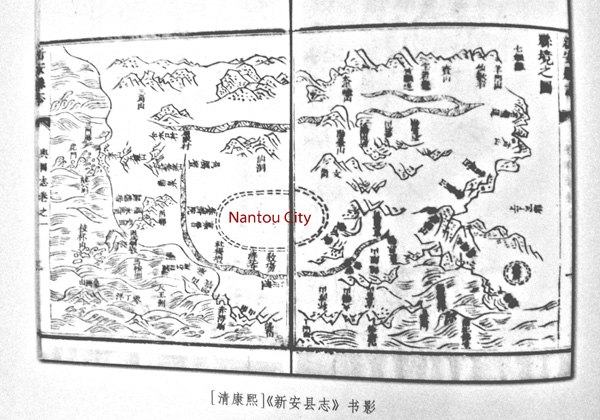
Over 1,000 years ago, salt fields were developed in the Shenzhen-Hong Kong area, and the yamen for the local salt intendant was located on the Nantou Peninsula. The area was also famous for its oyster and pearl production. The peninsula provided protected harbors and access to Guangzhou via the Pearl River. During the Ming dynasty, the Shenzhen-Hong Kong area was called Xin’an County and Nantou City was designated its County Seat. Located on the southeastern banks of the Pearl River, Xin’an was historically poorer than the counties on the eastern banks. Nevertheless, the harbors of the Pearl River’s eastern coastline were significantly deeper than those on the western coastline. Consequently, Chinese maritime access to the South China Sea traditionally went through Humen (in neighboring Dongguan) and Nantou. Indeed, Zheng He’s fleet stopped at the Tianhou Temple in Chiwan Harbor on their voyages of exploration (1405-1433), which took the Ming explorer as far as Africa. After the Ming ban on ocean travel made it possible for pirates to control the South China Sea, Guangzhou remained the southern gate to China and the ports on the eastern coast of the Pearl River became even more coveted by international traders (map 2).

nantou old city

Map 2: Xin’an County Seat in the Reign of the Kangxi Emperor (1661-1722)

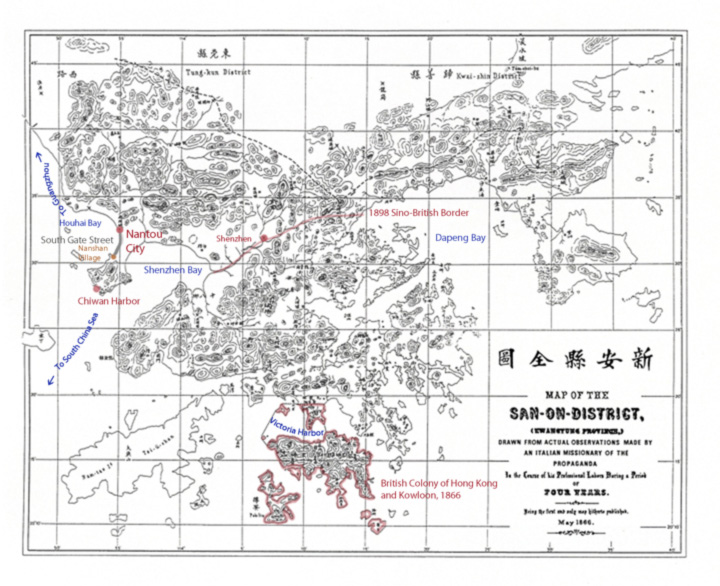
By the late 18th Century, Guangzhou had not only become and important financial center, but also the center of opium trade. The first Opium War ignited when Lin Zexu dumped the opium stocks of British traders in the Pearl River. In turn, the traders successfully pressured the British government to use military means to secure compensation for their losses. China’s defeat in the Opium Wars resulted in British colonialization of southern Xin’an, including Hong Kong Island, the Kowloon Peninsula and the New Territories. The Sino-British border was drawn along the Shenzhen River and passed just south of Shenzhen Market (map 3). The laying of the Kowloon-Canton Railway in 1913 further shifted the flow of goods and people toward Hong Kong and away from Nantou. Small-scale trade between settlements on the Pearl River continued, although Nantou no longer played a dominant role in the regional political-economy. Instead, Shenzhen Market, the first station on the Chinese side of the KCR became the political and economic center of Xin’an County, which was renamed Bao’an at the start of the Nationalist era.

incursions

Map 3: Riparian Trade Routes, Nantou City, and British Incursions

In fact, the establishment of Shenzhen explicitly invoked colonial history, making the return of Hong Kong to Chinese sovereignty one of the key political impulses behind economic liberalization. Maoist modernization of Nantou, for example, included a two-lane road (today known as New South Road), which was laid parallel to the ancient South Gate Road and connected the peninsula villages to the national railroad and highway system. In the post Mao-era, however, state investment has aimed to urbanize the area, rather than to integrate rural settlements into the state apparatus. Land reclamation of Pearl River coastline gives the clearest indication of the scale and ambition of these plans – replacing Hong Kong and possibly even Guangzhou in the global organization of South China trade.

The reform-era transformation of the Nantou Peninsula illustrates the broad contours and social contradictions that have characterized “cities surround the countryside”. During the Ming Dynasty, a pounded earth wall enclosed Nantou, but by the time of the first Opium War, the wall had crumbled into disuse and only the southern and eastern gates still stood. A road stretched from the decrepit Southern Gate and along the coast of the Pearl River to Nanshan Village, which was located at the foot of Nanshan Mountain. Between Nantou Old City and Nanshan Village six villages – Guankou, Yongxia, Tianxia, Xiangnan, Beitou, and Nanyuan – claimed land that included access to the Pearl River, a portion of South Gate Road that they identified as Village Main Street, and farmlands that extended inland. However, through land reclamation and the emplacement of a grid of four- and six-lane roads, such as Qianhai Thoroughfare, Shenzhen’s rural origins have been surrounded and isolated South Gate Street neighborhoods from the larger city (map 4).

 surrounding the countryside

Map 4: Cities Surround the Countryside: The Nantou Peninsula

laying siege to the villages: lessons from shenzhen

An essay written for Open Democracy is now online. Here’s the introduction. Over the next few days, I will put up the sections on Nantou, Luohu-Dongmen, Xixiang, and Baishizhou.

Laying Siege to the Villages: Informal Urbanization in Shenzhen

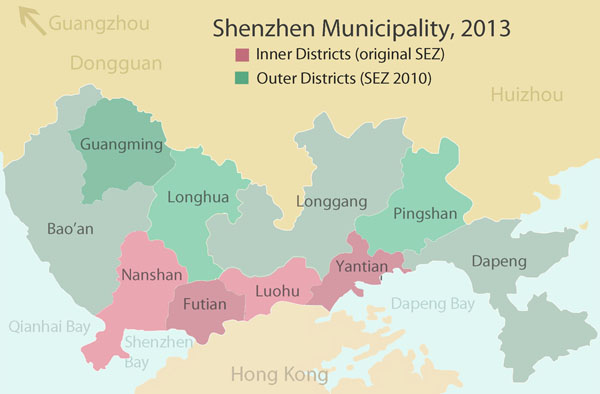
Although Shenzhen is famous for its “urban villages” or “villages in the city” (城中村 chengzhongcun), nevertheless, in 2004 Shenzhen became the first Chinese city without villages. Full stop. This fact bears repeating: legally, there are no villages in Shenzhen. As of 2007, Shenzhen Municipality had a five-tiered bureaucracy consisting of the municipality (市shi), districts (市区shiqu), new districts (新区 xinqu), sub-districts or streets (街道jiedao), and communities (社区shequ). Since 2010, the Districts have been known as the inner districts and outer districts, reflecting when they were incorporated into the Shenzhen Special Economic Zone (SEZ) (Map 1).

 Administrative_Divisions_of_Shenzhen_City

Under Mao, rural areas were China’s revolutionary heart and “villages surrounded the city (农村围绕城市)” was an explicit political, economic, and social strategy for revolutionary change. The Mandarin expression “surrounds (围绕)” can also be translated as “lays siege to”, highlighting the rural basis of the Chinese Revolution. Early Chinese Communists had followed the Russian example and entered cities to organize workers. However, when Nationalist forces led by Generalissimo Chiang Kai-shek violently suppressed Communist organizations in Chinese cities the Communists retreated to the countryside. Moreover, communists and local people identified colonial ports such as Hong Kong with the proliferation of traitors, parasitic merchants, and corrupt officials. Consequently, while Marx claimed that modern history was the urbanization of the countryside, the Chinese revolution aimed to re-occupy and purify the cities. Beginning in 1927 until the occupation of Beijing in 1949, the Communists organized rural resistance to both Japanese invaders and Nationalist hegemony, literally surrounding the cities with an estimated 5 million rural soldiers.

The establishment of Shenzhen signaled the beginning of a new era in Chinese history – “cities surround the villages (城市围绕农村)”, an expression which Shenzhen urban planners and architects have self-consciously used to describe urbanization in the city. Historically, there were legally constituted villages in Shenzhen. The present ambiguity over the status of villages and villagers is a result of contradictions between Maoist economic planning and post-Mao liberalization policies. Under Mao, the country was segregated into rural and urban areas. In rural areas, villages were designated production teams and organized into work brigades that were administered by communes. Communes had to meet agricultural production quotas that financed industrial urbanization and socialist welfare policies in cities, which were tellingly defined as “not-agrarian (非农feinong)”. Importantly, the hukou or household registration policy literally kept people in place – the allocation of food, housing, jobs, and social welfare took place through hukou status. Food and grain coupons were city-specific, for example, and a Shanghai meat coupon could not be legally exchanged in a neighboring city, let alone Beijing. In rural areas, however, communes and production brigades provided neither food coupons nor housing to members. Instead, brigade members produced their own food (usually what was leftover after production quotas had been met) and built their own homes or rural dormitories as they were known in the Maoist system.

In 1979, when the Guangdong Provincial Government elevated Bao’an County to Shenzhen Municipality, the area was rural, and the majority of its 300,000 residents had household registration in one of 21 communes, which were further organized into 207 production brigades. However, hukou status notwithstanding, the integration of brigades and teams had not been complete and members continued to identify with traditional village identities. Although the names of Shenzhen’s current districts were the names of ten of the larger communes, for example, with the exception of Guangming, they were also historically the names of large villages that had been the headquarters for communes. In 1980, the Central government further liberalized economic policy in Shenzhen by establishing the area that bordered Hong Kong as a Special Economic Zone (SEZ). This internal border was known as “the second line”, in contrast to the Sino-British border at Hong Kong or “the first line”. The re-designation legalized industrial manufacturing and foreign investment (primarily from Hong Kong) in the new SEZ. Outside the second line, Shenzhen Municipality established New Bao’an County, which was still legally rural and administered through collective institutions.

The elevation of Bao’an County to Shenzhen Municipality created an anomalous situation within Socialist China because the administrative division of Shenzhen into the SEZ and New Bao’an County only legalized new economic measures; it did not transfer traditional land rights from brigades and teams to the new municipal government. Instead, the first task of urban work units that came to the SEZ was to negotiate the equitable transfer of land rights from the collectives to the urban state apparatus. The goal was to insure that rural workers would continue to have space for housing and enough land to ensure agricultural livelihoods. And this is where historical village identities reasserted themselves. In theory, the urban work units negotiated with brigade and team leaders to transfer the administration of land from the rural to the urban sector of the state apparatus. In turn, the brigades and teams would continue to produce food for the new urban settlements. In practice, however, brigade and team leaders acted on behalf of their natal villages and co-villagers, asserting a pre-revolutionary social identity.

The legal slippage between collective identity within China’s rural state apparatus and collective identity through membership in a traditional village arose because although the Constitution and subsequent Land Law of 1986 stated that rural farmland belonged to the collective, neither document went so far as to define what a collective actually was in law. Indeed, the difference between rural and urban property rights has been the foundation for post-Mao reforms, first in Shenzhen and then throughout the country. In 1982, the amended Constitution formally outlined the different property rights under rural and urban government. According to Article 8 of the Chinese Constitution:

Rural people’s communes, agricultural producers’ co-operatives, and other forms of co- operative economy such as producers’ supply and marketing, credit and consumers co-operatives, belong to the sector of socialist economy under collective ownership by the working people. Working people who are members of rural economic collectives have the right, within the limits prescribed by law, to farm private plots of cropland and hilly land, engage in household sideline production and raise privately owned livestock. The various forms of co-operative economy in the cities and towns, such as those in the handicraft, industrial, building, transport, commercial and service trades, all belong to the sector of socialist economy under collective ownership by the working people. The state protects the lawful rights and interests of the urban and rural economic collectives and encourages, guides and helps the growth of the collective economy.[1]

In contrast, according to Article 10, land in cities is owned by the State:

Land in the rural and suburban areas is owned by collectives except for those portions which belong to the state in accordance with the law; house sites and private plots of cropland and hilly land are also owned by collectives. The state may in the public interest take over land for its use in accordance with the law. No organization or individual may appropriate, buy, sell or lease land, or unlawfully transfer land in other ways. All organizations and individuals who use land must make rational use of the land.[2]

The contradiction between the fact that villages no longer have legal status in Shenzhen and their traditional claims to land rights and social status – both of which are recognized by Shenzhen officials and residents – has constituted a serious political challenge for Shenzhen officials, who have viewed the villages as impediments to “normal (正常)” urbanization. Officials have defined “normal” urbanization with respect to the Shenzhen’s Comprehensive Urban Plan, which has already gone through four editions (1982, 1986, 1996, and 2010). In other words, “normal” urbanization has referred either to formal urbanization or informal urbanization that has secured legal recognition. In contrast, Shenzhen’s urban villages emerged informally as local residents not only built rental properties to house the city’s booming migrant population, but also developed corporate industrial parks, commercial recreational and entertainment centers, and shopping streets. As of January 2013, for example, it was estimated that half of Shenzhen’s 15 million registered inhabitants lived in the villages. Moreover, these densely inhabited settlements also provided the physical infrastructure that has sustained the city’s extensive grey economy, including piecework manufacturing, spas and massage parlors, and cheap consumer goods.

In Shenzhen, urban villages have been the architectural form through which migrants and low-status citizens have claimed rights to the city. Importantly, informal urbanization in the villages has occurred both in dialogue with and in opposition to formally planned urbanization. On the one hand, informal urbanization in Shenzhen urban villages has ameliorated many of the more serious manifestations of urban blight that plague other boomtowns. Unlike Brazilian favelas, for example, Shenzhen urban villages are not located at the edge of the city, but rather distributed throughout the entire city and many urban villages occupy prime real estate. Consequently, Shenzhen’s urban villages have been integrated into the city’s infrastructure grid and receive water, electricity, and also have access to cheap and convenient public transportation. Moreover, as Shenzhen has liberalized its hukou laws, urban villages have also been where migrants have access to social services, including schools and medical clinics. Thus, Shenzhen’s urban villages have provided informal solutions to boomtown conditions. On the other hand, the lack of formal legal status of urban villages and by extension the residents of urban villages has allowed the Municipality to ignore residents’ rights to the city via the convenience of centrally located low-income neighborhoods. In fact, the ambiguous status of urban villages became even more vexed in 2007, when the Shenzhen government initiated a plan to renovate urban villages. It has been widely assumed that the government promulgated the new plan in order to benefit from the real estate value of urban village settlements. Critically, the Municipality’s plans for urban renovation compensated original villagers while ignoring the resettlement needs of migrant residents. Thus, the status of at least half of Shenzhen’s population suddenly entered into public discourse as it has become apparent that although the urban villages resulted from informal practices, nevertheless, they have been the basis for the city’s boom.

Ruralization: The Ideology of Global Inequality

Each of the sections in this essay explores the social antagonisms that have emerged through the transformation of Bao’an County into Shenzhen Municipality via informal urbanization in the villages. The point is that Shenzhen’s so-called urban villages are in fact urban neighborhoods that grew out of previous rural settlements through rapid industrial urbanization. Nevertheless, the designation of “rural” or “village” still clings to these neighborhoods, making them the target of renovation projects and ongoing calls for upgrades. In turn, these calls justify razing neighborhoods and displacing the working poor with upper and upper middle class residential and commercial areas. Recently, Caiwuwei was razed and rebuilt as the KK 100 Mall, while Dachong was razed and as of 2013 a new development under construction. Hubei, the old commercial center in Luohu has been designated as the next major area to be razed, while in late 2012, the Shenzhen Government and Lujing Developers announced their intention to raze and rebuild Baishizhou as a centrally located luxury development.

In Shenzhen, ruralization is primarily an ideological practice through which neighborhoods for the working poor and low-income families have been created by denying the urbanity of these neighborhoods and their residents. In this practice, the city’s rural history is invoked to demonstrate that neighborhoods which grew out of villages are continuations of the village, rather than the results of informal urbanization. Indeed, there are few actual remains of Shenzhen’s rural past. Instead, the target of official rural renovation projects are in fact the informal housing and industrial parks that were built roughly between the mid 1980s through 2004/5, when the municipal government began actively preventing informal construction.

In addition, I have included annotated maps and photographs that illustrate the spatial and social forms of these different contradictions have taken. With respect to recent Chinese history, this level of specificity aims to make salient how Shenzhen enabled national leaders to reform Mao’s rural revolution. With respect to contemporary research on mega-cities, this essay draws attention to the ways in which architectural forms have facilitated neoliberal urbanisms that exclude the poor from desired futures.


[1] Constitution of the People’s Republic of China (adopted on December 4, 1982), accessed at http://english.people.com.cn/constitution/constitution.html on February 26, 2013.

[2] Ibid.

as if it never happened…

So, after a long silence, I return to The Great Transformation (沧海桑田:深圳村庄30年) and the ongoing composition of an official history for Shenzhen’s villages.

This official history begins with poetry. Located on Shenzhen Bay coastline, Shazui Village was established over 900 years ago. Villagers were surnamed Ou and their ancestors immigrated from Pingyang, Shaanxi via Shaoguan in northern Guangdong. At first, Shazui specialized in harvesting sea salt. However, over time the water became sweeter and it was no longer possible to making a living harvesting sea salt. According to Shazui oral history, village ancestors then started fishing and expanded village holdings inland, planting lychee orchards and rice paddies. The village’s history was recorded in poetry and couplets that villagers transmitted orally. For example, a seven-line poem that traced the history of the migration guaranteed hospitality between communities that shared the Ou surname.

金陵被乱始南辕    Chaos during the Jinling era forced the southern migration

唯有祯昌百代传    Only luck has been inherited by a hundred generations

一举汀州二细滘    The first stop was Dingzhou, the second Xijiao

三子石壁四陈村    The third stop was Shibi, the forth Chen Village

自从棉圃而交广    Leaving northern cotton fields, they entered Guangdong

世起堂梁厉宗元    The ancestor re-established the family

支派不拘分欠别    And new branches were established

明溪桥内祖根源    The ancestral well is by the Ming Creek bridge

In 1943, over 40 of Shazui’s less than 400 villagers died during a drought. This history was recorded in the following verse, “Thousands remember, ten thousands remember that in the 33rd year of the Nationalist era, a dollar bought 10 grams of rice (千记万记,记得民国三十三,一元买米三钱二).”

Subsequently, the official history of the transformation from socialist to capitalist collective begins with creative appropriation of the household responsibility system. In 1978, Shazui took advantage of easing policies to introduce a hybrid form of collective production, selling surplus vegetables and fish both in Shenzhen and in Hong Kong. One person from each family could join a voluntary association of 10 people. Each group gave 100,000 rmb to the collective, and then divided the profits amongst association members. Leaders were not permitted to join an association, however, any laborer could join an association. Within five years, many Shazui villagers had become rich and by 1983, Shazui villagers had put up new homes on their 30 m2 Mao-era plats. The villagers then decided to plan Shazui New Village, putting up handshakes as well as collective property, including factories.

Building the factories further transformed village organization, as the village secretly formed a limited stock-holding company. In 1984, Shazui leaders asked each villager to invest 10,000 into the factory zone. At first, villagers refused and leaders hoped to borrow 5 million from a bank. However, at the time, banking restrictions were strict and villages did not have an opportunity to secure finance capital. Instead, village leaders went back to the village with the following proposal: each villager would invest 10,000. Over the next three years, the village could use this capital to grow its industry. Beginning in the 4th year, the village organization and village investors would split profits 40-60. In the eleventh year of operation, the percentage would reverse, with the collective receiving 60% of the profits and villagers sharing 40%. At the end of this second decade, all profits from the collective enterprise would go to the village.

As of 1985, the new village occupied an area of 6.3 km2 and had earned commendations from Shenzhen Party Secretary and Mayor, Liang Xiang. Many villagers secured plats (宅基地) of 300 m2, three times larger than the area that would be formally recognized by the Shenzhen Government in later years. Moreover, the village also had to put in roads that would be wide enough to connect the village factories to cross-border shipping points at Wenjingdu. Indeed, although Shazui was only five kilometers from the Luohu border, until the new roads were laid, it took one hour to travel from Shazui to the Luohu. And this is where the official story ends until it jumps twenty years to a village cleanup and environmental upgrade.

What happened during the twenty years that the official story skips? In the years between 1985 well into the new millennium, Shazui went from being an enterprising village to Shenzhen’s most infamous second wife village. Village investment in planning and construction meant that relative to the surrounding area, Shazui New Village was a cheap, convenient, and comfortable place to live. Investors and visitors took up residence in Shazui and villagers opened restaurants, discos and bars. By the early 1990s, the collective was itself promoting the shift to a sex-based economy building hotels, restaurants, rental properties, and spas. This history cumulated with the infamous public shaming of Shazui prostitutes in 2008.

And there’s the rub: if we are to talk about the transformation of Shenzhen’s villages from poor rural settlements into neighborhoods for the working poor, we aren’t actually talking about what the villagers alone were up to. We’re actually writing the history of global capitalism and its rebranding by ambitious governments. Suddenly, Shenzhen’s villages become the quintessential rags to riches story. Or to quote Mark Ravenhill’s observation in Shopping and Fucking: Making money is barbarous, but having money is civilization.

cancer village map

On May 6, 2009, Deng Fei (邓飞) published the “Cancer Village Map” which documented reports on villages where cancer rates were significantly higher than elsewhere in the country. Three days ago, the Chinese government officially acknowledged the existance of cancer villages.  Not surprisingly, most of the villages are located in in the prosperous areas of the country. Moreover, as in Shenzhen, these villages occuppy a grey area regulated and unregulated space. Below, I have translated the orginal post.

Cancer Village Map

cancer map

Jiangsu Province

Yangqiao Village, Guhe Township, Funing Coungy, Yancheng City (盐城市阜宁县古河镇洋桥村). According to a 2004 report in Jiannan Daily, between 2001-2004 more than 20 villagers died of cancer caused by a nearby pharmeceutical and two chemical factories. At night, villagers slept with a wet cloth covering their mouths and noses. The did not feed ducks near the water, but in the pigsties.

Dongjin Vllage, Yangji Township, Funing County, Yancheng City (盐城市阜宁县杨集镇东进村). According to a 2008 report in China Economic Report, between 2001-2006 over 100 villagers died of cancer because of pollution from a nearby chemical factory. All villegers took liver medicine. The villagers sued the factory, but were only given 70 rmb (a little over $US 10.00 today) per person compensation.

Xingang Village, Longgang Township, Yandu District, Yancheng City (盐城市盐都区龙冈镇新岗村). According to a 2009 China Youth Daily report, over the past 7 or 8 years, there were 57 reported cancer cases. All of those who died from cancer were between the ages of 50 to 60 years old.

Guangfeng Village, Guangyi Zhen, Wuxi City (无锡市广益镇广丰村). According to a 2003 China Consumer Report, the village was surrounded by liquid gas and chemical factories. Between 1999-2003, 24 people or more than one-third of village deaths were cancer related. Toxic gas and powder filled the small alleys and emited a strange oder, which fumigated relatives who visited for Chinese New Year.

Gaoqiao Village, Gaoqiao Township and Tumen Village, Huangxu Township in Dancong District, Zhenjiang City (镇江市丹徒区高桥镇高桥村、黄墟镇土门村). According to a 2004 China Environmental Report, beginning in 1997 the area showed a significant increase in tumors, with 71% of cases located in the relatively prosperous southern areas of Zhenjiang. Cases were attributed to a contamination of the  groundwater system.

Jiangxi Province

Huangxiken Nursery, Wangcheng Township, Xinjian County, Nanchang City (南昌市新建县望城镇璜溪垦殖场). According to a 2004 Jiangnan Metropolitan Daily, runoff from a chemical factory contaminated rice paddies, where the seedlings were covered in black liquid. That year, out of a total of 80 village deaths, close to 20 died of throat and lung cancer.

Guanshanqiao Village, Yanrui Township, Yushan County (玉山县岩瑞镇关山桥村). According to a 2006 People’s Daily report, 6 lime kilns located near the village emited grey powder and smoke that negatively affected over 100 mu of arable land. After a rain, vegetable leaves turned pale grey. That year of 60 village deaths, over ten were due to cancer.

Baiyefang Village, Xinsheng Xiang, Yugan County (余干县新生乡柏叶房村). According to a 2004 People’s Daily (Eastern China Edition), mercury in drinking water was 3 times greater than standard. Over ten years, at least 45 people died of mercury poisoning, while another 20 surffered from related dementia. Baiyefang is the most famous of China’s cancer villages.

Sichuan

Minwang Village, Jiancheng Township, Jianyang City (简阳市简城镇民旺村). According to a 2004 report in Democracy and the Legal System, the N-nitroso compounds of ammonia in drinking water was 30 times higher than allowed by law. The source of contamination were chemical factories that did not process runoff befor discharging into the Tuo River. Historically, Minwang was known as a Longlife village, however recently 5 beople died of cancer.

Tingjiang Village, Shuangsheng Township, Deyang Shenfang City (德阳什邡市双盛镇亭江村). According to a 2008 report in China Economic Daily, the village escaped the ravages of earthquakes but not contamination. As of 2008, fifty or sixty people had died of cancer. The mother of Yang Jia, one of the youth heroes of the Wenchuan Earthquake, committed suiced because of the pain from throat cancer.

Henan Province

21 villages including Huangmengying Village in Zhouying Xiang, Shenqiu County (沈丘县周营乡黄孟营村等21个村庄). According to a 2004 Xi’an Evening Report between 1990 through 2004, over one hundred people died of cancer, almost half of total deaths for the same period. Industrial and residential contamination of the upper reaches of the Shaying River seriously contaminated the groundwater system. Residents of all 21 villages in the area need to buy purified water.

Old North Guanzui Village, Ling County (浚县北老观嘴村). According to a 2002 report in Southern Weekend, since the 1980s, the fast development of paper factories resulted in extensive water contamination and rivers that looked like black ink. In a period of four years, 79 people died of cancer.

Qiancun East Village, Changcun Township, Changheng County (长垣县常村镇前孙东村). According to a 2007 Guangzhou Daily report, serious water contamination resulted in numerous deaths due to cancer over a period of five years. All of the fish and shrimp in the river died off and it became impossible to use river water to irrigate fields. The cause of the contamination was 21CN Science and Technology Company.

Guangdong Province

Five villages including Shangbei Village, Xinjiang Township, Wengyuan County, Shaoguan City (韶关翁源县新江镇(上坝村等5个村庄). According to a 2001 report in Legal Daily, runoff from mineral extraction contaminated the “fish and rice country” of Shangbei and Xiaozhen Villages. Arable land became a deep red color. Villagers report increasing cases of skin and liver cancer, if ducks went into the water they died within four or five hours, although some lived as long as three or four days after exposure.

Hubei Province

Cuiwan Village, Zhuji Township, Nangpan City (襄樊市朱集镇翟湾村). According to a 2006 Yangzte River Commercial Report, within a three year period, over 100 people out of 3,000 villagers died of cancer. Of these, the majority were aged 30-50 years old. Villagers claimed that deaths were due to industrial contamination of their river.

Hebei Province

Guxin Village and at least 6 or 7 other villages in She County(涉县固新村等至少6、7个村庄). According to a 2004 report in Xinmin Evening Report, since the early 1970s, this area of the Shannanpan and Ganhe river systems had higher cancer rates than other parts of the country. Statistics from the 80s, show rates of esophagus and stomach cancer 20 times higher than other parts of the country.

Xinanliu Village and 7 other villages along the banks of the Ci River (磁河两岸诸多村庄西南留村等8个村庄). According to a 2007 report by Law and Life, the eight rivers along the banks of the Ci River, the water system of over 20,000 villagers had been contaminated. Cancer related deaths accounted for almost half the deaths in the area.

Wuzhuang Village, Qianxi County, Tangshan City (唐山市迁西县吴庄村). According to a 2009 report in Science News, over a five year period, 10 members of this village with a population of less than 700 residents had cancer. All ten of the cancer patients lived within a 100 meter radius of a smelting factory.

Anhui Province

Liuzhuang Village, Shitai Township, Sheji District, Huaibei City (淮北市杜集区石台镇刘庄). According to a 2001 People’s Net report, this was a famous cancer village. In 2001, over 66 people died of cancer, and the water was as “yellow as cow piss”, earning it the name “killer water”.

Hunan Province

Quangu Village, Guangjiao Township, Nan County, Yiyang City (益阳市南县厂窖镇全固村). According to a 2008 report on China News Net, water quality in the village was so low that it would ignite when lit. It was a former bomb testing site and for over 10 years grass hadn’t grown in the area. It was suspected that chemical weapons were also tested there.

Jinhu Village, Longhui County (隆回县金湖村). According to a 2006 news report on Changsha Political Television, over a period of 20 years, that 29 members of the 285 member village died of sudden deaths, primarily spleen and lung cancer. Villagers suspect the cause was chemical fertilizers.

Hainan Province

Yinggehai New Village, Ledong Li Nationality Autonomous County (乐东黎族自治县莺歌海新村). According to a 2008 Hannan Daily report, as of 2008 118 villagers had died of cancer, resulting in high levels of concern from the Provincial Public Health Ministry and Center for Disease Control.

Xinqun Village, Wanning City (万宁市新群村). According to a 2008 by Nanhai Economic Report, rates of lung cancer death in Xinqun were 9 times greater than in other developed areas. Village drinking water was already seriously contaminated.

Shaanxi Province

Longling Village, Guapo Township, Hua County (华县瓜坡镇龙岭村). According to an undated report from Beijing Youth Weekly, since 1974, of 58 villager deaths, 29 were due to cancer. Professor Lin Jingxing and other researchers and the Chinese Geological Research Institute confirmed that flour and vegetables from this village were contaminated.

Hezuitou Village, Shangluo City (商洛市贺嘴头村). According to a 2003 Xi’an Evening News report, between 1991 and 2003, 46 villagers died of cancer, and during the highest point, there was one death a month. Before the factories were built in 1991, only one villager died from cancer ever two or three years.

Zhejiang Province

Wuli and Zhushanjie Villages, Nanyang Township, Xiaoshan District (萧山区南阳镇(坞里村、赭山街村). According to a 2004 Daily Business report, 80% of villagers had died from cancer. The 26 chemical factories had an estimated daily discharge of 2,000 tons of liquid waste.

Shandong Province

Xiaojiadian Village, Feicheng City (肥城市肖家店村). According to a 2007 report in the Chongqing Morning Report and a broadcast of the Central Economic Half Hour in 2006, 1/3 of the 90 deaths in this village were due to cancer. The average age was 48 years old, with one cancer death of a 4 year old. Dr. Wang reported these deaths, all cancer deaths were confirmed by County and higher level hospital personnel. Dr. Wang also said that these rates of cancer were definitely related to water contamination.

Inner Mongolia Province

Latehai, Baotou (包头打拉亥). According to a 2006 report from New People Weekly, hospital records show cancer deaths accounted for 70.9% of all deaths. Public documents classified water quality as level five, with particulates, sulphates, hardness, and chlorine all exceeded national standards. Further investigation linked cancer deaths to radiation contamination of water from Baotou steel production. In addition, runoff contaminated fields in neighboring villages which no longer could grow wheat. In a ten year period, 77 people had died of cancer.

Yunnan Province

Hutou Village, Laibin Township, Xuanwei City (宣威市来宾镇虎头村). According to an undated Xinhua Net “Focus Discussion” Column, since the 1970s, 6.5% of the population has lung cancer, which is over 1,000 times that of global average.

Tianjin Independent City

Xidi Village and Liukuaizhuang Village(西堤头镇西堤头村和刘快庄村). According to a 2009 China Quality 10,000 li Walk Report, in a period of five years, over 200 people developed cancer, reducing a “fish and rice” village to a cancer village. According to an investigation, over 100 large and small chemical companies surround the villages, discharging black smoke and water discharge, and toxic odors and loud noises permeate the area.

Chongqing Independent City

Huangqiao Village, Bishan Township, Liangping County (重庆市梁平县碧山镇黄桥村). According to a 2006 report in the Chongqing Daily, it seems that the villagers have been visited by the “Illness Devil”. Between 2003 and 2006, out of 500 villagers, 20 died of cancer, but know one knows what caused the deaths.

Taiwan

Wangtian Village, Dadu, Taichong County (台中县大肚乡王田村). Through 2007, since telecommunication wires were put in five years previously, over 100 villagers died of cancer, and villagers were in a panic. Villagers suspected that electro-magnetic currents had turned their village into a cancer village.

czc entr’acte

The entr’acte between a thriving urban village and its gentrification into mall-burbia occurs as developers scramble to get the last hold outs to sign compensation packages. To ensure that noone moves into buildings that have already been acquired by the developer, windows and doors are often cemented over and 拆 the character for “raze” is painted in bright red stencil.

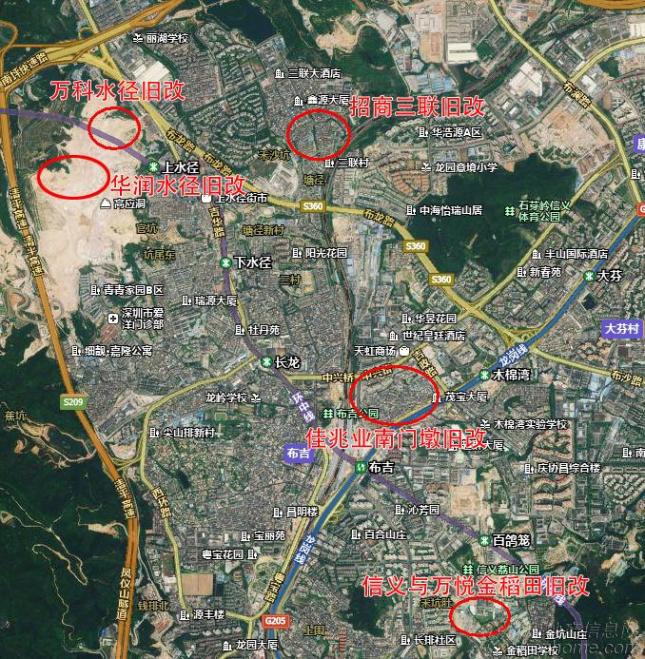
In Nanmendun, Buji (布吉南门墩), for example, the entr’acte has been in progress since May 26, 2011, when the Kaisa Group announced that it had begun the renovation project. According to the announcement, 18,879 people lived in 479 buildings (mostly handshakes, but some early 80’s and Mao era dormitories). Of this population, roughly 10% were Nanmendun residents and entitled to relocation and compensation. Roughly two years later, the process of getting holdouts to sign and stragglers to move on is still in progress.

This slideshow requires JavaScript.

Nanmendun is one of five renovation projects in Buji and the usual suspects — Vanke, China Merchants, Huarun, and Xinyi are also busy gentrifying the area. What the map below makes clear, however, is how extensive rural urbanization has been in Buji. Indeed, it is hard to speak of an “urban village” when handshake buildings and unregulated development have been the dominant form of urbanization for over thirty years.

Lay of the land:

4 renovationsin buji

shenzhen publications

In the hope that they may be useful, I am uploading five academic papers from the dark ages of Shenzhen studies. Be aware: much has changed, although much has not. In chronological order:

1999: Path Breaking(on how gendered nationalism facilitated the construction of SZ)
2001: Becoming Hong Kong (on how Shenzhen emerged through globalizing urbanization)
2006: Cultural Supplement (on political power as a cultural value in contemporary SZ)
2006: Fox Talk (on the emergence of neo-liberal urban identities in SZ)
2008: Vexed Foundations (on cultural continuity in SZ urban villages)

gaoling: shenzhen’s eastern periphery

Episode 13 of The Great Transformation, takes us to Gaoling Village (高岭村), which is located on Qiniang Mountain at Shenzhen’s eastern most edge on the Dapeng Peninsula.

The story of Overseas Chinese Chen Jiageng (陈嘉庚) opens the episode, connecting the history of Shenzhen’s eastern periphery to early modern Chinese nationalism. An ethnic Hakka, Chen Jiageng raised funds among to construct the Jimei School in his hometown Jimei Xiamen. For his nationalist efforts, Mao Zedong referred to Chen Jiageng as being “the banner of Overseas Chinese, the glory of the race (华侨旗帜,民族光辉)”.

Settled over 400 years ago by Hakka migrants, the layout of Gaoling reflected the founders need for safety and arable land. The village houses were located deep in the mountains, while village fields were located at the foot of the mountain. Every morning, villagers went down the mountain to work their fields and every evening, they returned to the relative safety of their homes.

The architecture of Gaoling reflected the agonistic relations between Hakka and local (本地 boon day [H], bendi [M], pundi [C]) peoples during the 19th Century. In fact, between 1855 and 1867, relations disintegrated into open conflict during the Punti-Hakka Clan Wars. During the early 20th Century, the village housed anti-Japanese troops, who were led by Hong Kong born Liu Peidai.

As in Xiamen, Gaoling villagers who lived overseas donated funds to build a school in their hometown. Over the course of the village’s history, Gaoling villagers immigrated to Singapore, Holland, the United States, and Canada, and many more lived in Hong Kong. Importantly, the Overseas Chinese funded improvements to their hometown, including modernizing the water system. The Euro-Chinese style of the school architecturally reflected these migrations and returns.