Wormhole

The Shenzhen University Department of Acting premieres Wormhole this Thursday, June 24, 2010 at the Shenzhen University New Black Box Theater.

Wormhole takes the audience on a speculative journey through the universe, where travellers encounter wormhole bugs (the Mandarin for wormhole is “bughole”), birds from a parallel universe, and a quantuum needle. The performance launches from the idea that knowing is itself co-evolutionary with the universe, so that how we know is the means for wonderfully, hopefully, and endlessly remaking the world. 

Wormhole was directed by Kuo Jing Hong, a long time Fat Bird collaborator.

Dates: June 24, 25, 26  and 28, 29

Time: 19:30

Place: Shenzhen University New Black Box Theatre

Directions:

Enter the Shenzhen University Main Gate; turn left and drive 30 yards; turn left onto the Teaching College driveway; facing the building make a left and go downstairs.

The theater is on sub-floor one in building B.

a character is a universe

today, i met chang hongcai, a calligrapher. teacher chang’s studio is located in liuxiandong (留仙㓊),an artist colony of sorts. the liuxian village head has rented out (at cheap cheap prices) an entire six story factory to a group of artists, who use the building as studio space. importantly, these artists are not struggling emergents, but established artists whose work is shown throughout china and the world. teacher chang, for example, is a highly respected calligrapher whose work hangs in some of china’s top museums.

we talked about many things – tea, the book of changes, and taichi – but all topics departed from and returned to calligraphy as the essential philosophy of china. according to teacher chang, how one holds the brush, each brush stroke, the actual meaning of the character, all this together forms a universe. he used the character “one (一)” to develop his point:

to write a proper yi one holds the brush with the entire body, arms loosely held as in taiji, one’s qi flowing. the brush stroke itself (and it is one fluid motion) actually follows the contours of the symbol for yinyang, stretching beyond the limits of a line and returning into infinity as the brush circles, pauses, and then quickly flicks back into itself. according to teacher change, the process of writing is itself chinese philosophy; calligraphy cannot be rushed, but must be cultivated, like breathing.

teacher chang also spoke of 势 (shi) or immanent tendency of a stroke. his explanation of 永字八法 (the 8 methods in the character yong) focused on how each stroke was in fact in motion. a heng, for example, was pulled like a bow and a gou was kicked back, strongly and decisively. a stroke that just ended because the brush was lifted, was a stroke that had been cut off, was empty. fullness came from the motion of the stroke, which had its own rhythm and spirit. in fact, when teacher chang helped me see a character, he emphasized the moving brush such that it seems possible to understand shi as traces of the calligrapher’s spirit; her body, her hand, her knowledge, her state of mind, her understanding of the world – all this comes together in the stretch and flick of ink on paper.

practicing calligraphy helps us center the mind and cultivate a good attitude because the idea that “a character is a universe” reminds us that we constantly (re)create the world. indeed, that is all we ever do.

the sea of desire is never filled


seedlings

Originally uploaded by maryannodonnell

On Sun, Mar 7, inheritance-shenzhen will offer a program of artist talks given by women artists working in the PRD. We hope to generate dialogue between and about different generations of artistic work. Please come!

Artists:

Phoebe Wong – Head of Research at the Asia Art Archive
Doreen Liu – of Node Architecture
Duan Jiyuan – conceptual artist from Guangzhou
Mrs Teng – director of the Shenzhen womens society of artists
Mary Ann O’Donnell – artist-ethnographer

Time: Saturday, Mar 7, 3:30 – 6:30

Place: No 104, Block 10, Tangxia Community, Hua Xia Road
Metro: Shi Jie Zhi Chuang (C)

广东省 深圳市 南山区 华夏路 鹤塘小区 10,栋 104号 地铁: 世界之窗

happy spirits – 喜酒

wedding food

yesterday, i went to a wedding banquet. the bride and groom, a kindergarten teacher and elementary school teacher, respectively, held a small banquet that nevertheless offered all culinary delights of a cantonese feast: lobster, shrimp, roasted pigeon, different preserved meats, beef cutlets in pepper sauce, a plate of savory preserved meats that are (according to dict.cn) unappetizingly translated as “marinated meat combination”. in chinese their are 卤水 (brine marinade) and 拼盘 (selection – as in my favorite “chef’s selection of desserts”).

i mentioned that i still wanted to dance at weddings (especially now that i’m trying to be a vegetarian and the organizing principal of the meal seemed to a bite of every kind of flesh) and my friend agreed that dancing and/or karaoke (?!) would make the event more festive. she then asked what my husband and i had done for our wedding. i said we had registered.

she laughed and then said, “if you don’t invite people to eat, you’re not married in chinese people’s eyes.”

i asked if my husband should be worried.

“no,” she replied quickly, “i think you should hold a great big fabulous wedding banquet.”

my friend is gentle and kind, with a light touch when the tips of her fingers rest on my forearm, “yes,” she continued dreamily, “think how much fun it would be.”

hmmm.

however, before i was drawn into another debate i couldn’t win (and never when the subject is my life), a group of guests jostled laughingly to our table chanting “big arm, big arm,” a way of drinking where couple’s embrace each other and down an entire glass of wine. the target of this happy teasing were jessica and percy, who had just recently become a couple. they stammered and blushed, and tried to drink through the giggles and cheers.

yes, in addition to eating delicious food, we were imbibing happy wine – the spirits drunk at chinese weddings (喜酒).

in point of subjective fact, one of my favorite chinese characters is 醉 (intoxicated), a word that like its english translation evokes those special moments when we float on happiness – drunk on life and friendship and love… and the happy spirits of the bride and groom. so yes, my friend was right – it is generous to share one’s love through food and drink, drank, drunk.

may all partake.

unexpected encounters with tradition…

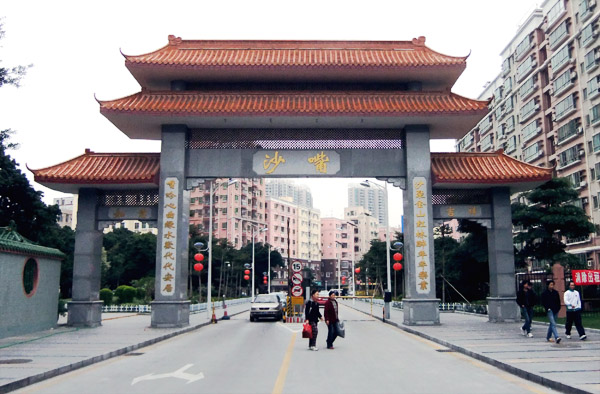
Entry gate to Shazui

Shenzhen villages are places of unexpected encounters with tradition, living and reworked. Indeed, these encounters are reason enough to meander through the villages. Just to the left of the entry gate to Shazui, for example, is a temple to Hongsheng (沙嘴洪圣宫), which is kept by an older Shazui couple. I asked about Hongsheng and they invited me to sit and chat.

Historically, Shazui villagers made their living fishing in the northern section of the South China Sea, beyond the mouth of the Pearl River Delta. Hongsheng, as his name “Flood Victory” suggests is a god who protects fishermen of the South Seas. Hongsheng is also sometimes thought to be 祝融 (Zhurong the god of fire) and THE god of the South Seas, suggesting that Hongsheng is either a local manifestation of a more general god, or was a specific god that was absorbed into a larger tradition.

From a decidely brief net surf, I have gathered that Hongsheng is very local. Most of the temples I came across were located in Hong Kong and this temple is the only one that I (thus far) know about in Shenzhen. Indeed, the Ou Family Association from Hong Kong (沙嘴[香港]欧氏宗亲会) had provided the computor printout with information about Hongsheng, which again suggests how local this god is. I’m wondering if this is because Hongsheng protects ocean fishermen? That said, throughout Nantou, most temples are dedicated to Tianhou (天后) with the largest temple at Chiwan.

So a post that begs more questions than it answers. Why Hongsheng and not Tianhou? Why only in Shazui? How important is the Hong Kong connection to the temple’s maintenance?  And why is the temple located at the gate? Questions, questions. More to follow as I stumble across answers…

food-scape updates, closure

Closure on the foodscape project. Last Wedensday, Sept 16, 19:30 at the Hong Kong Arts Centre, mccmcreations hosted a book launch for foodscape, the book. The book is on sale at the Bookshop of said Arts Centre. Please stop by, puruse, and buy a book!

Also, Milan Buttner completed Inter-view, his 30-minute exploration of inter-cultural exchange and multi-lingualism during the project. Click, view, and enjoy!

中国观澜版画基地: What is a cultural resource?

Yesterday, Wenzi and I visited her classmate, Zhao Jiachun who works at the Guanlan Woodblock Print Base (中国观澜版画基地). Jiachun generously showed us the Base and briefly introduced its history.

Guanlan interests me for three reasons (in addition to the beautiful setting, pictures here):

Guanlan is, at the moment, a purely municipal government funded project. This points to the growing ideological importance of culture in Shenzhen’s identity – both domestic and international.

Guanlan is part of the movement to recuperate elements of Shenzhen’s pre-reform history as a cultural resource. What’s interesting is that this recuperation is happening village by village. Consequently, what emerges is a loose network of sites, rather than an overall “history” of the city. In this case, Guanlan is the third Hakka site incorporated into the municipal cultural apparatus. The first was Dapeng Suocheng (大鹏所城), a military installation in the eastern part of the city. The second was Crane Lake Compound, which is now the Hakka Folk Custom Museum (深圳客家民俗博物馆鹤湖新居) in Luoruihe Village, Longgang (罗瑞合村).

Guanlan is an example of using pre-modern architecture to incorporate international art production into local identity. More specifically, the experience of architectural difference (such as living in a Hakka compound) bridges even as it creates cultural difference. Thus, the Base invites foreign and Chinese artists for residencies. These residencies allow foreign artists to “understand” China / Shenzhen and incorporate these new experiences into their art. At the same time, these exchanges also refigure a local art form (woodblock printmaking) as international cultural heritage. Importantly, this kind of “experience” of the local past as a cultural bridge seems a global trend. In Switzerland, we visited Romainmotier, which also offers artist residencies in a beautiful, restored, pre-modern setting.

This has me wondering about the ideological relationship between past and present urban settlements: Is “history” now the location of “culture”, while the “present” is all about one’s location on a scale of relative modernity? In other words, do Shenzhen and NYC participate in the same “culture”, their real differences explained away as “levels of modernity”? While their cultural “difference” must be found by excavating the past?

Continue reading

玉历宝钞:return of the repressed, reworked for the current age


old museum entrance

Originally uploaded by maryannodonnell

Recently I have noticed that buddhist iconography is seeping into local shrines, which have been growing stronger this past decade. At the Daxin Tianhou Temple, for example, Guanyin (boddhisattva of compassion, but also the Goddess of conception) and 天花娘娘 (Tiānhuā niángniáng the Goddess of pox -cow, small, and vaccines thereof, who also heals disease in general and is somehow related to conception) have joined Tianhou on the alter. Also, popoular Buddhist texts and sutras are being distributed in local shrines and temples. In fact, the Shenzhen Hongfa Temple in Fairy Park is actively publishing and presumably delivering these tracts. Other sutras are published by very local printers, whose addresses include place markers such as “side alley”. Continue reading

xiao chen – thoughts on how to do “small” business


xiaochen tea

Originally uploaded by maryannodonnell

More thoughts on how Shenzhen does and does not work, this time inspired by a conversation with Xiao Chen, my tea vendor.

Yesterday afternoon I went to Nanshan Tea City, where Xiao Chen and her husband have a tea stall. They are from Fujian and sell amazing Iron Guanyin (the new tea is in and fragrant) and different grades of pu’er, which is what I usually drink. Pu’er is a fermented tea, and, like red wine, becomes richer and more complex with time.

Xiao Chen had just received an order of 13 year old pu’er that she wanted me to try. We sat at the table, where she prepared the tea, washing the leaves three times instead of two, poured the tea from the clay teapot into a class pot, and then into my small teacup.

As she has taken it upon herself to educate me about tea, Xiao Chen explained the importance of each step. Washing the tea leaves insures that one drinks the best taste, the small clay teapot preserves the fragrance and quality of the leaves, moreover it achieves these high quality results without wasting tea leaves. A glass pot is necessary because when the tea is poured out of the clay teapot the tea does not have uniform flavor. Instead, the first tea is relatively weak and the last tea is relatively strong.

While we were sipping the tea, Xiao Chen explained how she and her husband do “small” business (做小生意). Unlike big business, she said, small business depends upon “renyuan (人缘)”. According to Xiao Chen, renyuan is about the trust that people have within a human relationship. For their business to succeed, she and her husband need return custumers. To maintain the trust, the vendor and the custumer have to believe that the other has their best interest at heart: the custumer wants the vendor to earn enough money to make a living, and the vendor wants the customer to purchase high quality goods at the most reasonable price. Continue reading

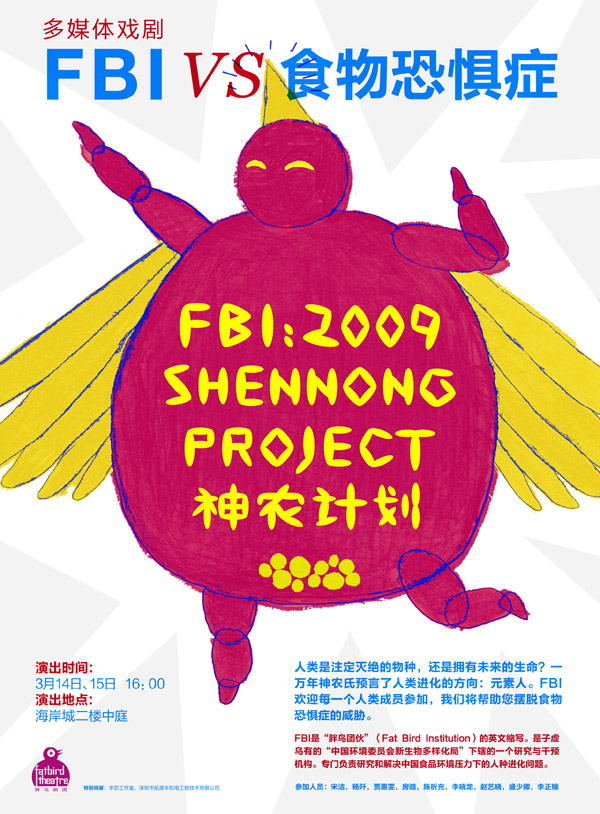
comephophia VS 食物恐惧症


It seems that Three Deer scandal remains a sensitive topic. Even as representatives in the People’s Congress are arguing over whether or not stars who advertised for the company, in Shenzhen Fat Bird has adapted FBI: 2009 Shennong Plan to fit more snuggly into the rhetoric of Coastal City’s plan du month – “知性女性聪明消费 (The Intelligent Woman Shops Smart)” advertising focus.

So, as of last night, the advertising and and title of the play have changed. The play is now called “胖鸟VS食物恐惧症 Fat Bird Takes on Comephobia”. “Comephobia – fear of eating” was in the original production an ironic medical condition. This weekend, comephobia will be staged as a real social problem. The other major change to the piece is the staging of ritual. In Hong Kong, the piece also spoofed Falun Gong. In Shenzhen, the rituals have all been “upgraded” to modern dance.

Strange indeed which venues fear what. In Hong Kong, there was pressure to make sure everyone understood that “FBI” was an ironic naming of the theatre troupe. In Shenzhen, we must make sure that everyone realizes the troupe is making a joke about a problem that while real, isn’t so serious that it can’t be mentioned at all. FBI still hopes it will be able to sing its theme song to the tune of the Olympic theme song. However, that decision has not yet been imposed.

Time of the show has also changed from 3 to 4. The venue, 2nd Fl, Coastal City Mall, above Jusco.