three class theory: speculating on the scale and possibility of reforming china

A while back I heard a princeling turned Shenzhen nouveau riche (and they do surface every now and again, entrepreneurs in their late 50s and 60s, who came to the SEZ to live well below the national political radar, but nevertheless take advantage of their status to reap economic benefits in the city that launched Reform) half-mockingly challenge a lunch table of intellectuals, saying:

China has three classes — high ranking officials (高干), national intellectuals (高知), and peasants (农民). Officials need help governing and are good to those who help them, but that’s not the important issue. The real question is: do you really want to share power with peasants?

That smug question provoked self-conscious chortles because most at the table were low-level national intellectuals, not peasants, no, but certainly ecclesiastes, who Gramsci defined as the category of intellectuals “who for a long time…held a monopoly of a number of important services: religious ideology, that is the philosophy and science of the age, together with schools, education, morality, justice, charity, good works, etc. The category of ecclesiastes can be considered the category of intellectuals organically bound to the landed aristocracy.”

The a-ha moment in “three class theory” is the emphasis on political, rather than economic power. Take a look at Chinese society and what becomes obvious is that high-ranking officials are, by and large, China’s property-owning class and national intellectuals are, by and large, members of the bourgeoisie. Within each of these classes, of course, exist various opportunities to confirm and strengthen social status, as well as opportunities to transfer and exchange socially valued goods, including money, but also including housing, medical care, and other social benefits. In contrast, peasants are those organically tied to the land, with all that the status has historically entailed: providing quota grain under Maoist collectivism to fund socialist urbanization, and presently being excluded from China’s urban boom except as members of the proletariat. The point, of course, is that in Chinese society economic opportunity is a function of political and social status, rather than the reverse.

The status of peasants and their ties to land are at the center of Shenzhen’s development.On the one hand, as rural areas urbanize, the question of land comes to the fore and in it we see how officials and intellectuals cooperate to expropriate land and justify its expropriation. In this scenario, the class struggle is over the terms of proletarianization and the creation of what are called “peasant workers (农民工)”. On the other hand, to the extent that villages retain control of their land and pursue capitalist projects, we see the stability of the three class system as local systems reproduce this hierarchy, producing “local emperors (土皇帝)”.  In this parallel scenario, the struggle is over the extent to which local emperors and local intellectuals might launch themselves into national politics. Obviously, although both historical trajectories transform individual lives, it is also clear that these changes are not bringing about a more just society, but rather using previous injustices to make and legitimate power grabs and the concomitant distribution of the spoils.

As China enters its fourth decade of reform, Gramsci’s call for intellectuals to theorize and provide alternatives to the present situation still haunts us. The fact that US and Chinese leaders continue to cosy up to one another and that US and Chinese intellectuals find so much in common makes salient the compatibility of US neoliberal ideologies and Chinese ideologies of socialist exceptionalism. However, this ideological compatibility has blinded many of us to a simple truth; the quality of life for Chinese nongmin remains the standard for evaluating the scale, possibility, and social forms of Reform and Opening, not the cross-cultural comfort level of high-ranking officials and national intellectuals, whatever their passport status may be.

Shajing Wanfeng Community learns from Wukan

Weibo reports that on the afternoon of April 8, 5-600 Wanfeng (万丰社区) community members/ villagers took to the street to protest Community Secretary and  Wanfeng Ltd CEO, Pan Qiang’en selling off collective lands for private profit. The protests began February 17, when 20-30 elder villagers gathered outside village offices and have continued until today.This afternoon, Epoch Times reported on the event, noting that villagers are calling for an accounting of the past twenty years. Currently, Wanfeng Community has an area of 6.8 sq km and a population of 2,067. Most are surnamed Pan. It is estimated that over 50,000 migrant workers also live in Wanfeng.

gu kailai arrested: “as chongqing turns” really is one of the best shows on the worldwide web

In today’s episode of As Chongqing Turns, Bo Xilai’s wife, Gu Kailai has been arrested for the murder of Neil Heywood, a Beijing-based British businessman.

When we last visited Chongqing, Guagua had been urging his father to truly reform Chongqing’s political-economic system instead of singing Cultural Revolution karaoke and cracking down on “black” activities. One of Bo Xilai’s patrons, Noodle Master Kang (played by Zhou Yongkang) had been fighting with Direct Line to Heaven (played by Wen Jiabao) and Tire (Hu Jintao) for control of the Center. There were rumors of bullets having been fired in Beijing, rumors which increased levels of paranoia because of the administrative separation between control of the military and control of the police. Remember, the military is controlled by, well, the military and in the hands of Tire. The police, however, report to Noodle Master Kang and although the military is larger than the police force, nevertheless the police have more ground forces than the military, who serve and protect Chinese people in the air and at sea, in addition to on land…

Flashback to November, 2011, place: a fancy Chongqing hotel room. Neil Heywood is found dead. Representatives of the Chongqing government tell Heywood’s family that he died of a heart attack. They tell the British Embassy that he died of an overdose of alcohol poisoning. Strange, someone says, I never knew him to drink…

Flashback to Wang Lijun’s mad dash to the US Consulate in Chengdu. Close up of the Chongqing police surrounding the building, demanding that the Americans release Wang Lijun. We jump to a reconstruction of what the New York Times says took place: Wang Lijun telling the Americans (large and in blue suits) all sorts of things about the inner workings of the Center. He lowers his voice and accuses Gu Kailai of poisoning Heywood and to force the Center to reopen the case. Wang Lijun begs the US officials for asylum, but it is not granted. Instead, 30 hours after he entered the Chengdu Consulate, he leaves “of his own accord”, which is what was said at the time and we now know not to be true…

Meanwhile, the Chinese internet pulses and throbs with speculation and analysis. If Gu Kailai did poison Heywood and if hubby, Bo Xilai did cover up the murder, then speculations about the absolute lack of any moral restraints in Chinese leadership seem confirmed. If, however, Wang Lijun lied and now Bo Xilai’s enemies are using the case to end his political career, then speculations about the absolute lack of any moral restraints in Chinese leadership also seem confirmed. And what is to be done when there are two separate armed forces — the military and the police –reporting to (at least two) amoral leaders engaged in a power struggle?

This episode leaves us in Shenzhen to ponder appropriate levels of paranoia. Suddenly, for example, I’m recalling that after the recent Politics and Law Committee Training (政法委书记培训) in Beijing, I’ve notice increased police presence throughout Shenzhen. What’s the reason? I’m reconsidering Bo Xilai’s earlier trip to Kunming Military museum in terms of internal divisions. As Mayor of Chongqing, Bo Xilai had police, his chief supporter, Zhou Yongkang is head of the Politics and Law Committee and  and thus can deploy police from any part of the country anywhere else. Was Bo Xilai actually cultivating military support from his father’s old friends in preparation for a worst case scenario?

And yet. I’m also thinking that the mountain is high and the emperor far away (山高皇帝远) and most of the people in the hot and heavy pursuit of Chongqing rumors tend to be either newspaper reporters, who pursue these sorts of stories for a living and friends from Beijing, who actually identify with whatever the Center is up to and spend time online tracking the rumors. Many of my southern friends don’t seem so interested, except to wonder how the political maneuvering will or will not impact manufacturing, financial services, and summer vacation plans.

That said, I may re-read my Machiavelli just to remind myself that any act by a leader should be interpreted as a power play and not within the rhetoric of serve the people. And sadly, I’m looking at you, too, American politicians who might use this fiasco to pander to anti-Chinese sentiments and American media personalities who would use anti-Chinese sentiments to increase ratings in my homeland. Unfortunately, As Chongqing Turns isn’t a telenovela. It’s what’s happening instead of necessary work to improve the lives of millions of Chinese people, which in a shared world means improving all of our lives.

六四 can be baidu’ed!

Ironies of the great firewall continue: We can now access information about Tian’anmen, but still can not directly get onto wordpress. Does this mean that whatever else he has done with or without Jiang Zemin’s blessing, Wen Jiabao looks good in Tian’anmen press? Or perhaps Tibet and Hu Jintao’s role in the March 5 Lhasa crackdown (also in 1989) remains more sensitive than Jiang Zemin’s role in the June 4 crackdown because so many leaders and members of the Han public continue to refuse to discuss 1959?

That said, nevertheless, today I’m feeling hopeful: we can baidu 六四!

Consuming power — Xi’an snacks

Power, its cultural incarnations, and subsequent transvaluations fascinate me. How we work with and through inequality defines us not only as an identifiable people, but also as a moral community. I understand the scholarly imperative to be discovering who, what, where, why, when, and how our appetites and assumptions, our attachments and defilements inform and transform shared worlds. That said, my interest in power tends toward the practical; I like knowing when I should pick up the tab and when silence is not a sign of respect, but a sin of omission. Continue reading

power and authority in a chinese high school

Last night I heard a fifteen year old girl ask the rhetorical question, “Why are some suited to be a leader and others aren’t?” She had been comparing a teacher and a vice principal, both from her school. Apparently, the teacher had treated her badly and the vice principal had treated her well. Her disparaging remark neatly summarized a common understanding of power — people who treat others well deserve to be leaders. Implicit, of course, was the assumption that those who don’t treat others well don’t deserve to be leaders.

The question vexed me. On the one hand, she was correct to note the difference between authority and power as styles of leadership. The vice principal had helped her, which confirmed the legitimacy or the authority of his position. In contrast, the teacher had coerced her to do something she didn’t want to do. Coercion falls pretty unambiguously into the deployment of power category. On the other hand, these were not isolated events. They took place within a fraught social network in which the reason she had sought out her teacher and the vice principal came into play. At this level, both the teacher’s and the vice principal’s actions make sense. Continue reading

the tale of hotpot waters…

For a brief moment, the following bit of satire circulated on the Chinese web:

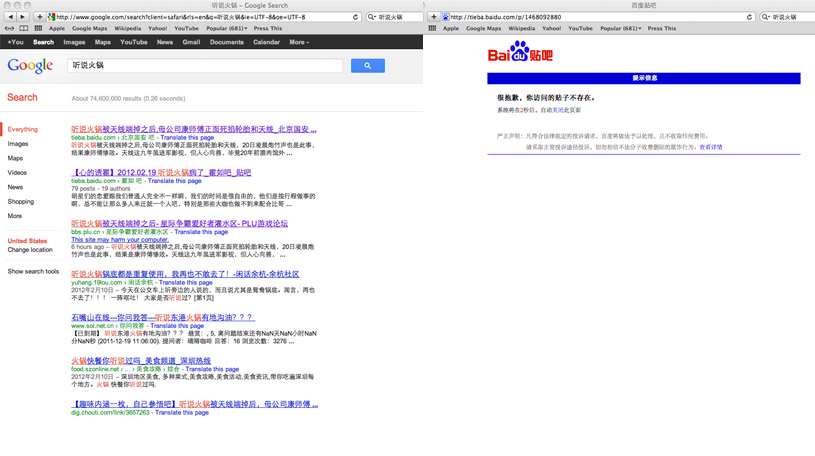
Rumor has it that after Hotpot was swept away by the Direct Line to Heaven, Noodle Master Kang of the Mother Company was openly fighting with Tire and Heaven Direct. The morning fireworks on the 20th were also part of this fight, with the result that the Noodle Master Kang took a serious hit. Even though these past nine years Heaven Direct has charged his way into the silver screen, nevertheless he’s well intentioned. After all, twenty years ago just outside the preserved ham shop, he was the man who stood behind Yangzhou Fried Rice. If y’all sing and eat hotpot again, his nine years of blood and sweat will be as nothing. Thus, it’s a good thing that Tire has the camouflage firmly in hand and soundly thrashed those instant noodles. [original: 听说火锅被天线端掉之后,母公司康师傅正面死掐轮胎和天线,20日凌晨炮竹声也是此事,结果是康师傅惨败。天线这九年虽进军影视,但人心向善,毕竟20年前腊肉馆外他是站在扬州炒饭背后的男人,你们再唱歌吃火锅,人家九年心血全没了,所以幸亏轮胎紧握迷彩涂装不放,才狠摔方便面。]

Traces of the passage remain in google cache but can no longer be accessed on Baidu (image below).

Why was the spoof so quickly removed from Baidu? Continue reading

Falungong appears on baidu, must mean Jiang Zemin is going, going, gone…

Learning to read Chinese media more often than not means learning to understand the significance of the information to those playing behind the walls of Zhongnanhai.

Today, for example, it is possible to get on Baidu (百度) and successfully search for Falungong (法轮功). We all know that 1999, Jiang Zemin ordered the violent suppression of Falungong. This led to over a decade of sustained persecution against practitioners. Observers speculated that he did so because he (and others in the Party) saw Falungong as not being a religious organization, but rather a potential political player in Mainland society. In English, Michael J. Greenlee provides a useful overview of the organization’s history and Jiang Zemin’s response. However, for many of us the most interesting part of ending censorship of information on Falungong is not that we can now jump to Li Hongzhi’s tomes 大圆满法 and 转法轮, but rather that it signals the end of the Jiang era. The Two Meetings are churning relentlessly forward and it seems that power has been wrested from Jiang’s hands.

Jiang Zemin came to power precisely because he was willing to implement Deng Xiaoping’s decision to suppress anti-corruption protests in June 1989. Moreover, it’s been a while since we could baidu ourselves to information about Zhao Ziyang, the former Party Secretary who apparently did not support the use of violence against protestors. So the question du jour is: will the firewall on news about Tian’anmen also fall? Or will Tian’anmen remain off limits as long as Reform and Opening remains the main Party line and Deng Xiaoping is identified as its architect?

Rumors, Rumors: What’s Bugging Guagua?

Two days ago, an open letter allegedly from a member of Bo Xilai’s family popped up on the internet, expressing the desire for a public hearing (“此信来自薄家亲戚, 希望公开发表”). Epoch Times – the media arm of Fa Lun Gong – broke the “story” saying that Bo’s son, Guagua may have written the letter. Maybe. Maybe not. Whatever else it may be, I believe that the letter is interesting for four reasons. First, in the absence of political opposition, satire formulates an alternative position. Second, the level of moral outrage that compelled the implied author to write seems genuine. Third, the fact that this letter is circulating as “news” reveals the extent to which the sentiments reflect popular dissatisfaction with the Center and its melodramatic backbiting political infighting Two Meetings. Fourth and relevant to Shenzhen, is the call that Chongqing might have been a Special Zone, like Yan’an and implicitly not like Shenzhen.

Translation of the Guagua letter below.

A FATHER’S TRAGEDY, A PEOPLE’S LAMENT – BO GUAGUA’S PUBLIC LETTER TO THE NETIZENS

In my last open letter to my father, I urged him to return the Chongqing Sing Red, Attack the Black back to the Yan’an years, making Chongqing the flag bearer for a democratic Party and the living spirit of Yan’an; to truly become a Special Zone for political reform. Unfortunately, my father has been too-long educated by the Party, ultimately prioritizing the Party and national power. I had hoped that through reflection and regret, the negative effects of the Chongqing model could be ameliorated. I had hoped that by sacrificing your political future, my Father could have restored the Party and the Country’s stability and harmony. Continue reading