the shenzhen gospel

Swedish missionary, Theodore Hamberg arrived in Hong Kong on March 19, 1846. The following year, he joined what became known as the Basel Mission, focusing on converting Hakka communities to Christianity. Indeed, Hamberg was the first to draft a dictionary of Hakka into a western language. Hamberg died in Hong Kong in 1854, however, his efforts to bring the gospel to Hakka people prospered. Located in Langkou Village, Dalang Street, Bao’an District, Shenzhen — and yes, I do enjoy the dense specificity of Chinese place names — the Langkou Gospel Hall (or Church) was built twenty years after Hamberg first arrived in 1866.

The first pastor of the Langkou Gospel Hall was Charles Piton, who served the congregation from 1866 through 1884. The next few years, there was no foreign pastor at the Church. However, in 1891, the German missionary 骆润滋 (and if you know his Western name, please let me know) came to Langkou from the Hong Kong Mission. That same year, the mission also established the “Devout and Chaste” Girls School (虔贞学校), moving from Hong Kong further inland.

During the Mao era, the church and school buildings were used as schools and administrative centers. In 1984, the central government allowed for religious services and the Langkou Gospel Hall reopened as a church. In 2003, the community broke ground to build a new church on neighboring land. The school building was used until 1986 and then abandoned to squatters until recently, when the Dalang Street government decided to restore the school and church as historic buildings. Presumably construction will begin in several months and early next year, the school and former Gospel Hall will reopen as public cultural centers. The Church will continue its mission, including exhibitions that document the history of Christianity in Guangdong generally, but amongst Hakka communities specifically.

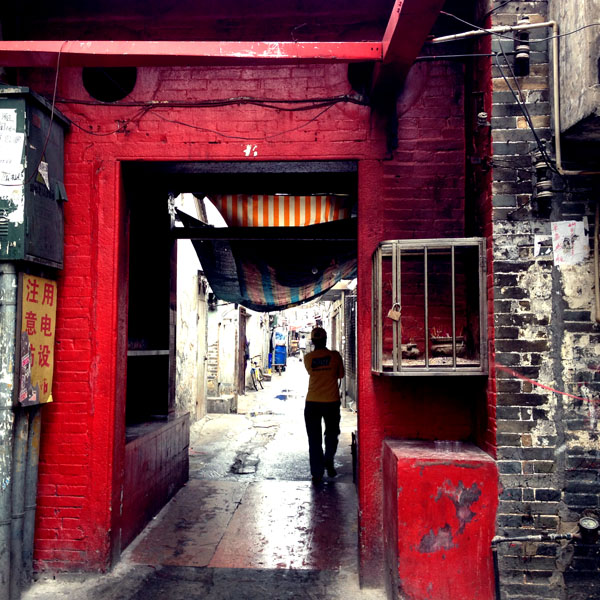
Below, impressions of a visit to pre-restored Devout and Chaste Girls School and Langkou Gospel Hall, which is currently occupied by a migrant worker family, who earn their living doing piecework for a nearby factory.

This slideshow requires JavaScript.

walls and sun

Today I walked the OCT Eastern Group buildings between meetings.

This slideshow requires JavaScript.


the view from the top, circa 1997

The 69th floor observatory of the Diwang Building remains an important tourist destination, albeit something of a time capsule.

The Diwang building was completed in time to celebrate the Return of Hong Kong to Chinese sovereignty. The 69th floor observatory includes a museum that commemorates Shenzhen’s history from 1980 through 1997, a kitchy “Lan Kwai Fang” bar street, and observation maps that date from 1997. The key exhibit is a wax figure installation of Deng Xiaoping and Margaret Thatcher’s iconic 1984 meeting. The installation symbolizes the ideological function of Shenzhen circa 1997 — the buffer zone between Beijing and Hong Kong, which enabled the PRC to push forward its “one country, two systems” policy.

The juxtaposition of Shenzhen then and now resonates precisely because the interior design of the museum hasn’t changed since 1997. In fact, all one has to do is look at one of the maps and compare it to the view from the observation platform to remember that in 1997 Diwang precipitated the city’s glass and steel makeover. Notably absent from the 1997 maps — the civic center, the kk 100 building, and the Binhai Expressway and Northern Loop. Obviously present in the 1997 maps — the extent to which the construction of border town urban villages such as Caiwuwei, Dengba, and Hubei had shaped urban possibility in Shenzhen . Moreover, in the 1997 images, Buji and the second line seem distant, far far away from the booming border region. Nevertheless, villages still show up in the images below — the relatively dark patches are urban villages, including the remains of Caiwuwei after the construction of the KK 100.

Visiting the museum and observatory costs 80 rmb a ticket and if memory serves (because sometimes it doesn’t), fifteen years ago the price of admission was 80 rmb.

This slideshow requires JavaScript.

shangbu

One of Shenzhen’s first administrative zones (管理区) and former commune, Shangbu (上步) disappeared from the Municipality’s administrative nomenclature during the restructuring of 1990. Nevertheless, architectural traces remain, even as the Nanyuan New Village and Badeng New Village handshakes have been creatively upgraded. Shenzhen’s Minority Work Team  is also located in the area, reminding us of the diversity of Shenzhen’d migrant population.

This slideshow requires JavaScript.

the shape of space: buji village #1

In the urban villages around the Old Buji Market (布吉墟), alleys and narrow roads wind upward, accomodating dense settlement and inadvertant public spaces. The most notable feature of the space is the proliferation of walls and determined privatization of small plots, or homesteads (宅基地). The isolating spatial organization of Buji reflects what urban planners disparagingly call “small farmer mentality (小农民意识)”. In practice, this means only investing in one’s own home, and minimal investment in public spaces and programs. Obviously, not only farmers have this mentality.  The Shenzhen Dream entails homeownership, while Tea Party populism represents one version of the US American  urge to privatize land and resources. However, the term “small farmer mentality” is usually a pretext for urban renewal programs that involve razing neighborhoods where the working poor live and replacing them with mall-burban settlements, where only the upper middle class can buy into the dream. Spaces like a Buji urban village  illustrate one of the key conundrums facing not only Shenzhen, but cities everywhere — creating livable neighborhoods for the working poor, rather than leaving urbanization in the hands of privatizing opportunists, whether they be individual farmers or employees of an urban planning board.

This slideshow requires JavaScript.

double bind urbanization

At dinner last night a friend asked me, “If you had to choose between living in a 50 story building or an urban village walk-up, where would you live?”

This question illustrates the kind of double bind thinking that current debates about urban villages generate. As posed, the question compels us to choose between either high end futurism or unsanitary crowded settlements. But all too often the question itself becomes rhetorical justification for ignoring other examples of more successful urbanization. What’s more, the question also blinds us to what we can learn from the  tight organization and convenience of the villages, while using high tech knowledge and skills to imagine low-rise, more environmentally friendly settlements. Continue reading

gaoling: shenzhen’s eastern periphery

Episode 13 of The Great Transformation, takes us to Gaoling Village (高岭村), which is located on Qiniang Mountain at Shenzhen’s eastern most edge on the Dapeng Peninsula.

The story of Overseas Chinese Chen Jiageng (陈嘉庚) opens the episode, connecting the history of Shenzhen’s eastern periphery to early modern Chinese nationalism. An ethnic Hakka, Chen Jiageng raised funds among to construct the Jimei School in his hometown Jimei Xiamen. For his nationalist efforts, Mao Zedong referred to Chen Jiageng as being “the banner of Overseas Chinese, the glory of the race (华侨旗帜,民族光辉)”.

Settled over 400 years ago by Hakka migrants, the layout of Gaoling reflected the founders need for safety and arable land. The village houses were located deep in the mountains, while village fields were located at the foot of the mountain. Every morning, villagers went down the mountain to work their fields and every evening, they returned to the relative safety of their homes.

The architecture of Gaoling reflected the agonistic relations between Hakka and local (本地 boon day [H], bendi [M], pundi [C]) peoples during the 19th Century. In fact, between 1855 and 1867, relations disintegrated into open conflict during the Punti-Hakka Clan Wars. During the early 20th Century, the village housed anti-Japanese troops, who were led by Hong Kong born Liu Peidai.

As in Xiamen, Gaoling villagers who lived overseas donated funds to build a school in their hometown. Over the course of the village’s history, Gaoling villagers immigrated to Singapore, Holland, the United States, and Canada, and many more lived in Hong Kong. Importantly, the Overseas Chinese funded improvements to their hometown, including modernizing the water system. The Euro-Chinese style of the school architecturally reflected these migrations and returns.

border theory

End of last semester, I attended the review for MArch 1 studio: Inbetweeners taught by Joshua Bolchover, The Department of Architecture, The University of Hong Kong. Six teams offered analysis and plans for the Shenzhen-Hong Kong border. I have found it useful to think through and against the students’ work because when juxtaposed, our respective points of departure highlight critical issues that need to be thought if we are to create a genuine cross-border society. So, thoughts:

1) From the perspective of Hong Kong, the SZ-HK border is peripheral to the city proper or downtown. In contrast, the border was the reason that Shenzhen was established. Two areas in particular — Luohu/Wenjingdu and Huanggang — have been exceptionally important to Shenzhen’s ongoing self-construction and yet remain, on the Hong Kong side relatively marginal to the larger society. Luohu and Wenjingdu were of course the points where respectively people and goods passed during the Mao era and early Reform. In fact, Dongmen refers to the area that used to be Old Shenzhen Market and was the commercial area that thrived once the border reopened as both Chinese and Hong Kong residents went there to purchase goods and services unavailable or unavailable that cheaply back home. Huanggang, of course, is an extension of the new central axis and with the construction of the Lok Ma Chau Loop will become even more important to Shenzhen’s construction of its border-crossing cosmopolitan identity.

2) The disproportional population growth in Shenzhen and Hong Kong complicated by residential densities in the region. Over the past thirty years, Hong Kong has had one of the world’s lowest birthrates, growing from a population of roughly 5 million in 1980 to a little over 7 million in 2010. During that same period, Shenzhen’s official population exploded from 300,000 to over 10 million in 2010. However, I have heard that the Shenzhen’s administrative population (管理人口) is over 17 million, while Hong Kong’s population continues to hover at 7 million. Moreover, even though Hong Kong has one of the highest residential densities in the world (6,420 people per square km), Shenzhen has surpassed it (7,500 people per square km), and continues to grow. How to feed, shelter, and provide for the well-being of this population, which is also concentrated along the border fundamentally shapes and will continue to shape both how we imagine the integration of these two cities as well as the social and environmental forms that integration will take.

3) All this begs the question of the appropriate scale of planning and designing for a cross-border society in the absence of a vision of what that society is and/or might be. Does the border area refer to those who live there? Those who cross through? Or those who benefit from the way the border sustains the international division of labor? We all know that borders are social artifacts, built and maintained for particular ends. And that’s the rub: in order to design and plan a better border, we need a vision of how the border might benefit both Shenzhen and Hong Kong, or maybe a vision of how Shen Kong might be differently lived. A story perhaps of membranes and sutures, rather than borders and exclusions.

Impressions from the review, below:

This slideshow requires JavaScript.

…and the juggernaut rolls on

By the year 2017, Shenzhen plans to have built 95 shopping malls, totaling 17.8 million square meters. Moreover, the raze and raise juggernaut seems unstoppable, even in the face of growing support for historic preservation and public recognition of the social, cultural, and historic value of village settlements.

In October this year, the Municipality announced that  China Resources (华润) will raze Hubei Village and raise another high-end mall despite the fact that Hubei was built during the Ming Dynasty between 1465 – 1487, boasting a settlement history of almost 550 years.

The “three horizontal and eight vertical roads (三纵八横)” layout of Hubei exemplifies Guangfu (广府) or Cantonese style. The village also includes an ancestral hall that was rebuilt in 1804, a village gate, well, and over 200 houses. In addition, the ancestral hall used granite, a building material rarely seen in the area.

Hubei Village was part of the original Shenzhen Market (深圳墟), which has already been extensively razed. Indeed, Hubei Village is the largest and most concentrated of historical architecture in the area. Moreover, the village also serves as cheap housing for those who work in the surrounding hotels, spas, restaurants, and malls.

The recent and loudly protested decision to raze Caiwuwei and build the KK 100 is the immediate context for ongoing calls for some kind of preservation effort.

Impressions from a recent walk in Hubei, below:

This slideshow requires JavaScript.

schools at the edge

These past few days, I have visited elementary schools in the Xishuangbanna Dai Autonomous Prefecture.

The prefecture capital, Jinghong is undergoing a small (by coastal standards) boom: in 2003, Jinghong had an estimated population of 370,000 and roughly ten years later, school officials estimated a population of over 1.2 million people, suggesting that the same processes of internal migration and rural urbanization that we have seen along the coast; China’s population is not growing so much as it is redistributing (results of the 2011 Census). Indeed, the goals of China’s socialist new village campaign sound explicitly urban — “to develop production, enrich life, civilize the countryside, clean up the villages, and use democratic governance (生产发展、生活宽裕、乡风文明、村容整洁、管理民主的社会主义新农村)”.

Extraction and tourist capitalism have fueled the boom. On the one hand, the primary source of production revenue has been the expansion of rubber tree farming. However, the region also produces pu’er tea, mahogany, and has ancient jade mines. In addition, because Banna (as it is colloquially known) borders Burma, Thailand, and Laos, the prefecture also serves as an entrepôt for Burmese jade, Thai agricultural products, and Laotian hard woods. On the other hand, internal tourism to experience stylized representations of minority cultures continues to grow. Indeed, much of the building development in Jinghong involves adding stereotypical Dai flourishes to concrete buildings, which are structural heirs to Maoist dormitory and mass architecture.

The boom is a reform twist on Maoist efforts to integrate minority communities into the larger Chinese state. The situation of Yunnan ethnic minorities varies, reflecting indigenous pre-Mao state building (the Bai Kingdom at Dali, for example, in contrast to the rain forest tribes of Mengla, Banna), integration into the ancient tea trade, and the building of modern roads and transportation systems. During the Mao era, for example, it took several days to make the trip from Jinghong to the provincial capital, Kunming. Today the trip is a 40-minute plane trip and ethnic Han people hold most political positions and control access to economic opportunities. Indeed, the situation of ethnic minorities in Yunnan resembles that of villagers in Han cities like Shenzhen; whatever opportunities locals have it is tied to traditional land rights as they have been re-interpretted by the state.

However, unlike in Han settlements, where (crudely speaking) rural urbanization has meant making access to some aspects of elite Han culture accessible to peasants, while strengthening class differences, in Yunnan, rural urbanization has had a double thrust — cultural homogenization while asserting Han superiority. In other words, through new village programs, Banna minorities are both sinified and regulated to the lowest rank within Han hierarchies. Of course, many of the Banna born Han are themselves relatively impoverished, but nevertheless better placed than ethnics to capitalize on extraction and tourist opportunities. Thus, what seems to have emerged in Yunnan generally, but Banna specifically, is a situation similar to other colonial situations — on US American indian reservations and throughout the Brazilian Amazon, for example.

The Banna schools that I visited teach the national curriculum to ethnic children. The schools are not destitute, but the problems they face are similar to those faced in peripheral societies elsewhere.

  1. There are not enough students to for large scale investment in education. Consequently, in Banna there are three kinds of elementary schools — education spots (for settlements that only have resources to educate grades 1-2), early elementary schools (combined schools to educate grades 1-4), and complete elementary schools (combined schools that teach the full primary curriculum).
  2. In order for higher level education, most students must leave their home settlements at a young age, some as young as 8 years old to board at an early elementary school. However, any education beyond elementary school entails moving to a county seat; for high school, Jinghong offers the best opportunity to succeed on the gaokao. Not unexpectedly, in Yunnan, Han children, whose parents use a version of Mandarin, are most likely to achieve relative high scores, which are not so high when compared to the results achieved in coastal city schools.
  3. The low birth rate means that even when a complete elementary school exists, there are not enough children to have a class. Consequently, many students end up waiting 2 years to begin their education.

The children were wonderful. The teachers generous. The officials (mostly Han, but some ethnic representatives) determined to improve the situation. However, unless, the values motivating the integration of Banna minorities into the Han state change, I am not sure that the results will differ from other national efforts to integrate minorities elsewhere — cultural loss, relative impoverishment, and the destruction of rain forest. It bears repeating: Underdevelopment and concomitant forms of inequality are the result of human actions, which arise when we confuse profit with the common good.

Impressions from Banna schools, below:

This slideshow requires JavaScript.