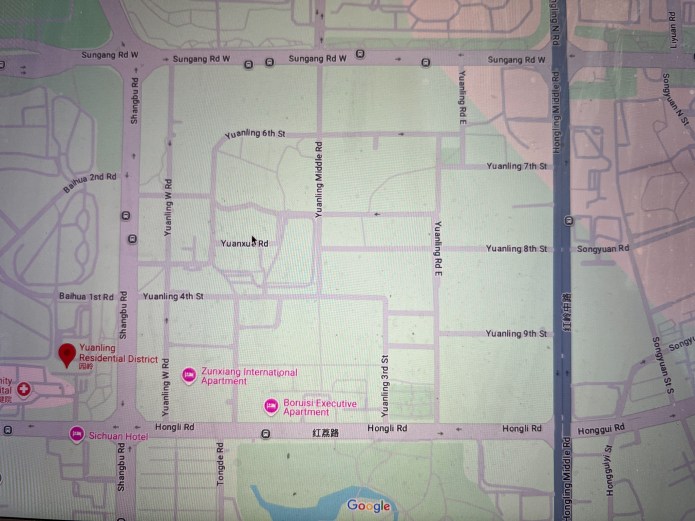
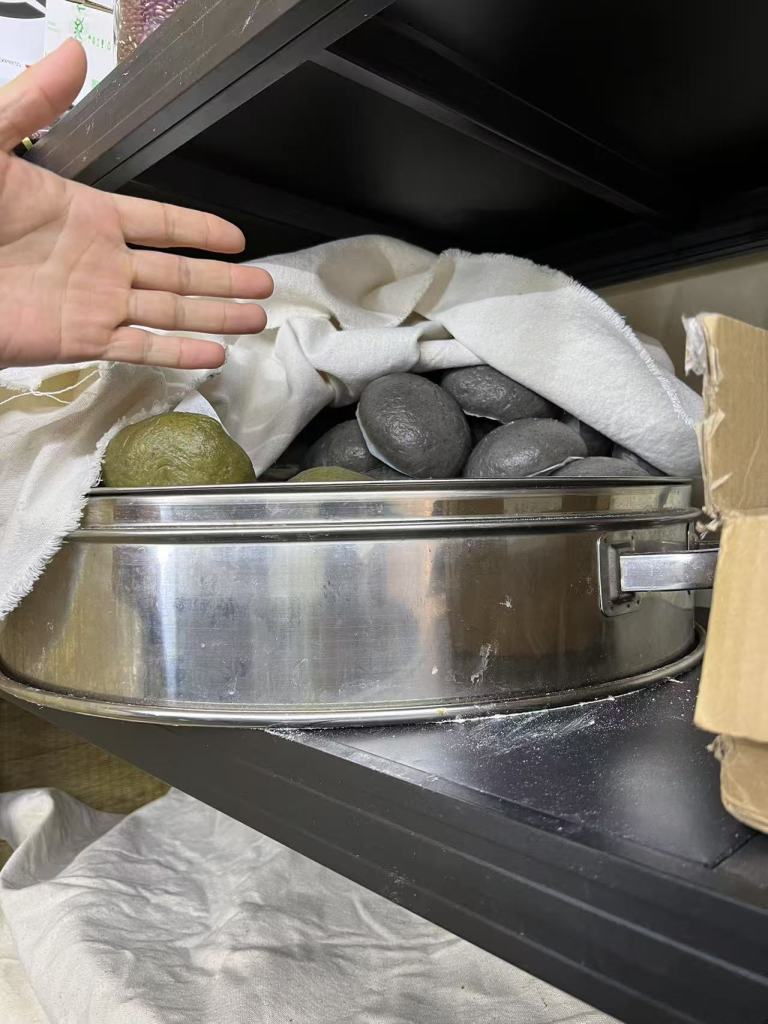
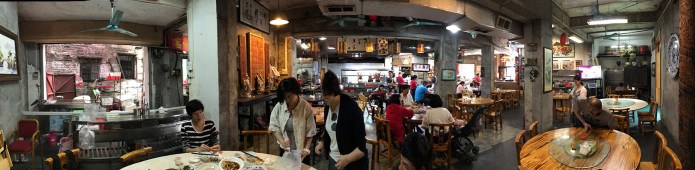
Originally a farmer, in Shenzhen CY worked in a kitchen at the Shangri-la Hotel in Xili and then went to eastern Huizhou to run a small, organic farm. Unfortunately, he couldn’t make a living as a farmer. Now he’s selling organic organic congee, buns, and medicinal teas. and sourcing his material through a network of “farm friends 农友.” CY’s restaurant used to be a first story apartment, which has been divided. In the other section of the house, a bike repairer lives. It’s the low rent that brought them to Yuanling. A two- or three-bedroom apartment can rent for as little as 5,000 rmb a month. He pays 3,100 for his section of the divided apartment.
Today I went into the very distant reaches of Guangming, to one of the new developments. During the Republican era (and from what I can glean, even earlier), this area was mountainous and had little agriculture. Consequently, in 1958, an Overseas Chinese Farm was set up here, bringing in both productivity and producing for the HK market. At the beginning of Reform and Opening Up they did some manufacturing (Konka and Overseas Chinese Town are both children of this settlement), but the area’s claim to fame remained agriculture, especially milk and roasted pigeon.
Point du jour: as with many parts of Shenzhen that missed the initial manufacturing boom (looking at you Longgang), the area is marketing itself as a high end suburban area. However, its far, far away (over 1.5 hours by subway from Shekou, or 3 hours round trip) and since there are few jobs out there, it’s filled with bedroom communities and empty shopping malls. A few snaps from today’s trip:
The English and Chinese online introductions to the Steel Structure Museum (深圳中国钢铁博物馆) emphasizes that the history of steel structures is an international story of human progress. The English intro reads: “We are the only museum in China themed steel structure, which is sponsored by CSCEC Science and Industry as an CSR project. Open to the public since May 18 “International Museum Day” of 2017, we narrate the story of steel structure both of China and rest of the world chronologically and in order of technical process, and explain steel structures’ advantages.” The Chinese introduction is a bit more specific but makes the same point: 深圳中国钢结构博物馆是中国唯一以钢结构为主题的博物馆,由中建科工集团有限公司举办。以“行业首创、中国一流”为建馆目标,以历史和科技并重为陈列原则,以实物、模型、图片、文字、多媒体等为展示手段,集收集、展览、研究、教育、交流于一体,融科普性、学术性、趣味性、参与性于一身,旨在让观众了解世界钢结构的发展历程、探寻中国钢结构的崛起之路以及感受钢结构文明的气韵,是建筑科普的重要基地和科技交流的重要平台 (in Chinese).
The museum tracks the use of steel as a sign of human developmental progress, which begins in England, is aestheticized in Paris, flourishes in the US and culminates in China. Important but missing from this march of progress are mentions of Stalin and socialist industrialization via centralized planning and concomitant movements like the Great Leap Forward, where steel was the key (以钢为纲 image below).
Nevertheless, the theme itself is enlightening, especially in the context of global restructuring in the post Cold War era. So, here’s what the museum has me thinking:
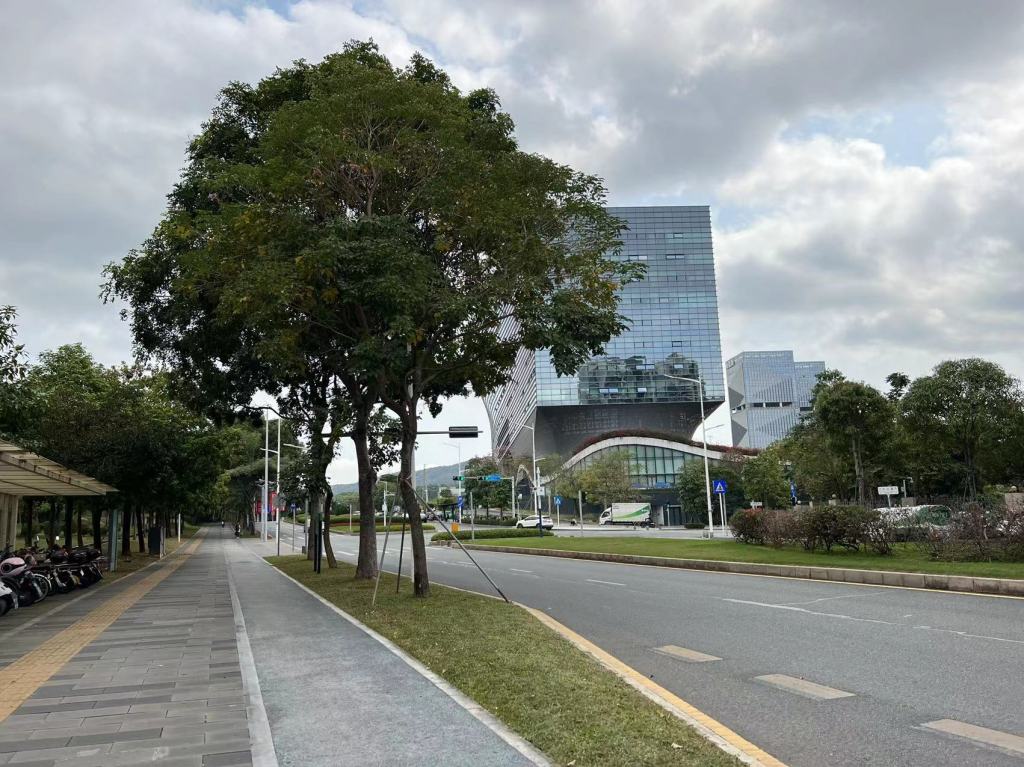
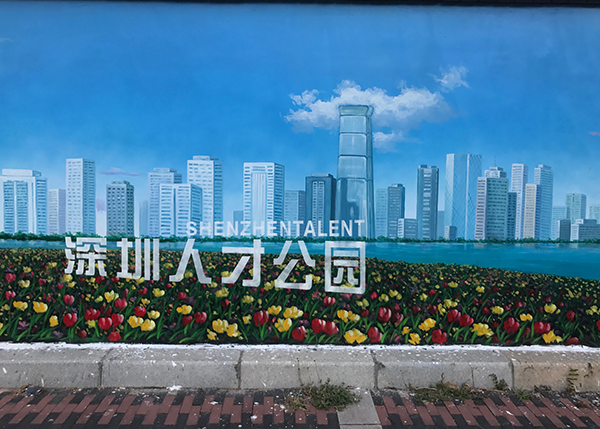
I walked from Coastal City to Shenzhen Bay Park via Talent Park. It is a stunning venture, where it is possible to experience the best of what Shenzhen offers–futuristic architecture, sparkling coastline, and expansive skies–without having to deal with the consequences thereof–overbuilding, monopolized waterways, and pollution. Indeed, as in the city’s beautiful parks, this stretch of modern living embodies the goals, aspirations, and ideologies of reform and opening.
The image that many have of Shenzhen is a collection of state-of-the-art buildings because for years, these towers have represented the city and its progress. These buildings, of course, not only represent important state-owned enterprises in the Shenzhen landscape (China Merchants and China Resources, for example), but also provide a particular map to the city: the downtown investment area, Huaqiangbei electronic markets, Overseas Chinese Town, the recently opened Hi-Tech area along Shenzhen Bay, and the Dameisha beach. The latest skyline montage includes architecture from all over the city (labeled to the best of my ability):
If you’re like me, you probably didn’t realize the loveliness that awaits you in “Guan Cheng,” the old section of Dongguan City. And yes, the surprise adds to the pleasure of strolling its meandering streets and riverside boulevards. Ke Yuan (可园), which comes from the expression “lovely garden” is open to visitors. It is an example of Lingnan sensibility and was a key site for the development of Lingnan style painting. Impressions, below.
In this episode of Shenzhen Book of Changes, we visit architect Huang Zelin, who’s work is deeply connected to Shenzhen – the city he grew up in. His designs for projects in the city and beyond reflect Shenzhen’s dynamism and great possibility for change.
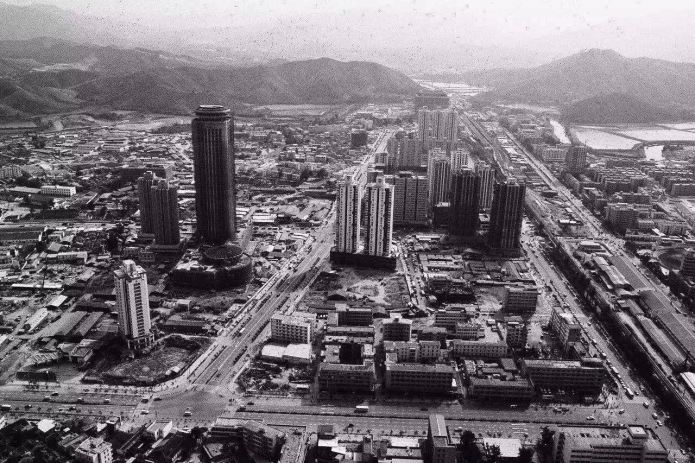
“Shenzhen Speed” has become a catchphrase amongst urban planners and journalists, makers and ordinary citizens to describe the transformation of Bao’an County into Shenzhen Municipality. In less than forty years, highways have replaced lychee orchards, high-rises have replaced oyster fields, and wi-fi has become as common as coffee shops and fast fashion. Boom!
Here’s the thing: the speed of historical transformation may be blinding us to how quickly we’re forgetting how we got here. Continue reading →
Those of you who have been following Shenzhen media are aware that Hubei Ancient Village (湖贝古村) has become a touchstone in debates about historic preservation, pubic participation in establishing urban planning values and goals, and the place of “life (生活)” in high-end rent districts.










 Shenzhen Noted