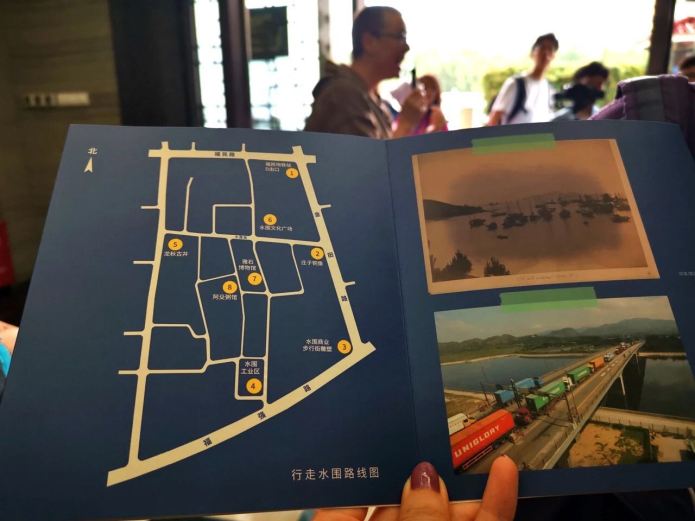
On Saturday April 27, Handshake 302 led fifteen curious guests on a full-day discovery of Huaqiangbei from perspective of the historic Shangbu Industrial Park. The organization of the tour emphasized the intimate stories behind the emergence of Huaqiangbei as a global landmark. After all, Huaqiangbei did not emerge as fully formed nexus in a global network of technological innovation, but rather formed in the ongoing evolution of Shenzhen’s cultural geography.Continue reading →
Since the invention of cell phone cameras, most of us take more pictures in a day than we used to in a week or sometimes even a month. We take pictures of ourselves, we take pictures of landscapes, we take pictures of friends, and we take pictures of cats. Many, many pictures of cats. The question, of course, is what are we doing? What desires do these pictures represent? What is the story behind a selfie or the truth capture in a photography of a sleeping kitten? Continue reading →
The next installment in the Myriad Transformations, “City on the Fill” is a series of riffs on land reclamation, both as an important feature of Shenzhen’s cultural ecology and as a metaphor for the replacement of southern Chinese culture with northern norms.
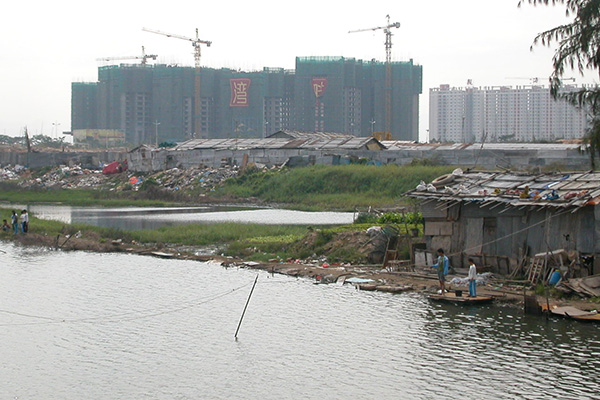
This image of the Shenzhen Bay coastline was taken behind the south gate of Shenzhen University in 2002. Squatters occupied the landfill and planted small vegetable gardens and raised chickens near their houses. Most worked in the informal economy, sorting garbage, working on nearby construction sites, and cultivating the oyster and fish farms that would be shut down in 2006. Today, the water has been reclaimed and is part of the Hi-Tech corridor that connects the Tencent Headquarters to University town via Shenzhen University, branch campuses of Hong Kong universities, and office buildings of Shenzhen and China’s top hi-tech companies. Indeed, this area was the site of the Shenzhen Maker Faire, 2015. The building under construction in the background is the Yangri Wanpan (洋日湾畔)estates, next to the Coastal City Shopping Mall complex. However, what strikes me more than the “that was then feeling” of a landscape transformed is the squatters’ clothing; even in 2002, when Shenzhen was still a manufacturing city, squatters would have difficulty finding jobs in the formal economy where appearance was part of gaining employment.
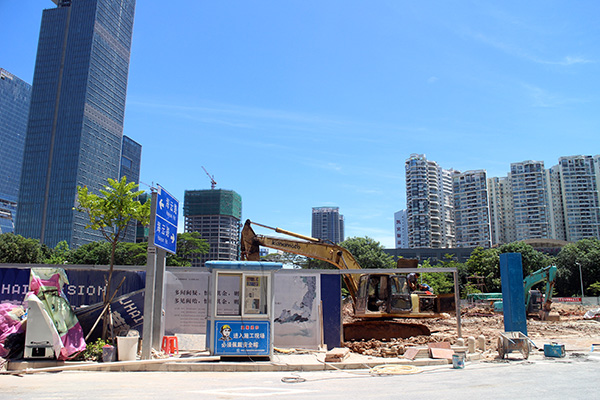
This is the Hi-Tech area, circa 2015. The white buildings in the left of the photograph comprise the Yangri Wanpan housing estates, which were under construction (and considered seafront property) in 2002. In 2015, the Hi-Tech area was the site of the Shenzhen Maker Faire, shown in the Chaihuo clip, below:
Current maps to Huaqiangbei suggest a state-of-the-art maker experience. High tech and high concept, these representations would have you forget how ordinary, how banal globalization actually is. The stuff of everyday life.
On March 29, Chengdu artist CHEN Weicai held his final salon at Handshake 302, showing us the work he created while in Baishizhou. He focused on two questions–materiality and rules of engagement. The results were inspiring. Here are a few of the pieces he created in and out of Baishizhou’s material substrate.
On March 23 and March 24, Handshake 302 brought the “Urban Flesh and Bones: Futian Edition” project to Shuiwei—one of our favorite urban villages. The Saturday tour was in Chinese and the Sunday tour was in English, but both tours were fully booked and even though the weather was overcast, everyone showed up. In fact, on Saturday afternoon, Handshake 302 led the tour in the rain!
This is another “not all villages are equal” note, this time about access to the Guanlan Foxconn campus, which is surrounded by urban villages. These villages have differently benefited from the world’s number one maker of electronics. At the end of 2018, for example, Dashuikeng (大水坑) made international news as Vanke prepared to top-down gentrify it. Located just outside the southern entrance to the Guanlan Foxconn campus, Dashuikeng has provided more than inexpensive housing for company workers; it also offers housing for married workers, workers who want respite from company management, and workers who want more privacy. In contrast, while Jutang Community (桔塘社区) abuts Dashuikeng, nevertheless, it is not conveniently located near either of the campus’ two gates. This has meant that the neighborhoods that comprise Jutang are less commercialized, with much lower end housing available for the company’s lowest paid workers–truly just a place to sleep. Jutang occupies over 4.5 square kilometers and has a population of 40,000 people. My impressions, below:
I have been used to thinking of the Cultural Revolution as the immediate backdrop to the ideological transformations initiated by the establishment of Shenzhen. However, as I was reacquainting myself with the cultural geography of Huaqiangbei I came across the Zhenhua Industries sign on Zhenxing Road. The logo is a throwback to Third Front industrialization, when futurist aesthetics still informed nationalist dreams. But what actually caught my eye was Jiang Zenmin’s calligraphy; by providing the calligraphy (题词) for this enterprise, the former General Secretary showed explicit support for the manufacturing company. After all, the most famous example of Jiang Zemin’s calligraphy in Shenzhen was written for Window of the World in 1994, as part of Overseas Chinese Town’s transition to leisure and tourism. So I was curious: when and how did he actively support Zhen Hua specifically and the construction of the Shangbu Industrial Zone more generally?
I know, you’re asking yourself: how is it already 2019? The date pounds like a migraine because once again we’re in the middle of a China-history countdown: 70th anniversary of the founding of the PRC, 60th anniversary of the start of the great leap forward famine, 50th anniversary of the Sino-Soviet border conflict, 40th anniversary of the “First Blast” of Reform and Opening chez Shekou, 30th anniversary of the Tian’anmen democracy movement, 20th anniversary of the crackdown against Falungong, and the 10th anniversary of Shenzhen’s decision to upgrade its “dirty, chaotic, and substandard (脏乱差)” urban villages. Continue reading →
When I first moved to Shenzhen in 1995, I lived at Shenzhen University, which at the time was located on the northern banks of Shenzhen Bay and boasted oyster farming on just beyond its campus border. In fact, for the first decade that I was in Shenzhen (1995-2005), land reclamation and the reconstruction of the coastline was one of the major ongoing infrastructure projects, even as the city shifted its economic emphasis from manufacturing to innovation. So for over a decade, I walked reclaimed land. As the landfill settled, grass grew, squatters came and went, and the city itself “washed its feet and stepped on land,” an expression that was used in the 1990s to describe the transformation of farmers into urban residents. Locally, the expression referred to how local villagers left their paddies and fish ponds to become landlords, while in terms of migrants, it referred to migrant workers who left their home villages to work in factories. Continue reading →






 Shenzhen Noted