Shenzhen abruptly arrives at the edge of something new, some palatable, pulsing readiness that has been growing beneath our feet, and launches us into unanticipated desires. Or so it seems today. Continue reading

Shenzhen abruptly arrives at the edge of something new, some palatable, pulsing readiness that has been growing beneath our feet, and launches us into unanticipated desires. Or so it seems today. Continue reading

By now you may have already seen footage of the Guangming landslide, which occurred yesterday at 11:40. The landslide buried twenty-two buildings and has affected 15 businesses. Only one person has been reported dead.
Help for the area is being organized on WeChat and weibo, and the research group reTUMU is also providing virtual updates. In addition, Chinese sites have a lot of information, however, to actually view videos (especially on Soku or Youku), you need to be using a Chinese browser. For those googling information in Chinese, the complete address is: 光明新区凤凰社区恒泰裕工业园. The word for landslide is 山体滑坡。
For those using non-Chinese browsers, this video has been uploaded to youtube:

So “Oysters and Champagne” the Shajing version opened this weekend and it was quite beautiful:


Meanwhile, Handshake 302’s installation, “n=distortion” also opened at the SZ-HK Biennale:


This rhythm of Shenzhen culture can overwhelm. Suddenly, there are installations, performances, and salons everywhere. We are inundated, but frankly often too tired to enjoy the deluge.
However, as a Cantonese proverb says, “Water is wealth.”
Yes.
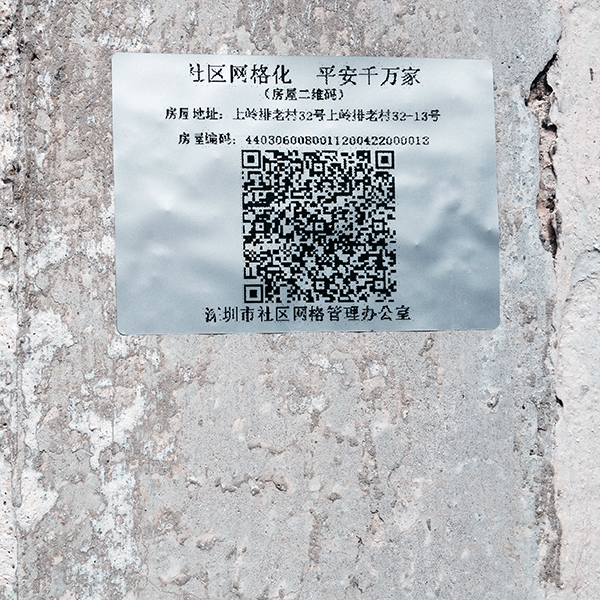
This past week, I toured Shangling Old Village (上岭村) in Dalang. Decaying villages like Shangling contextualize the “what came after” success story that is SHENZHEN! And yet. This contextualization depends upon one, standardized (and quite frankly boring) narrative of rags to riches, sudden wealth, boom boom boom, etcetera etcetera and so forth. Continue reading

A strange week that hasn’t coalesced into a statement so much as it has become fragments in search of glue; thinking as pastiche, and underneath it all a throbbing fear. Continue reading
A short video about “Of a Piece”, the project that Handshake 302 brought to the Shenzhen Art Museum, June 1-19, 2015.

Thank you, Karuna Ezara Parikh.

This week I have been thinking about iterations of the “local” in two sites: the 2015 Shenzhen Hong Kong Biennale of Urbanism/Architecture and the Baishizhou Street Museum. In particular, I’m thinking about the possibility of making connections from “here” to “there” when they hinge on the distance between (a) some outside understanding of what the local might be and (b) what might be interesting to actual locals. The possibility of meaningful dialogue is further complicated when “outsiders” and “locals” are organized by global hierarchies, internal class structures, and unquestioned ideas of what might be intellectually and/or aesthetically engaging. Continue reading
Last weekend I met two young men, 18 and 19 years old, who are filming interviews with and about “Shenzhen’s Second Generation”. We talked about the actual definition of a “Shen 2 (深二),” which I have tended to think of in terms of immigrant generations. In contrast, they were specifying the term also with respect to decades: they consider the 80s and 90s generations to be members of Shen 2, while 70s kids and millennials are not. They also noted that Shekou’s Second Generation (蛇二) is even more precisely defined; these are the children of utopian Shekou, who lived in the old China Merchants housing developments, and attended the original Yucai School.
So what defines Shen 2 kids? Continue reading
I have been applying for a grant. The US based foundation asks for a CD-rom of work samples, while it is still illegal in China to send CD-roms overseas (domestic mailing no problem.) Here’s the thing. It is perfectly possible to send mega-files from China anywhere in the world, even without a VPN. It’s also possible for foundations to store information on clouds and have a protocol for deleting extra information after a round of submissions. But instead of a simple information transfer, I’m stuck between two outdated systems for archiving (or not) information. Continue reading
 Shenzhen Noted