SZ8X8//The_Myriad_Transformations

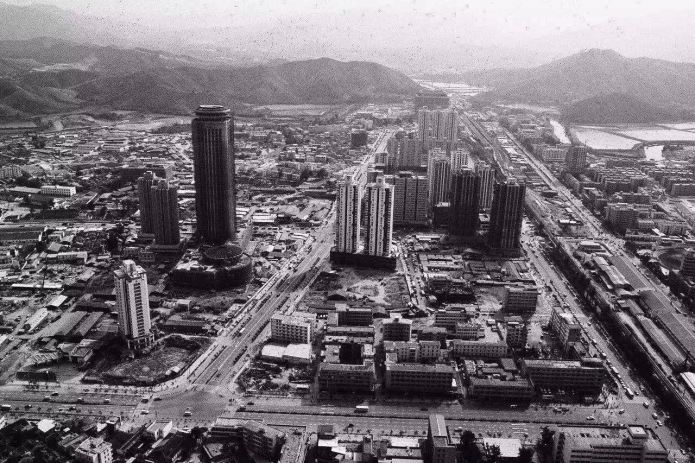
The Myriad Transformations comprises sixty-four images that I created using photographs taken between 2002 and 2010. These dates are arbitrary but not random, marking the purchase of my first digital camera (August 2002) and the decision to my rudimentary photoshop skills to create a project to commemorate the thirtieth anniversary of the establishment of the Shenzhen Special Economic Zone (during an artist residency at the Sitka Center for Art and Ecology, December 2008-January 2009). I finished the images in 2010. In the process of saving and transferring these files to smaller drives with larger storage capacity, many of the original photoshop files were lost. What remains as a complete set are the files I created to print photographs of the images in 2011 or 2012. I reopened one of these files in January 2019 and  realized they were more interesting in retrospect than they had been when I made them precisely because over the past decade (2010-2020), Shenzhen has re-invented itself yet again, and suddenly, abruptly, we see the latent structure of today in images that once upon a time seemed definitive, eternal even. Continue reading

an archeology of shenzhen’s digital daze…

A ten-year retrospective of Sui Jianguo (隋建国)’s work, System is currently on display at the OCAT Art Terminal. Across the street, Hua Museum, has showcased Miao Xiaochun (缪晓春)’s work in the solo exhibition, Simulations. Both artists have played with scale and method, calling attention to the material practice of creating in an era of digitalized mass production. However, where Sui Jianguo has interrogated the relationship between the human body, clay and its digitalized transformations, Miao Xiaochun has turned his attention to the relationships between digital simulations, imagined futures, and the resulting landscapes.

Continue reading

Rediscovering Shenzhen Market: The Commercial Culture of the Old Special Zone

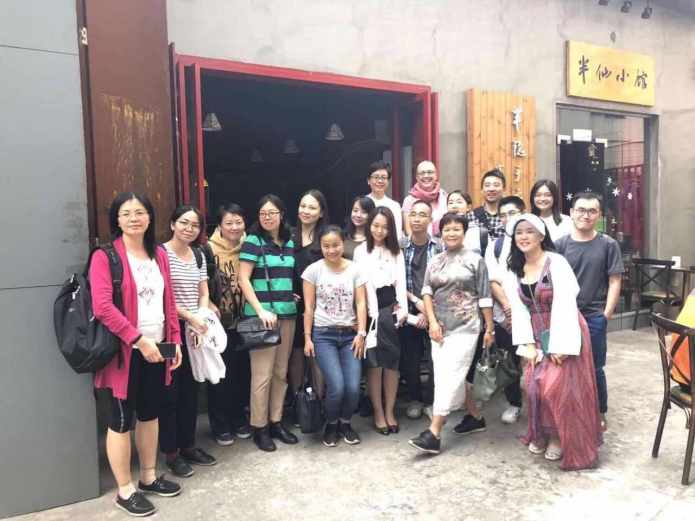
On Saturday November 24, 2018, over twenty people joined Handshake 302 on our rediscovery of  the commercial culture of the “Old Special Zone.” The program began in Hubei, traversed Dongmen and ended in the historic Guomao Revolving Restaurant. Over the course of the day, we discussed how Chaoshan migrants influenced Shenzhen’s “entrepreneurial” cultural geography, the role of the garment industry in Shenzhen’s early industrialization, and the way in which new infrastructure—especially the railroad and the East River waterworks—allowed the city to compensate for its lack of water resources. Continue reading

a victory for the common people?

So after the Municipality announced that it would suspend demolition of extant urban villages, villagers who will still have to hand their property rights over to the city took to the streets to agitate for demolitions. Because here’s the rub. The city has been using the demolitions as a way of regularizing property ownership, transforming the grays of collective ownership into the black and white of law. Now, the new plan will proceed with the regularization of property without the wealth that demolition has generated. Suddenly, there are villages facing what they clearly see as “lose-lose.” On the one hand, as the city upgrades living conditions in the handshake buildings, in perpetuity rights will become the 70 year rights of ordinary urban property. On the other hand, the transfer fees for those rights will no longer (can no longer) generate instant millionaires a la Gangxia and Dachong.

stories from the first “singleton lunch”

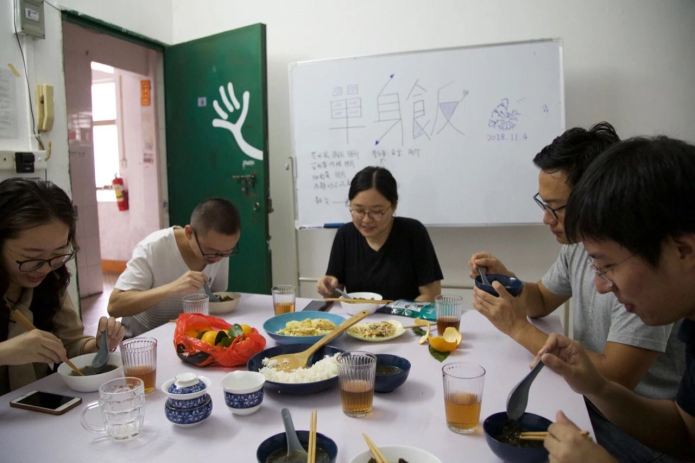
When the first “Singleton Lunch” was announced on November 1, we received 13 applications for three places. Everyone said that they were excited about the topic and we hope that in future, there will be opportunities for more friends to participate and share their ideas. (For the original article in Chinese, skip to the bottom of the post). Continue reading

hubei: bearing witness

So, Hubei Old Village isn’t being demolished, but it’s not being protected from the fallout of master plans and hammer drills. I walked the edges of the demolition area in and around New Hubei Village and the former Luohu Culture Park, which used to be one of my favorite public spaces downtown. Impressions of the withering practices that encroach on the “Old Special Zone, below.”

This slideshow requires JavaScript.

baishizhou: the city’s history through seven micro-environments

On October 14, 2018, Handshake 302 welcome a group of Chevening scholars to Baishizhou. We brought the Chevening scholars to seven of Baishizhou’s micro-environments. Each micro-environment not only illustrates the urban life of Shenzhen, but also represents an important moment in the city’s history. Continue reading

generations, again

The other day over lunch, a good friend expounded on the characteristics that distinguish children born in the 80s, 90s, and 00s based on what she understood of their parents, who were born in the 50s, 60s, and 70s respectively. Continue reading

the photography of he huangyou

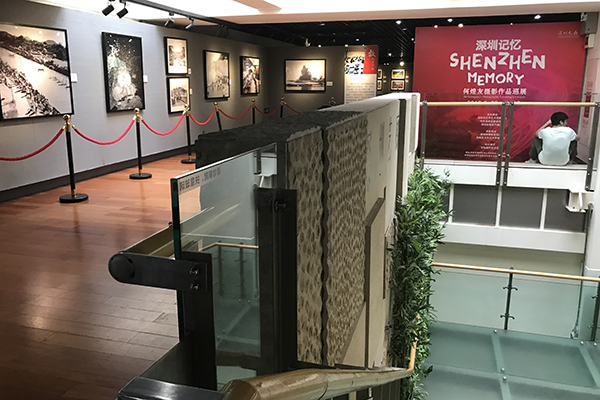
A current exhibition of the photography of He Huangyou (何煌友), Shenzhen Memory is something of a historical mashup. It includes many of He’s most-well known photographs, which have shaped our visual imagination of the Shenzhen before and at the cusp of reform. These photographs are well worth seeing in person. However, the exhibition neither contextualizes nor places the photographs in chronological order, leaving interpretation up to the viewer. This form of representation may in fact conform to what we know of how memory works–it is highly personal and unreliable–but it makes it difficult to place the images into larger histories. It feels as if we are suddenly viewing the illustrated introduction to the “fishing village to world city” narrative without bothering to mention that the exhibition includes pictures from at least three different coastlines and two different epicenters of reform (Shenzhen and Shekou).

Continue reading

Singleton Lunch @Handshake 302

“Singleton Lunch” is a thought experiment with food. Handshake 302 invites participants to prepare a meal for 4 to 6 people (the average size of a household). We provide rice, oil, seasoning, bowls, water and electricity. We give the chef five yuan per person to purchase ingredients anywhere in Baishizhou. The chef uses these ingredients to prepare a meal. During the meal, the chef leads a discussion about the challenges of making a home in Shenzhen. In other words, “Singleton Lunch” asks people to share their stories about settling down in a city, which is famous as a destination for unmarried migrants. Continue reading