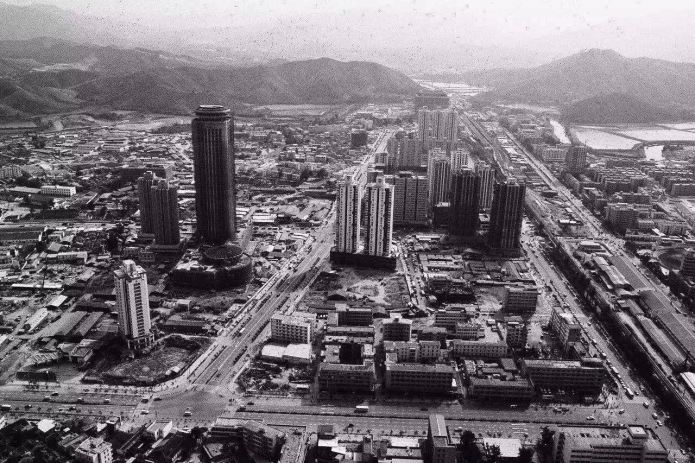
SZ8X802//The_Myriad_Transformations//City on the Fill

The next installment in the Myriad Transformations, “City on the Fill” is a series of riffs on land reclamation, both as an important feature of Shenzhen’s cultural ecology and as a metaphor for the replacement of southern Chinese culture with northern norms. 
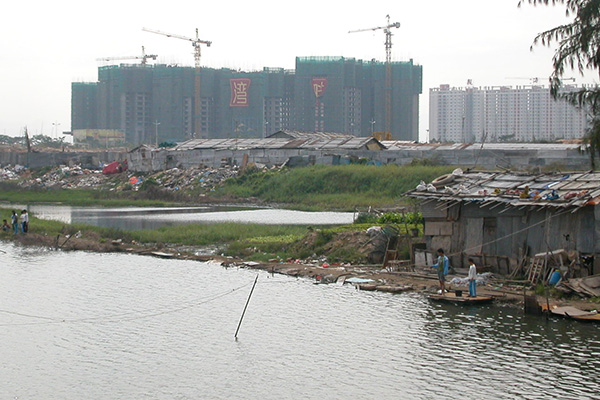
2002

This image of the Shenzhen Bay coastline was taken behind the south gate of Shenzhen University in 2002. Squatters occupied the landfill and planted small vegetable gardens and raised chickens near their houses. Most worked in the informal economy, sorting garbage, working on nearby construction sites, and cultivating the oyster and fish farms that would be shut down in 2006. Today, the water  has been reclaimed and is part of the Hi-Tech corridor that connects the Tencent Headquarters to University town via Shenzhen University, branch campuses of Hong Kong universities, and office buildings of Shenzhen and China’s top hi-tech companies. Indeed, this area was the site of the Shenzhen Maker Faire, 2015. The building under construction in the background is the Yangri Wanpan (洋日湾畔)estates, next to the Coastal City Shopping Mall complex. However, what strikes me more than the “that was then feeling” of a landscape transformed is the squatters’ clothing; even in 2002, when Shenzhen was still a manufacturing city, squatters would have difficulty finding jobs in the formal economy where appearance was part of gaining employment.
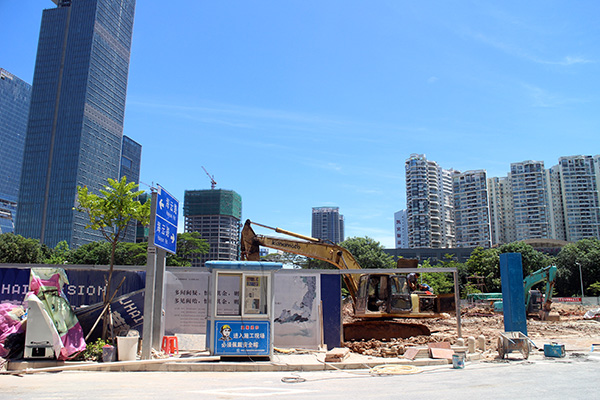
2015

This is the Hi-Tech area, circa 2015. The white buildings in the left of the photograph comprise the Yangri Wanpan housing estates, which were under construction (and considered seafront property) in 2002. In 2015, the Hi-Tech area was the site of the Shenzhen Maker Faire, shown in the Chaihuo clip, below:

Continue reading

everyday globalization

Current maps to Huaqiangbei suggest a state-of-the-art maker experience. High tech and high concept, these representations would have you forget how ordinary, how banal globalization actually is. The stuff of everyday life.

This slideshow requires JavaScript.

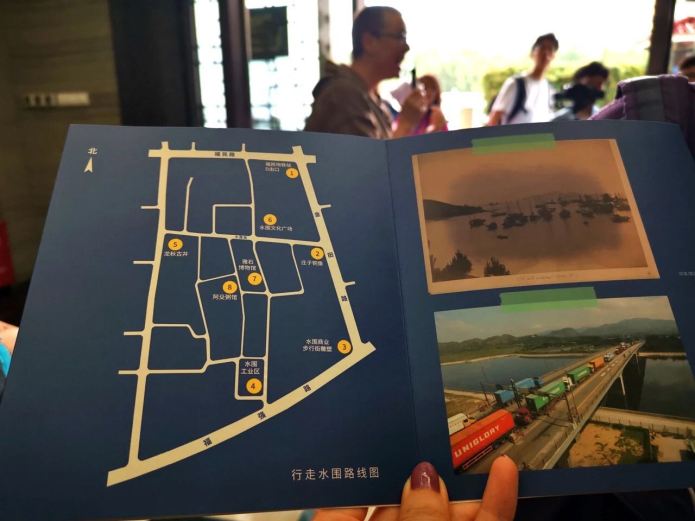
Shuiwei through an Anthropologist’s Eyes

On March 23 and March 24, Handshake 302 brought the “Urban Flesh and Bones: Futian Edition” project to Shuiwei—one of our favorite urban villages. The Saturday tour was in Chinese and the Sunday tour was in English, but both tours were fully booked and even though the weather was overcast, everyone showed up. In fact, on Saturday afternoon, Handshake 302 led the tour in the rain!

Continue reading

six year reprieve?

So, many of you know that Shenzhen has been debating what to do about urban villages. Half of the city’s population lives in one village or another, most of the city’s population has lived in a village at one point in their lives, and millions have set up mom & pops in a village, providing for themselves and their families through small capital investments. Just recently, the city approved the “Shenzhen Urban Village (Old Village) Comprehensive Remediation Plan (2019-2025) (《深圳市城中村(旧村)综合整治总体规划(2019-2025)》).” The key point, of course, is that the city is now choosing to remediate and upgrade village spaces, rather than demolishing and evicting residents. Continue reading

guomao: how quickly we forget

The image that many have of Shenzhen is a collection of state-of-the-art buildings because for years, these towers have represented the city and its progress. These buildings, of course, not only represent important state-owned enterprises in the Shenzhen landscape (China Merchants and China Resources, for example), but also provide a particular map to the city: the downtown investment area, Huaqiangbei electronic markets, Overseas Chinese Town, the recently opened Hi-Tech area along Shenzhen Bay, and the Dameisha beach. The latest skyline montage includes architecture from all over the city (labeled to the best of my ability):

Continue reading

SZ8X80106//The_Myriad_Transformations//Cut and Pastiche: That was then…

I know, you’re asking yourself: how is it already 2019? The date pounds like a migraine because once again we’re in the middle of a China-history countdown: 70th anniversary of the founding of the PRC, 60th anniversary of the start of the great leap forward famine, 50th anniversary of the Sino-Soviet border conflict, 40th anniversary of the “First Blast” of Reform and Opening chez Shekou, 30th anniversary of the Tian’anmen democracy movement, 20th anniversary of the crackdown against Falungong, and the 10th anniversary of Shenzhen’s decision to upgrade its “dirty, chaotic, and substandard (脏乱差)” urban villages. Continue reading

人才公园: the new new coastline

Several days ago, I walked from Coastal City (海岸城) to Shenzhen Talent Park (深圳人才公园). Previous walks–now long ago and far away, and besides that was a different city–had me wandering the reclaimed land behind Coastal City. However, the new coastline is as firmly in place as anything on shifting sands. What’s more, its a popular destination for families and this popularity deserves comment. After all, people are walking from the old new coastline (at roughly Houhaibin Road) to its newest coastline, a walk that takes at least fifteen minutes one way. Below are images that give a sense of the layout of the new park. In the maps, the purple line is Houhaibin Road, the approximate old new coastline. Continue reading

we’ve gone chinese opera

Anyone else following the musical choices of the plaza dancing aunties? This year, in my compound its suddenly Beijing opera, complete with drums, high pitched arias, and flowing sleeves. I had accustomed myself to the forgettable blandness of “my little apple.” And now, abruptly I learn that Beijing opera plaza dancing has been a thing for at least a year!


SZ8X80101//The_Myriad_Transformations//Cut and Pastiche: Lifestyle Leading the World

In Shenzhen, the ongoing transformation of a rural periphery into a mega-city is the latest chapter in global grabs to control  local significance. Located just north of Hong Kong, the Shenzhen area has comprised the Sino-British border since July 1, 1898, when the Convention for the Extension of Hong Kong Territory came into effect. Once upon a time, the Sino-Bbeen accomplished through a logic of practical means to endlessly churned out desires and there has been something cut and pastiche about the construction of Shenzhen. What, for example, to make of this advertisement for real east developer Vanke’s East Coast development in Yantian District? What kind of space is implied by the figure of Lifestyle Leading the People?

Continue reading

thoughts on social possibility at handshake 302

Why Singleton Lunch? Why invite someone to Handshake 302, have them prepare a meal, share it with a group of friends and strangers, and call it “art”? What’s the difference between a Singleton Lunch meal and more traditional forms of art like painting or theater or even a happening?

Continue reading