The women of Shuiwei continue to make the village, one treat at a time. For Grave Sweeping Day (清明节), they gathered in the village kitchen to make a variety of traditional snacks. The treats are steamed and vegetarian. What’s not to love?
The women of Shuiwei continue to make the village, one treat at a time. For Grave Sweeping Day (清明节), they gathered in the village kitchen to make a variety of traditional snacks. The treats are steamed and vegetarian. What’s not to love?
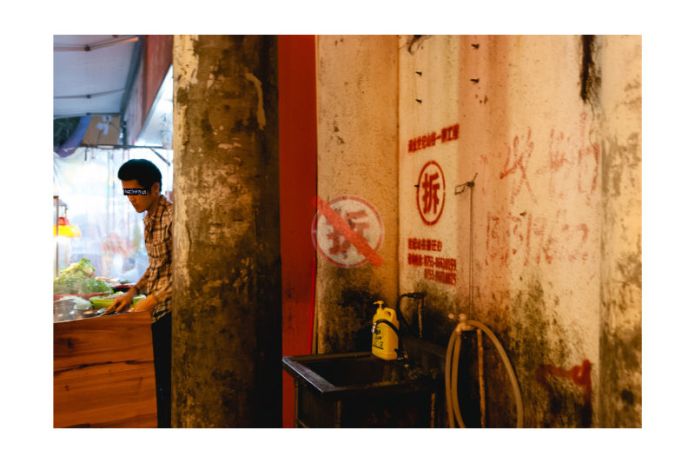
The demolition of the Shahe Industrial Park, Baishizhou (located west of Shahe Road) has been scheduled for April 30, 2016. The six-story factories are owned and managed by Shahe Enterprises and occupied by mid-size business owners. This area is the easiest to raze because it has a single property owner.
The image is from the ongoing “Don’t Raze Baishizhou Photography Exhibition” which meets every Saturday to photography Baishizhou’s residents and garner attention for the call for more equitable redevelopment.

How have our parents’ and grandparents’, and their parents’ and grandparents’ sojourns–some forced, some voluntary, and some taken on a whim–shaped the people we have become? It is a quintessentially American question, and yet it resonates in Shenzhen where almost everyone of the city’s 20 million people have migrated here from somewhere else. It also resonates because before the establishment of the Special Zone, emigration–rather than immigration, departure rather than arrival–informed family trajectories. Continue reading
For the third year, Group+ has ranked its top-30 online communities, which is interesting as it is part of a model of disseminating information about not-for-profit, non-governmental organizing. Over 1,500 groups use Group+, a Shenzhen-based online platform to organize real time “community” events. Fat Bird ranked 3rd, even above the Shenzhen Reading Federation (#5) and Green Mango (#13), which have much broader audiences than does experimental theater. What do these rankings tell us about the possibilities of imagining outside the state in Shenzhen specifically and China more generally? Continue reading

One would think, and one would not be wrong, that I spend much time thinking about urban villages and glass towers, or the differences between informal and formal settlements. That said, however, it is probably more to the point is that semi-formality allows Shenzhen to function as well as it does.
“Semi-formality,” Mehran Kamrava argues in his analysis of The Politics of Weak Control: State Capacity and Economic Informality in the Middle East,
Is not simply the result of entrepreneurs’ natural impulse to evade state regulations. It is, more fundamentally, a function of the state’s own limited capacities to fulfill the regulative tasks it sets for itself. The state’s uneven enforcement of regulative policies—uneven over time or in relation to different economic actors—allows nonstate economic actors, whether overwhelmingly in the formal sector or in the informal sector of the economy, to slip in and out of semi-formality.

December in Shenzhen is known as “Creative December”. The city has been officially promoting culture and creative industries since 2005, moving manufacturing to the outer districts, incubating start-ups, and funding creative spaces and so forth. Many of the large-scale, government promoted events during Creative December 2015 focused on history and memory and the scale of these imaginary formations. For those who often what to do on a weekend afternoon, this past December offered an embarrassment of choices in addition to the city sponsored Shenzhen-Hong Kong Biennale of Urbanism/ architecture and the Shenzhen Public Sculpture Exhibition, every single level of government and private art spaces sponsored large-scale cultural events that ranged from the first Kylin Dance Festival (in Longhua) to the Indie Animation Festival in Overseas Chinese Town. In addition, every weekend has been filled with lectures, workshops and salons. For those of us who work in culture—we paint or run galleries or act or produce plays or think about society and take critical photographs of changes in the land—December is the month when we present a year’s worth (or not) of endeavor to the public.
In January, before Shenzhen turns its gaze back to the problem of making an industry of culture—Culture, Inc, we begin rounds of New Year’s dining privately with friends and family, as well as formally with colleagues. During these meals, culture and Culture, Inc are discussed in tandem; there is a potentially large market for culture because everyone is vaguely dissatisfied and looking for spiritual forms of satisfaction that are also economically viable. Continue reading
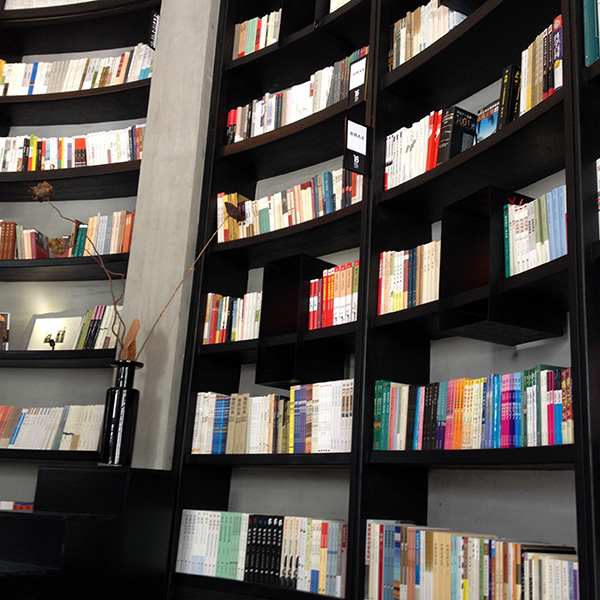
Shenzhen is a bookish city. Even a click over to the English language Alibaba site for “Book Printing in Shenzhen” suggests the extent of how many books are printed in the city. We are so awash in books that it is possible to use them instead of wallpaper when decorating. What’s more, many of my favorite cafes are not only decorated with books, but also serve as lending libraries via 青番茄, a Shenzhen based NGO. All you have to do is register online and then you are free to lend and return books at any of their almost 2,000 participating cafes in China. Continue reading
I’m participating in the Urban Futures Workshop at the University of Singapore, Feb 22-23, 2016. Participant abstracts and my abstract are online. If you’re in the neighborhood and tempted by critical geology, please join the conversation.

So “Oysters and Champagne” the Shajing version opened this weekend and it was quite beautiful:


Meanwhile, Handshake 302’s installation, “n=distortion” also opened at the SZ-HK Biennale:


This rhythm of Shenzhen culture can overwhelm. Suddenly, there are installations, performances, and salons everywhere. We are inundated, but frankly often too tired to enjoy the deluge.
However, as a Cantonese proverb says, “Water is wealth.”
Yes.
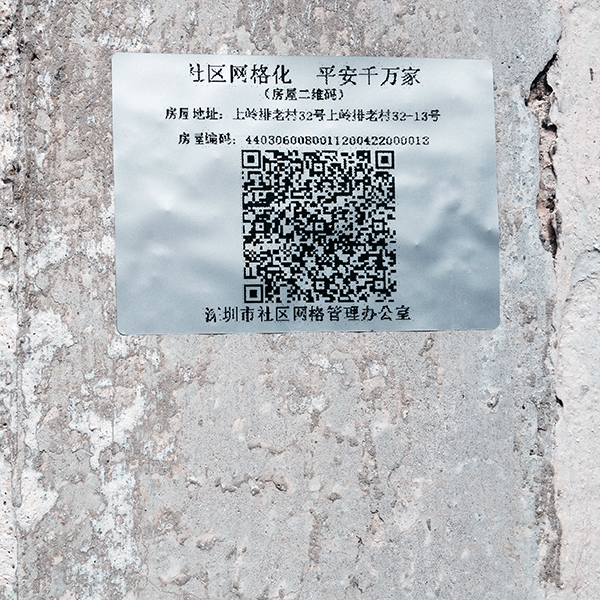
This past week, I toured Shangling Old Village (上岭村) in Dalang. Decaying villages like Shangling contextualize the “what came after” success story that is SHENZHEN! And yet. This contextualization depends upon one, standardized (and quite frankly boring) narrative of rags to riches, sudden wealth, boom boom boom, etcetera etcetera and so forth. Continue reading
 Shenzhen Noted