spring cocoon


spring cocoon

Originally uploaded by maryannodonnell

Nicknamed the spring cocoon (春茧),the Shenzhen Bay Stadium (built for the Universiade) is nearing completion. A group of Shenzhen photographers have taken night shots and, yes, the latest of Shenzhen’s architectural mania is stunning.

An earlier post shows what the area looked like a year ago, contextualized by a coastline shot from 2003.

settled in?

Am now moved into new home in Shekou. Yesterday, rode the Shekou line to Window of the World, changed for OCT East and arrived for coffee at OCT Creative Park all in about 30 minutes. Very convenient. Nevertheless, half an hour was more than enough time to notice and set me wondering about one or two, well three actually, discordant notes.

Do: The Shekou line advertising is playing to the cultural Nantou theme. Those who know a bit about Shenzhen’s history, know that Nantou is the oldest city in the area, having been a salt yamen 1,000 years or so ago.Know that there was (and still is) a small temple to those Gods that bless Cantonese Opera singers. Moreover, Reform began in Shekou and the first Chinese themeparks (strictly speaking) were built in OCT, Nanshan; Shenzhen University is also here. So, the Shenzhen Subway company has illustrated these themes from Nantou’s cultural history. Wanxia, for example, is morning tea and Dongjiaotou has a Cantonese singer. An image of Nvwa illustrates Shekou’s importance in Reform and Opening; Windows of the World is the Eiffel Tower.

Alas, those who know this history also realize that this historical trail ran along “old street” from the west gate of Jiujie to Shekou. They also know that know that there was no direct path (except a mountain trail over Nanshan Mountain or on a boat around the peninsula tip) from Shekou to Chiwan. However, the Shekou Subway rewriting of this cultural history is on the order of land reclamation and, in fact, the subway does not connect Shekou to Nantou, but instead at Houhai (and more about Houhai below) turns east, heading through Science and Technology Park South though Mangrove Park to Windows of the World. Thus, the Subway Station History of Nantou appropriates and displaces the cultural ecology of the area. Wanxia, for example, is a local village and yes, you can have morning tea there, but Dongjiaotou was a riparian port, where trade goods from Zhongshan and other parts of the Delta were shipped to and from Nantou. Today, Dongjiaotou is the site of The Peninsula Estates, high end real estate development that winds around a genuinely old and decaying, already being “reclaimed” part of Shekou.

Re: Within this postmodern rewriting of Nantou’s history, Houhai is now a subway station and no longer a sheltered backwater. I have commented upon the Shenzhen tendency to raze mountains and lychee orchards and then name malls and housing estates after the no longer extant land formation. Land reclamation naming practices follow apace. Not only only has Nantou’s cultural history been rewritten as a series of Subway Stations through what used to be Houhai Bay, but also that Bay is now just another subway stop.

More importantly, Nantou’s cultural history was a history of backwater fishing, oyster cultivation, and riparian trade between small, village owned docks. A two-step sequence of appropriation is at play. First, the actual socio-economic base of local history has been destroyed. The last oyster fishing folk were relocated in 2006. Thus, in order to live here, one needs to be part of the new economy, which includes real estate development and working in more abstract cultural industries such as academia and tourism. Second, local history is now being deployed to add “flavor” or “local interest” to rich outsiders who are inhabiting Shenzhen. And real estate promoters can get away with this because most of those moving into Nantou don’t know the history of the area.

Mi: I also noticed that on the “local street map” which hangs in our station, our housing estate is conspicuously absent. There still remains much construction behind us, although I suspect that come Universiade, our own Europe [Shopping Mall for those living in Dubai style condos] will open. Here’s the point: with the opening of the Shekou Subway our housing estate is now part of the historic backwater. And as those of us who have watched the development of Nantou know, the purpose of backwater has been to reclaim it for ever-higher end development. Once all the reclaimed land has been filled in, our short walk to the Subway makes our housing development a prime target for upgrading and us for resettlement. Upside to looming displacement: we aren’t the only affordable housing development not on the map and maybe someone else will be targeted first. More upside: negotiations to raze a development usually take longer than the actual razing an old development and building a new development. We probably have several happy years ahead of us.

So yes, we are as settled as anyone in Shekou, where the landscape has been reshaped, cultural history is being rewritten, and the sands of prime real estate shift beneath our feet.

ungodly creations

i have been thinking about the phrase “and god created the world in his own image.” i’ve also been wondering about how worlds get made and unmade in everyday life. a weekend of arts festivals prompted this speculation, which is necessarily permeated by the ongoing re- de- construction of shenzhen.

god’s gender provides a useful point of departure for thinking about what it means to create in one’s own image because, of course, there are (at least) two possible interpretations of “image”. image could refer simply to god’s face, snowy white beard and amazingly grecian and white toga. obvious and understandable target of feminist outrage. more interestingly and less exclusionary, image could also mean whatever happens to be going on in god’s head, which opens us to discussions that veer into dream interpretation. if we are every part of our dream, by analogy, god would be every part of the world as it was in the beginning, is now and every shall be…, begging the question: which part of god am i? and oh my god. you, too?

the play between image as what is visible and image as what we think was central to the subtlemob performance piece, as if it were the last time, which i saw saturday evening as part of the microwave new media arts festival.

the title of the piece itself, as if it were the last time is in the subjunctive, the tense where we suspend our disbelief and live the story as truth. the piece was created through the interaction of audience members with each other, a small commercial area of tsuen wan, and the other people in the area. the audience was divided into two groups, “lost” and “found”. both groups were given an mp3 with a mix of music, story, and instructions. throughout the 30-minute piece, the members of the two groups variously performed, watched each other, listened to the music and story creating a cinematic experience in the space.

last time played with both senses of image. on the one hand, none of the performers looked like an actor. on the other hand, in order for the piece to work, audience members needed enough familiarity with audiovisual conventions in order to appreciate what was happening. indeed, one of the more moving effects of this process was how the performance opened me more fully to those around me as if we were part of the same story and therefore the same world.

this spirit of creative exploration continued on sunday, when i enjoyed an afternoon with friends at the shenzhen bay fringe, including fun mime by the trip of mime, a group from hong kong and then participated in the fifth shenzhen pecha kucha night, showing twenty images of the transformation of houhai since 2002. uncanny moment that. the slides were projected onto a screen in the middle of a decorative pond where once was coastal water now a coastal mall. indeed, it was the sense of displacement that foregrounded for me the slippage between images as what appears and images in the mind’s eye. houhai has been razed and reconstructed so many times that there is no there on which to hang a history. the place crumbles away only to re-emerge as another version of modernity from someone else’s sketchbook.

now, i don’t know if our creative conflation of what is and what the mind’s eye sees makes us divine. it would be nice to think so, but my experience in last time has me thinking otherwise. the success of the experience hinged on collaboration, more on the idea that we are all part of god’s unfolding, so to speak and less on the imposition of individual images onto that world. more explicitly, the history of reclaiming houhai teaches that when we impose one image onto the diversity of life, we end up with less life and more pollution, not to mention fewer refuges for spoonbills to nest and mangroves to flourish.

and there’s the ethical rub. it is so difficult to understand myself not as a source of world transformation, but rather as an expression of the world itself and the role i am assigned.

size 36 C and counting

I have been thinking about the purpose of human human adaptability. To what ends and how should we craft human lives? The context for my speculation has been the constant construction and reconstruction of Shenzhen, where I have watched the landscape constantly morph and mutate as if it were an organism with a life of its own and not a collaborative human project; all that is solid melts into air. Today, I am wondering: what kind of bodies are co-evolutionarily suited to this landscape?

Lately, in Shenzhen, human bodies, especially female bodies  have been changing even faster than the skyline. Discussions about women’s breasts reveal the range of  emotions and level of bodily change out there. Anxious discussions about milk powders and early sexual maturation (“precocious puberty”) frequently appear in newspapers. The most startling was the claim that milk powder caused 4-month baby girls to grow breasts, even as celebratory discussions of Gong Li’s voluptuous figure have been ongoing for years. In between these two extremes fall hospitals like Sunshine (阳光医院 in downtown Shenzhen) that specialize in cosmetic surgery to provide any woman with  the perfect 360 figure and debates about the perversions there of.

The diversity of these breasts have me wondering to what extent our ability to manipulate the world and our bodies has distracted us from the real work of figuring out who and where we are (pun truly unintended! I only caught on rereading post). If women only needed to interact with sexual partners and  hungry infants, I could understand how “water drop (水滴)” shaped breasts might enable us to become fully human. However, the crafting of an individual’s purpose occurs over an entire life through interactions with many different people. Thus, whatever the immediate benefits of cleavage (or six packs or firm buttocks…), it seems short-sighted and limited to confuse sporting / touching a set of 36 C breasts with human development.

The construction and reconstructions of Shenzhen suggest not only that human minds can imagine and build a world, but the forms themselves indicate how deeply we share a yearning for transcendence. Each building stretches deeper into the heavens, the roads connect more and more places, boundaries burst with new activities. Each human being is attempting to become more beautiful.

My musing about these new bodies the has been in terms of an ethical telos. Being human means that we are completed – perfected, if you will – through maturation toward a distinctly human purpose. This development constitutes human transcendence and must be embodied. Thus, I am not making an argument against the pleasures of the flesh, but seriously asking if we have confused what we can do with what we ought.

the view from my window

stunning play of light. every morning, i wake to beauty, despite. and yes, hard to believe that this is the eastern edge of the houhai land reclamation area, viewed yesterday at sunrise, mid-day, and early evening.

i’m also experimenting with photobucket as a way of getting images onto blog. i can but hope…

The Sea of Desire is Never Filled – presentation


claire accepted 芒种

Originally uploaded by maryannodonnell

On Mar 7, 2010, I presented the “Sea of Desire” cycle of poetry and images at the Inheritance-Shenzhen art space in Baishizhou.

The performance was designed to encourage interaction between the audience and the works; indeed, i hoped that the images and poetry would encourage reflection on land reclamation in houhai. I am grateful to all who came and participated.

The performance and presentation were quite simple. Four images (迁海,芒种,塘,and 天) were laid on a table with calligraphy pens and markers. Members of the audience were asked to read the poems, alternating between the English and Chinese versions. When the reading concluded, the audience was invited to respond to the poems and images directly on the images. At the end of the day, i dedicated and signed the images over to four members of the audience. The four recipients will now grow each image-poem into a new work of art. Images and recipients, here.

The poems.

The Sea of Desire is Never Filled

I.

You ask what came before –

Before Backwaters were reclaimed,
Before Reforms unmade the Revolution,
Before Shenzhen Market was peacefully liberated,
Before South China Sea huaqiao built the Illustrious Ancestor School,
Before Li Hongzhang established China Merchants and Lin Zexu’s disgrace,
Before the Red Feather Barbarians occupied Tiger’s Gate,
Before gentle waves delivered Zhao Bing’s unblemished corpse to Tianhou at Chiwan,
Before divisions and revisions of prefectures and counties, villages and saltfields, oyster racks and pearls,
Before rope figures – delicate exemplars of the Middle Neolithic – danced on storage pots at Salt Head,

Let us be precise.

Before all this, there was what there is now – silt deposits, the twice-daily rhythm of the tide, weakening summer monsoons, phytoplankton, fish and shellfish, migratory birds, kandelia candel flourishing inflorescence, white, in ball-like clusters above the mud.

II. A Lexicon of Estuarine Desire

Spat
Cultch
Fattening ground

Brackish tides
Summer heat
Sweet discharge

Shuck
Suck
Bite
– dare I swallow?

Brackish tides
Winter cooling
Patient cultivation

III. American I wend

an unfamiliar coast, where oyster beds and buried toys, litter and despair thicken deltan arteries – the Shahe, Futian and Buji
Rivers channelized and redirected become bloated, choking runoff drains.

American I crash

on desiccated shores, which crumble as through dust I wander from Shekou east to Houhai, through western district landfill and village reconstruction
Zones appropriated and promoted do not a new world make.

American I sing

an unrequited (and yes) unwelcome dirge, when passport status trumps lament and unskilled, unclaimed teens drift in globalizing storms;
Meiguoren they say and neatly change the topic, what big guns you have.

IV.

On the edge of the known world
The previous barbarians swam and ate raw fish
Lived on boats and were forbidden land
They secured their young with ropes and threw them overboard.

Technical advances might have made it safer
– thin pipes for breathing, grease to keep small bodies warm –
But the shoals were just too deep and the harvest that uncertain

Children dove for pearls
And children were the reason
Savage, dangerous, naked like otters
They cast their offerings to the sea.

V. The Grammar of Evolution

The mind is not a mountain
Desire is not a sea

Yet each can be likened to each and in our likeness joined in thought through deeds, inherited habits of conjugation and decline –

We say, “The sea of desire is never filled.”
We also say, “Move mountains, fill the sea.”

When words become relentlessly literal
– As if language were mere talk
When metaphor becomes compulsion
– As if wishes could be commands
When articulation becomes unmediated truth
– As if poetry ought be research and design

When our lives are reduced to disfigured speech, then we level mountains to reclaim actual seas and call it progress. Full stop.

and in Chinese (translated by Yang Qian):

欲海难填

I
你是问从前有的

在填后海之前
在改革革了革命之前
在深圳虚被和平解放之前
在南洋华侨盖了“光祖学堂”之前
在李鸿章创办招商局和林则须自取其辱之前
在红毛夷占领了虎门之前
在暖的浪把完好如初赵丙送给赤湾天后之前
在郡和县,村庄与盐场,蚝架和珍珠被分离之前
在绳纹起舞盐头新石齐贮水土陶上之前

更精确一些

在着一切发生之前,原来有的就是现在有的—土壤泥积,一天两次有节奏的潮汐,越来越弱的夏季台风,浮游物,鱼和贝类,候鸟,红树开花,绚白的绣球闪动在泥土之上

II 三角洲性欲词典

蚝仔
水下蚝架
积肥区

咸的交潮
夏天的热
甜蜜的排泄物

撬縫


—敢下嚥?

咸的交潮
冬天的冷落
耐心培养

III 美国的我慢慢流

在不熟悉的岸边,蚝田,丢弃的玩具,废纸和失望堵塞了
条条支流—沙河,福田,布吉
河流治理改道变成壅淤的排水沟

美国的我撞到
干硬的岸边,细成灰,我穿过蛇口东到后海,从填海工程到旧村改新工程的尘土扬天
特区,被征用被推销但不是一个新世界

美国的我唱
一支单()是不受欢迎的安魂曲,在今天
比灵歌更动听,没有技术而无家可归的青年 泊与国际化的世界上
“美国人”他们这样改了话题,“你的抢真大”

IV

在开世界的边缘
前批野人 水吃生鱼
以船为家,无地可籍
他们用绳子拴住自己的崽儿,扔进海里

科技让这一切变得稍微安全
—呼吸器细 ,保温体油—
可海底太深而珠蚌难遇

孩子入水寻珠
孩子是入水的理由
野蛮、危险、海狸般赤裸的
野人 向大海献祭

V 进化的语法

心灵不是一座山
欲望不是一片海

语言让两个本不相联的东西在思想中结合
就如性交,遗传习惯让主语和谓语联结,名词变成形容词

我们说:欲海难填
我们也说:移山填海

当词变成无可忍受的具体时
语言好像成了扯淡
当比喻变成动机时
希望好像成了指令
当说事儿变成纯粹真现的自说 话时
诗歌好像成了科技研究和设计

当 生活 缩到没有了想象力的语言存在时,我们移山去填真正的海,为之进步。句号。

do not remove sketch


do not remove sketch

Originally uploaded by maryannodonnell

’nuff said.

for a wonderful gallery of shenzhen grafitti, visit the western bank of the shahe river bridge at binhai road. the old new coastline has been filled in, roads laid, and the river securely cemented in place. all is in place to continue extending the park. before that happens, visit.

to get to the gallery, it’s best to go to hongshulin park and walk west until you reach the shahe river: if you follow the water, you’ll even get a nice view (on a clear day) of the western corridor bridge and one of our many connections to hong kong. you’ll also have a view of the edges of land reclamation and the remnant wooden boats that anchor at docks strapped together out of styrofoam, bamboo, and plastic string. the eastern bank of shahe is at the furthest edge of the baywalk park that hongshulin is growing into.

(yes, just last week i realized that xiasha is renovating with an eye to integrating into this extensive park and wanke has donated strange log cabin / guard stands to hongshulin.)

if you walk from the west (as i did), begin at coastal city. walk past the kapenski, shuffle across the binhai on ramp and follow the wall that says “western district land reclamation area”. at different points, you can jump onto the landfill. keep your eyes open for granite posts. these were once the safety chain links along the former coastline and proposed extension to baywalk park. pay attention to the names of the buildings – not just “coastal city”, but also “river’s edge” and “bayview”. many of these residences and shopping areas were undertaken before the coastline was redrawn. be sure to notice the motley crew of puppies that guard another patch of squatter gardens and chicken coop. bring water. the walk takes about 90 minutes and the sun is hot.

unexpected encounters with tradition…

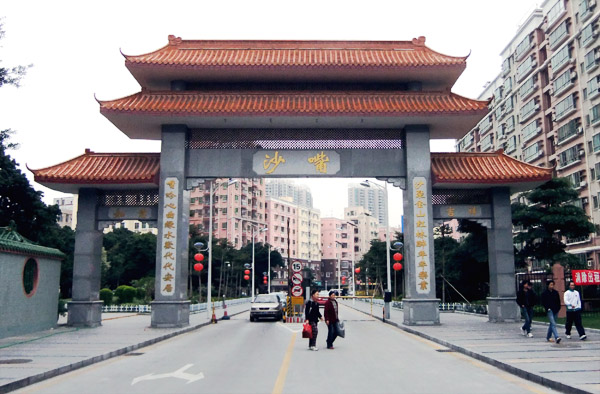
Entry gate to Shazui

Shenzhen villages are places of unexpected encounters with tradition, living and reworked. Indeed, these encounters are reason enough to meander through the villages. Just to the left of the entry gate to Shazui, for example, is a temple to Hongsheng (沙嘴洪圣宫), which is kept by an older Shazui couple. I asked about Hongsheng and they invited me to sit and chat.

Historically, Shazui villagers made their living fishing in the northern section of the South China Sea, beyond the mouth of the Pearl River Delta. Hongsheng, as his name “Flood Victory” suggests is a god who protects fishermen of the South Seas. Hongsheng is also sometimes thought to be 祝融 (Zhurong the god of fire) and THE god of the South Seas, suggesting that Hongsheng is either a local manifestation of a more general god, or was a specific god that was absorbed into a larger tradition.

From a decidely brief net surf, I have gathered that Hongsheng is very local. Most of the temples I came across were located in Hong Kong and this temple is the only one that I (thus far) know about in Shenzhen. Indeed, the Ou Family Association from Hong Kong (沙嘴[香港]欧氏宗亲会) had provided the computor printout with information about Hongsheng, which again suggests how local this god is. I’m wondering if this is because Hongsheng protects ocean fishermen? That said, throughout Nantou, most temples are dedicated to Tianhou (天后) with the largest temple at Chiwan.

So a post that begs more questions than it answers. Why Hongsheng and not Tianhou? Why only in Shazui? How important is the Hong Kong connection to the temple’s maintenance?  And why is the temple located at the gate? Questions, questions. More to follow as I stumble across answers…

thinking food: images from the houhai overpass, 2002-2010

this post is a brief contextualiztion of  china lab’s  landgrab city exhibition for the shenzhen-hong kong biennale 2009. the exhibit draws attention to the the ways that cities are imagined without reference to the countryside and food production. it also usefully brings china into international conversations about urbanization.

The countryside is a vital but frequently overlooked category in the contemporary discourse around spatial policy, and its role with respect to the future of urbanism is more often than not neglected. Landgrab City is an attempt to visually represent the broader spatial identity of the 21st century metropolis; it proposes a new spatial definition of the city and thereby a more complex understanding of urbanism, one that no longer considers city limits as the boundary of its remit, but instead looks beyond – even across international borders – to the spatial, social, economic and political implications of the planet’s rapid urbanization.

i support efforts to think about food – its production, distribution, unequal consumption – are all critical to how shenzhen is imagined, experienced, and reproduced. nevertheless, this exhibition disturbs me because it discusses shenzhen as if the city were one wealthy enclave, rather than an amalgamation of enclaves -rich, poor, and destitute, which abut and constantly disrupt one another.

shenzhen has sold itself and reform in precisely the terms that china lab uses to describe the city’s “reality”. unfortunately, by taking shenzhen’s self-promotion as fact, rather than promotional fantasy, china lab overlooks  how rural migrants inhabit and  transform shenzhen. this silence distresses me because the spatial, social, economic, and political consequences of shenzhen’s modernization are not implied; they are facts of life for many migrants.

so a very simple point:

In reality, of course, these agricultural territories are not actually clustered around Shenzhen, as in the installation, but scattered across China and contiguous regions.

counter point: a five minute walk from the land grab project, agrarian squatters have persistantly grabbed, evacuated, and reoccupied  a portion of the houhai land reclamation area to grow food, which they eat and sell. the differences between overpass then and now are now are instructive because they illustrate both the persistance of shenzhen’s rural poor as well as their increasing destitution.

the map below locates the land grab project with respect to several generations of agricultural squatters at the houhai overpass.  pictures of the squatters and their gardens, here.

the houhai overpass is located at the intersection of houhai and binhai roads. in the map, the squatter areas are located in the southeast quadrant of the intersection, coastal city in the southwest, and the land grab in the northwest. these areas are roughly a five minute walk from each other. in the map, the blue areas used to be underwater; the brown areas were not.

深大南区:the map is not the territory


the map

Originally uploaded by maryannodonnell

Once upon a time, this territory was ocean. There were oyster farms and fishing boats. And the people who lived here had single story homes that came to represent the poverty that these maps and plans would end.

The effort it takes to force territories into maps pulses through each inch of the houhai land reclamation area. Lines imagined elsewhere are being bulldozed, pounded, and moulded into six-lane highways and ten-lane expressways. Beside these roads climb glass buildings and residential developments with exotic gardens – palm trees, English grass, a goldfish pond, which is drained and cleaned once a month.

This is the territory – unmapped, but not unsung: Beneath the grey sky and rising walls of a high-tech research compound, a woman washes vinyl advertizing sheets for indigent tenting, paths veer in hidden enclaves that serve as public toilets, and a child plays on a piece of flatboard that has been placed protectively on top the mud.

Shenzhen’s poor are poorer than they were 15 years ago, when squatters had enough space and privacy to build small shelters beneath the lychee orchards that have also been imaginatively disappeared.

May the new year bring new possibilities.