fairy lake botanical garden: naturalizing control

These past two days, Zhang Kaiqin led a Handshake 302 art workshop in the Shenzhen Fairy Lake Botanical Garden. The workshop was organized quite simply: on the first morning we learned about the plants and then in the afternoon and next day we created site-specific art. The only rule was that we couldn’t bring anything (except tools) into the botanical garden. And that limitation led to visceral experience of how narrow the actual space for creative subjectivity is in modern spaces.

Continue reading

啃老: on millennial poverty

In 2010, when many of the 90s kids where applying for college, they were encouraged to become economically independent. Shame was also deployed, and recent college graduates who couldn’t find a job and continued to live at home were accused of “gnawing on the old folks (啃老)”. Of course, these were the same kids who were also accused of “being too rich for their own good (富二代)”. Continue reading

dinner plans

Here’s the thing, when making dinner plans–or dim sum plans or coffee plans or dinner plans–there are some neighbourhoods that are better than others.That said, its also clear that the consequences of village demolitions and ongoing construction of residential developments at subway stations include the replacement of independently owned restaurants with more expensive chains. This means that it is not only increasingly harder to afford just to go out, but it is increasingly difficult to find mom and pops places around the corner for a cheap night out. Sigh.


baishizhou, dusk, 2016.12.20

They will soon begin digging the basement and putting in foundation where the Shahe Creative Park used to be. As I have yet to invest in a drone, I resort to climbing–past the five&dime, the yoga studio, the taikwando studio, and the Shahe Creative Park Office–to the top of a partially cordoned building to take pictures of the changing landscape:

This slideshow requires JavaScript.

this year, christmas in dalang


When I was young, Christmas was a special time that started just after Thanksgiving. Indeed, in the month before Christmas there was much work. We made lists of presents for our parents, siblings, and friends. We went Christmas tree shopping and then spent an evening decorating the tree. Each decoration had a story. Each year I would make an angel or Christmas mouse for the tree and my mother had special lights. We practiced singing carols and made cookies, delighting in reindeer and elf shaped cookies. We watched the same classic movies (“Miracle on 42nd Street” and “It’s a Wonderful Life”) as well as the same TV specials (“Rudolph the Red Nosed Reindeer,” “Santa Claus is Coming to Town,” and “Frosty the Snowman.”) Several days before Christmas we went on vacation and if we were lucky and if it had snowed, we made snow people and snow angels, and then when we were cold and tired we had hot chocolate at a friend’s house. The night before Christmas we made a plate of refreshments for Santa Claus and even remembered to put out carrots for Rudolph. And then. On Christmas morning we woke up laughing to discover what presents Santa had left us and to feast and play all day. Even today, Christmas still sparkles in memory and I am happiest when I have a chance to go home and celebrate with family and friends. Continue reading

flash exhibition / baishizhou

Last night, the Baishizhou Squad (as I think of the loosely organised group that is dedicated to documenting and finding alternatives to redeveloping urban villages) held a “flash exhibition” of images from their “Don’t Demolish Baishizhou” series. The entire performance took 30 minutes: 25 minutes to put up the images and then roughly 5 minutes for the city management folk to take them down. They chose to put the pictures up near the pharmacy, which is contesting the demolition in order to secure compensation for his investment. Continue reading

half-urban guangzhou

These past two days, I have been in Leming, a mountain village located in the northern reaches of Guangzhou. It’s a site where one confronts the unevenness of development, where artists and environmentalists are trying to do something meaningful with what remains after the most of the village’s young people have left for factories in “Guangzhou” proper. Continue reading

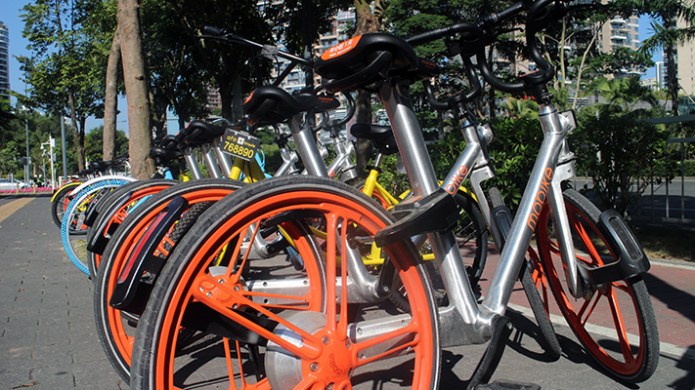
bikes. this time with feeling

When I first came to Shenzhen, bikes were so common it took me a while to notice them. However, by the time I did notice them, they (the bikes) were actually being pushed off the streets in favor of cars and the emergent commuter economy, which did not yet have a metro and so relied on cars. In turn, the number of motorized and electric bikes became prevalent, with motorbike taxis a common form of transport in parts of the city with inconvenient or no public transportation.

In November, the city (or at least the inner districts) went full on bike and now these rentals can be found throughout the city. Rental bikes are provided by at least four different private companies and for 1 rmb per half hour, one can pedal from subway station to home, or take a leisurely ride. These new bikes have disrupted two businesses that were once controlled by private entrepreneurs: site-seeing bikes in Mangrove Park and motorbike taxis. The most recent massive removal of motorbike taxies from the urban environment that took place in April of this year. Nevertheless, banning motorbikes and electric bikes has actually been an ongoing, decade-long project. See reports here (2003), here (2007)here (2009), and here (2011).

fuyong new village / bao’an road

It’s instructive to jump off the number 11 subway line, once its passed the airport station. In Bao’an District, the No 11 line runs parallel to Bao’an Road, which delineates the inner border between the older, historic village settlements and their industrial parks. East of Bao’an Road, one heads toward the Pearl River, land reclamation, and scattered reminders of this deeper history. West of Bao’an Road, one heads through large industrial parks toward National expressway G107, which was the road that first connected the original Special Zone to Guangzhou via Songgang (images of a 2008 walk, here). At Nantou Checkpoint, National Highway 107 becomes Shannan Road and a fast track to the inner district real estate boom. Continue reading

baishizhou housing update

This is just a short note on a conversation that I had a few days ago with an entrepreneur who lives in Baishizhou. She’s a millennial, runs a small business, earns over 10,000 a month, and lives in Baishizhou. Why? Because she wants to buy a house in Shenzhen and living in an urban village is the only way to save money for the down payment. It turns out she’s not alone. Her friends who want to purchase a home in Shenzhen are opting to live in a village, while friends and other millennials who have decided not to buy a home are renting in housing estates. On her account, even folks who are making upward to 20,000 a month are choosing a village if they want to buy a home, while their colleagues who aren’t saving for a home are paying three to four more times a month, traveling, and spending their money and time cafes, microbreweries, and music venues. These are, of course, first generation migrants. Most second generation migrants have houses through their parents, who migrated to Shenzhen before the 2004 housing price boom.

Takeaway? We’ve known for a while that many nearby firms provide dormitory housing in Baishizhou, while many architects and designers who work in OCT firms have opted to live in the village for convenience. It seems, however, what we hadn’t picked up on (or has only recently emerged) is the extent to which the desire to buy a house in Shenzhen is shaping the way that millennials are inhabiting the city and reshaping the urban villages.