baguang

For those who doubt that once upon a time Bao’an County was coastal, I offer images from Baguang, one of the more beautiful sections of Dapeng New District. The majority of Baguang villagers have been relocated, while land and coastline have been red-lined for environmental protection, green living and research. At the moment, Baguang shimmers at the cusp of redevelopment–not yet remade, but yet already under erasure. Boom!

This slideshow requires JavaScript.

one tradition, two villages

The entrance to Changling Village (长岭村) is located on the southern side of Luosha Road at the foot of Wutong Mountain. Before the construction of the Binhai Expressway (1999) and the opening of the East Coast Highway (2008) made traveling across Shenzhen commonplace, Changling marked the practical eastern edge of the early Special Zone. Today, however, Changling is conveniently located on the J1 bus route which connects Seaworld at the southern tip of the Nantou Peninsula to Dameisha on the eastern edge of the Dapeng Peninsula. The entire trip takes 90 minutes without traffic, but usually takes over two hours. Indeed, the J1 route traverses the entire Shenzhen-Hong Kong border, and its constituent roads—Houhai Road, Binhai Expressway, Binhe Road, Luosha Road, and Huishen Coastal Express—literally name the waterways and migrations that once shaped the area: Backwaters, Oceanside, Riverside, Luohu to Shatoujiao, Huizhou to Shenzhen. Continue reading

chimerican geographies of opportunity and despair

This year I was in the Chinese northland during the first week of the Trump presidency, a fact which had me thinking about national geographies of opportunity and despair. (Honestly, how could I resist when we were celebrating the Year of the Cock?!) Of note? The pride and resentment, wellbeing and jealousy that I encountered in the Chinese interior resonated with my experience of the American heartland, where my parents were born, even as the valuation of Shenzhen and other southern cities seemed much like American valuations of  the progressive northeast, where I was raised.
Continue reading

wishing you prosperity

100 rmb notes and US C notes go together like boy and girl, like modernity and tradition, like Mao Zedong and Benjamin Franklin, like officialdom (guanfang) and society (minjian), like yang and yin. I was thinking about how in Shenzhen du jour tradition is being (re)constituted through economic reform–specifically, I was thinking about how tradition has become the vehicle that naturalizes the demolition of (unnatural) urbanized villages in a city long described as “lacking history,” and this matched New Years set shows up on the entrance to my apartment building. As with many symbols of Chimerica, gender suggests the multiple forms of power that create particular subject positions, especially in the figuring of ideal relationships, where even if the male, head-of-house holds money that is ostensibly worth less than the female, nevertheless, in Chimerica East the primacy of renminbi makes sense (cents) precisely because “tradition” keeps us in place.


hi-tech houhai

img_0302

Those who have followed Shenzhen Noted for the past twelve years know that the reclamation of Houhai Bay has been one of my ongoing obsessions. Today, I walked again and found myself momentarily confused by the current grid; previously I used Binhe Road and its constructions to locate myself. I’m trying to think through what it means that sand has become glass. It is not the case that “all that is solid melts into air,” but rather all that was liquid solidifies and congeals. Mummies and amber. Dinosaurs and fossil fuels. Anyway, photos, below:

This slideshow requires JavaScript.

changling village: spring festival traditions

Tonight, I was one of roughly 2,000 people who welcomed spring in Changling Village (长岭村) by eating pencai together. Like a wedding banquet, a pencai banquet constitutes society table by table. The hosts were the 40-odd families who belong to the village, and their guests came from the Hong Kong side of the family, affines from neighboring villages, friends, street office officials, and representatives from the developer who aims to transform Changling into high end real estate on the Shenzhen River.  Continue reading

hubei / fuyong: tracking history

So Hubei and Fuyong, two of Shenzhen’s “ancient” villages.

img_0102

Hubei Panarama

311484184146_-pic_hd

Fuyong Panarama

Continue reading

learning from shenzhen at HKU

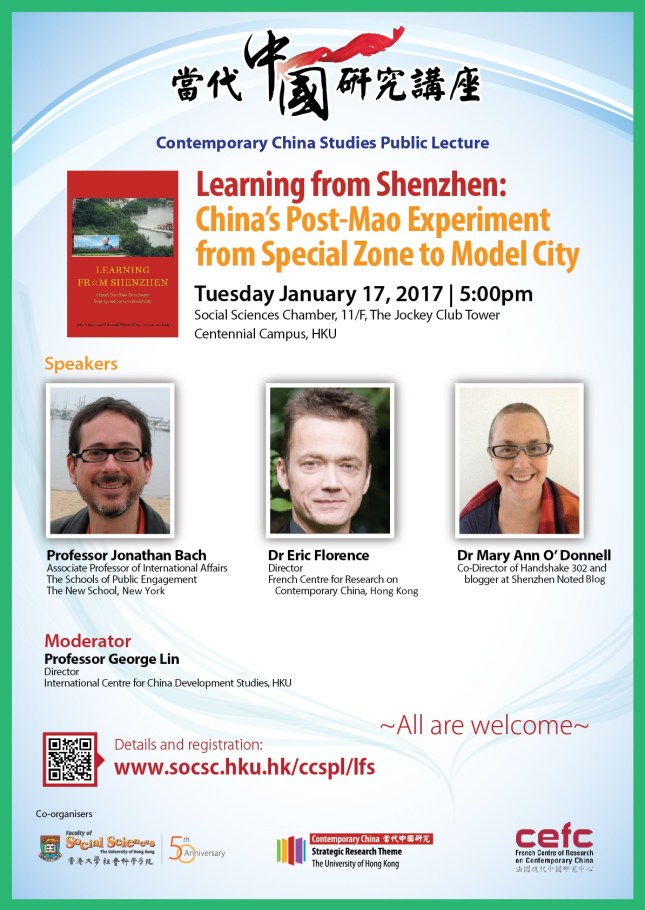
Jonathan and I will be joining Learning from Shenzhen contributor, Eric Florence at 5:00pm, January 17, 2017 in the Social Sciences Chamber, 11/F, The Jockey Club Tower, Centennial Campus, The University of Hong Kong. Please join us.

hku

learning from shenzhen

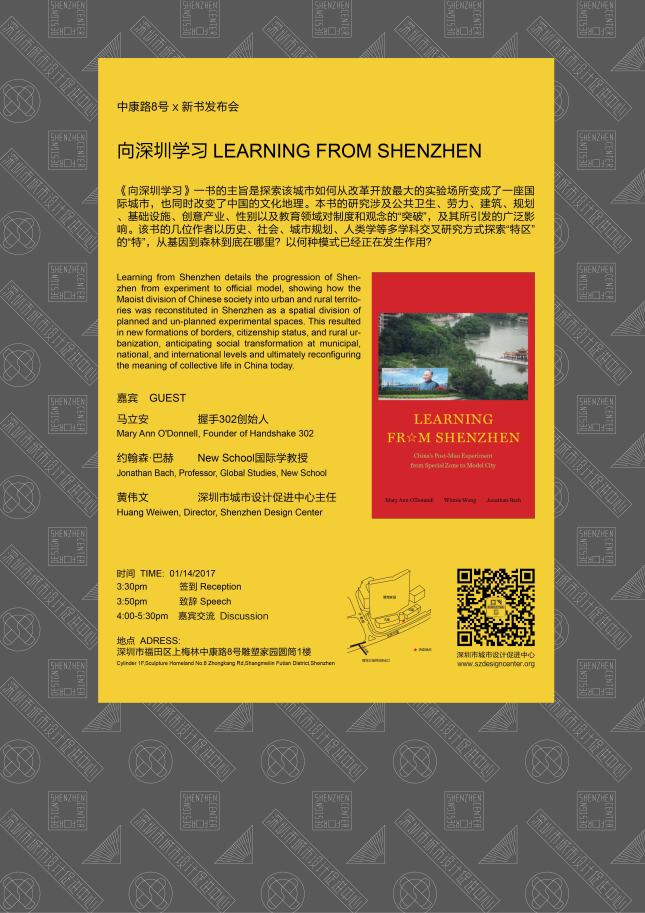
The book is out (and can be purchased, here). Please join us at the Shenzhen launch!

%e8%ae%be%e8%ae%a1%e4%b8%ad%e5%bf%83

free associations, or, what does baishizhou mean to you?

Yesterday, I visited the two-day exhibition that Xu Lan (徐岚) put up in a one-bedroom apartment (2,400 / month) in Tangtou Block 6, Baishizhou. The exhibition took place over two days (Jan 8 and 9, 2017) and comprised mountain and water sketches / illustrations from a week-long stay (previous) in Baishizhou. The series itself is part of an ongoing project of travelling and documenting those travels. The inspiration for the exhibition (as narrated by Xu Lan) was random (偶然). He was thinking of the painter Qi Baishi (齐白石) and painted his own “Baishizhou” and then decided to show the works in Baishizhou, Shenzhen because he remembered having been here once.

img_5784

Continue reading