spizzwinks in shenzhen

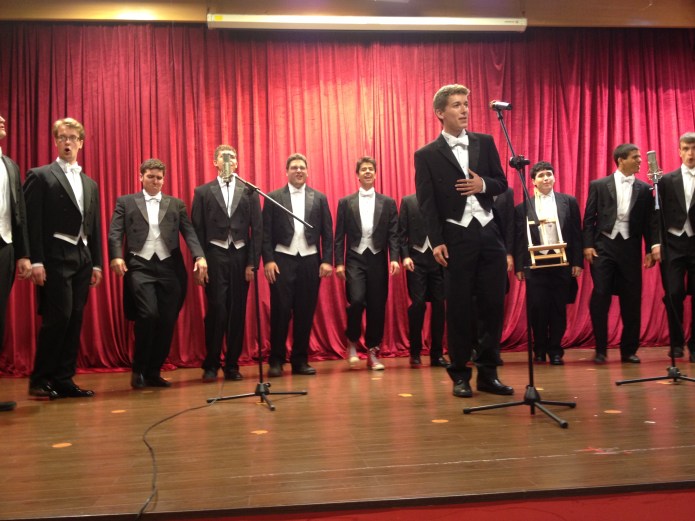
Just spent the past 2 and a half days tagging along with the Spizzwinks. They are all that. Energetic, generous with their smiles and attention, respectful, and talented. And yes, the Spizzwinks charmed and amazed three very different audiences at the Mass Arts Theater (群众艺术馆), Green Oasis School, and at the Dalang Culture Center (大浪文化馆), hopefully inspiring more people to sing and join choirs.

The hospitality of the Shenzhen hosts completed the exchange. In Shenzhen, friends arranged a large dumpling making banquet for the group, in addition to a delecious dim sum brunch before the GOS concert. In Dalang, we were taken to see a factory showroom, libraries that have been set up for workers and their families, as well as to meet the unicorn dance troupe. I was especially moved by the talent and passion of the Dalang Workers Youth Choir, whose members work during the day and practice two hours once a week. One of the troupe members works in a watch factory and handmade 17 watches, one for each Spizzwink.

This trip reminded me that successful cultural exchanges are everywhere the same: when we give all that we are, we all share in the joy.

Incomplete impressions, below.

This slideshow requires JavaScript.

futian village

After several months, I return to my synopsis of The Great Transformation (沧海桑田:深圳村庄三十年). This episode is about Futian Village (富田村), which begins raising the counterintuitive question of why Walmart would build a megastore in Futian Village. The underlying message of the episode might be half-facetiously summarized as “location, location, location”.

The story of how Futian Village became known as Futian suggests the shifting contours of village lands. 田 (tian) of course meant “paddy” or “fields” and has been constant over history. Over 900 years ago. One went to Futian, one settled in Shangsha, and the third went to Yuanlang in what today is known as the Hong Kong New Territories. However, the village was originally called “Getian (隔田)” because it was separated from the mainland by a stretch of seawater that extended to Tianmian. Over time, sedimentation filled the marshy areas between the coast and the separate fields. This new agricultural land was called Futian (幅田). When the name was formalized during the Mao era, the village was named Futian (福田), which included the character 福 (fu – prosperity), a homophone for 幅 (fu -meaning landfill). According to an old villager, “real Shenzheners” call him “Getian person (隔田佬)”.

In fact, the history of the area is the transformation of the status of fields. Before 1980, Futian villagers cultivated grain, sugar cane, and peanuts. The village itself was defined in terms of these land holdings. They were organized as one brigade, which was further organized into two work teams – total population 1,000 people. However, according to the old Village Party Secretary Huang many more villagers escaped to Hong Kong before reform. At the establishment of the SEZ, the village occupied had strategically located land holdings, at the edge of the Luohu downtown area. In 1992, when inner district villages transferred historic land rights to Shenzhen Municipality, the village developed rental property and commercial areas. There were two key developments that went on to have national impact. Firstly, in 1998, Walmart opted to open its first megastore in Futian Village. In turn, the Futian megastore became the model of how to operate a Walmart in China. Secondly, the Venice Hotel chain also opened its first hotel in the village.

1990s and early turn of the millennium corporate village development emphasized profit rather than public space. Importantly, however, Futian Village was located directly adjacent to the new central axis area. However, when the new Civic Center opened, Futian Village was required to upgrade accordingly. In 2007, when Futian decided to build a new culture plaza, then Futian District Party Secretary, Lv Reifeng reputedly said, “I can’t give you funding to build the plaza, but I can give you a policy.” The policy was quite simple: Futian District gave 30% of the total cost to build the plaza.

To recap: The Great Transformation tells the story of thirty Shenzhen villages. Importantly, the idea of “village resident” in the series constantly shifts between “indigenous villagers” and “migrants who live in the village”. This slippage is subtle but hinges on the way in which urbanization has not only transformed fields, but more importantly restructured property rights. For example, when the narrator says “villager/s (村民)”, he clearly means “local villager/s”, referring to those who own buildings and have stock in the collective holdings. However, when he speaks of “urban villages (城中村)”, he means the urban neighborhoods that evolved out of the previous village. More tellingly, the slippage between “villages” and “urban villages” structures rhetorical questions throughout the series. The episode, “Futian Village”, for example, opens with the rhetorical question, “Many wonder why one of the world’s 500 richest companies would choose to open their first megastore in an urban village.” Clearly, the intended audience of the serial documentary continue to view urban villages as rural villages rather than urban neighborhoods.

return to dafen

Yesterday I visited Dafen for the first time in over a year. Noticed several tourists, better coffee shops, and a store selling Tibetan clothing. It seems that Dafen’s makeover from site of copy painting production to a shop-front / tourist site continues. Impressions, below:

This slideshow requires JavaScript.

yan’an by way of frankfurt

Theodor Adorno and Max Horkheimer’s 1944 essay The Culture Industry: Enlightenment as Mass Deception helps us think through the idea that capitalism in the West functions like socialism in China. The point, of course, is the attempt to control social processes to benefit a few, whether they be investors (as in the States) or cadres (as in China).

In the quote below, for example, I have replaced “consumer” with “the People (人民)” and “producers” with “cadres”. Note that as with the critique of censorship in China, Adorno and Horkheimer’s critique of the Western cultural industry focuses on the enforced passivity of the intended audience. Note also that A&H lament the fact that the cultural industry has coopted enlightment to its own ends. Similarly, the critique of cultural production in contemporary China emphasizes how the progressive ideal of liberating workers, peasents, and soldiers has been subordinated to maintaining Party hegemony:

There is nothing left for the consumer People to classify. Producers Cadres have done it for him. Art for the masses has destroyed the dream but still conforms to the tenets of that dreaming idealism which critical idealism socialism baulked at.

The result of systematically subordinating human creativity to monolithic ends (profit in the West and political power in China) results in boring, predictable literature and art:

Not only are the hit songs, stars, and soap operas cyclically recurrent and rigidly invariable types, but the specific content of the entertainment itself is derived from them and only appears to change. The details are interchangeable. The short interval sequence which was effective in a hit song, the hero’s momentary fall from grace (which he accepts as good sport), the rough treatment which the beloved gets from the male star, the latter’s rugged defiance of the spoilt heiress, are, like all the other details, ready-made clichés to be slotted in anywhere; they never do anything more than fulfil the purpose allotted them in the overall plan.

Adorno and Horkheimer assumed that the extent to which art and literature liberate or nourish or enhance a human life pivots on the the extent to which an individual actively participates in the realization of a work. They followed Kant in understanding that this participation is rational; the work of appreciation is to classify and organize aesthetic experience, creating a critical consciousness. In the Talks at the Yan’an Forum on Literature and Art (在延安文藝座談會上的講話), Mao Zedong also posited a beneficial kind of aesthetic engagement, albeit revolutionary rather than critical because he followed Marx. For Mao, socialist art and literature would facilitate the mental work of transforming one’s half-feudal, half-colonial consciousness into revolutionary consciousness.

I’m actually an advocate of both critical and revolutionary consciousnesses, especially when used to hone each other. Today, however, I’m wondering how it is that human societies end up in these painful and painfully similar cultural ruts. In other words: what’s the generalized (or mass) appeal of repeated bouts of boredom? Indeed, maybe what’s at stake isn’t boredom, but rather our anxiety about the fact that true repetition is impossible. In other words, what if we’d rather be bored than confront the irrefutable freshness of every moment? To the extent that we can’t step in the same river twice, it follows that we can’t watch the same movie model opera twice.

Thought du jour: when Mickey Mouse stepped through the looking glass, he found himself among a Red Brigade of Women, who were applying to study in the United States, where they might realize their Chinese dreams.

audience passivity in the yan’an talks

As preparations for the Bienalle start, I have found myself thinking again about the level of censorship over literature and art in China. Yesterday, I even went so far as to re-read the Talks at the Yan’an Forum on Literature and Art (在延安文藝座談會上的講話), which Mao began on May 2, 1942. Audience passivity and the ignorance of artists and writers were two key ideological assumptions structuring Mao’s arguments about the social functions of literature and art. Below, I have taken several key phrases in order to show the way in which the Maoist politicization of literature and art was concomitantly a disempowerment of the audience or reader of a work, even as artists and writers became tools — and I use the word deliberately — of the Revolution Party.

Mao opens the talks by greeting his comrades and outlining the social-aesthetic questions he sees facing revolutionaries: the question of standpoint, the question of attitude, and the question of the object of work. Mao’s interpretation of correct standpoint and attitude are unsurprising and straight-forward. The question of correct standpoint for Party members was unambiguously defined as being the Party’s position (對於共產黨員來說,也就是要站在黨的立場,站在黨性和黨的政策的立場). The question of correct attitude was then defined with respect to three types of people — enemies, allies, and one’s own people (有三種人,一種是敵人,一種是統一戰線中的同盟者,一種是自己人). The emphasis on “one’s own people” is important because in everyday Chinese, these are the people that one can count on no matter what. Mao then further defines “one’s own people” as the masses and their vanguard (這第三種人就是人民群眾及其先鋒隊). In short, on Mao’s reading, a correct attitude involved opposing one’s enemy, criticizing one’s allies when they were wrong, and “patiently teaching one’s own people, helping them with their burdens, and to struggle with their mistaken views in order to help them make great progress (我們應該長期地耐心地教育他們,幫助他們擺脫背上的包袱,同自己的缺點錯誤作鬥爭,使他們能夠大踏步地前進).” In turn, “our” literary and artistic works describe these struggles to overcome one’s mistaken views (他們在鬥爭中已經改造或正在改造自己,我們的文藝應該描寫他們的這個改造過程). However, when Mao turns to the long discussion of “the object of work” the discussion becomes interestingly convoluted.

The discussion opens with the line, “the question of the object of work, that is the question of who the literary work will be read/seen by (工作物件問題,就是文藝作品給誰看的問題)”. As I read it, the Mandarin defines the intended audience of revolutionary works as objects (物件) who will be given something to read/see (給誰看). In many translations of the Talks, this line is translated as, “The problem of audience, i.e., the people for whom our works of literature and art are produced”. This translation not only transforms the object of literary and artistic creativity into an “audience”, but also gives the writer and artist productive agency. However, neither of these subjectivities is implied in Mao’s language, a fact which becomes more explicit several lines later.

On the one hand, Mao contends that in Yan’an, the objects of literary and artistic work are the workers, peasants, soldiers, and cadres who are the “receivers of literary and artistic work (文藝作品的接受者)”. He emphasizes that the objects of literary and artist work in Yan’an were “completely different (完全不同)” from those in Nationalist-held Shanghai, where the primary objects were students, officials, and merchants.

On the other hand, he also stresses that “our literary and artistic workers (我們的文藝工作者)” who don’t understand the workers, peasants, soldiers, and cadres have a responsibility to learn about them. One of the more interesting examples of Mao’s designation of the object of literary and artistic work comes in this discussion of literary and artistic workers’ ignorance of the lives of workers, peasants, soldiers, and cadres. Mao states, “Literary and artistic works are not familar with the their descriptive object and product-receivers (文藝工作者同自己的描寫物件和作品接受者不熟,或者簡直生疏得很)”. In this line, we see that for Mao, “workers, peasents, soldiers, and cadres” were simultaneously the object of and receiver of descriptions. In other words, the purpose of literary and artistic work was to help the masses become self-conscious of their class position, without actually teaching them critical reading skills.

The discussion then turns to the question of education for both literary and artistic workers as well as for the masses, with the Party providing correct standpoints and attitudes for this work, which is based on Marxist-Leninism. At this moment, we see the rhetorical transformation of creative workers into tools of the State because standpoint and attitude have already been defined as being in line with the Party position.

Thought du jour: as someone who engages in literary and artistic work, I agree with Mao’s contention that many of our ideals and passions are class-determined. Where I part ways with his analysis, however, is in his characterization of audiences as passive object – receivers of creative work and writers and artists as vehicles for one standpoint and attitude on any question. It’s not only that I enjoy a good dose of whimsy in my art, but also that I have more faith in a variety of standpoints and attitudes than I do in one proscribed, formulaic interpretation there of. Indeed, I find the idea that all creative work must be immediately accessible to all audiences more in keeping with Hollywood goals than with creative exploration.

And there in lies a core paradox in doing creative work in Shenzhen: while I agree with Maoist analysis that we need to take economic inequality and class differences into account if we are to create a more just world, nevertheless, as both a writer and reader, I am nourished by a diversity of perspectives and interpretations.
what is the party’s benevolence?

In news broadcasts and interviews, old peasents frequently evoke “the Party’s benevolence (党恩)” to explain their lives. Young and hip urbanites hear these interviews as more evidence that old peasents are the dupes of corrupt officials. However, when I take the time to listen to an old peasent’s life history, it’s clear that more often than not, these peasents did benefit from the establishment of the People’s Republic.

Yesterday afternoon at the Dalang Culture Center, for example, I helped conducted interviews with Uncle Chen and Aunt Zhang for an oral history project. Both Uncle Chen and Aunt Zhang were both born into peasant families in 1930 and 1940, respectively. Auntie’s family owned three single-story houses, while Uncle had left home early because his family did not have room for him. Auntie mentioned that at the turn of the last century, her grandparents went to Singapore to work. Her mother was “brought home” as a child bride for her father. In contrast, Uncle did not mention his family except when asked about how poor his family had been, he remarked that two of his sisters had been sold to strangers, but where they ended up was unclear.

As a poor man, Uncle could not afford to marry. Instead, he went to find work in Hong Kong. In 1951, Uncle became sick and returned to his hometown, where he could recieve care. In 1952, although he had a sporadic education, Uncle was able to secure the documents necessary to join the first test for admission to the Bao’an Normal School. He passed the test and was admitted to an elementary school teachers program, which was located in the Nantou High School building. Teacher Chen emphasized the extent to which his current wellbeing was a result of the Party’s benevolence. He was assigned to teach at Langkou Elementary School, where he met Auntie.

As a young girl, Auntie stayed at home and helped her parents. However, when she was 10 years old, Auntie began attending Langkou elementary school because her father asked the school principal to allow her to bring her brother. 10 year-old Auntie strapped her brother to her back and attended classes. At lunch time she fed her brother a bottle of condensed milk that had been thinned with water. Several years later, she carried her sister to school. Altogether, Auntie carried her siblings for six years. At the end of elementary school, Auntie tested into middle school, where she studied elementary education. Auntie emphasized that her teachers like her because she was a good student. Moreover, her younger siblings were well-behaved and didn’t cry during classtime.

After Auntie graduated from middle school, she married Uncle, who was still teaching at the village school. Auntie’s mother exhorted her to marrie Uncle because he “could do anything”. Uncle could not give Auntie any presents for the marriage. However, he did have housing at the elementary school, where Auntie was also hired to teach first and third grade. The school was located near Auntie’s parents’ house. Auntie did not attribute any of her life history to the Party’s benevolence, but rather emphasized her family background and her mother’s words.

Implicit in Uncle and Auntie’s simple story were the gendered contours of rural poverty in South China, where one of the most important events of a lifetime was to continue family lines through marriage and children. Uncle and Aunt were born into South Chinese villages, where bringing in wives or selling out daughters was a common practice before 1949. However, they married 10 years after the establishment of the People’s Republic, when some policies had already restructured traditional social structures. Auntie married because her family could afford to give her an education, but not to keep her at home. In contrast, Uncle had delayed marriage until he could afford a family, which was a direct result of attending teaching school. He described that opportunity — and all that followed, a job, a house, and eventually a wife and children — as an expression of the Party’s benevolence.

politicized face masks

protests

On May 4 this year (more here), Kunming residents wore surgical face masks to protest the construction of a p-xylene factory. In response, the government issued a gentle reminder that clinics, pharmacies, and printers should use the “real name system (实名制)” to complete surgical mask sales and immediately report the transaction to the police.

IMG_2788

Gentle Reminder to all pharmacies, clinics and printing shops in Bianbanjie Village, Jitou Township: From this day forward, if anyone comes to you to purchase large quatitities of surgical masks or to print any of the phrases “human health, petrochemical project, Pengzhou [proposed factory location], or PX”, please take down their telephone number and identity card number, and then report the transaction to either the Jitou Precint or neighborhood police station. Thank you for your cooperation. Jitou Precint telephone number: 85369511 and neighborhood police officer cell phone number: 15828585968.  

Paraxylene is an isomer of xylene, one of the most produced petrochemicals in the United States. In the toxic daisy chain of polymers, xylene is a raw material used to produce terephthalic acid, which is used to manufacture polymers, which are used to make products ranging from pantyhose to take-out containers to baking tins. Paraxylene (or PX as it is being called in Chinese) is the most commonly used isomer in the production of terephthalic acid. The major producers of p-xylene tend to locate factories in poorer regions. One of the world’s largest producers, Chevron Phillips, for example, produces p-xylene at their Pascagoula, Mississippi plant. BP owns the world’s largest single factory in Texas City.

P-xylene is highly toxic:

In humans, overexposure to xylene can cause headache, fatigue, dizziness, listlessness, confusion, irritability, gastrointestinal disturbances (nausea and loss of appetite), flushing of the face, and a feeling of increased body heat. Exposure to xylene vapors above recommended exposure limits (100 ppm – TWA) can cause irritation of the eyes, nose and throat as well as tightening of the chest and staggering gait. Severe overexposure to xylene has been reported to cause irregular heartbeat or rapid incoordinate contractions of the heart, tremors, central nervous system depression, and unconsciousness. Lethality has resulted upon exposure to 10,000 ppm. The odor threshold for xylene is reported to be 1 ppm…Aspiration of this product into the lungs can cause chemical pneumonia and can be fatal. Aspiration into the lung can occur while vomiting after ingestion of this product.

Six years ago, protests against a PX plant in Xiamen caused local authorities to cancel plans to build a processing factory. Similar protests took place in Dalian (2011) and Ningbo (2012) also resulted in authorities withdrawing plans to build PC processing plants.

The levels of pollution in many Chinese cities have resulted in many residents wearing face masks. There are also reports of face-kinis to protect skin on the beach. To date, however, the Kunming protests and government response have been the most explicit politicization of face masks.

are there any shenzheners?

The Shenzhen Volunteer Association claims that “If you come, you are a Shenzhener (来了,就是深圳人). The claim itself is fascinating because it not only flies in the face of traditional hometown identities, but also because it implies that those who were already here aren’t Shenzheners.

There are three main labels for people in Shenzhen: 深圳人 (Shenzhener),本地人 (local),and 外地人 (outsider). As a general rule of thumb, Shenzheners are as much a construction of ongoing municipal campaigns to generate identification with the city as they are the rich second generation who grew up here. The point is that in addition to refering to an individual’s hukou status, the label “Shenzhener” also and importantly refers to a recognizable lifestyle and aesthetic that in the US we would call “middle class consumer”.

In contrast, locals and outsiders refer to the hometowns of people who live in Shenzhen. Locals have traditional roots here (through a historic village), while outsiders came from elsewhere to live and work in Shenzhen. Technically, everyone in Shenzhen is either a local or an outsider. However, as indicated above, the category of “Shenzhener” is an ongoing social construction that transvalues local and outsider identities, usually by smoothing out differences in the second generation. Thus, the children of both locals and outsiders frequently identify as Shenzheners, even when their parents have Shenzhen household residency but continue to identify with their hometown.

The distinction between Shenzheners, locals, and outsiders points to the overlap between traditional Chinese hometown identities and the reform policies that created Shenzhen. On the one hand, Chinese people identify with their hometowns, creating identity out shared language, food, and customs, such as Shanghai or Hakka people. On the other hand, Shenzhen identity has been constructed out of the transformation of Bao’an, environmentally, socially, politically, and culturally. Shenzheners are the people who have participated in and/or benefited from that process. In contrast, locals remain identified with their natal villages, while outsiders continue to identify with theirs.

The symbols through which individuals craft Shenzhener identities are vexed by contradiction and uncertainties for three reasons. First, less than 3 million people (or 1/6) of the total population have Shenzhen hukou, which means legally most inhabitants are not Shenzheners. Second, if locals are not considered Shenzheners, it is because identity remains rooted in policy, rather than history. And third, even second generation Shenzhen residents remain emotionally embedded in hometown relationships elsewhere because their were raised by outsider grandparents.

Of course, therein lays the rub. The debate about who is a Shenzhener not only raises the question of who has rights to the city, but also the question of who is willing to be responsible for the city. To date, these questions have not been explicitly addressed, begging the question: is it enough to define a Shenzhener through how an individual has used the city (to achieve political and/or economic goals), or do we need to re-imagine the Shenzhener identity in terms of contributions to society?

2013 gaokao update

I find the gaokao process daunting: so many rounds of admissions, so many different variables — including hometown and quota requirements — to consider, so many practice tests and, in the end, so few points difference between students.

That said, the gaokao season began with registration (Dec 1-10, 2012), testing to estimate admission baselines, and has just completed mock exams (April 2-20). The mock exams give students, parents, and teachers an estimate of likely test scores, which can be compared to historic results in order to decide on which program to apply. We have entered the final phase of test preparation, during which time students take tests and refine their baseline estimates. On June 7 and 8. 36,633 students will sit for the exams in Shenzhen, unless, of course they have an abnormal pre-exam medical check-up. Students with physical ailments will be permited to take make-up exams on June 17-18.

edgy map

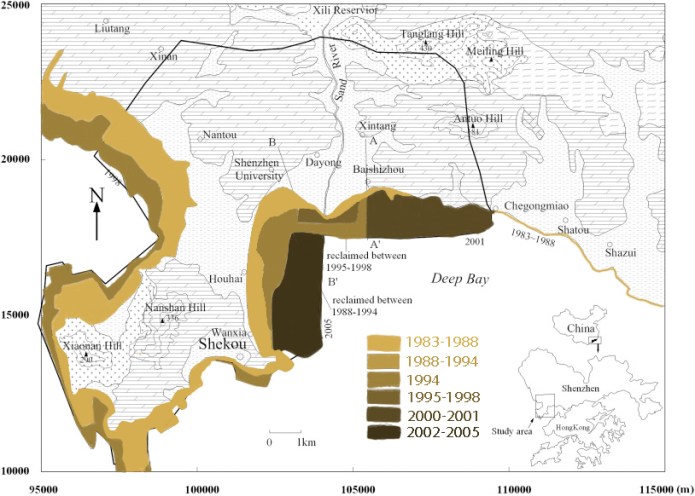
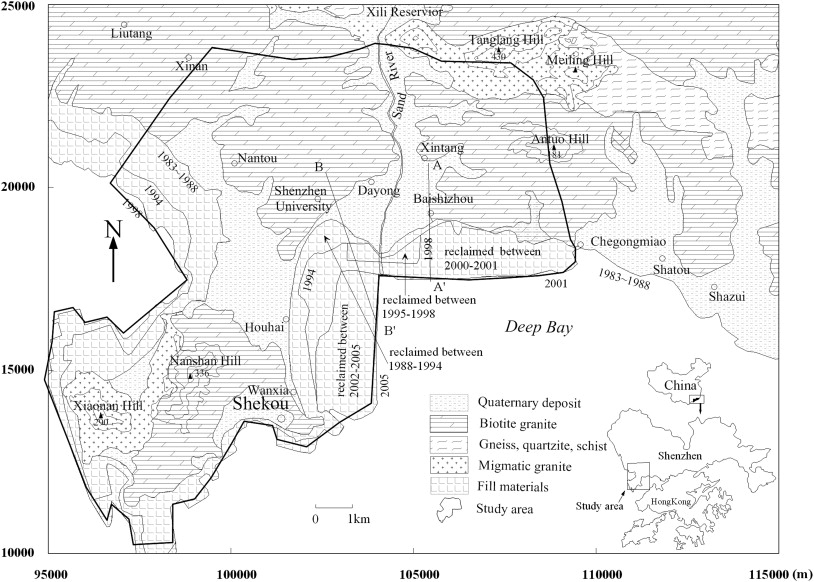
Ryoyu Kido sent me the link to Modeling the influences of land reclamation on groundwater systems: A case study in Shekou peninsula, Shenzhen, China, which includes a map of land reclamation around the Nantou Peninsula, 1983-2005:

shenzhen land reclamation

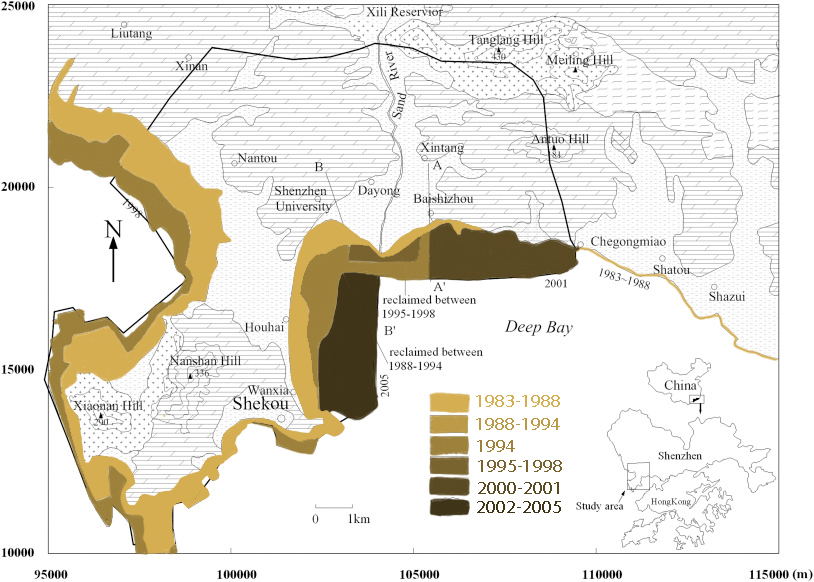
I colored in the boundaries to give a sense of the progression of land reclamation in in the Qianhai and Houhai areas of the Peninsula:

shenzhen land reclamation-mao

The tags land reclamation and Shekou bring much of this change into cultural perspective.