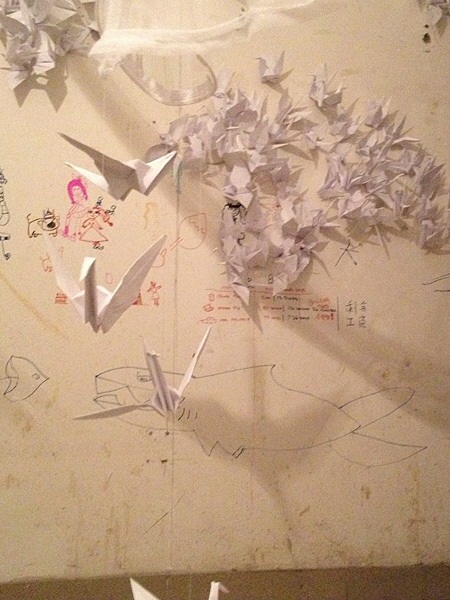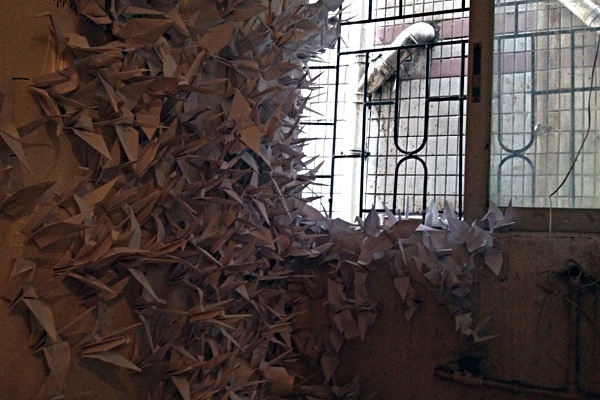
paper cranes

The inspiration for Paper Crane Tea came from Wan Yan, an architecture student by way of the fine arts. Below, her statement on the current installation at Handshake 302:

We’ve probably all heard about paper cranes; if you fold 1,000 they will take flight and help you realize your aspirations. Children believe this story, but for adults it is. Nothing more than a pipe dream. And that transition–from hope to resignation and simultaneously from ignorance to understanding–is the journey of a human heart.

The repetitive task that is folding 1,000 paper cranes symbolizes an important truth about being human. We are constantly repeating some task to achieve some goal; in order to graduate, we memorize and review coursework; to earn a living, we go to work from 9 to 5; to master a new skill, we practice, practice, practice. Each of these repetitions is like folding 1,000 paper cranes–it embodies the hope and determination necessary to realize a particular goal.

In an urban village handshake building, renters come and go, but the spirit that haunts each cramped rental unit remains–the recurring struggle to realize a dream. Indeed, achieving a a goal by diligently repeating he same activities is like folding one’s life in order to realize the crane of freedom. And there is something exuberantly childlike in that image. However, there is no unambiguous desire. In an era of heterogeneous values, different desires and ambitions will create fierce conflicts and mental confusion. Hope can be simple and even pure, but to realize an ambition requires unavoidable complexity and sufficient flexibility.

The first time I came to Handshake 302, in addition to feeling how cramped and narrow it was, I also thought about the repetitive suffering and struggles that every inhabitant would have to undergo in order to move into a “respectable” home. I also thought about how difficult it would be to find oneself (as the expression has it) in that vexed space between desire and it’s realization. But ultimately, each of us must inhabit that mental crucible where relentless economic and social pressure smelt perseverance, inner voices, and anxiety into “me”.

Handshake 302 is our stage, where members of Urban Village Special Forces perform stories of and about Baishizhou and it’s 140,000 residents. For some people, however, Handshake 302 symbolizes he cage they are trying to escape, or the long ago first stop on thei Shenzhen sojourn. In this space, 1,000 folded paper cranes take on new meanings, not only drawing our attention to what it means to be human, but also reminding us that we strive to achieve our humanity in specific contexts.

And photos of the Paper Cranes Fly installation at Handshake 302.

This slideshow requires JavaScript.

what’s the good of public art…

…in an urban village?

This was the topic of the first Paper Crane Tea 2014.03.09. I’m posting the link because my VPN isn’t fast enough to tunnel video over or under the great firewall. Will upload next time I’m in Hong Kong. Sigh.

blooming contradictions

Unfortunately, more often than not modernization leaves us with street names instead of actual landscape features.

Shenzhen public landscaping, for example, has been defined by its enthusiasm for inaccessible green space that adorn its roads. Throughout the city, there are lovely swathes of topiary and grass that pedestrians (and even birds) can’t actually access except in passing. In part to rectify this problem, but also in response to the city’s white collar residents, a vast network of bike trails have been installed throughout the city. Moreover, these trails have been mapped and the public encouraged to walk and ride through the cities green belts.

Here’s the moment of ecological dissonance: at the same time that functionaries are being encouraged to bike on the weekend, plans have been announced to reclaim 39.7 sq kilometers of Dapeng Bay. The corporate culprit is China Oil, which intends to use the reclaimed land for extracting South China Sea oil reserves. And yes, these plans are moving forward despite the fact that Dapeng New District is an environmental conservation district.

So pictures of the Nanhai (literally “South Ocean”) Road, below and a link to an article about the land reclamation project, here.

What’s in a name, indeed.

This slideshow requires JavaScript.

gentrification with shenzhen characteristics

So hukou remains an ongoing problem. According to Dec 2012 Sanitation Bureau statistics, Shenzhen has a long term resident population of over 10 million and resident (hukou) population of 3.05 million. In order to bring some balance to the demographic, a 2014 regulation has dropped the education requirement from college graduate to associate’s degree. Apparently, they’ve also simplified the process.

The measures come about as both the rates of population growth AND turnover has slowed. It used to be that every Chinese New Year millions left, while after New Year a different batch of more millions returned. Now more and more temporary residents are making Shenzhen their primary home. These new migrants are different from earlier migrants in that they tend to be better educated, and have come to participate in Shenzhen’s new core industries–finance, logistics, culture, and high-tech, as well as the city’s strategic industries–bio-tech, internet, and alternative energy. So they are settling in and raising families without hukou.

In addition, the City’s second generation is starting to participate in Shenzhen society, and many are not actually legal residents. Along with new migrants, they are giving birth to the City’s third generation. In fact, there are so many children in the SEZ, the ongoing Shenzhen baby boom has become something of a marketing niche, despite the fact that young parents must return to their legal residence in order to receive subsidized neonatal care. In fact, Shenzhen has the highest birth rate in the country. The biggest economic beneficiaries of the boom are owners of homes with seats (学位) in the top schools. And real estate websites happily speculate (all puns intended) on the price of those houses over the next decade.

Inquiring minds want to know–what about the illegal floating population? And this is one of the interesting aspects of Shenzhen’s shifting demographic. As factory jobs have been moved elsewhere, we see a corresponding social restructuring–more white collar technocrats, fewer blue collar workers. At the same time, the City seems willing to formally claim these new migrants, even as requirements continue to exclude manual laborers, sanitation workers, and other low-end migrants from transferring their hukou to Shenzhen. Importantly, the social eugenics of this process dovetail with and reinforce the gentrification that the demolition of centrally located urban villages has brought about (Laying Siege to the Villages).

Dongguan is passing similar laws to manage its disproportionately large floating population, and one assumes its highly visible sex industry.

next to go: huanggang

The plans for renovating Huanggang have been released–just in case you were wondering, “How quickly can Shenzhen remake itself in its own ever shifting image?” That said, Tianmian has also evicted the design companies and is gearing up to raze and renovate its former industrial park. In fact some areas of the city–looking at you OCT–are preparing the fourth generation of urban plan. Below, the maps and images of Huanggang 3.0, urbanized villages vanishing except as real estate companies.

This slideshow requires JavaScript.

books and aftershocks

In the aftermath of Kunming, the military armed and in groups of three can be seen at the odd subway station. The machine guns and bullet proof vests are disconcerting and, given the extreme lack of news, feel like overcompensation. If the situation really is this fraught, why haven’t we heard anything? And if it’s not, why the anti-terrorist performance?

In less distressing news, I finally got a copy of 深圳记忆 (Shenzhen Memory) by Nan Zhaoxu (南兆旭). It is an archive of Shenzhen pictures and stories from Liberation to the present. It’s organized by theme, such as “love” and then offers a selection of materials that highlight the vast transformation that has occurred. Under “love”, for example, Nan Zhaoxu has filed a 1954 article from the Bao’an Daily on the topic “How to find a spouse”. In contrast, in 2006 the Shenzhen Women’s Federation confirmed that Shenzhen had the highest number of divorces in the country.

I also snagged a copy of 深圳拓荒人 (Shenzhen Pioneers), which tells the story of the engineering corps that put in most of the City’s basic infrastructure. This history interests for many reasons, but also because I hadn’t realized that when the 20,000 odd strong brigades of engineering soldiers came in, the doubled the population in the Luohu area. Interesting way to think of demilitarizing the border by having soldiers dig trenches for civilian use. In this sense, the book also introduces the companies that arose out of the restructured military, including the rise of Huawei and it’s links to this transformation.

de-industrialization with chinese characteristics

This past week I have been in Wuhan, the political, economic, cultural, transportation a land educational center of China. Like it’s US American sister cities Pittsburgh and St Louis, once upon an early industrial time, Wuhan thrived and sparkled and offered developmental opportunities that paradoxically challenged and reinforced coastal hegemonies, in New York and Shanghai, respectively.

Wuhan also faces the challenge of restructuring its heavy industrial economy, even as young people migrate to coastal cities for more contemporary opportunities. In Shenzhen I know many Wuhan people involved in the City’s creative industries. In point of fact, Wuhan has more college students than any other city on the planet, which is to say the city grooms talent that leaves for elsewhere, carrying dreams and solid heartland values in suitcases that fuel coastal growth.

I moseyed around two of Wuhan’s historic areas, one famous the other not so. Hankou boasts colonial architecture and a formerly robust mercantile history. Tanhualin in Wuchang was long ago the site of a Buddhist temple and later the location of Christian missions, including churches, schools and a hospital. Impressions of ongoing historic convergence, below.

This slideshow requires JavaScript.

fuhua south road

Impressions of a walk along Fuhua South Road. This is one of the oldest areas in the city. Of note, the street is busy and vibrant and runs parallel to Shennan Road, which is wide and long and filled with vehicular traffic, but few pedestrians.

This slideshow requires JavaScript.

paper crane tea

Today, we had the first tea at 302. The conversation ranged from why urban villages through the muddled terms–city in village, farmer laborer–of contemporary urbanization to the ubiquity of urban villages throughout China. We also laughed. A lot. Impressions below.

This slideshow requires JavaScript.

baishizhou officially slated for renewal

Yesterday, the Shenzhen Government online portal announced that Baishizhou is on the list of areas designated for urban renewal.

The plan to renew “the five Shahe villages” was submitted by the Shenzhen Baishizhou Investment Company Ltd. It calls for razing 459,000 square meters of built area. The area has been zoned for residential and commerce, with at least 135,857 square meters of public space.

Baishizhou is one of 18 projects announced. All plans take place at the street level, and all target communities and/or early industrial areas. All emphasize the planned public area, but do not mention plans for evicted residents or scheduled construction.

Of note, the urban renewal announcements were tucked away in the Bureau of Land, but the announcement of Shenzhen’s plans for its first village preservation project, Shayu (沙鱼涌古村保护项目) made the front page.