been there, but not here–dalang

Images from a recent trip to one of the earliest (circa mid 1990s) factory areas in Dalang. I had a déjà vu moment because when I came to Shenzhen, these factories could be found throughout within the second line (guannei) churning out all sorts of goodies for export.

The point of interest? Although still a functioning industrial park, this area is already consciously “historic”. The Dalang New District Government is in process of a “love the cage, change the bird (疼笼换鸟”” redevelopment. The area surrounding the park includes the Dalang Fashion Valley and a piece of land recently purchased by Vanke for another gated community. These comparatively quaint factories will be renovated for cultural production.

So a few before pictures as the transition to after begins.

This slideshow requires JavaScript.

paper crane tea #4 online!

This edition of Paper Crane, Animal City Rights looks at how abandoned cats and dogs are treated in Shenzhen, including the efforts of SZCat, a community organization that actively promotes animal welfare. In fact, just yesterday, CZCat protested at the Futian hospital because a security guard had abused an abandoned cat. The episode was recorded but the administration ignored it. So SZCat occupied the SARS monument plaza in front of the hospital, generating TV coverage of the plight of abandoned pets and urban feral cats.

resolutely believing in the party

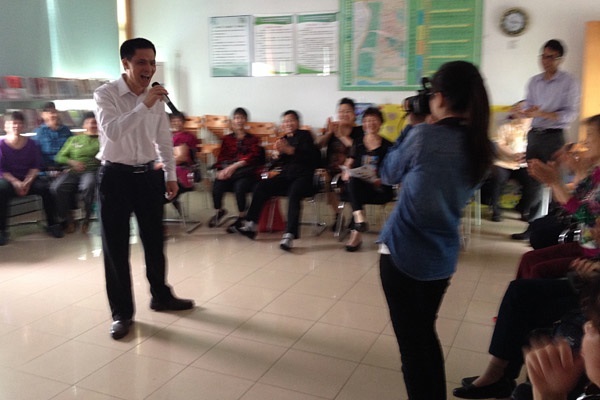
This morning I observed the Baishizhou Culture Station in action. Two groups of aunties were singing. The first group was singing Mandarin karaoke, the second group was singing an original Hakka composition entitled, “Resolutely Believing in the Party”. Later that morning the new Shahe Party Secretary came by, singing a karaoke song (“The Northern Spring”) and enjoyed the performance by the Xintang Hakka Mountain Song Chorus. Handshake 302 also presented our work to date.

The morning of community culture, including a Party Secretary karaoke moment reminded me that so much of Chinese political culture is making and maintaining good relationships between Party representatives and the represented. The pictures show the lyricist, the singing Secretary, and the Culture Center’s documentation of the event.

So here are the translated lyrics of “Resolutely Believing in the Party”. Note the definition of xiaokang–a basic material standard of well being. Note also in the picture that the lyrics have been written by hand.

Spring brings the fragrance of one hundred flowers, one hundred flowers
Everyone has a car and building, a house, a building and a house
Every kind of furniture
Three healthy meals a day, nutrition and health

Summer comes and the heat is hard to bear, the heat is hard to bear
Everyone has a fan or air conditioner, installed an air conditioner
No need to roast and sweat
We have electric slow cook pots for traditional soup, traditional soup

Fall comes and it turns cool, it turns cool
We wear fashionable clothes, fashionable clothes
Everyone carries a cell phone
Each home has internet and is linked to the world, linked to the world

Winter brings snowflakes to the mountain, snowflakes in the mountain
Reform and Opening is the promise of Spring, the promise of Spring
Resolutely believing in the Party
Beauty and happiness with the realization of xiaokiang, we’ve realized xiaokang

paper crane 3 online!

And here’s the link, “Arrival Shenzhen”, episode 3 in the series.

to fill or not to fill…

…that is the question.

The lead article in today’s Shenzhen Evening Daily provocatively asks if the reader is for or against the China Petroleum plan to reclaim 37.9 hectares of Dapeng Bay. To date, Shenzhen has reclaimed 69 sq kilometers of coastline, an area six times larger than the Shekou Peninsula or 6.5% of Shenzhen’s total area. Moreover, of the Municipality’s 254 kilometer long coastline, only 40 kilometers remain undeveloped.

China Petroleum has proposed building a liquid natural gas (LNG) peaking power plant. Also known as peaker plants, and occasionally just “peakers,” these power stations do not run continuously, but rather provide additional energy during peak hours of demand, such as during summer afternoons when air-conditioning use is at its highest. They command a higher price per kilowatt hour than do base load plants, which operate continuously.

There has been a persistent buzz of protest against the proposed plan. The article goes on to say that in Shenzhen news net online survey, over 82% of respondents were against the plan. Moreover, there seems to be government support for the social push back. Last week, for example, a journalist friend said that Dapeng New District Government had no vested interest in the plant, but did have a interest in the coastline. Consequently, the government was using public disapproval as a means of countering China Petroleum, which is a national, state-owned enterprise.

Currently, Shenzhen is handling the stand-off through a hearing. The question facing the board, is whether or not the proposed station conforms to or is in conflict with Shenzhen’s environmental sustainability laws, which include protection for remaining coastline areas. Zhou Wei, a nature photographer and environmental activist has been at the forefront of bringing public awareness to the proposal and its environmental consequences. It is therefor notable that he is not one of the five members of the board that will hear arguments for and against building a Dapeng Peaker.

Of note. Today’s article phrased the question of “to fill or not to fill” in terms of the well-being of the City’s grandchildren:

We don’t know what the future of Dapeng Bay will be, nor do we know how you will view the decisions that we make today. Today we write this letter in the name of Shenzhen, in the hope that every choice we make will not harm our grandchildren.

innovate with china…

…was the slogan of this year’s Shenzhen Maker Faire. I attended on Sunday, and then Monday afternoon joined researchers from the Institute For the Future on a tour of BGI (Beijing Genomics Institute) or “China Great Gene (华大基因)” as the name translates from the Chinese.

What did I see and learn?

That children love playing with gadgets. That most of the “products” were in fact toys. And that the most popular booths had the greatest room for serious play. In other words, the successful objects themselves structured a particular–and somehow “first”–experience. Hence, the wow moments that attracted children and adults alike.

That BGI has concentrated a massive amount of capital and resources in order to further the production of data. Moreover, as the cost of mapping genomes has dropped from $US 3B to around $US 3,000 in a little over twenty years, the data has proliferated to the point where the challenge facing researchers is technologies for storing and analyzing the data. I’m not sure what this volume of data means in terms of life experiences, but it does strike me that our imaginations constantly seek material form. And I learned the expression human augmentation, as if we are not enough.

That the Shekou Relaunch campaign has brought in interesting cultural programs to the area. In addition, these programs have been popular and attracted residents from all over the city to Shekou. So notable that–again–we’re looking at the design of experience. And all this hinges on the promulgation of culture and creativity as both the means and ends of socio-economic development.

This slideshow requires JavaScript.

shuiwei kunstkammer

The CEO of Shuiwei Holdings Ltd, Zhuang Weicai loves collecting. He has been collecting rocks, calligraphy, traditional paintings, teapots and tea, trees and Han Dynasty tiles and figurines for over twenty-five years. He even has a dinosaur skeleton. The fruit of his passion is housed in the Shuiwei Rock Art Museum, which is not a museum per se, but rather a contemporary cabinet of curiosities that reveals as much about Zhuang Weicai’s eclectic taste as it delights visitors. As a social fact, it also reconfigures how we think of collecting in an era of corporate museums.

Historically speaking, Cabinets of Curiousities (and yes, we are talking about items, rather than the feeling of curiosity) appeared in Rennaissance Europe. Precursors to the modern museum, Cabinets were nevertheless characterized by the tastes, experiences, and unexpected encounters of elites, who expressed and sought knowledge, broadly defined. Simultaneously, these collections also demonstrated the magnificence and power of a given ruler. Thus, for example, Rudolf II, Holy a roman Emperor brought dignitaries and ambassadors to his Kunstkammer in a ritual display of all that he reigned.

Cabinets of Curiousities have been studied by cultural critics and repurposed by artists. There have been extended critiques of Anthropology’s vexed relationship to the impulse to and practices of collecting. After all, many of the world’s leading natural history, ethnographic, and archaeological collections were a direct result of colonial occupation and subsequent looting slash removal of local items and their display as “curiousities” or “artifacts” in Europe and North America.

Here’s what I’m mulling today: what is the significance of Shuiwei’s Rock Art Museum?

Chronologically, the Art Rock Museum appeared well after the Rennaissance transition from individual to public collections. However, it is not a private art collection. It is a natural history collection that celebrates a traditional aesthetic that many educated Chinese have eschewed in favor of science and contemporary art. It is open to visitors throughout the week. And it really is more fun to visit than many of the stuffy museums that show off expertise rather than passion; the collection makes it obvious that Zhuang Weicai really does love rocks.

I haven’t reached a theoretical conclusion. However, I do think the Rock Art Museum does give insight into the different cultural logics that inform urban village style urbanization and official state directed urbanization. So, take an afternoon to visit and the explore Shuiwei itself. The Rock art Museum is located in the heart of Shuiwei, which is itself one of the best eateries in Shenzhen. Impressions of the Shuiwei Kunstkammer, below.

This slideshow requires JavaScript.

jiaochangwei, or the coastal economy

For those who have been following Shenzhen’s expansion, you have noted the correspondence between the establishment of an administrative category, the announcement of an economic sector, and the full on government led reappropriation of folk investments and small scale development.

The opposition in play is the contradiction between 官方 and 民间 I’ve translated 官方 as government led because the appropriating entity is often government appointed or a state owned enterprise, but there is diversity and even discord therein, as will become apparent below. I’ve translated 民间 as folk because it captures something of the quaint and small and outdated notion of the public that seems to operate during these transitions. Moreover, the public is itself an important sphere of government led action.

Dapeng constitutes Shenzhen’s one remaining strip of relatively undeveloped coastline. It has been a site of 民间 development. The forms of folk development, for example, have included seafood restaurants in Nan Ao, and the strip of cheap inns at Jiaochangwei (较场尾). Jiaochangwei is a coastal village, as is evident from the mash-up of various generations of what are colloquially known as “farmer housing (农民房). And yes, Jiaochangwei is technically an urban village, with an emphasis on village and nature, rather than urban a la Baishizhou). Previous large scale development has been undertaken by Vanke (万科) which opened Shenzhen’s first yacht clubs far, far from the city. Or so it seemed.

In theory the Dapeng Peninsula is a conservation area, but so was the original Mangrove Park. However, in 2011 the Municipality designated Dapeng a New District (discussed earlier). Since then, there has been all sorts of investment in roads and even a national level geological museum slash park. This has been part of a movement to encourage the development of the coastal economy, including government led real estate development, which (as in Shekou) involves infrastructural transformation and privatization of the coastline.

At the moment most of these areas are only accessible by car, but an express bus, the E 11 gets ordinary folk into the area and a subway line is being built. Impressions of Jiaochangwei, below. And yes, if you decide to go, go during the week. On the weekend, there can be road delays of more than an hour, and lines for restaurants and ubiquitous BBQ joints.

This slideshow requires JavaScript.

paper crane tea #2 is online

For the curious. “So why do foreigners go to urban villages?” is online. Please check it out and grow the conversation about Baishizhou and why it matters. For all of us.

volunteerism and possible civic identities in shenzhen

In the Summer of 2011, Shenzhen hosted the Universiade. At the time, we complained about the face projects and cost there of. In retrospect, it seems, however, that one of the more lasting effects of hosting what is basically an Olympics for college students was that volunteerism and u-stations took root and flourished.

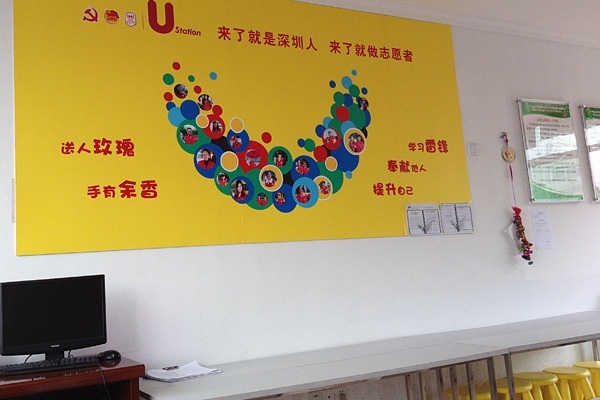
U-stations can be found throughout the city, and are staffed by young friendly and sufficiently bi-lingual folk, who hand out bike maps to the city and introduce nearby attractions. All wear the highly recognizable Shenzhen volunteer vest. In fact, this new emphasis on volunteer citizen participation may also have contributed to an interesting renaming–Shenzhen migrant workers are now officially called “those who have come to build Shenzhen”. The phase reworks the Shenzhen volunteer slogan, “if you come, you are a Shenzhener”. The Chinese wordplay is from 来了就是深圳人 to 来深建设者.

Several days ago, I met with the director of the Baishizhou Culture Center. We spoke in a comfortable, well lit library which was also a u-station! Other programs run by the Center included an after school program, which is staffed by those young and friendly red-vested volunteers. We were in the station to talk about opening a community learning center under the auspices of this collaboration between multiple levels of government. We would be another NGO sponsored by some level of government to work in Baishizhou.

This is where the administrative structure gets interesting. The culture station is housed in the Baishizhou Five Village corporation, which represents locals’ interests and manages Baishizhou properties, electrical, sanitation, and other municipal services. However, the culture station is funded by the street government, which is responsible for implementing district policy. The volunteers are a municiple level NGO.

So here’s the a-ha moment: u-stations and volunteers have permeated even urban village regulatory structures and may have an important role in redefining citizenship and the role of the city in financing not-for-profits.

This slideshow requires JavaScript.