B; it’s more than a letter, much less than love

Couplets and rhymes circulate as text messages on Chinese cell phones and as scratched graffiti on walls. Although economic class and levels of education may separate texters from scratchers, nevertheless, the spirit of the message and the understanding of what it means to be human — especially and unfortunately about gender relations — is often the same.

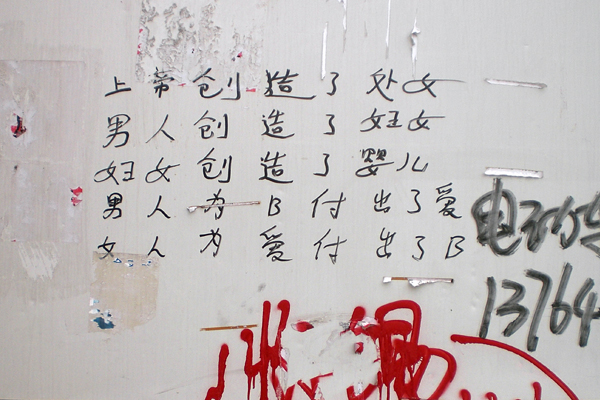
The above poem reads:

God created virgins; men created women; women created babies; men give love to get cunt; women give cunts to give love.

Compare with earlier texts for a sense of how misogyny circulates in Shenzhen.

On the banks of the Newly Established — Peanuts

Yesterday, enjoyed a lovely walk and conversation with Sara, a young curator visiting from Canada. We took a bus to Fuyong, one of the Baoan precincts which abuts the old Guangshen highway and is now more commonly known as National Highway 107.  Guangshen / 107 is (in)famous for its factories, migrant workers, and more recently container dwellers, which have entered Shenzhen conversation as extreme examples of the SEZ’s cost of housing problems.

This slideshow requires JavaScript.

Sara’s interest in urban gardening brought us into conversation with Aunt Xu, who migrated from Fujian to live with her son in Lixinhu (Establish the New) Estates, a 90s era housing development located next to the Lixin Reservoir. Aunt Xu had come to live with her son and take care of her grandchild. But five or six years ago, the grandchild started school and no longer needed childcare. Aunt Xu abruptly had time on her hands. Uninterested in television programs and full of energy, Aunt Xu decided to cultivate peanuts on the banks of Lixin reservoir.  Continue reading

princeling genealogy and advanced guanxixue

Normally, I am not a fan of imperial court television dramas first because the family dynamics of dog eat dog don’t appeal and also (and primarily) because I can’t keep track of all the players. Even with a scorecard, the nuances of multiple and overlapping connections between protagonists and lesser characters evade me. There are, for example, reportedly over 400 main characters in Dream of the Red Chamber. What’s more as an American, I like watching the action. However, as far as I can tell in an imperial television drama nothing of substance ever really happens — a marriage here, a conquered nation there, perhaps, but we never see it. Instead, the drama of an imperial court melodrama unfolds through charting various levels of family ties and in turn the revelation of who respects those ties, who abuses them, and who ignores what those ties mean. In other words, family protocols reveal personal ethics — national affairs are an effect thereof.

Take, for example, a brief sojourn into Bo Xilai’s family circle. I’ve already mentioned that his father was Bo Yibo and that his son, Guagua is know for his extravagant lifestyle. Bo Xilai’s second wife, Gu Kailai is a Beijing lawyer slash Princess. Gu Kailai’s father and Bo Yilai’s father-in-law, Gu Jingsheng (谷景生) was one of the key leaders in the December 9th [1935] Movement (一二九运动) to organize resistance against the Japanese invasion. Imprisoned for twelve years (from the Anti-Rightest campaign through the Cultural Revolution), Gu Jingsheng was appointed Vice Political Commissar of the Guangzhou Military Region after his rehabilitation, leading troupes in China’s brief Vietnam War, when Deng Xiaoping secured his place among PLA leaders. In 1981, Gu Jingsheng was appointed Second Secretary of Xinjiang, the first Secretary of the Xinjiang Production Brigade, and first Standing Member of the Xinjiang Provincial Politboro.  Just a few days ago, Bo Xilai’s brother-in-law, Lt. General Gu Junshan (谷俊山), Vice Minister of the People’s Liberation Army was removed from office. Speculation is that the removal is connected to the Wang Lijun fiasco and associated corruption charges.

All this to say, the Bo Xilai Wang Lijun scandal has rekindled my anthropological interest in genealogy and its obvious connection to guanxixue (关系学). And yes, it seems that Bo Xilai’s family background is more and more the story, regardless of what he or Wang Lijun may or may not have done. Meanwhile, Shenzhen announcements have begun to remind us that in 1979, when Xi Zhongxun, father of China’s future leader Xi Jinping was Guangdong’s governor, he proposed the establishment of the Shenzhen SEZ. And in that shimmering moment of imperial court Princeling drama, Deng Xiaoping is simultaneously remembered and erased from Shenzhen history, as local leaders try to position themselves and the SEZ as close to the inner party family as they can.
indie film premiere tonight

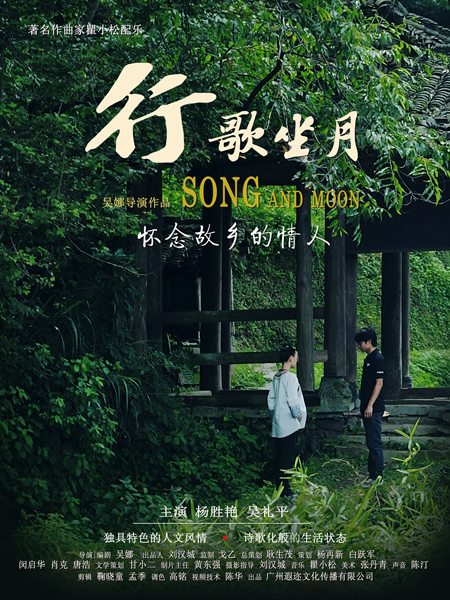
Feng Yu of Art de Vivre in Meilin (圆筒艺术空间) works to bring documentary and independent films to Shenzhen, organizing underground festivals. Tonight, Song and Moon will be premiered in a public venue. Director Wu Na is a Generation 80s ethnic Dong. She tells a story about coming of age in between Dong Village traditions and migration to Han cities to find work. So, come, view, and join Feng Yu’s efforts to bring alternative voices and images to Shenzhen screens.

14 Feb 8:00 pm

Jia Zhi Hua golden Carnival Center Cinema (嘉之华中心影城), 1/F Shenzhen Concert Hall, Behind the Civic Center, Futian

Song and Moon (行歌坐月) Drama / Color / Digital HD / Chinese and English Subtitles / 90 min / 2011 / China

shekou upgrades continue

Walking Shekou today, I remembered that not only are urban villages subject to Shenzhen’s cultural industry inspired renovations. Older areas of Shenzhen, especially factories and housing estates are also being razed and/or remodeled to conform to different aesthetics and economic plans. Views on the process near Seaworld and the e-cool area, which used to be Sanyo factories (pictures of area, 2008).

This slideshow requires JavaScript.

Changing Patterns of Rural Suicide (1980-2009)

Below, I have summarized Liu Yanwu’s article, The Problem of Rural Suicide (1980-2006) [刘燕舞:中国农村的自杀问题(1980-2006)]. The article responds to previous research on rural suicide, which had focused on the changing status of rural women, rather than on the modernization of village society as a whole. Liu argues that changing intergenerational family dynamics and the rising divorce rate of rural couples has caused the changing pattern of suicide in rural China. After the article summary, I make a few observations on what research in Shenzhen contextualizes the question of rural suicide.

The Problem of Rural Suicides (1980-2009)

Abstract [translated from text]: Based on a uniform survey of 34 villages accross 7 provinces and analysis of the suicides of 604 farmers between 1980 and 2009, this author believes that the suicide rate in villages continues to rise. There has been a significant decline in young people’s suicides and the marked rise of elder suicide in contemporary villages. The declining suicide rate of young women lowered the overall rate of young people’s suicide, however, the rapid rise of elder suicide has meant that the overall rate of villager suicide continues to rise. The analysis suggests that the determining factor in this complex situation is not the migration of village young women, but rather changing intergenerational relations and the increase of divorce. At root, the more obvious systemic cause of the complex transformation of rural suicide is that modernity continues to erode villages.

Keywords: sucide rate of young women (青年女性的自杀率), suicide rate of the elderly (老年人的自杀率), transformation of intergenerational relations (代际关系变动), divorce (离婚), modernity (现代性) Continue reading

political subtext in chinese television: bo xilai, wang lijun, and pla history

Just after Wang Lijun was reported on “medical leave”, Bo Xilai went to Kunming on an inspection tour, with a special visit to a military museum. Chongqing news broadcast footage of the tour. Now it is probable that this tour and visit to the military museum were previously scheduled. However, within the context of the Wang Lijun debacle and the rise of the Princeling Party to power, these images of Chongqing’s Secretary inspecting toothpaste and toilet paper resonated ironically.

During the revolutionary war, the People’s Liberation established six military regions: the Northeast (东北军区), the North (华北军区), the East (华东军区), the South (中南军区), the Southwest (西南军区) and the Northwest (西北军区). Each region had a General and a Political Commissar. Bo Xilai’s father, Bo Yibo was the Political Commissar of the North, Xi Jinping’s father, Xi Zhongxun was the Political Commissar of the Northwest, and Deng Xiaoping was the Political Commissar of the Southwest. Thus, in visiting Kunming, Bo Xilai was not simply going on an inspection tour, but also retracing the revolutionary steps of his father’s generation and thereby declaring his revolutionary lineage. Continue reading

Coaster Raid Biennale Retrospective

Last night, Gigi and Michael of Riptide Collective hosted the opening for Coaster Raid Shenzhen’s Biennale Retrospective. Witty and fresh the Retrospective will be up for the final week of the Biennale and is well worth a visit. Venue:

市民中心B区南门,多功能厅东侧, 地铁市民中心站B出口

Civic Center – East Hall – Area B South Gate, Subway: Civic Center Exit B

This slideshow requires JavaScript.

party melodrama as prelude to the 18th national people’s congress

Shenzhen friends have been speculating about the political-economic shifts we will see as a result of the 18th National People’s Congress. The latest scandal involves Politboro Standing Committee hopeful Bo Xilai (薄熙来) and his henchman slash vice Mayor slash Chief of Police, Wang Lijun (王立军).

The scandal and source of gossip: Wang Lijun visited the US Consulate. The Chongqing military policy surrounded the Consulate, demanding the US to handover Wang Lijun. Beijing sent Qiu Jin, vice Minister of National Security. 24 hours after entering, Wang Lijun “willingly” left the US consulate with Qiu Jin. Subsequently, Bo Xilai went to Kunming for unknown reasons.

I have been trying to understand what’s at stake, why the fallout, and how to read between the lines. This is what I’ve gathered; some of the gossip may even be reliable.

The dramatic background of the Bo Xilai scandal is the fight to become a member of the Politboro Standing Committee, which is a recognized springboard for becoming President and Premier, positions one and two in China. Bo Xilai is one of the more prominent and/or notorious members of China’s Princeling Party (太子党), the generation of Party leaders who have come to power because of their powerful parents. Bo Xilai’s father, Bo Yibo was one of the “eight immortals” of the Deng era Communist Party. The Princelings are in the news because China’s next leader Xi Jinping, son of Communist veteran, Xi Zhongxun is also a Princeling.

Continue reading

serve (only) the people’s currency?

My one brand, two systems cup of java has me thinking about the manipulation of national currencies in an international economic system. In particular, I reviewed what I knew and didn’t know about the rise and fall of 外汇卷 (foreign exchange certificate) as opposed to 人民币 (the People’s currency). FEC circulated from the early 60s through January 1, 1995, when the government began phasing it out, completing the process on Dec 31, 1996, just in time for Hong Kong’s Return.

Now, China’s FEC is interesting because before 1980, Chinese citizens were not allowed to hold either FEC or foreign currency, while after 1980, they were. Continue reading