The other day, I walked from Huaqiangbei through Gangxia and Xinzhou, where I hooked back to Shuiwei via Huanggang Park, a wonderfully unexpected urban oasis. Today, I’m uploading impressions of the diverse complexity that characterizes Futian Distict, which is home to Huaqiangbei, the central business district, and some of the most well-planned urban villages in the city.
Tag Archives: urban villages

handshake 302 in the classroom
Our current project, “Shake Hands with the Future” started last week, when curator Liu He and I went to Shenzhen Middle School to talk with students about an after school project to investigate and creatively respond to the urban villages in their neighborhood. And, because Shenzhen Middle School is located right next to Dongmen, the school is also next to several of the most iconic urban villages. So very excited about what the students will bring us.

baishizhou: withering practices
The process of uprooting the northern section of Baishizhou has begun through withering practices–the removal of social nutrients in order to promote razing and evacuations as inevitable, necessary, desired. Continue reading

can renters become stakeholders in shenzhen?
I like meeting and talking with visiting urbanists because the conversation is refreshingly straight forward about constructing society (via environmental interventions). Who are the stake holders, they ask. Where can we find them? What should we ask them? These clear and solid questions help me think more precisely about Shenzhen because identifying stake holders entails (1) acknowledging competing rights to the city and also (2) mapping the fraught and unformed territory of Shenzhen identity; who does have rights to this city of immigrants? And how did might they claim them?
Today, I’m thinking about approaching these questions through the construction and allocation of rental property. Why do urban village handshakes — despite constituting the demographically significant residence in the city — why don’t they transform migrants into stakeholders? Continue reading

the violence of rural (re)construction (5): lessons from shenzhen
So what am I learning about Shenzhen through my engagement with Meizhou forced evictions and the young people who are trying to figure out how to articulate new relations to their Hakka past and rural injustice? Continue reading

next to go: huanggang
The plans for renovating Huanggang have been released–just in case you were wondering, “How quickly can Shenzhen remake itself in its own ever shifting image?” That said, Tianmian has also evicted the design companies and is gearing up to raze and renovate its former industrial park. In fact some areas of the city–looking at you OCT–are preparing the fourth generation of urban plan. Below, the maps and images of Huanggang 3.0, urbanized villages vanishing except as real estate companies.
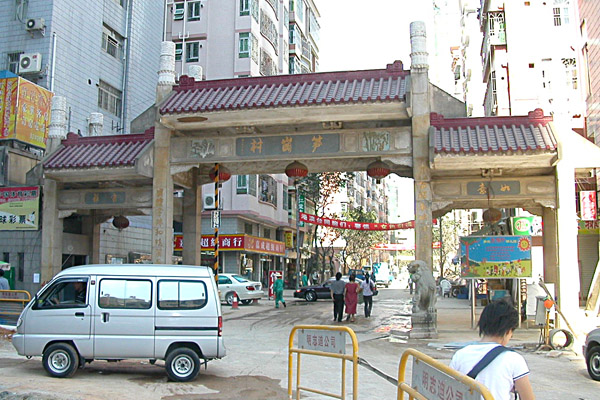
ten years ago…
I have been reviewing my photo archives and came across pictures of new village gates that I took roughly ten years ago. The pictures show village gates old and new and point to the persistence of community identity precisely because it is malleable to the needs of the present.

czc manifesto (of sorts)
 CZC特工队 (tègōngduì) organized in 2012 in order to discuss, plan and support creative engagement with Shenzhen’s urban villages. Three questions have inspired us.
1. What can be learned and gained from returning to the urban villages?
2. How can handshake efficiency apartments, densely crowded streets, and bustling small plazas be repurposed as cultural spaces?
3. How can creative interventions motivate Shenzhen residents to cross cultural and economic difference and discuss our common urban condition?
Our decision to locate our art space and the performance series, Handshake 302 in Baishizhou, one of Shenzhen’s most (in)famous villages, constitute concrete answers to these questions. We hope that each visitor to our art space and every audience of a performance will use these diverse works to discuss and formulate their own answers to these questions, stimulating a rediscovery and re-evaluation of Baishizhou – the good, the bad, and the ugly.
In order to integrate art exhibitions, performances and research with the residents of Baishizhou, we are collaborating with the Shenzhen Baishizhou Investment & Development Company. We also attempt to purchase supplies from Baishizhou shops and vendors.
We welcome collaboration with artists, performers, and scholars from Shenzhen and the rest of the world. Please contact us if you have a project to realize in Baishizhou or another urban village.
Handshake 302 has been selected as a collateral exhibition of the 2013 Shenzhen-Hong Kong Bi-City Biennale of Urbanism\Architecture.

chinatowns
Today, I’m wondering about how the prejudices that contemporary China exports overlap with historical prejudices in the West, especially when we talk about “Chinatowns” or “traditional” and “rural” China. In other words, what to make of the fact that Westerners continue to like Chinatowns (and urban villages), while China’s rising elite does not?
Yesterday, I ate lunch with Shenzhen friends at Hakkasan, a hip international Chinese-inspired chain (with amazing desserts) and then walked Chinatown, San Francisco. Before we separated, my northern Mainland friends (who had enjoyed the food) warned me that Chinatown was “just like Chaozhou in the 1960s”. The implication was not only that Chinatown was backward, but also that there wasn’t anything there to see or enjoy. Instead, they were interested in buying a home in Mission Bay, which was new and modern and, in many ways, just like Shenzhen albeit, “not as convenient”.
The historic link between Chinatown, San Francisco and other Guangdong settlements is explicit. The Kaiping watchtowers, for example, were not only built with monetary remittances from Overseas Chinese in San Francisco, but also with materials, techniques, and blueprints that were sent back home. In fact, there is a Kaiping Hometown Association on Washingtown St (开平侨网). I enjoyed my walk. But then again, I also like Shenzhen urban villages. I also appreciate informal forms of urbanization across Guangzhou, which nourishes dense settlements and lively commerce.
The fact that my friends drew attention to the “backwardness” of Chinatown, SF echoed similar warnings about urban villages, Shenzhen. In fact, explicit contrast either to neidi or locally to the urban villages predicates the celebration of modern Shenzhen. The difference hinges on the glorification of the wealthy and their tasteful lifestyles in contradistinction to the working poor and their traditional lifestyles. Of course, in practice, “tradition” glosses low-tech practices that enable the working poor to “make do” with less than their share of the goods their labor produced.
These past few years, Shenzhen has also become increasingly well known in the foreign media. It is no longer just a symbol of the government’s decision to reform and open the Maoist system, but also an example of the success of that decision. Today, Chinese no longer disparage Shenzhen as being backward, nor do they exhort me to go elsewhere to see the real China. Instead, new immigrants say how wonderful Shenzhen is and second generation residents are proud to say they come from Shenzhen. Indeed, they now claim it is the “best city” in China, and note that it is more livable than Beijing, Shanghai, or Guangzhou.
On the one hand, my friends’ determination to distinguish themselves from the residents of Chinatown, San Francisco as well as the fact that they did so via Chaozhou should give pause. After all, within Guangdong, Chaozhou is considered one of the largest homelands for Overseas Chinese as well as one of the most “traditional”. On the other hand, Western racism enabled colonialism abroad and ghettoization at home. Guangdong immigrants appropriated elements of these twinned processes to create neighborhoods in their hometowns, new and old. Similarly, migrant workers to Shenzhen take advantage of reform and opening policies to create lives in adverse conditions.
Inspirations from Chinatown, San Francisco and culinary delights, below:
laying siege to the villages: lessons from shenzhen
An essay written for Open Democracy is now online. Here’s the introduction. Over the next few days, I will put up the sections on Nantou, Luohu-Dongmen, Xixiang, and Baishizhou.
Laying Siege to the Villages: Informal Urbanization in Shenzhen
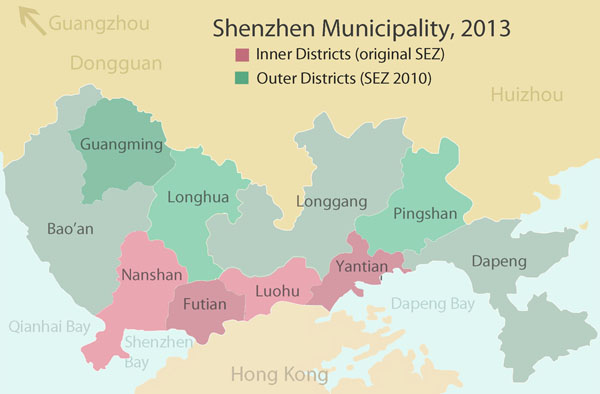
Although Shenzhen is famous for its “urban villages” or “villages in the city” (城中村 chengzhongcun), nevertheless, in 2004 Shenzhen became the first Chinese city without villages. Full stop. This fact bears repeating: legally, there are no villages in Shenzhen. As of 2007, Shenzhen Municipality had a five-tiered bureaucracy consisting of the municipality (市shi), districts (市区shiqu), new districts (新区 xinqu), sub-districts or streets (街道jiedao), and communities (社区shequ). Since 2010, the Districts have been known as the inner districts and outer districts, reflecting when they were incorporated into the Shenzhen Special Economic Zone (SEZ) (Map 1).

Under Mao, rural areas were China’s revolutionary heart and “villages surrounded the city (农村围绕城市)” was an explicit political, economic, and social strategy for revolutionary change. The Mandarin expression “surrounds (围绕)” can also be translated as “lays siege to”, highlighting the rural basis of the Chinese Revolution. Early Chinese Communists had followed the Russian example and entered cities to organize workers. However, when Nationalist forces led by Generalissimo Chiang Kai-shek violently suppressed Communist organizations in Chinese cities the Communists retreated to the countryside. Moreover, communists and local people identified colonial ports such as Hong Kong with the proliferation of traitors, parasitic merchants, and corrupt officials. Consequently, while Marx claimed that modern history was the urbanization of the countryside, the Chinese revolution aimed to re-occupy and purify the cities. Beginning in 1927 until the occupation of Beijing in 1949, the Communists organized rural resistance to both Japanese invaders and Nationalist hegemony, literally surrounding the cities with an estimated 5 million rural soldiers.
The establishment of Shenzhen signaled the beginning of a new era in Chinese history – “cities surround the villages (城市围绕农村)”, an expression which Shenzhen urban planners and architects have self-consciously used to describe urbanization in the city. Historically, there were legally constituted villages in Shenzhen. The present ambiguity over the status of villages and villagers is a result of contradictions between Maoist economic planning and post-Mao liberalization policies. Under Mao, the country was segregated into rural and urban areas. In rural areas, villages were designated production teams and organized into work brigades that were administered by communes. Communes had to meet agricultural production quotas that financed industrial urbanization and socialist welfare policies in cities, which were tellingly defined as “not-agrarian (非农feinong)”. Importantly, the hukou or household registration policy literally kept people in place – the allocation of food, housing, jobs, and social welfare took place through hukou status. Food and grain coupons were city-specific, for example, and a Shanghai meat coupon could not be legally exchanged in a neighboring city, let alone Beijing. In rural areas, however, communes and production brigades provided neither food coupons nor housing to members. Instead, brigade members produced their own food (usually what was leftover after production quotas had been met) and built their own homes or rural dormitories as they were known in the Maoist system.
In 1979, when the Guangdong Provincial Government elevated Bao’an County to Shenzhen Municipality, the area was rural, and the majority of its 300,000 residents had household registration in one of 21 communes, which were further organized into 207 production brigades. However, hukou status notwithstanding, the integration of brigades and teams had not been complete and members continued to identify with traditional village identities. Although the names of Shenzhen’s current districts were the names of ten of the larger communes, for example, with the exception of Guangming, they were also historically the names of large villages that had been the headquarters for communes. In 1980, the Central government further liberalized economic policy in Shenzhen by establishing the area that bordered Hong Kong as a Special Economic Zone (SEZ). This internal border was known as “the second line”, in contrast to the Sino-British border at Hong Kong or “the first line”. The re-designation legalized industrial manufacturing and foreign investment (primarily from Hong Kong) in the new SEZ. Outside the second line, Shenzhen Municipality established New Bao’an County, which was still legally rural and administered through collective institutions.
The elevation of Bao’an County to Shenzhen Municipality created an anomalous situation within Socialist China because the administrative division of Shenzhen into the SEZ and New Bao’an County only legalized new economic measures; it did not transfer traditional land rights from brigades and teams to the new municipal government. Instead, the first task of urban work units that came to the SEZ was to negotiate the equitable transfer of land rights from the collectives to the urban state apparatus. The goal was to insure that rural workers would continue to have space for housing and enough land to ensure agricultural livelihoods. And this is where historical village identities reasserted themselves. In theory, the urban work units negotiated with brigade and team leaders to transfer the administration of land from the rural to the urban sector of the state apparatus. In turn, the brigades and teams would continue to produce food for the new urban settlements. In practice, however, brigade and team leaders acted on behalf of their natal villages and co-villagers, asserting a pre-revolutionary social identity.
The legal slippage between collective identity within China’s rural state apparatus and collective identity through membership in a traditional village arose because although the Constitution and subsequent Land Law of 1986 stated that rural farmland belonged to the collective, neither document went so far as to define what a collective actually was in law. Indeed, the difference between rural and urban property rights has been the foundation for post-Mao reforms, first in Shenzhen and then throughout the country. In 1982, the amended Constitution formally outlined the different property rights under rural and urban government. According to Article 8 of the Chinese Constitution:
Rural people’s communes, agricultural producers’ co-operatives, and other forms of co- operative economy such as producers’ supply and marketing, credit and consumers co-operatives, belong to the sector of socialist economy under collective ownership by the working people. Working people who are members of rural economic collectives have the right, within the limits prescribed by law, to farm private plots of cropland and hilly land, engage in household sideline production and raise privately owned livestock. The various forms of co-operative economy in the cities and towns, such as those in the handicraft, industrial, building, transport, commercial and service trades, all belong to the sector of socialist economy under collective ownership by the working people. The state protects the lawful rights and interests of the urban and rural economic collectives and encourages, guides and helps the growth of the collective economy.[1]
In contrast, according to Article 10, land in cities is owned by the State:
Land in the rural and suburban areas is owned by collectives except for those portions which belong to the state in accordance with the law; house sites and private plots of cropland and hilly land are also owned by collectives. The state may in the public interest take over land for its use in accordance with the law. No organization or individual may appropriate, buy, sell or lease land, or unlawfully transfer land in other ways. All organizations and individuals who use land must make rational use of the land.[2]
The contradiction between the fact that villages no longer have legal status in Shenzhen and their traditional claims to land rights and social status – both of which are recognized by Shenzhen officials and residents – has constituted a serious political challenge for Shenzhen officials, who have viewed the villages as impediments to “normal (正常)” urbanization. Officials have defined “normal” urbanization with respect to the Shenzhen’s Comprehensive Urban Plan, which has already gone through four editions (1982, 1986, 1996, and 2010). In other words, “normal” urbanization has referred either to formal urbanization or informal urbanization that has secured legal recognition. In contrast, Shenzhen’s urban villages emerged informally as local residents not only built rental properties to house the city’s booming migrant population, but also developed corporate industrial parks, commercial recreational and entertainment centers, and shopping streets. As of January 2013, for example, it was estimated that half of Shenzhen’s 15 million registered inhabitants lived in the villages. Moreover, these densely inhabited settlements also provided the physical infrastructure that has sustained the city’s extensive grey economy, including piecework manufacturing, spas and massage parlors, and cheap consumer goods.
In Shenzhen, urban villages have been the architectural form through which migrants and low-status citizens have claimed rights to the city. Importantly, informal urbanization in the villages has occurred both in dialogue with and in opposition to formally planned urbanization. On the one hand, informal urbanization in Shenzhen urban villages has ameliorated many of the more serious manifestations of urban blight that plague other boomtowns. Unlike Brazilian favelas, for example, Shenzhen urban villages are not located at the edge of the city, but rather distributed throughout the entire city and many urban villages occupy prime real estate. Consequently, Shenzhen’s urban villages have been integrated into the city’s infrastructure grid and receive water, electricity, and also have access to cheap and convenient public transportation. Moreover, as Shenzhen has liberalized its hukou laws, urban villages have also been where migrants have access to social services, including schools and medical clinics. Thus, Shenzhen’s urban villages have provided informal solutions to boomtown conditions. On the other hand, the lack of formal legal status of urban villages and by extension the residents of urban villages has allowed the Municipality to ignore residents’ rights to the city via the convenience of centrally located low-income neighborhoods. In fact, the ambiguous status of urban villages became even more vexed in 2007, when the Shenzhen government initiated a plan to renovate urban villages. It has been widely assumed that the government promulgated the new plan in order to benefit from the real estate value of urban village settlements. Critically, the Municipality’s plans for urban renovation compensated original villagers while ignoring the resettlement needs of migrant residents. Thus, the status of at least half of Shenzhen’s population suddenly entered into public discourse as it has become apparent that although the urban villages resulted from informal practices, nevertheless, they have been the basis for the city’s boom.
Ruralization: The Ideology of Global Inequality
Each of the sections in this essay explores the social antagonisms that have emerged through the transformation of Bao’an County into Shenzhen Municipality via informal urbanization in the villages. The point is that Shenzhen’s so-called urban villages are in fact urban neighborhoods that grew out of previous rural settlements through rapid industrial urbanization. Nevertheless, the designation of “rural” or “village” still clings to these neighborhoods, making them the target of renovation projects and ongoing calls for upgrades. In turn, these calls justify razing neighborhoods and displacing the working poor with upper and upper middle class residential and commercial areas. Recently, Caiwuwei was razed and rebuilt as the KK 100 Mall, while Dachong was razed and as of 2013 a new development under construction. Hubei, the old commercial center in Luohu has been designated as the next major area to be razed, while in late 2012, the Shenzhen Government and Lujing Developers announced their intention to raze and rebuild Baishizhou as a centrally located luxury development.
In Shenzhen, ruralization is primarily an ideological practice through which neighborhoods for the working poor and low-income families have been created by denying the urbanity of these neighborhoods and their residents. In this practice, the city’s rural history is invoked to demonstrate that neighborhoods which grew out of villages are continuations of the village, rather than the results of informal urbanization. Indeed, there are few actual remains of Shenzhen’s rural past. Instead, the target of official rural renovation projects are in fact the informal housing and industrial parks that were built roughly between the mid 1980s through 2004/5, when the municipal government began actively preventing informal construction.
In addition, I have included annotated maps and photographs that illustrate the spatial and social forms of these different contradictions have taken. With respect to recent Chinese history, this level of specificity aims to make salient how Shenzhen enabled national leaders to reform Mao’s rural revolution. With respect to contemporary research on mega-cities, this essay draws attention to the ways in which architectural forms have facilitated neoliberal urbanisms that exclude the poor from desired futures.
[1] Constitution of the People’s Republic of China (adopted on December 4, 1982), accessed at http://english.people.com.cn/constitution/constitution.html on February 26, 2013.
[2] Ibid.
 Shenzhen Noted