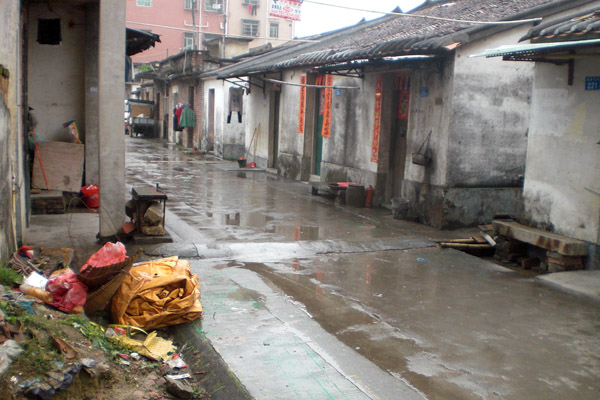
Jilong Village ruins

In the ongoing rush to raze urban villages, vestiges of the actual old villages have suddenly assumed an almost mythic aura and handshakes seem classically urbane. The latest example? Remnants of Jilong Village, one of the four neighborhood/ villages that constitute Huanggang (the other three are Shangwei, Xiawei, and Huanggang New Villages) are currently being renovated in the shaded grove next to Huanggang Plaza and now flicker with ancient promise. As close as half a year ago, migrant workers rented these decaying row houses; now, visions of a Huanggang Xintiande dance in my head. A few pictures, below.

This slideshow requires JavaScript.

Xiasha: What continues and what fades away

Yesterday, I met Chen Hong (陈宏), executive producer of the Shenzhen Villages documentary mini-series (桑海桑田:深圳村庄三十年) and was gifted my own set of DVDs and associated book! No longer dependent on the odd youku upload, I can now finish my review of episode 5, The Background of Xiasha (下沙背景).

The opening begins with the last Song Emperor fleeing the Yuan. His grave, of course is in Chiwan, but it turns out, over 800 years ago, Xiasha villagers met the imperial refugee and his ragtag army with large casseroles of chicken, seafood, pork, and vegetables or pencai (盆菜) as they are known in Shenzhen. The mini-series narrator solemnly intones that although the Emperor died before his ninth birthday, the pencai tradition lives on in Xiasha Village.  Continue reading

Daban Bridge Road

The other day, Annette Kisling and I walked from Xiangnan Village-Neighborhood to Guantou along Daban Bridge Road (大阪桥路), which once paralleled the coastline, connecting the old Yamen at Nantou to Dongjiaotou, a small cove that geographically marked the entrance to the Shekou Port. The stone bridge went over a small tributary from the inner Pearl River Delta. Today, of course, Daban Bridge Road twists parallel to Qianhai Road and the tributary has been reclaimed. In addition, Nanshan District’s extensive road network has partitioned the villages/ neighborhoods that Daban Bridge Road used to link, creating city blocks. Unfortunately, these blocks to not conform to historic breaks between villages along Daban Bridge Road, but rather enforce a strict traffic grid. Pay attention not only to the diversity within neighborhoods, but also between. Enjoy.

This slideshow requires JavaScript.


handshake urbanity — xinqiang community

In 2003, Shenzhen initiated a sanitation beautification project called the “clean, smooth, peaceful project (净畅宁工程)”. The aim of the project was to clean up roads and gutters and trash and beautify public areas, which included razing the shanty communities (棚户区) that once flourished deep in the area’s lychee orchards.

How common were the lychee orchard shanties? Continue reading

(光明新区)楼村: Of what use is [urban] planning?

Located in Guangming New District (光明新区), Lou Village has the largest area of any in Shenzhen and a villager population of 4,000. Of course, it is no longer Lou Village but Lou Village Neighborhood (楼村居委会) and its population is no longer under 5,000 — and therein lies today’s tale.

At the 15th Anniversary of the Establishment of the Shenzhen Special Economic Zone, the second line (二线) still divided Shenzhen into two distinct administrative structures, the SEZ (now called guannei or “inside the gate”) and Baoan and Longgang Districts (now called guanwai or “outside the gate”). The year was 1995 and Baoan and Longgang District governments had been built and staffed, 25 urban markets soon to be precincts (镇 into 街道办事处) had been designated, and consequently the work of incorporating over 200 guanwai villages into the municipal apparatus begun. Economic advancement was an important aspect of political incorporation precisely because 15 years into reform, Shenzhen had discovered that “allowing a few to get rich first (让一部分人先富裕起来)” undermined social stability. Continue reading

in the aftermath of housing reform (房改)

Much of what I know about Shenzhen, I know through hearsay. How much might be confirmed through other sources — people, reports, maps, or books, for example — is a methodological question. Sometimes I can track down confirmation, other times I can’t. What I do know, however, is that most folks are willing to talk about other people’s affairs, even when not willing to disclose anything about themselves. The other day, I heard a story about the Baoping Community compound and here’s how it goes:

Built in the area around the train station and then moving north parallel to the train tracks, the earliest residences for Shenzhen cadres were small, danwei compounds. In 1980ish, the Xili Industry and Trade Enterprise bought land rights from Caiwuwei Village and built a small compound along what became Heping Road, just east of the railway. Xili went out of business and Shenzhen Travel took over the compound. However, Shenzhen began privatizing danwei houses in 1988, a full ten years before the rest of the country. Thus, China Travel employees who had housing in the residential area were able to purchase their benefit housing (福利房) at cost.

Sometime after privatization, the residential compound was renamed, Baoping. Old and small, the residential compound is no longer upscale housing. Instead, most of the homes are shared rentals (合租), in which each bedroom is rented out and then the kitchen, bathroom, and living spaces are shared. Continue reading

new village origin stories: Caiwuwei redux

What to make of the following quote by Terry Farrell, architect behind the KK 100?

The site of KK100, [Farrell] says, used to be Caiwuwei village, a poor and rundown area. Kingkey had to build seven towers to rehouse local people and a further seven for other locals to own and rent out, so that they might share in the boom. It’s an extraordinary idea: even as China hurtles into capitalism, it does still show remnants of old socialist ideals.

It echoes a quote from archello, a website dedicated to world architecture. Although archello has erased the reference to socialism:

The 3.6-hectare site [for the KK 100] was previously occupied by a dense residential quarter, Caiwuwei Village. The developer had the creative vision to form a company with the villagers, initiating an entirely new approach to the art of place-making in Shenzhen. This serves as a model for 21st century for urban change all over the world. Existing buildings were run down and living conditions were poor. As part of initiating this transformation, a Joint Development Initiative was formed in which villagers became stakeholders. Each owner was offered a new property as well as a second home which serves as an income generating asset. This meant the preservation of community links that are built over generations.

Origin stories for Shenzhen and its various buildings continue to use “poor backward Baoan villages” as a foil for their own achievements. In Mandarin, stories about the KK 100 are more detailed (深圳城中村专题-罗湖蔡屋围蔡屋围:梦想的真实围绕, for example), but in essence no different: the KK100 symbolizes urban proress.

What’s more these stories share an enthusiasm for height, illustrating how phallic aesthetics not only bridge the social distance between England and China, but also between the Shenzhen Municipal Government, KK 100 developers, and Caiwuwei Villagers. Indeed, Farrell has received acclaim both for his design and the fact that it is the tallest building ever realized by a British architect, a neat illustration of the link between competitive masculinity and nationalism.

Importantly, the idea of the KK 100’s height is established through explicit comparison to low (level, quality, income) Caiwuwei. Continue reading

Thinking conservation: whose lives matter?

Thursday last (Feb 16), the Hong Kong version of the bi-city biennale opened and then on Friday afternoon, Shenzhen began its closing events with a series of roundtable panels. Along with moderator Juan DU, architect Ben Wood, and urban planner Michael Gallagher, I participated in panel #2, contemporary perspectives on preservation.

We agreed that history should serve living people and thus conservation was not a question of saving old buildings for their own sake. Rather, what is conserved are patterns of human relation and environments that support those relationships. In this sense, any act of conservation entails a value judgment; whose lives do we wish to strengthen and deepen by creating sites that reference the past?

Not unexpectedly, it was at this moment of making value judgements that our differences became clear precisely because history serves different purposes in different social groups. Continue reading

On the banks of the Newly Established — Peanuts

Yesterday, enjoyed a lovely walk and conversation with Sara, a young curator visiting from Canada. We took a bus to Fuyong, one of the Baoan precincts which abuts the old Guangshen highway and is now more commonly known as National Highway 107.  Guangshen / 107 is (in)famous for its factories, migrant workers, and more recently container dwellers, which have entered Shenzhen conversation as extreme examples of the SEZ’s cost of housing problems.

This slideshow requires JavaScript.

Sara’s interest in urban gardening brought us into conversation with Aunt Xu, who migrated from Fujian to live with her son in Lixinhu (Establish the New) Estates, a 90s era housing development located next to the Lixin Reservoir. Aunt Xu had come to live with her son and take care of her grandchild. But five or six years ago, the grandchild started school and no longer needed childcare. Aunt Xu abruptly had time on her hands. Uninterested in television programs and full of energy, Aunt Xu decided to cultivate peanuts on the banks of Lixin reservoir.  Continue reading

china’s 2011 clinker production capacity

It’s true, in searching for statistics about how much cement has been used in Shenzhen (I keep hoping some social statistically minded engineer will do the calculations), I stumbled across China’s cement web. One of the articles, relevant to aforesaid search, was the clinker production capacity of China’s ten largest cement producers in 2011.

As of Jan 1, 2012, China’s big cement ten are, in order: Hailuo (海螺水泥)、Southern (南方水泥)、China United (中联水泥)、China Resources (华润水泥)、Sinoma (中材集团)、Hebei East (冀东水泥) 、TCC (台泥水泥)、Sunnsy (山水集团)、Huaxin (华新水泥)、and Hongshi (红狮集团). Together they have the capacity to produce just under 581 million tons of clinker, annually. Just how much can be built with all that cement? Well, the Empire State Building weighs in at 370,000 tons. This means that ten Chinese cement factories produce the mass equivalent of 1,570 Empire State Buildings.  Continue reading