Today, there was an exhibition opening in the afternoon and a performance of The Hairy Ape this evening. Suddenly, culture all over Shenzhen. Impressions, below.

Today, there was an exhibition opening in the afternoon and a performance of The Hairy Ape this evening. Suddenly, culture all over Shenzhen. Impressions, below.

Yesterday, I went to the Bao’an Archives Office (深圳市宝安区档案馆) and met with one of the editors of the Bao’an Gazetteer (宝安史志).
The conversation turned to the paradoxical dependency of historical narratives on a sense of immortal China and actual historical archives. This paradox might be glossed as a contradiction between “emotional” and “documented” history. On the one hand, patriotism, tradition, and the deep history of Han settlement anchors the idea of “Shenzhen history”. The emotional sense that Shenzhen is and has always been part of “China” is created through a narrative that links the history of Xin’an Ancient City, for example, is written with respect to the area’s integration into the Eastern Jin Dynasty and the development of the imperial salt monopoly. Thus, ongoing political restructuring — beginning with contemporary Shenzhen and arriving at the Eastern Jin via Bao’an, Xin’an, and Dongguan — is rewritten as evidence of the city’s ongoing participation in something that might be glossed as “eternal China”.

This map is of the Eastern Jin when Nantou City was the prefectural seat of the Guangdong Eastern Prefecture (东晋东官郡), including present day Dongguan City, Shenzhen, and Hong Kong.
On the other hand, the actual archives to which a historian has access bureau is an artifact of political restructurings and the concomitant shifting of administrative borders. The question of land titles (地契) that were issued during early land reform (1950-52) is an interesting case in point. Originally, all Bao’an county land titles were held in Huizhou City, which administered the county from 1950-1979. These land titles, of course, became void during collectivization movements (second half of 1950s) and land holdings shifted from individuals to collectives. Consequently, during the 1980s household responsibility system (家庭联产承包责任制), land rights were redistributed via collectives. Nevertheless, in the early 1980s, the land titles were sent to Bao’an, where they are incomplete, but nevertheless have been increasingly used by villagers to make land claims.
The ongoing construction of Shenzhen has further complicated the actual practice of creating viable historical archives. Theoretically, archives have followed administrative hierarchies. In practice, this means that when an administrative unit is promoted and/or redistricted documents have to be moved from one building to another. For example, the transfer of Bao’an land titles from Huizhou to Bao’an. Moreover, the ongoing construction of Shenzhen municipal and district offices means that these archives have not only been packed and sent to another building, where they may or may not have been unpacked, but also during the redistribution boxes of material have been lost.
Our conversation concluded with the recognition that history — as we are writing it in Shenzhen and I suspect elsewhere — turns on context. Are we responding emotionally to patriotic calls? Or are we developing arguments out of extant documents? In either case, here on the ground, the tension between these two extremes serves to buttress both emotional and documentary uncertainties. When we lack a document, we can turn to the hyperbolic understanding that Shenzhen has always been part of China and when we need to assert the truth of our feelings, we can point to these maps, which although now virtual, continue to reassure us that history is not just of our own making.

Yesterday, a weixin article claimed that among China’s 230 million migrant workers, the number of workers over 50 years of age could be as high as 36 million. These 36 million, of course, were the first generation of migrant workers, who left their villages in 80s and early 90s — before reforms had spread beyond the borders of special economic zones and coastal cities, to work in China’s newly opened factories.
The article raises the important and increasingly pressing social question, where will these workers retire? And what will they do in the absence of retirement plans? The journalist interviewed older workers in the northern city of Lanzhou, where there is little option but to retire to their hometowns. According to a report published in 2010 by the Chinese Elder Workers Council, 84.7% of city and town residents have a pension, averaging 1,527 yuan a month. In contrast, the percentage of rural residents with a pension is 34.6% and the average income is 74 yuan a month.
In Shenzhen, the debate over what to do with older migrant workers has been ongoing since March 1987, when the city legalized the participation of rural migrants in pension plans. Indeed, Shenzhen has been at the forefront of reforming China’s pension plans, allowing self-employed entrepreneurs to buy into pension plans (1992), and provided pension supplements for regional workers and for non-Shenzhen residents to collect pension benefits in the city (1999). In 2007, twenty years after migrant workers were permited to buy into pension plans, there was a rash of articles about Guo Jinzhao (郭锦钊), the first migrant worker to collect a monthly pension in Shenzhen (at the time of the article 1,005 yuan a month).
Over 25 years since the debate about migrant workers began and the celebratory publicity campaigns notwithstanding, the majority of Shenzhen migrant workers has not earned enough to either retire in the city or to have purchased into pension plans. In 2012, Wen Qingqiang published a photoessay on the city’s “naked old tribe (裸老族)”. The gist of the article anticipates the Tencent post: older migrant workers can not afford to stay in the city where they have lived and worked for the past several decades. Instead, their most viable retirement option is returning to their hometowns.
Note about language: In Chinese, the expression for “rural urbanization” is more specific than its English translation, highlighting both extant labor regimes and the administrative structure of the Chinese state apparatus: 农村城镇化, literally means, “agriculture villages city town transformation”, or “the transformation of agricultural villages into cities and towns. The distinction between cities and towns is relevant, of course, because within the Chinese state apparatus, cities rank higher than towns (which rank higher than villages) and are thus more eligible for state funding and preferential policies. At the level of geopolitics, then, rural urbanization has referred to the restructuring of spatial hierarchies. The transformation of rural Bao’an County to Shenzhen Municipality remains the national poster child for successful rural urbanization.
Importantly, rural urbanization has also occurred through the migration of rural residents from agricultural villages and townships to the country’s cities. In fact, these workers are literally called “farmer-workers(农民工)”, an expression that not only emphasizes rural origins, but also their role within urban hierarchies. This point bears repeating because rural migrants have not been fully integrated into urban societies, either formally (through hukou and concomitant welfare benefits) or informally (through friendships and associations that might blur the distinction between urbanites and bumpkins). Here, although Shenzhen has taken initiatives to experiment with tweaking the hukou system, nevertheless, the ideological distinction between urbanites and bumpkins continues to shape both public policy and the concomitant imaginary of just who is (and is not) a Shenzhener.

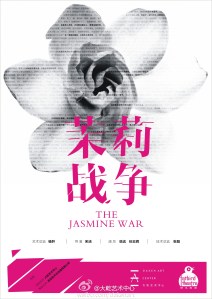
The latest Fat Bird production, The Jasmine War (茉莉战争) will go up next week at the Daqian Art Center, which is located in Eco-Park OCT (深圳华侨城生态圈广场大乾艺术中心). Tickets will be available online through the art center.
Impressions from rehearsal, below:
The Foreign Policy series “China’s Left Behind Children,” by freelance journalists Deborah Jian Lee and Sushma Subramanian followed the migrant worker Huang Dongyan, who left her daughter back home to work in Shenzhen. Her relationship with her daughter remains fraught and teeming with unsatisfied yearnings. In response, Huang, decided to raise her son in Shenzhen instead of leaving him in the countryside with his grandmother. The two articles are well worth reading, here and here. Of note is the continued relevance of hukou in the lives of migrant workers, especially with respect to receiving an education.
Yesterday, my friend told me a story about how her sixth grade lost the role of Maria in a short skit based on The Sound of Music.
The sixth grade is preparing a graduation celebration that includes skits, songs, speaches, and food. Parents are organizing these events, including an English teacher who wrote the Sound of Music skit. Apparently, the English teacher intended that her daughter would play Maria. However, when the daughter declined, my friend’s daughter said, “Yes!” and started preparing.
Soon after, the English teacher’s daughter sought out my friend’s daughter and said that she wanted to play the role of Maria. My friend’s daughter asked what to do. On her interpretation, she had several options: (1) cede the role to her classmate; (2) ask the teacher to decide, or; (3) audition before the class and let their classmates decide. What my friend’s daughter understood clearly, was that if a teacher’s daughter wanted the role, then their homeroom teacher would take the role away from her and reassign it to the teacher’s daughter.
My friend comforted her daughter, saying that there would be many other opportunities to perform. However, her daughter was sad and so my friend asked me what I thought. I didn’t have to think. I said that it was perfectly natural for her daughter to be upset at such blatent injustice. My friend agreed, but added that in China this was how things happened. Sometimes you could spend more time and energy only to have your work denied or the glory taken away. I concurred, but asked if it was really necessary to learn such a lesson in elementary school.
And there’s the culturally interesting question: when and how do children learn the politics of everyday life?
I remember in high school having a teacher who took a dislike to me. Once when I was not in class (I don’t actually remember the reason), said teacher held a vote, asking students to decide whether or not I should be allowed to remain in class. I was voted out of the class. So, I went to the vice principal to mediate. When I sat down with that teacher, he chronicled what a horrible student I had been — talking in class, passing notes, and not attending. All true. Thus, when he finished speaking, he stood up to leave; clearly, he thought that sitting down with me was enough to demonstrate his good faith in the process.
I actually needed the vice principal to call that teacher back to the conversation, when I had a chance to mention that this teacher made inappropriate remarks about the girls in the class. I had started making snide comments and when he addressed me, I spoke back. Once I said this, the vice principal asked the teacher if their was any truth to my story. The teacher shrugged and then offered the following compromise: I could take a study hall during history class, but receive an “A” for my work. And what did I know? I didn’t turn to my parents, but accepted the deal, leaving the vice principal and history teacher to figure out their relationship, which had suddenly been complicated.
After I told how I was bought off, my friend nodded. She said that she would advocate for her daughter to keep her role. After all, these moments of injustice — in Chinese elementary schools and US American high schools — are learning moments. Unfortunately, we more often than not first learn and then unconciously teach the unequal politics of everyday life.


One of the most common sights sites in Shenzhen — the prefabricated, movable dormitory. Of note, although almost half of sales are domestic, nevertheless the “Chinese standard” is being profitably exported throughout South America, Southeast Asia, Africa, Oceania, and the Middle East. It is of note du jour because I just realized that this is one of the primary housing typologies for workers. Moreover, it serves the purposes of urban rennovation without leaving housing stock for more permanent working class neighborhoods. That said, one of the other uses of prefabricated houses is building suburbanesque working class neighborhoods in the United States and Japan.
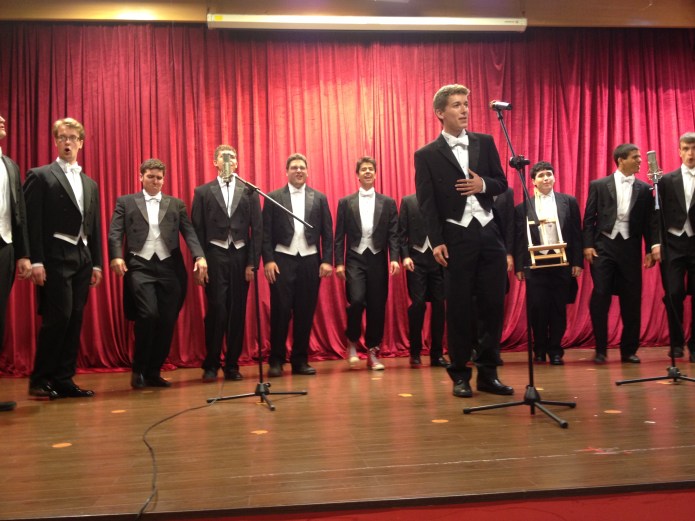
Just spent the past 2 and a half days tagging along with the Spizzwinks. They are all that. Energetic, generous with their smiles and attention, respectful, and talented. And yes, the Spizzwinks charmed and amazed three very different audiences at the Mass Arts Theater (群众艺术馆), Green Oasis School, and at the Dalang Culture Center (大浪文化馆), hopefully inspiring more people to sing and join choirs.
The hospitality of the Shenzhen hosts completed the exchange. In Shenzhen, friends arranged a large dumpling making banquet for the group, in addition to a delecious dim sum brunch before the GOS concert. In Dalang, we were taken to see a factory showroom, libraries that have been set up for workers and their families, as well as to meet the unicorn dance troupe. I was especially moved by the talent and passion of the Dalang Workers Youth Choir, whose members work during the day and practice two hours once a week. One of the troupe members works in a watch factory and handmade 17 watches, one for each Spizzwink.
This trip reminded me that successful cultural exchanges are everywhere the same: when we give all that we are, we all share in the joy.
Incomplete impressions, below.
After several months, I return to my synopsis of The Great Transformation (沧海桑田:深圳村庄三十年). This episode is about Futian Village (富田村), which begins raising the counterintuitive question of why Walmart would build a megastore in Futian Village. The underlying message of the episode might be half-facetiously summarized as “location, location, location”.
The story of how Futian Village became known as Futian suggests the shifting contours of village lands. 田 (tian) of course meant “paddy” or “fields” and has been constant over history. Over 900 years ago. One went to Futian, one settled in Shangsha, and the third went to Yuanlang in what today is known as the Hong Kong New Territories. However, the village was originally called “Getian (隔田)” because it was separated from the mainland by a stretch of seawater that extended to Tianmian. Over time, sedimentation filled the marshy areas between the coast and the separate fields. This new agricultural land was called Futian (幅田). When the name was formalized during the Mao era, the village was named Futian (福田), which included the character 福 (fu – prosperity), a homophone for 幅 (fu -meaning landfill). According to an old villager, “real Shenzheners” call him “Getian person (隔田佬)”.
In fact, the history of the area is the transformation of the status of fields. Before 1980, Futian villagers cultivated grain, sugar cane, and peanuts. The village itself was defined in terms of these land holdings. They were organized as one brigade, which was further organized into two work teams – total population 1,000 people. However, according to the old Village Party Secretary Huang many more villagers escaped to Hong Kong before reform. At the establishment of the SEZ, the village occupied had strategically located land holdings, at the edge of the Luohu downtown area. In 1992, when inner district villages transferred historic land rights to Shenzhen Municipality, the village developed rental property and commercial areas. There were two key developments that went on to have national impact. Firstly, in 1998, Walmart opted to open its first megastore in Futian Village. In turn, the Futian megastore became the model of how to operate a Walmart in China. Secondly, the Venice Hotel chain also opened its first hotel in the village.
1990s and early turn of the millennium corporate village development emphasized profit rather than public space. Importantly, however, Futian Village was located directly adjacent to the new central axis area. However, when the new Civic Center opened, Futian Village was required to upgrade accordingly. In 2007, when Futian decided to build a new culture plaza, then Futian District Party Secretary, Lv Reifeng reputedly said, “I can’t give you funding to build the plaza, but I can give you a policy.” The policy was quite simple: Futian District gave 30% of the total cost to build the plaza.
To recap: The Great Transformation tells the story of thirty Shenzhen villages. Importantly, the idea of “village resident” in the series constantly shifts between “indigenous villagers” and “migrants who live in the village”. This slippage is subtle but hinges on the way in which urbanization has not only transformed fields, but more importantly restructured property rights. For example, when the narrator says “villager/s (村民)”, he clearly means “local villager/s”, referring to those who own buildings and have stock in the collective holdings. However, when he speaks of “urban villages (城中村)”, he means the urban neighborhoods that evolved out of the previous village. More tellingly, the slippage between “villages” and “urban villages” structures rhetorical questions throughout the series. The episode, “Futian Village”, for example, opens with the rhetorical question, “Many wonder why one of the world’s 500 richest companies would choose to open their first megastore in an urban village.” Clearly, the intended audience of the serial documentary continue to view urban villages as rural villages rather than urban neighborhoods.
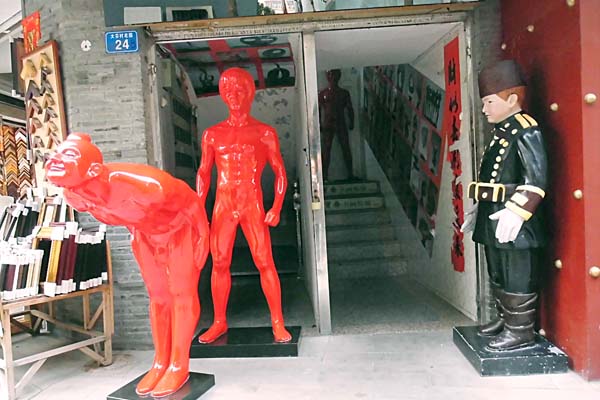
Yesterday I visited Dafen for the first time in over a year. Noticed several tourists, better coffee shops, and a store selling Tibetan clothing. It seems that Dafen’s makeover from site of copy painting production to a shop-front / tourist site continues. Impressions, below:
 Shenzhen Noted