WoWorldly desires

Window of the World opened in 1984, on the auspicious day of 6.18 (June 18). Yesterday, I visited WoW with Constant Dullaart, one of the residents in this years OCT Art Residency. The featured image for this post is a snap of us in front of Niagara Falls.

This is the first time I’ve visited WoW since 1997, and was impressed by two of the new installations — a plane ride trip through the United States (installed 2004) and a toy train ride through mountainous Europe (June this year). The plane ride uses IMAX technology and moving seats to give the impression of flying coast to coast on a double wing plane. At each landmark, white Americans wave to visitors, yelling, “Welcome to the United States”; in watery areas, visitors are lightly spritzed with water. The toy train is less high-tech, but more popular with young children. According to one of the friendly staff members, these rides are part of plans to shift WoW entertainment from viewing miniature landscapes to interactive rides and activities; I’m thinking WoW goes Epcott.

I was struck not only by the yearning for elsewhere manifest in the WoW installations, but also by the continuing nostalgia for a particular kind of elite life. Tourism as an activity of early 20th century elites continues to shape built forms of this yearning. (Or perhaps we experience nostalgia in search of an object?) This neo-liberal appropriation of colonial forms of pleasure was also been reproduced at Shekou’s Seaworld, circa 1984, where the plaza houses western consumption in quaint buildings and the landlocked Shining Pearl.

Seaworld was one of the first efforts to materialize Chinese yearnings for the better (relentlessly global) life. Nevertheless, by the early 1990s, when WoW was built and developers put up European style estates (with appropriate tributes to Versailles excess), Shenzhen grappled to implement neo-liberal economic policies without neo-liberal political changes. The political-economy of both early Shekou and 1990s Shenzhen were reminiscent of early 20th century capitalism, when all sorts of material wealth began to appear, but only a few people were positioned to enjoy it. Or more to the point, perhaps, only a few elites had both the leisure and resources to enjoy it, including romantic alpine train rides and virtual plane rides on double wing planes a la the Wright brothers.

The fantasy life infusing representations of the early 20th century high life — the fashionable world — were a fixture of 1990s Shenzhen architecture. Seaworld and WoW, for example, were conceived and built in the post Tian’anmen era, when “European-style” housing estates were also popular, including OCTs upscale Portofino. In fact, throughout Shenzhen, but especially along Shennan Center Road, the mini-fascades that wrap WoW and Seaworld dreams have been enlarged in themed real estate developments, where many of Shenzhen’s solidly middling middle class still live and to which many migrants aspire.

Yesterday morning while waiting for Constant, I stood at the subway exit that is located beneath the Jiang Zemin inscribed glass pyramid and watched ticket scalpers approach tourists. The tourists spoke accented Mandarin, and had organized themselves into small groups of carefully dressed visitors. They examined the pamphlets, considered their options, and then opened their umbrellas to embark a rainy day of exploration. Those I later saw again within the park seemed to be enjoying themselves; I certainly enjoyed the toy train and virtual plane rides.

In recent years, of course, Shenzhen’s vision of the world has gone SciFi glassy — steeled if you will — against the imaginary onslaught of encounters with alien lives. However, that kind of elite consumption does not resonate with the same visceral pleasure of early 20th century elites enjoying both their traditional privileges and the mass produced delights of a new era. I’m trying to figure out why. Guess du jour: we want elite agency, but we want it as pleasure,in the play of tourism and leisurely meals, for example, rather than as the high stress, overwhelmed and overwhelming agency that seems to characterize elite life on the ninety-first story of a 21st century glass tower.

Postcards from my Alpine excursion, below:

This slideshow requires JavaScript.

aging in tangtou, baishizhou

This past week I have been listening to stories from the residents of the Tangtou row houses. Here is one:

Old Xu was born on November 12, 1945. In neidi, he was an accountant on a production team and then for the village enterprise.  After the redistribution of land during the household responsibility system, he and his wife did not receive enough land to farm cotton profitably. Consequently, his three children left to work elsewhere and the land has gone fallow except for a small vegetable plot.

Two years ago, Old Xu came to Shenzhen at the age of 65 because he did not want to burden his children with the cost of his retirement. His wife continues to live back home, taking care of their grandchild.His pension is only 30 or 40 rmb a month. Together, he and his wife need 20,000 rmb annually, or about 1,700 a month to meet their expenses. In Baishizhou, he makes a living collecting and reselling cardboard boxes and other garbage. He says he can save money this way because although there’s no real profit, he makes enough to support himself and to bring a little home for Chinese New Year.

At present Old Xu lives with two other old men in one of the 25+ square meter houses. This house is one of the cheaper in the settlement, with a rent of about 600 rmb a month plus water and electricity. His share is 200 rmb a month, or roughly 5 times his retirement pension back home. A bathroom has been added to the outside of the building. Inside, the space has been divided for sleeping and simple cooking.

When I asked him how the environment could be improved, Old Xu said that old people have no place to exercise. Instead, they just sit around talking, but that was the fastest way to an unhealthy old age! Old Xu also admitted that he was lonely because except for his roommates, he didn’t know anyone in the area. He then shrugged and asked rhetorically, “What can be done? If I go home, I can only become a burden for my children.”

maillen hotel and apartments

The Architectural Review has published my review of the Maillen Hotel and Apartments by Urbanus. In the published review, I look at China Merchants’ recent push to gentrify Shekou in terms of gated communities for Shenzhen’s expatriate community. As designed by Urbanus, the Maillen Hotel and Apartments suggest the role of traditional Chinese gardens in the ideological transformation of Maoism into neoliberalism. A synopsis of the review, below; full article, here (with pictures by Sarah Cain).

Urbanus’ stated intention was to design the Maillen Hotel and Apartment with respect to both extant geographic conditions and the traditional Chinese ideas about landscape and garden design, incorporating Nan Shan Mountain into its design with an eye to realizing the aesthetic ideal of “bu yi jing yi”, a four-character expression which literally translates as “step moves landscape moves” and refers to the experience of enjoying new garden scenes with each step taken.

By incorporating the hill into its design, Urbanus took advantage of the section of Nan Shan that remains standing. Historically mountains and hills defined the South China landscape, and Shekou was no exception. However, during the first two decades of development in Shenzhen, urban planning and design prioritized speed and price over any other value, including environmental impact. The Chinese expression for land reclamation, “yi shan tian hai” or “move mountains and fill the sea” literally describes the step-by-step transformation of the Shenzhen Bay coastline. First, raze a mountain – and many Shenzhen hills no longer exist except as place names – and, second, reclaim coastal land, creating flat, relatively inexpensive building sites. The point, of course, is that as the city has prospered and natural features such as Nan Shan have been restructured, their market value has increased exponentially.

The Maillen design also invokes traditional garden design through landscape. Elegant courtyards, perennial bamboo clusters, and delicate plum blossoms evoke literati lives in Suzhou, which during the Song dynasty codified the defining features of a traditional garden. In a classical Chinese garden, stylized elements – ponds, a rock garden, trees and flowers, as well as built structures, for example – symbolized the larger world. The key point, of course, is that the garden allowed members of the Emperor’s court, classical scholars and wealthy merchants to experience themselves as being one with nature without actually having to go into a forest or sail on the ocean.

It is at the moment of exclusivity, or rather the potential to market and sell privatized pleasure that we see the appeal of classical Chinese gardens to contemporary real estate developers. Classical gardens were restricted spaces of elite pleasure, where scholarly achievement and social rank determined who was or was not permited to enjoy the elegant topiary and tranquil spaces. Today, money and status rather than scholarly achievement or social rank might determine who crosses the threshhold, but the effect is the same, the creation of a fashionable space for a select minority. With the Maillen Hotel and Apartment, Urbanus has designed a witty, elegant, and self-enclosed space of privileged consumption.

Indeed, when we architecturally cite China’s classical past, it is important to remember that we are also invoking the feudal hierarchy that the Revolution aimed to overcome.

demise of the shenzhen youth herald

In April this year, Cao Changqing (曹长青 who now operates an influential Chinese language news source) posted “Bo Xilai’s Father Destroyed the Shenzhen Youth Herald (薄熙来父亲灭掉《深圳青年报》)” to commemorate the 25th Anniversary of the closing of the Shenzhen newspaper, where he began his career in journalism. The post was prompted by a conversations with Yan Jiaqi (严家其), who had been the Head of the Politics Department, the Chinese Academy of Social Sciences (中国社科院政治所长) during the 1986-87 student movement and was an advisor to both Hu Yaobang and his successor, Zhao Ziyang. Indeed, Yan Jiaqi himself would flee to Paris after his support of student protests in the 1989 democracy movement.

In the early years of reform, the Shenzhen Youth Herald was, along with Shanghai’s World Economic Herald (世界经济导报), one of the two most independent newspapers in China. Consequently, despite being a small newspaper, the Youth Herald had a national subscription base, providing Chinese intellectuals a platform for debating progressive ideas and evaluating ongoing experiments in reform Chinese society. On October 21, 1986, for example, the newspaper printed Qian Chaoying (钱超英)’s contraversial opinion piece, “I Support Commerade Xiaoping’s Decision to Retire (我赞成小平同志退休)”.

In the manner of traditional intellectuals, Shenzhen University professor of literature, Qian Chaoying’s writing style was sincere and humble, but the content was unmistakably radical. Moreover, the piece drew directly on and from Shenzhen’s experience, asking: Why must the People show our sincere and deep feelings for Deng Xiaoping by sacrificing further reform of the political system (为什么表达人民对小平同志纯朴深挚的普遍感情,就非要以延缓政治体制改革的进程为代价不可呢)? On Qian’s reading, Deng’s retirement would allow China to reflect on and establish a more just political system, a system that was more in keeping with the needs of reform, rather than a return to the cult politics, which had characterized the Cultural Revolution glorification of Mao Zedong.

Yan told Cao that Bo Yibo (薄一波, Bo Xilai’s father and one of the Eight Elders of the CCP) was not only furious about the opinion piece, but had also approached it as an attack the power of older and already retired leaders. During a meeting on political reform, Bo Yibo participated as a consultant. Zhao Ziyang was talking about the opinion piece with Peng Chong (彭冲). Upon overhearing the conversation, Bo Yibo became livid and is reported to have screamed at the younger leaders, “You are already fifty, sixty and seventy years old. We won’t die and you won’t rise (你们也五十六、七岁了吧?我们不死,你们也上不来).” Hu Qili (胡启立) was apparently so frightened that he immediately showed his support for the elders, wishing that the the old leaders of the proletarian revolution would live to a healthy old age (我们希望老一代的无产阶级革命家健康长寿). Importantly, at that closed meeting, Bo Yibo called for the Party to investigate who had written and the newspaper that had published the opinion piece. The word used, zhuicha (追查) meant to find out who Qian Chaoying was speaking for. Bo Yibo assumed that neither Qian Chaoying, nor the Youth Herald was acting as an independent voice, but rather was acting on behalf of one of the young reformers, most likely Hu Yaobang.

The opinion piece was published at a critical time in Central politics. Hu Yaobang and Zhao Ziyang, Deng Xiaoping’s “right and left hands” were pushing for further political liberalization. Less, than two months after the letter was published, students organized public protests across over a dozen cities in support of political and economic liberalization. Astrophysicist, Fang Lizhi (方励之) led the protests, calling for introducing political reforms that would ultimately end the one-Party system and the continuing use of government as an instrument of Party policy. Two other intellectuals, Wang Ruowang (王若望) and Liu Binyan (刘宾雁) also led the intellectuals. It is said that Deng disliked Fang, Wang, and Liu, directing Hu to dismiss them from the Party, but Hu refused. In the fallout, Hu was forced into retirement because it was said he had been too lenient with student protestors. The Shenzhen Youth Herald was also one of the victims of the 1987 crackdown. The Shenzhen Youth Herald was closed and Cao Changqing banned for life from working in journalism at the same time that Hu Yaobang was forced into retirement. Two years later, the Tian’anmen protests would begin when students gathered to eulogize Hu Yaobang. The now defunct World Economic Herald published an article supporting the students’ call to re-evaluate Hu’s legacy.

shenzhen bay coastline, oct 27, 2012

I wandered to the Shenzhen Bay Park, tracking the construction and commodification of the new coastline. Land reclamation has brought views and parks, but I noticed that children and dogs still want to get their feet wet. Impressions, below.

This slideshow requires JavaScript.

architectural thinking — from the nanjing sun yat-sen memorial to luohu train station

One of the highlights of the XLarch Masterplanning the Future Conference was Wang Yun (王昀)’s keynote speech that periodized the development of Chinese style architecture, arguing for an internationalist approach to architecture, rather than an ideologically charged use of architectural symbols.

As an architectural style, Chinese classicism was invented by western trained architects who upon returning to Nationalist China received commissions to build “Chinese style (中华风格)” buildings during the decade of 1927-1937. These buildings had large, Chinese style roofs, windows and decorative details, and sometimes included stylized gardens. The Nationalist capital, Nanjing was the location of some of the most important examples of this style as well because commissions not only represented individual client preferences, but also the determination of government leaders to create a recognizable Chinese public architecture.

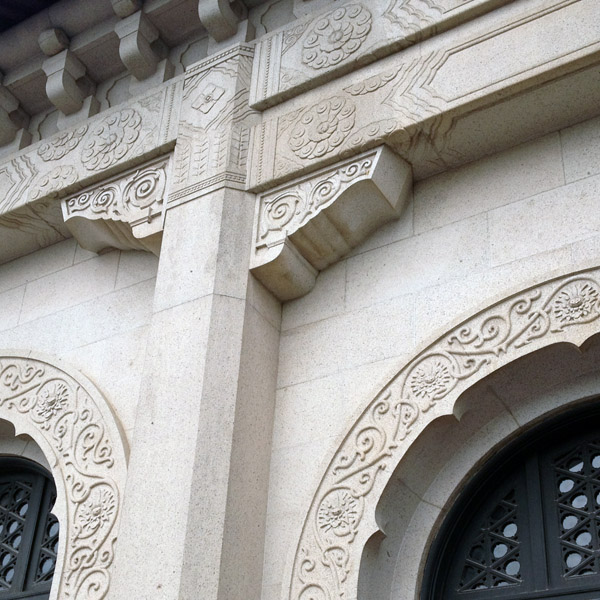
One of the most important examples of Chinese classicism is the Nanjing Sun Yat-sen Memorial, which was designed by one of China’s first starchitects, Lv Yanzhi (吕彦直). Lv also also designed the Guangzhou Sun Yat-Sen Memorial before his untimely death in 1929. The Nanjing Memorial reinterprets traditional themes through choice of material (reinforced concrete and mosaic tiles) and through the secularization of traditional symbols (animals become geometric shapes, for example). In addition, the Memorial layout abstracts and represents Nationalist China as the difficult realization of Dr. Sun Yat-sen’s three principles of the people (三民主义) — nationalism, democracy, and public welfare. To reach the Memorial proper, for example, there are 392 steps going upward, each step representing one million Chinese, and together representing the population of nationalist China. These steps are broken by eight flat platforms, which represent the fragmentation of China by warlords and civil war. However, when one looks back on the stairs, all one sees is a flat surface, an optical illusion that promises national unification.

The Nanjing Sun Yat-Sen Memorial provides a lexicon for understanding Chinese Classicism during the Nationalist era, including the reference to the Lincoln Memorial (1920) by way of the seated figure of Dr. Sun (1926-29). Not unsurprisingly, perhaps, the Lincoln statue also dominates a neo-classical building, albeit through references to Greek architecture. Indeed, both the Sun Yat-sen and Lincoln Memorials use the respective classicism of their countries to assert timeless governance, even as they commemorate leaders who governed countries divided by civil war.  I show the following images of the Nanjing Memorial with the caveat that they are not architectural — an architectural photo has amazing resolution, geometric composition, and absolutely no people, unless, of course, the figure contributes to architectural exegesis. My snaps, however, aim to emphasize just how popular this site is and thus how it continues to shape the visceral experience of being in “China” through a particular architectural style.

This slideshow requires JavaScript.

How does the Nanjing Memorial relate to Shenzhen?

This architectural lexicon has been picked up, tweaked and redeployed throughout Shenzhen, but as a private rather than public source of architectural symbols. The Luohu Train Station is the only exemplar of public Chinese Classicism that has been built in Shenzhen in the Reform Era. The other large example of post Reform classicism is the Hongfa Temple in Fairy Park, which is arguably political in its adamant denial of any political message. Certainly, in its assertion of the reintroduction of official religion to civic life, Fahong was as ideologically charged as the train station, which signaled China’s opening to capitalist countries. However, with the exception of these two buildings, Chinese Classicism in Shenzhen is limited to decoration in urban villages, where many handshakes have tiled roofs, restaurants, and the odd sculpture, such as Nvwa Holding up the Sky in Shekou, which is a socialist realist rendering of a mythic theme.

All this is interesting because given the explicit modernism of Shenzhen’s public architecture, the rediscovery or explicit use of Chinese tradition and roots are often used in neoliberal arguments for alternative forms of architecture and historic preservation. Chiwan comes to mind as do struggles for some form of preservation in urban villages. These efforts contextualize the design and construction of key civic architecture, including the Civic Center and central axis, which has the ideological expression of Reform and Opening (here, here, and here). Importantly, both the relentless modernization of Reform era public buildings and the alternative movement to construct a classical past for Shenzhen ignore Maoism, which nevertheless continues to inform the built environment.

tianmian celebrates 20 years of incorporation

Yesterday evening, Tianmian Industries Ltd (田面实业股份有限公司) celebrated 20 years of incorporation, simultaneously confirming the group’s new status as a corporation and the corporation’s status as the continuation of Tianmian Village. The celebration achieved this sense of historic continuity through the sequencing of socialist and traditional customs, including the presentation of and speeches by Tianmian, Fuhua Precinct, and Futian District leaders, which was followed by singing and dancing performances, a demonstration of Bruce Lee style kongfu by one of Bruce Lee’s students, and pencai, a local specialty that is only eaten at collective ceremonies. The speeches and performances took place on a stage in the vip area, while two large LED screens had been set up throughout the common area so that guests could watch the entertainment while eating.

Another important ceremonial function was to demarcate borders both within Tianmian and between Tianmian and outside communities. The 137-table event occupied  most of the main road into the village (directly off Shennan Road) as well as adjacent public areas, dividing Tianmian into two sections: the ceremony area and the rest of the neighborhood. Importantly, only Tianmian Ltd has the authority to cordon off public areas for private ceremonies. The ceremony area itself was subdivided into a vip area for leaders, their families and guests and a common area for Tianmian stockholders, their families and guests. Tianmian guards prevented non-guests from passing the red cordons.

Rituals such as these and the concomitant right to occupy public space are perhaps why we continue to speak of Tianmian Village as a village. In point of fact, we were celebrating the dissolution of Tianmian Village and its reconstitution as Tianmian Ltd. In ritual terms, however, the celebration clearly established Tianmian Village as the host and hegemonic subject of this territory and Tianmian Ltd as the contemporary manifestation of the village. What’s more, throughout the evening the gaze of outsiders — many of whom live in Tianmian housing stock — reinforced the sense of Tianmian as a vibrant and recognizable collectivity.

These rituals are particularly important in Tianmian because the corporation has not built traditional village buildings, such as an ancestral hall or a temple. In obvious contrast to Tianmian’s appropriation of public space, when larger village-corporations hold pencai ceremonies, they set their tables in designated village plazas that are surrounded by traditional buildings. In Xiasha, for example, the large village plaza includes an ancestral hall, a temple, a public theater, a traditional garden, and a path to the Xiasha Museum. Consequently, where Xiasha relies not only on ritual, but also on the built environment to reinforce communal solidarity, Tianmian’s village identity remains as such primarily through what is commonly called “non-material culture (非物质文化)”, or rituals.

It will be interesting to see, say in twenty or fifty years, how strong Tianmian’s sense of village solidarity remains and to compare that solidarity to that of a village like Xiasha, where the construction of village architecture sets the stage for village rituals. In other words, although Shenzhen has been seen as a laboratory for economic and social experimentation, we might specify further, and watch the ongoing reconstruction of traditional solidarities despite and within the maelstrom of modernization. Impressions from Tianmian’s 20th anniversary celebration, below.

This slideshow requires JavaScript.

time zoned urbanization

The walk from Central Walk Mall to the Civic Center by way of Central Park suggests the contradictory temporalities of Shenzhen speed, which was set when Guomao went up — one story every three days. Shenzhen Speed is time zoned urbanization, where architecture appears as a function of place X project-time subdivided by GDP expectations and the inevitable algorithm of actual buildings + entropy gains momentum in the absence of mindful inhabitation. Impressions from yesterday’s walk:

This slideshow requires JavaScript.

blue star blues

Yesterday, Ministry of Tofu translated a Southern Daily article about a Shenzhen elementary school teacher who marked students faces with blue stamps for misbehavior. They also published samples of weibo responses to this practice. No unexpectedly, there was general outrage over using humiliation as a means to correct student behavior. The article also mentioned that students received stamps for good behavior. Netizens were noticeably silent on this topic, no doubt because as long as I have been in Shenzhen, rewarding student behavior with stars and stickers has been standard practice in elementary schools.

In fact, public recognition and shaming are the most important motivators in the Shenzhen education system, where schools give and receive public recognition for “results (成绩)”. What’s more there is no question that we are speaking of test results, especially gaokao test results. At the high school level, municipal and district governments reward schools for the number of students sent on to first tier universities, in turn, the schools reward teachers for their students results, and teachers reward their students. In middle schools, public rewards are based on zhongkao, or high school entrance exam results with a similar system of bonuses for teachers who can produce results (出成绩) and students who get into top scores.

Given the importance of test scores their reputation and livelihood, Shenzhen teachers constantly seek ways to help students to improve their test scores. High school teachers run mandatory study sessions, while middle school teachers use classroom time to teach test taking skills. Moreover, most parents not only accept the primacy of test taking to education, but also arrange for their children to attend cram schools at night and over the weekend. In fact, many high school students often ask to attend cram schools in order to compete with their classmates.

Importantly, the system only works – Chinese schools infamously produce test-taking machines – to the extent that teachers and students accept test scores as their raison d’être. Consequently, elementary school schools and teachers have an awkward place in this system because it is their job to transition students from home life to the test life. At the same time and to a greater degree than their middle and high school colleagues, elementary teachers are expected to care for the total student, including their emotional and physical wellbeing. And there’s the rub: most young children and especially boys cannot sit still for long periods of time.

The restlessness of young bodies places elementary school teachers in a difficult position because in order to take tests, students must sit at desks for at least 40 minutes with an eye to eventually taking 2 to 2.5 hour tests that make up the gaokao. The 2012 Shenzhen gaokao, for example, took place on June 7 and 8. In the morning, candidates sat for 2.5 hours (Chinese on the 7th and humanities/science on the 8th) and in the afternoon they sat for 2 hours (humanities/science on the 7th and English on the 8th). The zhongkao was held on the 9th, with two 1.5 hour test periods, one in the morning and one in the afternoon. Thus, more often than not, restless elementary students receive low test scores, their teachers are accused of ineffective pedagogy, and the schools are criticized for not doing their jobs.

In order to transform the restless body into a test-taking machine, elementary school teachers often use public recognition to encourage students. In fact, stickers and stamps are just two elements of a repertoire that also includes publicizing grades, issuing certificates and holding award ceremonies. During weekly flag raising ceremonies, top students receive public commendation and at the end of the year, the best students receive merit scholarships and their photos are hung in prominent places.

Obviously, this system creates pressure for the majority of students who cannot (by definition) earn the top scores. For these students, the desire to alleviate feelings of envy and shame sometimes become motivations to study. Or as often the case, middling students learn to live with second-rate status and find pleasure in non-academic activities. At the same time, teachers will attempt to use envy and shame to motivate students to overtake top students or to redeem themselves in the public eye.

Nor are teachers alone in celebrating top scores and denigrating poor results. Parental bragging about good students is rampant, while parental complaints about poor results are never simply good manners, but also strategies to motivate children to do better in school. Parents often negatively compare a child to another, even as some of the most brutal set downs entail parental complaints about lives wasted to support a student who has failed academically.

Point du jour: The blue star of shame on third grade faces are symptoms of a much larger problem that cannot be ameliorated by ridiculing the teacher herself or calling for different pedagogy. Rather, the system of Chinese education constitutes a problem so vast and entrenched that it is hard to know where to begin deconstructing it. Do we begin with the gaokao? Or with a more equitable system of job opportunities? Or allow for private schools that are certified even when they do not teach the national curriculum?

I am not posting this response to absolve the teacher from her responsibility in damaging her students’ self esteem. I am, however, posting this response to highlight the desperate hypocrisy of netizen complaints about blue stars. On the one hand, in a system that motivates through public recognition, shame is effective. Thus, issuing blue star demerits should be understood as a natural extension of extent pedagogy. On the other hand, until the system changes, parents and teachers find themselves in the desperate position of trying to force children to become test-taking machines in the gentlest manner possible. All recognize that the goal itself is violent, but hope getting there doesn’t have to hurt.

东方村:the modern politics of traditional villages

Today, I recount and comment on the 11th episode in The Transformation of Shenzhen Villages (沧海桑田深圳村庄三十年), Dongfang Village (东方村), which is interesting because it illustrates current concerns with rewriting urban village history as the continuation of Confucian values in a new environment.

In 1978, border police captured several refugees from the Dongfang Brigade, who were trying to cross the Sino-British border and enter Hong Kong illegally. The organizer of the group was none other than the brigade party secretary, Wen Zhixiang, who was sentenced to four years in jail for his crime, but did not actually attempt to go to Hong Kong. Instead, he decided to send his daughters to Kong Kong, while he remained in Dongfang. After his release, Wen Zhixiang shifted sand for use in concrete and died four years later of liver cancer.

The story of Wen Zhixiang is presented as a story of sacrifice that links present-day Dong Fang to the Southern Song official, Wen Tianxiang (文天祥). In 1278, Wen Tianxiang committed suicide rather than serve the conquering Yuan. However, in order to insure that his family line would continue, he made sure that his younger brother would escape to have descendants. Accordingly, the two brothers fulfilled their Confucian obligations to both their Emperor and family, in Mandarin their decision has been described as “one loyal and one filial (一忠一孝)”. In fact, Wen Zhixiang was a descendent of Wen Tianxiang’s younger brother, Wen Bi. The Wen family descendants have been living at Dongfang Village for over 600 years.

During Wen Zhixiang’s incarceration, then Baoan Party Secretary, Fang Bao petitioned to have him released. However, the higher ups continually denied to release Wen Zhixiang, but also to approve more than the official quota of border passes for visits to Hong Kong. In his interview for the documentary, Fang Bao emphasized that policy placed local farmers in a difficult, but understandable position. On the one hand, Baoan residents knew life was better across the border because they had family there. On the other hand, they also had worked hard for the Party. This was a question that tested the contradictions between one’s loyalty to the Party and family responsibility.

Not unexpectedly, the film asserts that Hong Kong investment in village-owned factories resolved the contradiction that Wen Zhixiang faced. Good government, it suggests, means enabling citizens to have a high quality of life, so that they are not faced with the decision of remaining loyal to government or their family.

For me, the juxtaposition of Wen Tianxiang and Wen Zhixiang’s respective stories elides important differences between Confucian and neoconfucian understandings of loyalty, and the role of individual consent in traditional and modern hegemony. Wen Tianxiang, for example, did not choose between to extant political orders. Instead, once the Song had been defeated, he chose to die rather than serve the new dynasty. For Wen Tianxiang, loyalty was absolute. This is a traditional political value. In contrast, Wen Zhixiang chose between socialism (and subsistence farming) in Songgang or wage labor in Hong Kong, basing his decision on the quality of life in the two places. In other words, his neoconfucianism allowed for conditional loyalty, which is a highly modern political value.

In other words, the story of Wen Zhixiang reveals the modernity of “traditional” famers, rather than their blind repetition of tradition. From the perspective of local Party Secretary Fang Bao, Wen Zhixiang’s decision was understandable. Even if Wen Zhixiang broke the law, he did not deserve imprisonment. Indeed, the man who replaced Wen Zhixiang as Dong Fang Village secretary reiterated this point; they tried repeatedly to reintegrate Wen Zhixiang into the village after his release. In other words, by making the stories of Wen Tianxiang and Wen Zhixiang analogous, the film reveals the explicit modernity of “traditional” Baoan, where citizens give or withhold loyalty to a government based on their quality of life (however defined), rather than, committing their lives to the government they happened to be born to (as did Wen Tianxiang).