local historian, liao honglei

How we evaluate the meaning of Shenzhen’s emergence and increasing prominence, both nationally and internationally, often hinges on when we entered the SEZ maelstrom of frenzied development and nouveau riche ambition.

Local historian Liao Honglei (廖虹雷) concludes a post on the thirtieth anniversary of Shenzhen’s founding with the following words:

It’s been thirty years. I remember what thirty years in Shenzhen have given me, I also can’t forget what the thirty years before Reform and Opening left me. What has been the greatest gift of these sixty years? “Life” — two completely different lives. The first thirty years constituted a difficult, pure, honest, and bitter but not painful life; the second thirty years constituted a nervous, struggling, deep pocket, wealthy, and sweet but not optimistic life. (30年了,我记得深圳30年给我什么,也不忘改革开放前30年给我留下什么。60年给我最大的礼物是什么?“就是生活”,两种截然不同的生活。前30年是一种艰苦、清纯、扑实,苦而不痛的生活;后30年是一种紧张、拚搏、殷实、宽裕,甜而不乐观的生活。)

As a local historian, Liao Honglei is sensitive to the disparagement in phrases such as “Shenzhen was just a small fishing village” because he knows that before the SEZ, Baoan Shenzhen was not simply a “one college graduate town” or “border town with only 300,000 residents”. He remembers the first experiments with cross border culture — in the 1980s, Shenzhen made famous al fresco dining (大排档) and night markets (灯光夜市), which were local graftings of Hong Kong’s Temple Street and Western Vegetable Streets (庙街 and 西洋菜街). As well as when and how Shenzhen adopted Hong Kong protocols for the institution of joint ventures, stock issuances, and futures trading. And, of course, the language that came with this change — illegal booth owners (走鬼), settle a matter (搞掂), did you get it wrong (有没有搞错呀), bye bye (拜拜), and bury (pay for) the check (埋(买)单).

Liao Honglei’s blog, 廖虹雷博客 is a wonderful resource for anyone interested in Shenzhen’s history. On the one hand, the gritty details of lived experience permeate each post, taking into account how profoundly the establishment of Shenzhen transformed Baoan lives. On the other hand, he calls for the active inclusion of pre-1980 Baoan culture and material history as the basis of any kind of Shenzhen identity. Liao Honglei is a rare Shenzhener: an organic intellectual who advocates the recognition of Baoan as one of the SEZ’s true and necessary roots. Moreover, he actually knows this history, rather than has generalized a Lingnan type past onto the territory. Thus, on his reading, Shenzhen is not just an immigrant town, but also and more importantly, a hybrid mix that has a responsibility to acknowledge and to nurture its diverse origins.

bureaucratic nomenclature

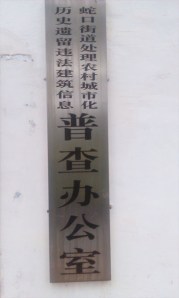
bureaucracySeriously. There is a Shekou office called the Shekou Subdistrict Census Office for Information on the Handling of Illegal Buildings Leftover from  the History of Rural Urbanization. But the signage is well balanced. And think of the cocktail party conversations this business card could spark!

schools at the edge

These past few days, I have visited elementary schools in the Xishuangbanna Dai Autonomous Prefecture.

The prefecture capital, Jinghong is undergoing a small (by coastal standards) boom: in 2003, Jinghong had an estimated population of 370,000 and roughly ten years later, school officials estimated a population of over 1.2 million people, suggesting that the same processes of internal migration and rural urbanization that we have seen along the coast; China’s population is not growing so much as it is redistributing (results of the 2011 Census). Indeed, the goals of China’s socialist new village campaign sound explicitly urban — “to develop production, enrich life, civilize the countryside, clean up the villages, and use democratic governance (生产发展、生活宽裕、乡风文明、村容整洁、管理民主的社会主义新农村)”.

Extraction and tourist capitalism have fueled the boom. On the one hand, the primary source of production revenue has been the expansion of rubber tree farming. However, the region also produces pu’er tea, mahogany, and has ancient jade mines. In addition, because Banna (as it is colloquially known) borders Burma, Thailand, and Laos, the prefecture also serves as an entrepôt for Burmese jade, Thai agricultural products, and Laotian hard woods. On the other hand, internal tourism to experience stylized representations of minority cultures continues to grow. Indeed, much of the building development in Jinghong involves adding stereotypical Dai flourishes to concrete buildings, which are structural heirs to Maoist dormitory and mass architecture.

The boom is a reform twist on Maoist efforts to integrate minority communities into the larger Chinese state. The situation of Yunnan ethnic minorities varies, reflecting indigenous pre-Mao state building (the Bai Kingdom at Dali, for example, in contrast to the rain forest tribes of Mengla, Banna), integration into the ancient tea trade, and the building of modern roads and transportation systems. During the Mao era, for example, it took several days to make the trip from Jinghong to the provincial capital, Kunming. Today the trip is a 40-minute plane trip and ethnic Han people hold most political positions and control access to economic opportunities. Indeed, the situation of ethnic minorities in Yunnan resembles that of villagers in Han cities like Shenzhen; whatever opportunities locals have it is tied to traditional land rights as they have been re-interpretted by the state.

However, unlike in Han settlements, where (crudely speaking) rural urbanization has meant making access to some aspects of elite Han culture accessible to peasants, while strengthening class differences, in Yunnan, rural urbanization has had a double thrust — cultural homogenization while asserting Han superiority. In other words, through new village programs, Banna minorities are both sinified and regulated to the lowest rank within Han hierarchies. Of course, many of the Banna born Han are themselves relatively impoverished, but nevertheless better placed than ethnics to capitalize on extraction and tourist opportunities. Thus, what seems to have emerged in Yunnan generally, but Banna specifically, is a situation similar to other colonial situations — on US American indian reservations and throughout the Brazilian Amazon, for example.

The Banna schools that I visited teach the national curriculum to ethnic children. The schools are not destitute, but the problems they face are similar to those faced in peripheral societies elsewhere.

  1. There are not enough students to for large scale investment in education. Consequently, in Banna there are three kinds of elementary schools — education spots (for settlements that only have resources to educate grades 1-2), early elementary schools (combined schools to educate grades 1-4), and complete elementary schools (combined schools that teach the full primary curriculum).
  2. In order for higher level education, most students must leave their home settlements at a young age, some as young as 8 years old to board at an early elementary school. However, any education beyond elementary school entails moving to a county seat; for high school, Jinghong offers the best opportunity to succeed on the gaokao. Not unexpectedly, in Yunnan, Han children, whose parents use a version of Mandarin, are most likely to achieve relative high scores, which are not so high when compared to the results achieved in coastal city schools.
  3. The low birth rate means that even when a complete elementary school exists, there are not enough children to have a class. Consequently, many students end up waiting 2 years to begin their education.

The children were wonderful. The teachers generous. The officials (mostly Han, but some ethnic representatives) determined to improve the situation. However, unless, the values motivating the integration of Banna minorities into the Han state change, I am not sure that the results will differ from other national efforts to integrate minorities elsewhere — cultural loss, relative impoverishment, and the destruction of rain forest. It bears repeating: Underdevelopment and concomitant forms of inequality are the result of human actions, which arise when we confuse profit with the common good.

Impressions from Banna schools, below:

This slideshow requires JavaScript.
egalitarian architecture

One of the more interesting architectural continuities between Maoist Tangtou and Handshake Baishizhou is the ideology of egalitarianism (平均主义).

When Tangtou villagers first came to Baishizhou in 1959, they gave up their rural status and became members of the Shahe Farm (沙河农场). As members of the Farm, their hukou status was “non-rural (非农)”. This meant that they had rights to socialist welfare benefits, including housing, a salary, a rice allocation, and education for their children. In turn, they gave up their land rights. All this, even though they continued to do agricultural labor. Thus, as a architectural typology, Tangtou’s flat houses were not rural buildings — traditional or modern — but rather socialist dormitories.

According to the Maoist planned economy, non-rural members of socialist work units were entitled to dormitory housing, or “one houselhold, one room (一户一间)”. Within these dormitories, all facilities were the same — the same size sleeping and communal areas, the same number of windows, and the same access to the collective canteen and outhouses, differences in family size, notwithstanding. This type of dormitory construction was the architectural manifestation of a larger egalitarian ideology.

Of course, architectural egalitarianism was relative to regions as well as local resources. For example, the dormitories that Tangtou villagers built in Baishizhou were one story structures made of cement admixtures, wooden beams, and Hakka technology. After the canteen system broke down, families constructed small stoves outside their front doors, but continued to share nearby outhouses and wells. In contrast, dormitories in cities ranged from buildings of stacked, one-room efficiencies with a bathroom at the end of the hallway to buildings of multiple room apartments. In the colder northern cities, the decision to turn on and off central heating for everyone in a dormitory was an extension of this theory as was the decision not to provide central heating to dormitories south of the Yangtze River.

The construction of urban villages in Shenzhen has been an extension of architectural egalitarianism in the post Mao era. All handshakes were built on plats of 10 X 10 meters. To insure equal access to sunlight, there is a mandatory distance of 3 meters on the east-west axis between buildings and a distance of 8 meters on the north south axis. This mandated layout is the basic grid of an urban village. Moreover, when juxtaposed against older settlements, including rural dormitories like Tangtou or village settlements at Hubei, for example, the layout of a handshake settlement extends and often further rationalizes the egalitarianism of the previous layout.

This form of development has brought with it two urban planning conundrums:

  1. The 10 X 10 grid, with its mandatory distances of 3 and 8 meters between buildings pre-empts the efforts to put in adequate roads. 3 meters is small enough that handshakes have grown closer together — albeit without touching — on the east-west axis. At the same time, 8 meters is only wide enough to accommodate one traffic lane, which often gets jammed during deliveries or when too many motorcycles dart through.
  2. Public space and access to main roads is at a premium within the settlements. At Tangtou, for example, the large basketball court in front of the 59 dormitories is the one large space, where children and older people can meet outside. At night this area becomes a night market with more business than those areas in the Baishizhou alleys. Likewise, the roads that connect Baishizhou to Shennan Road are also the most profitable because they have storefronts in areas with large numbers of pedestrians.

The ongoing ruralization of Tangtou (and other urban villages  neighborhoods) has had paradoxical ideological effects. On the one hand, thinking of Tangtou as rural empowered Tangtou residents to make handshake land grabs. On the other hand, thinking of Tangtou as rural continues to justify the exclusion of Tangtou residents from discussions of future development, differing to the expertise of “urban” intellectuals and authorities. Moreover, the urban planning problems presented by Tangtou are considered effects of “rural” and “traditional” thinking. However, Tangtou is as “rural” and as “traditional” as Greenwich Village, NYC. The current built environment of Mao-era dormitories and post Mao handshakes is itself a product of non-rural socialism, first as the Shahe Farm and then as the Shenzhen Special Economic Zone.

And there’s the rub: what does it mean that “rural” and “traditional” Tangtou Baishizhou has come to represent all that is good and problematic about Shenzhen’s “urban villages”?  More generally, what are we to make of Maoist egalitarianism — both its continued appeal to the broad masses of Chinese people and its problematic manifestations — when we confuse it with a Chinese past that never happened?

inscribed dongguan

Unlike Shenzhen, which has managed to disassociate itself from its rural past, Dongguan continues to be considered a market town, population and exports, notwithstanding — provincial in all condescending senses of the word. Unfortunately for folks in Dongguan, urbanizing strategies to overcome the stigma of cultural boorishness are often the problem. The Lamwa (联华国际) development, 星河传说 (Milky Way Legend), for example, is located in Dongcheng District, Dongguan Municipality’s aspiring middle class district, where English inscriptions, including a Cambridge education kindergarten are all part of local efforts to rebrand the city. It feels, however, like 1990s Shenzhen, before millennial skyscrapers and creative industries replaced industrial parks, creating Shenzhen urbanity and the concomitant nostalgia for urban villages. Impressions of Milky Way Legend’s high culture pretensions, below:

This slideshow requires JavaScript.

tangtou research begins!

After many months of waiting and hoping and wishing (and yes research is often an overplayed love song), the CZC Special Forces have begun our research in Tangtou, Baishizhou. Yesterday morning and afternoon, we began a survey of the buildings.

This slideshow requires JavaScript.

tianmian celebrates 20 years of incorporation

Yesterday evening, Tianmian Industries Ltd (田面实业股份有限公司) celebrated 20 years of incorporation, simultaneously confirming the group’s new status as a corporation and the corporation’s status as the continuation of Tianmian Village. The celebration achieved this sense of historic continuity through the sequencing of socialist and traditional customs, including the presentation of and speeches by Tianmian, Fuhua Precinct, and Futian District leaders, which was followed by singing and dancing performances, a demonstration of Bruce Lee style kongfu by one of Bruce Lee’s students, and pencai, a local specialty that is only eaten at collective ceremonies. The speeches and performances took place on a stage in the vip area, while two large LED screens had been set up throughout the common area so that guests could watch the entertainment while eating.

Another important ceremonial function was to demarcate borders both within Tianmian and between Tianmian and outside communities. The 137-table event occupied  most of the main road into the village (directly off Shennan Road) as well as adjacent public areas, dividing Tianmian into two sections: the ceremony area and the rest of the neighborhood. Importantly, only Tianmian Ltd has the authority to cordon off public areas for private ceremonies. The ceremony area itself was subdivided into a vip area for leaders, their families and guests and a common area for Tianmian stockholders, their families and guests. Tianmian guards prevented non-guests from passing the red cordons.

Rituals such as these and the concomitant right to occupy public space are perhaps why we continue to speak of Tianmian Village as a village. In point of fact, we were celebrating the dissolution of Tianmian Village and its reconstitution as Tianmian Ltd. In ritual terms, however, the celebration clearly established Tianmian Village as the host and hegemonic subject of this territory and Tianmian Ltd as the contemporary manifestation of the village. What’s more, throughout the evening the gaze of outsiders — many of whom live in Tianmian housing stock — reinforced the sense of Tianmian as a vibrant and recognizable collectivity.

These rituals are particularly important in Tianmian because the corporation has not built traditional village buildings, such as an ancestral hall or a temple. In obvious contrast to Tianmian’s appropriation of public space, when larger village-corporations hold pencai ceremonies, they set their tables in designated village plazas that are surrounded by traditional buildings. In Xiasha, for example, the large village plaza includes an ancestral hall, a temple, a public theater, a traditional garden, and a path to the Xiasha Museum. Consequently, where Xiasha relies not only on ritual, but also on the built environment to reinforce communal solidarity, Tianmian’s village identity remains as such primarily through what is commonly called “non-material culture (非物质文化)”, or rituals.

It will be interesting to see, say in twenty or fifty years, how strong Tianmian’s sense of village solidarity remains and to compare that solidarity to that of a village like Xiasha, where the construction of village architecture sets the stage for village rituals. In other words, although Shenzhen has been seen as a laboratory for economic and social experimentation, we might specify further, and watch the ongoing reconstruction of traditional solidarities despite and within the maelstrom of modernization. Impressions from Tianmian’s 20th anniversary celebration, below.

This slideshow requires JavaScript.

luohu bridge: the bamboo curtain, literally

For many years, but especially during the Cold War, the Luohu Bridge was the narrow connection between China and the world — the bamboo curtain, literally. It is important to underscore the border’s Cold War status because during the colonial era, the Sino-British border was an open border. Indeed, it’s open status had made it an important refuge for Chinese intellectuals during the War against Japan. In fact, the border was not closed until 1950,when Great Britain agreed with US concerns that an influx of Chinese refugees and possible strikes threatened Hong Kong security. Not surprisingly, the border hardened as a result of the onset of the Korean War in June that same year.

In 1955, the Father of China’s space program, Qian Xuesen (钱学森) crossed the Luohu Bridge when he returned to China. Other important Overseas Chinese who returned to China by way of Luohu included mathematician Hua Luogeng (华罗庚), geologist Li Siguang (李四光), nuclear physicist Qian Sanqiang (钱三强), nuclear physicist Deng Jiaxian (邓稼先), and aerodynamics specialist Guo Yonghuai (郭永怀). Qian Xuesen’s life symbolizes how the US and China collaborated to militarize the border as the world shifted from British colonial to US hegemony. In 1935, Qian received a Boxer Rebellion Indemnity Scholarship to study mechanical engineering at MIT. He completed his doctoral studies at Caltech. In 1943, Qian and two others in the Caltech rocketry group drafted the first document to use the name Jet Propulsion Laboratory and included a proposal to develop missiles in response to Germany’s V-2 rocket. After WWII, the US Army commissioned Qian, giving him the rank of colonel. However, during his application for naturalization in 1949, he was accused of being a communist and he lost his security clearance in 1950. For the next five years, he lived under constant surveillance, until he was released to repatriate to China, where he helped China develop nuclear weapons, in addition to the country’s space program.

I mention all this history because episode 12 of The Great Transformation (沧海桑田深圳农村三十年) treats 30 years of development at the Luohu Bridge and Luohu Village (1980-2010) without mentioning the Cold War. Nevertheless, the military symbolism of the border is explicit. Images of Qian Xuesen observing the detonation of China’s first nuclear bomb open the episode. Then the episode cuts to “nine years earlier” when Qian crossed from Hong Kong into China by way of the Luohu Bridge. Then we see images of soldiers firing bayonets, and are told that the Sino-British border was established as a result of the 2nd Opium War, 1898. And then, in keeping with this military theme, we jump to images of the 1979 First Detonation, when China Merchants began construction on the Shekou Industrial Zone. All these guns going off and no mention of the Cold War. No explosions in Korea. Or Vietnam. Or ongoing war games in the Taiwan Straits. Instead, after the Shekou detonation, we cut directly to images of bulldozers flattening Luohu Mountain in order to put in the new railway station and infrastructure for the new Special Economic Zone.

Now, I understand the leap from the Opium War to Shekou is through China Merchants. I also understand the the one country two systems debate was rhetorically framed in terms of the end of colonialism. However, none of this explains why the Cold War was not mentioned in the brief introduction to the border. After all, Qian Xuesen and all the other Chinese scientists who returned from overseas did so in the context of the Cold War. To my knowledge, the history of that era, especially the pre- Lushan Conference history, is not sensitive, so there’s no reason not to mention it because the border was militarized during the Cold War and not during the colonial era.

Question du jour: does the general dampening of interest in Maoist history also mean that the Cold War is ignored? Or are we to understand Shenzhen history only in the context of the end to colonialism? And if so, does this mean that the Cold War will only end when Taiwan has been returned through another version of One Country, Two Systems?

rainy day, lushi

We drove about eight hours from Dali to Lushi (鲁史), a market town (镇) in the Lincang Mountains (临沧山). The last 80 kilometers covered a narrow road, which twisted through dramatic slopes and was, in places, covered in thick mud and rocks from a rainstorm the night before. The trip and the unreliability of the roads created a sense of distance from my everyday life; lack of access to internet reinforced this sense that I was far from the modern world. Moreover, I found it difficult to understand local Mandarin, let alone the local language.

And yet.

The layout and size of the old city area remind us that Lushi was once a vibrant center of mountain life. Peasants packed mules with tea, walnuts, and palm leaves and then set out on narrow trails to sell their goods in seasonal markets in Fengqing (凤庆), Nanjian (南涧), and Weishan (巍山). Old Mr. Zhang told us that during WWII, national forces from Guangdong and Hunan stationed at Lushi. In the not so distant past, Lushi was more prosperous than Fengqing, which only rose to local prominence as a county seat during the Mao era.

Moreover, this was not a trip that placed me beyond the reach of gaokao results (all 42 members of the graduating class of 2012 found places at university), Olympic broadcasts, and packaged snacks. We stayed at a clean motel and ate regional specialities, including jizong mushrooms in spicy oil (油鸡枞) and broad beans stir fried with local pickles. There were telephones and high heels, motorcycles and cigarettes, angry bird balloons and electronic toys scattered through out the crumbling buildings and old stone walkways.

The restructuring of the relationship between Chinese cities and their hinterlands that began during Maoist collectivization and intensified with post Mao industrialization not only favored coastal cites, but also disenfranchised rural China. Today, Lushi is a painful contemporary to Shenzhen precisely because the mountain town has been so obviously positioned at the underdeveloped edge of the modern world and not because that’s what it once was.

Impressions of a rainy day in Lushi, below:

This slideshow requires JavaScript.

fengyu: at the periphery of the periphery

The two hour trip from Dali to Fengyu Market Town (凤羽镇) eases senses overstimulated by tourist crowds, let alone Shenzhen’s urban crush. Nestled within extensive rice paddies and surrounded by mountains, Fengyu stands in provocative contrast with Shenzhen’s industrial parks and reclaimed housing estates. The town’s crumbling architecture evokes past elegance and stately lifestyles, while elderly women dressed in traditional Bai costumes maintain local religious traditions, setting up small altars at the entrance to the town. Here, at the periphery of urban China’s periphery, I slip into forms of rural nostalgia — once upon a time, a stately, elegant society of noble warriors, rural scholars and happy peasants resisted both Tibetan and Han incursions.

And yet. Where Shenzhen streets bustle with young migrant workers, Fengyu’s main street and side alleys shimmer silently. Whatever remains of the Nanzhao and Dali Kingdoms, today, young Bai must choose between agricultural labor and life elsewhere, in Shenzhen, for example, where one of my favorite restaurants serves Yunnan delicacies that are flown in daily to tempted jaded palates. A walk through Fengyu, below:

This slideshow requires JavaScript.