unexpected encounters with tradition…

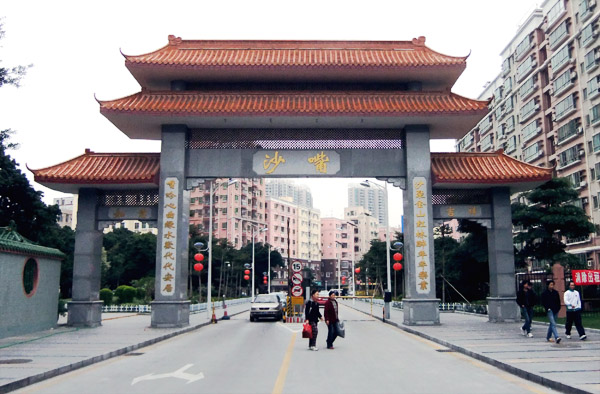
Entry gate to Shazui

Shenzhen villages are places of unexpected encounters with tradition, living and reworked. Indeed, these encounters are reason enough to meander through the villages. Just to the left of the entry gate to Shazui, for example, is a temple to Hongsheng (沙嘴洪圣宫), which is kept by an older Shazui couple. I asked about Hongsheng and they invited me to sit and chat.

Historically, Shazui villagers made their living fishing in the northern section of the South China Sea, beyond the mouth of the Pearl River Delta. Hongsheng, as his name “Flood Victory” suggests is a god who protects fishermen of the South Seas. Hongsheng is also sometimes thought to be 祝融 (Zhurong the god of fire) and THE god of the South Seas, suggesting that Hongsheng is either a local manifestation of a more general god, or was a specific god that was absorbed into a larger tradition.

From a decidely brief net surf, I have gathered that Hongsheng is very local. Most of the temples I came across were located in Hong Kong and this temple is the only one that I (thus far) know about in Shenzhen. Indeed, the Ou Family Association from Hong Kong (沙嘴[香港]欧氏宗亲会) had provided the computor printout with information about Hongsheng, which again suggests how local this god is. I’m wondering if this is because Hongsheng protects ocean fishermen? That said, throughout Nantou, most temples are dedicated to Tianhou (天后) with the largest temple at Chiwan.

So a post that begs more questions than it answers. Why Hongsheng and not Tianhou? Why only in Shazui? How important is the Hong Kong connection to the temple’s maintenance?  And why is the temple located at the gate? Questions, questions. More to follow as I stumble across answers…

thinking food: images from the houhai overpass, 2002-2010

this post is a brief contextualiztion of  china lab’s  landgrab city exhibition for the shenzhen-hong kong biennale 2009. the exhibit draws attention to the the ways that cities are imagined without reference to the countryside and food production. it also usefully brings china into international conversations about urbanization.

The countryside is a vital but frequently overlooked category in the contemporary discourse around spatial policy, and its role with respect to the future of urbanism is more often than not neglected. Landgrab City is an attempt to visually represent the broader spatial identity of the 21st century metropolis; it proposes a new spatial definition of the city and thereby a more complex understanding of urbanism, one that no longer considers city limits as the boundary of its remit, but instead looks beyond – even across international borders – to the spatial, social, economic and political implications of the planet’s rapid urbanization.

i support efforts to think about food – its production, distribution, unequal consumption – are all critical to how shenzhen is imagined, experienced, and reproduced. nevertheless, this exhibition disturbs me because it discusses shenzhen as if the city were one wealthy enclave, rather than an amalgamation of enclaves -rich, poor, and destitute, which abut and constantly disrupt one another.

shenzhen has sold itself and reform in precisely the terms that china lab uses to describe the city’s “reality”. unfortunately, by taking shenzhen’s self-promotion as fact, rather than promotional fantasy, china lab overlooks  how rural migrants inhabit and  transform shenzhen. this silence distresses me because the spatial, social, economic, and political consequences of shenzhen’s modernization are not implied; they are facts of life for many migrants.

so a very simple point:

In reality, of course, these agricultural territories are not actually clustered around Shenzhen, as in the installation, but scattered across China and contiguous regions.

counter point: a five minute walk from the land grab project, agrarian squatters have persistantly grabbed, evacuated, and reoccupied  a portion of the houhai land reclamation area to grow food, which they eat and sell. the differences between overpass then and now are now are instructive because they illustrate both the persistance of shenzhen’s rural poor as well as their increasing destitution.

the map below locates the land grab project with respect to several generations of agricultural squatters at the houhai overpass.  pictures of the squatters and their gardens, here.

the houhai overpass is located at the intersection of houhai and binhai roads. in the map, the squatter areas are located in the southeast quadrant of the intersection, coastal city in the southwest, and the land grab in the northwest. these areas are roughly a five minute walk from each other. in the map, the blue areas used to be underwater; the brown areas were not.

shazui

this afternoon, i walked through shazui, the village below my 31st floor windows and was struck by the odors and and the shadows. even though the streets are relatively wide, the cement is old and dank, the slabs of meat intimidating, and the people weary. shazui is an older industrial zone and where there is still work, chemical smells permeate the rows of factories. another section of the village has been upgraded and sells handicrafts and rocks, for half a million rmb. these pictures of the street. will add pictures of the cultural turn later.

计划赶超变化–a new era in Shenzhen development

赶 is often translated as “to overtake”, but can also mean “to drive away”. It first appeared in Chinese political discourse in 1957 when Mao Zedong responded to Nikita Khrushchev’s statement that “the Soviet Union would overtake the United States in 15 years” by saying that “In 15 years the PRC would overtake England”.  In 1958, Liu Shaoqi supported the Great Leap Forward with the idea of “Surpassing England and overtaking the United States (超英赶美)”. Indeed, in Shenzhen’s previous incarnation as Baoan County, there once were two communes named Surpass England and an Overtake America, respectively.

In many of the online interpretations of 赶英超美 (here and here, for example) Reform and Opening (改革开放) is offered as the correct policy for achieving surpassing and overtaking. This scenario is one way of understanding both the importance of Shenzhen (first and largest experiement in reforming and opening the planned economy) and why it is often experienced as “not Chinese”. Indeed, residents have often asked me how similar the United States and Shenzhen are.

赶 reappears in Shenzhen popular discourse in the late 80s and early 90s in the expression “plans can’t keep up with change (计划赶不上变化)”, which comments sarcastically on the governments inability to implement its urban plans. In Shenzhen, for example, the overall plans have been done in 15 year bursts. This has meant that what is planned isn’t built for years. More often than not, village developers and others have taken advantage of this situation to errect their own buildings. Thus, in the 90s, I frequently heard the expression “计划赶不上变化” to explain this situation.

During the 80s and 90s, de facto independence from government plans in Shenzhen resulted in a kind of pioneering exuberence that was often called “the Shenzhen spirit (深圳精神)”, but also found expression in slogans such as “little government, big society (小政府,大社会)” that moved with Shenzhen mayor Liang Xiang to Hainan in 1986 and which continues to inspire debates about changing the relationship between the government and the people (here, here, and here).

However, in conjunction with urban village renovation [administratively located in “Urban village (old village) renovation offices (城中村(旧村)改造办公室)],the government has  recently begun razing buildings that were erected on these unused sites, justifying their actions (with or without compensation depending on various) with respect to the plan. This means that Shenzhen may have entered a period of that could be called “plans overtake change (计划赶超变化)”, whereby neighborhoods of several years are being razed to make way for roads and other public infrastructure (the subway) that have been planned for years.

I am interested in how “plans overtake change” because it describes several of the important contradictions that over time have taken root and flourished in Shenzhen.

Continue reading

Tianmian: East West South North

About a year ago, I had the privilege of participating in Vexed Urbanism: A Symposium on Design and the Social at The New School. I contributed Tianmian: East West South North an image poem that mapped four of Shenzhen’s formative ideologies along east-west and north-south axes.  In this piece, I aim to show – quite literally – how landscape is never simply place, but also and always a symbolically organized world, a cosmos. Thus, Tianmianillustrates how it is possible to read not only Shenzhen’s history, but also the values that have informed the city’s construction in the lay of the land, the placement of a building, and movements in and out of an urban village.

East West South North

thoughts from kunming


artist area, kunming

Yesterday, I arrived in Kunming to spend some time with my old friend, Sasha. We are staying in a factory area that is being converted into an art area, with studios, restaurants, and cheap overnight housing. Just around the corner is an art center set up by a group of Scandinavians.

When the cab driver dropped me off here he sighed and asked, “What are the workers going to do?”

And that’s part of the question that’s posed by the abrupt transformation of Shenzhen factories into upgraded productive areas, like the creative technologies in Xiasha, design offices in Tianmian, and bohemian art facilities in OCT loft: even if it isn’t the artists’ fault that factories are closing and moving to new areas, what are the workers going to do?

I find this question, along with questions about the salience of a workers’ revolution muted in Shenzhen. Or perhaps its more accurate to say, the questions seemed forced because there’s little (left) in the environment that directly references what gentrification has meant for workers’ quality of life or how the Shenzhen experiment grew out of issues raised by the revolution.

Historical forms of silencing or glossing over the question of working class politics in Shenzhen include:

1. Shenzhen workers are defined by their exclusion from the city. This exclusion is an overdetermined effect of hukou policies, urban design, and Shenzhen social protocols. First, migrant workers do not have Shenzhen hukou and are therefore technically not “Shenzheners”. Second, factories workers either live in dormitories or new villages. This means that they are either unseen (in the case of dormitories) or subsumed under the category of local villager (in the case of new villages). Third, if a migrant worker has earned enough money to move into white collar neighborhoods, that person is considered a Shenzhener. The key here is that, except for local villagers, everyone living in Shenzhen migrated to work. The class distinction between office and factory work is the pivot on which rights to belonging in the city hinge.

2. Shenzhen’s traditional “workers” were Baoan farmers, who have yet to embody either the revolution or reform. For most Chinese and foreigners the classic Chinese worker was defined by socialist industrialization during the 50s and 60s in cities like Harbin, Shenyang, and Dalian; the forms of industrialization that have taken place since 1980, do not fall under the same rubric and therefore have also produced a different understanding of workers. Indeed, post Mao urbanization has entailed transforming rural areas and rural people into cities and urban residents. In this process, the actual class relations defining industrial production get recast as “cultural”.

Specifically, after Liberation, Baoan County was designated for rural production. This meant that during the Mao years, villagers were not factory workers, who represented the socialist vanguard. Under Deng, Baoan county was elevated to the status of Shenzhen Municipality. As such, the ideal Shenzhener has been an urban, white collar worker. In other cities, like Kunming, the shift in social importance from factory to office workers represents a re-valuation of class relations internal to the city itself. Rural migrant workers and traditional factory workers embody different forms of lower class urban possibility. However, in Shenzhen, this contradiction has not actualized as such because there were never factory workers here. Instead, Shenzhen actualizes an intensification of the relative ranking of rural and urban lives. In this sense, Shenzhen’s recent history has been consistent with Maoism in ways that prevent urban residents from reflecting on the injustices that have come along with reform.

3. Shenzhen buildings have a half-life of seven years. It takes active searching to find, photograph, and categorize traces of history, both socialist and local. During the eighties and nineties Shenzhen produced electronics and textiles and toys and shoes and what-not, those factories have since been razed or transformed. In the SEZ itself, the few factories that remain are being upgraded into cultural industries centers like the design center in Tianmian or commercial areas like in Huaqiangbei.

A visit to a city like Kunming where it is still possible to find Stalinist architecture on a main street or still functional factories downtown highlights the Shenzhen impulse to erase all traces of manufacturing, instead projecting an image of already actualized upper middle class city that was never build on production. A city of two classes–white collar workers and their servants and servers. With manufacturing located offsite out of sight and their for out of mind.

The ironies and the difficulties that entangle workers and artists (even before complete capitalization of the Chinese economy) are perhaps represented by “The Materialist (唯物主义者),” a statue by Wang Guangyi (王广义) that stands in front of the Gingko Elite (翠湖会) shopping center. Want Guangyi’s work was once banned in the PRC because it combined socialist and pop cultural symbols. His resistance to the socialist state increased his marketability among Western collectors. That his work is now public culture in Kunming suggests both the extent to which China has changed as well as the need for reminders of why the revolution was and continues to be necessary.

The commodification of culture defines contemporary gentrification in Shenzhen. The difference I am noting is how the process remains built into Kunming’s urban space, while in Shenzhen this process is a glorified municipal policy to create a city in keeping with global standards. Although I could be wrong. However, the presence of the Scandanavians suggests a different kind of reliance on government funding for art.

In addition to manifesting socialist history through remnant buildings, Kunming also has monuments to the revolution. We visited the Yunnan Army Training School, just near Lake Cui. The large compound seems a popular tourist site, and I saw two brides posing for pictures within the compound space. Inside was an installation that wrote Yunnan’s Double Nine (重九) uprising into national history, indeed, an installation that positioned Yunnan at the forefront of the revolution. When I later asked some Chinese friends, they said they new about the War to Save the Nation (护国战), but not the Double Nine, which even had its own flag.

So points of comparison with Shenzhen.

月亮湾: remnants


gate, nanyuan village

the nantou peninsula juts into the pearl river delta just above hong kong. the houhai land reclamation project takes place along the southern coast, stretching east toward mangrove natural preserve. historically, the southern coast was unprotected from taiphoons and pirates, and so the nantou villages huddled along the yueliang harbor (月亮湾) on the northern coast of the nantou penisula. each village had it’s own pier, where fishing boats anchored. a narrow road that stretched from the county seat at nantou market (today “nine streets”) to shekou linked each village to its neighbor, and then curved around nanshan mountain toward shekou and then chiwan. the road was divided up by gates, which were once locked at night, but now stand as reminder of previous loyalties and social worlds.

in the eighties, after village lands had been appropriated (征用) by state and newly established shenzhen ministries, the villages were left with plats of land(宅地) for each male villager, his sons, and grandsons as well as land for collective economy. this land became the basis of the new villages. now, in nantou, this system of giving out plats to people with extant land as well as to their sons and grandsons, who had not yet built homes, resulted in a particular landscape. on the one hand, there are identifiable sections of new village of colorfully tiled 3 to 8 story buildings. these areas were built on farmland, which was planned in that each eligible villager received exactly one hundred sq meters. pressed up against each other, these buildings occupy all of the space, except for a narrow alley in between each building. indeed, they are so close, neighbors can reach across the alley and shake their neighbor’s hand. on the other hand, there remain old buildings, which the owners have not yet razed and replaced. these buildings are now used for commercial storage or as small workshops.

the new villages as did the old villages, once nestled along yueliang wan. the point of this entry is simply that yueliang harobor has now been successfully reclaimed. the first street, which winds along the former coast is called, ironically enough, qianhai road (前海路). another, larger road yueliang harbor road now stretches along the much straightened coast. as the harbor has been filled, the villages have been surrounded by upscale housing developments, creating familiar “basins” on nantou. specifically, the city has surrounded the countryside, hidden it from view.

south of the nantou penisula villages, cars rush along nanxin road toward five-star hotels and 30-story condo buildings. north of the villages, cars speed home on qianhai road. indeed, for several years now, nantou has been considered a white-collar haven. inside the villages, shenzhen’s original residents live on one floor of their handshake homes, renting the rest of the space, including old buildings to migrants, who can’t afford to live on either nanxin or qianhai roads. within the narrow alleyways of the new villages, original shenzhen peasents and rural migrants from the rest of china have recreated rural chinese markets within the belly of shenzhen’s capitalist beast. i walked east from nanyuan village toward guimiao road, passing through nanyuan, beitou, xiangnan, and duntou villages. contradictions posted here.

南油文化广场:urban facelife, rural fairs


nanyou cultural plaza

the nanyou cultural plaza, like most shenzhen cultural centers was built to promote high culture. however nanyou, like most shenzhen governments doesn’t actually budget all that much money for cultural production, instead requiring that center or plaza administrators capitalize on the space to keep it running. most cultural centers have achieved this by showing movies and renting space for cultural consumption (weiqi clubs, dance lessons, and martial arts instruction, for example).

the success of a cultural center depends on access–in all senses of the word–to the center. many village level cultural centers are in fact quite active because they not only target their cultural production to villagers and migrant workers, who (as rural people) share similar cultural tastes, but also are located within walking distance of most of their patrons. in contrast, street level centers, like nanyou, have to mediate between rural and urban tastes, which don’t really overlap, making it difficult to build a cultural community. consequently, these centers depend upon public transportation and private cars to bring their patrons to them.

the construction of the western corridor bridge has compounded nanyou’s economic difficulties because the street in front of the plaza has been under construction for over two years now. although the nanyou cultural plaza continues to screen movies, the entire space has been rented out to mom and pop vendors, who have transformed the space into a market for the many migrant workers who live nearby.

about five years ago, the area around nanyou was a thriving restaurant district that catered to urban white-collar workers. most of those restaurants (including macdonald’s) have moved out, replaced by small eateries and street level grills. five years ago, there were also villas and upscale residential complexes in this area. these are now being rebuilt, in anticipation of the opening of the western corridor bridge, when nanyou will again and perhaps as suddenly change character, becoming prime real estate for those commuting from western shenzhen to hong kong.

for a sense of how migrant workers occupy shenzhen spaces, please visit nanyou.

emplacements


detail, incense burner, julong village

addresses in chinese read from the largest to the smallest unit. last week, for example, i went to guangdong province, dongguan city, wangniudun township, julong village (广东省东莞市望牛顿镇聚龙村). in terms of the use and organization of the built environment, this administrative hierarchy takes clear form. my trip began at the shenzhen city, luohu bus station, transvessed guangdong’s elaborate (and still expanding) highway network, passed through dongguan city center, and stoped on niuwangdun’s main street, which is narrower and less built up than downtown dongguan, which in turn, is less densely built than is downtown shenzhen, where the journey began. this pattern of narrower streets, shorter buildings, and fewer cars continued with each stage of the journey. from main street, niuwangdun toward julong village, for example, i walked on a main street of four lanes, turned onto a two lane street, stepped onto the one lane street that bordered the julong river, and then turned into a gated alley wide enough to accomodate motorbikes and pedestrians.

in addition to reiterating administrave ranking (provinces administer cities, which administer townships, which administer villages), chinese addresses also tell you whether or not an administrative unit is urban or rural. thus, dongguan (shi) is an urban administrative unit, while wangniudun (zhen) and and julong (cun) are rural levels. in contrast, i live in shenzhen city, futian district, huafu street office, tianmian neighborhood (深圳市福田区华富街道办事处田面居委会). district (qu), street office (jiedao banshichu), and neighborhood (juweihui) are urban designations. not unexpectedly, rural and urban designations also take clear form in the built environment. significantly, rural forms tend to be more traditional and urban forms tend to be more modern or western. thus, for example, the buildings in dongguan city, especially the new city plaza, reflect contemporary architectural trends, while in julong village traditional housing abuts updated one-story homes (平房 literally means flat house and refers to traditional village homes throughout china).

in the prc, rural and urban designations do not simply refer to landuse and population, but also to how the land is used. urban areas are directly under the state, where enterprises, corporations, and individuals can obtain landuse rights (in a process modelled after hong kong’s), but the land ultimately belongs to the state. in contrast, in rural areas, farmers have legal rights to land both for livelihood (growing crops) and housing. there are two main consequences of this situation. first, urban areas have been designated for industrialization, while rural areas have been designated for agricultural production. legally, one can only build a factory in an urban area (although in practice, this has been erroding since deng xiaoping’s southern tour in 1992). second, in terms of property, the traditional, one-stories in the villages are situated on land that belongs to the farmer. in contrast, an urban residents purchase a condo in a highrise, but they do not have eternal rights to it because the land on which the building stands still belongs to the state.

for the past few years, then, dongguan city has been a poster child of sorts for guangdong’s ongoing economic boom. if online statistics are to be believed, from 1999 to 2003, dongguan’s economy grew at a rate of 18.4% a year, enough to make the city the fourth fastest growing in guangdong and 10.3% higher than the national average. now before i went to julong village, i didn’t really think that much about dongguan and when i did it was in terms of boomtown evils: exploitation, prostitution, and pollution. i frequently passed by dongguan on my way to guangzhou and, like supernaut, was both distressed and fascinated by dongguan’s industrial landscape.

now, what’s important about townships like wangniudun is that much of the guangdong boom is actually located in rural townships and villages. administratively, townships are hybrids; they are rural cities. this means that in niuwangdun, julong villagers can invest in industrial production (because it is a city), but that the landuse rights return to villagers, both collectively and individually, because they hold eternal land rights. this loophole has provided guangdong townships and villages with the incentive and flexibility to industrialize in different ways from cities. on the one hand, it has also enabled villagers to become wealthy independent of the state. in shenzhen, this loophole inspired the rural urbanization movement, which changed the administrative status of shenzhen’s farmers from rural to urban, with the result that their children no longer have traditional rights to the land. on the other hand, it has produced a distinctive landscape of tiled multi-story housing, factories, and traditional remnants. for a sense of the emplacements that rural urbanization produces, please visit wangniudun township, julong village.

旧村改新:initial observations

this is another thoughts-in-progress entry. these past few days, i have been trying to organize thoughts about the 旧村改新 (old village make-overs), a recent government initiative to clean-up shenzhen’s new villages (now understood as “old”). this was part of the reason for posting on luohu; i actually took that series of pictures last december, but the juxtaposition of new luohu village, the era of two cities building, the new housing development, and the renovated train station point to issues that come together in the make-over initiative. so if you haven’t yet, you may want to first take a walk about luohu.

the point, of course, is simple: there are many shenzhens and they all abut one another. indeed, it’s as difficult to miss new villages, which have a distinctive layout and architecture, as it is to overlook a high-end housing development. these different urban forms actualize the different development trajectories that shenzhen’s villagers and white-collar migrants have pursued. that is to say, even if we bracket for the moment the question of whether or not shenzhen has deep, imperial history, nevertheless, it has been over 25 years since deng xiaoping began reform and opening just north of hong kong. architecture styles and urban plans actualize different moments in this process, providing a material history of the city. with the village make-over initiative, the government seems determined to remove traces of historic difference, even as cultural officials continue to moan about shenzhen’s lack of history. below is a picture of the arch at the entrance to huanggang new village.

the old village make-over initiative first came to my attention over dinner last year, when friends were discussing the government’s decision to raze 18 mid-rise buildings), right at the huanggang cross-border checkpoint. the topic came up not because those at the table disagreed with the make-over process, but because this was the first time china was simultaneously imploding 18 buildings. the event was know as “china’s first blast (全国第一爆).the buildings belonged to yunong village (渔农村). if memory holds, the conversation focused on the technology involved, the need for a modern area to face hong kong, and the avarious fearlessness of villagers, who continued to errect illegal, rental properties.

this past year, i have watched construction teams lay the foundations for a new yunong with something of a jaded eye. this is not the first time that the municipal government had directed a movement specifically at shenzhen’s urban villages. and in a certain sense, it often feels like a more of the same kind of project.

in 1991, the government initiated the rural urbanization movement (农村城市化运动) with the goal of integrating all villages into the municipal government and giving all shenzhen peasants, citizen status. this was called the double transformation. this movement finally ended in august 2004, when baoan and longgang districts announced that all villages had been redistricted and all villagers had been given a new hukou. shenzhen was thereby the first city in china to have neither villages nor villagers within its borders.

for officials determined to turn their city into a global, international city, the end of rural shenzhen was a major milestone. indeed, in this area shenzhen has been heralded as a national leader. these administrative changes, however, did not irradicate the visceral spatial differences between shenzhen villages and the surrounding city.

in order to deepen the integration of the villages into the fabric of the city, shenzhen officials turned their gaze to the built environment as a sign of rural-urban difference. consequently, the following year, in 2005, the government decided to start the old village make-over initiative. crudely, this entails razing what are known as “handshake buildings” and replacing them with modern residential developments. handshake buildings are so-called because they are so close to each other that neighbors can reach out their windows or across their balconies and shake hands. the initiative includes building plazas and public areas, as well as different kinds of housing developments. i include a picture of a row of handshake buildings, huanggang new village.

compare with an image of the new urban dreams currently under construction in huanggang:

the old village make-over initiative was formally approved on october 28, 2005. it is a special five-year plan to improve the urban villages (城中村), speed up urbanization, promote the unification of infrastructure within and outside the sez, realize the joint planning and harmonious development of urban villages and other areas in the city, and to advance the architecture of a global, modern, and key city, errect a harmonious and efficient shenzhen. the curious can check out the full old village make-over plan online.

nevertheless, the question of make-overs and everyday life only became interesting the other day, when i was in shuiwei and huanggang, two of the futian villages that abut the hong kong border. frankly, i was impressed with the layout of shuiwei’s culture plaza, which boasts a funky (if derivative) outdoor stage, a curious rocks museum (the rocks are mainly from guangxi), and a library. i also had tea at a colorful hong kong style teashop, where the milk tea was strong and rich. suddenly, i wanted to move from tianmian, which is conveniant but not like shuiwei. (the lack of tasty but reasonable restaurants in tianmian is a bone of ongoing contention. after all, one of the defining features of the urban villages has been the quality and price of the restaurants.)

my desire to move to shuiwei points to an underlying fact about new village life; the primary source of income for most villagers is rental property. this has meant that villagers have built as densely and as highly as possible, with little concern for the overall environment. it also has meant a density of cheap beauty and massage parlors, restaurants, places to play mah johng, food markets. indeed, since the mid-1990s, as most of shenzhen’s factories have been pushed outside city limits, the importance of rental property and services to village economies has grown. the main residents of the villages are low income migrants, usually from the countryside.

it seems that the ratio of villagers to migrants in the villages concerns the government. the villages maintain their own militias (民兵) that act as a police force within village borders, shifting social regulation from the state to these quasi-governmental organizations. according to futian government statistics, for example, there were 19,353 villagers registrared in 15 administrative villages (there are 20 natural villages in futian.) those villagers provided housing for 572,143 migrants. a ratio of 1 villager for every 29.5 migrants. (these figures do not include unregistered migrants, some of whom live in illegal housing, but others who live in the underground walkways that connect villages to the city proper.) these migrant laborers are precisely the persons regularly identified in the press and popular opinion as causing social unrest. outside the sez in baoan and longgang districts, the villager to migrant ratio is even higher. thus, this research suggests that the greatest challenge facing the make-over movement is a contradiction between the villagers’ economic interest (as landlords) and the state’s interest in maintaining social discipline.

i conclude with a picture of the home of the shuiwei militia (水围民兵之家).