In order to grasp the moralities and consequences of social non-existence, and incidentally to demonstrate that non-existence partially registered in American understandings of its Cold War conundrums, especially our self-envisioned role in Asia, one could do worse than a close reading of Horton Hears a Who, which was published in 1954, roughly a decade after Theodor “Dr. Seuss” Geisel had transitioned from drawing editorial cartoons to writing politically charged children’s books. Continue reading
Tag Archives: political culture

ideal subject positions (by the numbers)
The current stock market frenzy has people dreaming about more than free lunches. The following adverts are from Money Daddy (钱爸爸), an online trading / investment platform based in Shenzhen. Of note? In addition to the pyramid scheme promises of rapid wealth, the site address plays with both “rich daddy, poor daddy” ideology and Cantonese numerology, where the number 8 is a homophone for the character for father and can also represents the character for “get rich”.
Translations of Money Daddy advertisements show “ideal” middle class Shenzheners enjoying their high returns. The underlying anxiety point is actually quite simple: if you’re earning an honest living in any of these jobs (including an ordinary bureaucrat), you’re not earning enough for carefree spending. And carefree spending is, of course, the site where the self is being constructed as “macho”, “successful”, “loving”, “sexy”, and “independent”, respectively. Continue reading

the dalang graffiti festival
Today we held the design workshop for the Dalang graffiti festival. 27 people attended the workshop, which involved creating designs for manhole covers. With the exception of one individual, none of the participants admitted to having taken any art classes outside of school; none admitted to sending their children to art classes. All were immigrants and during their self introductions, they mentioned their hometowns; one made a joke that her hometown was “too small to have English names”. Next week, participants will take their designs and begin painting manhole covers at a workers’ dormitory, a neighborhood, and a school.

it’s international labor day, 2015
and I’m listening to music by 张广天, whose music simultaneously evokes revolutionary times and postmodern desires. Zhang Guangtian is considered one of the first figures of Shanghai’s 1980s rock and independent music scene. In 1990, he moved to Beijing, where he has collaborated with both theater practitioners and film makers, most notably with the National Experimental Theatre’s Meng Jinghui. In 2000, Zhang Guangtian burst into national consciousness with Che Guevera (切·格瓦拉), which he wrote and directed. However, today it is the vexed lyrics of Mao Zedong that have me feeling bittersweet about the Chinese Revolution and the aftermath of Reform. The song was written for the 110th Anniversary of Mao Zedong’s birth–how resplendent he was, Zhang Guangtian nostalgically sings–and although the lyrics allude to the need for revolution the images firmly tie Mao to the Party’s purposes. And the idolization. Simultaneously compelling and disturbing, I find it difficult to turn away from the Great Helmsman (below).
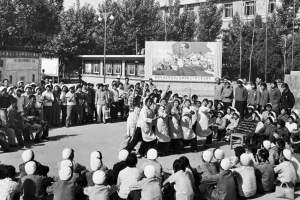
Dancing for the Nation’s Birthday at Our Factory, 1971
The past IS a different country.


shenzhen speed as simultaneity
Shenzhen Speed has been taken up as a metaphor to describe the pace of life in the city, including the velocity at which buses race through the city. According to friends, Shenzhen buses cover more ground in less time than do buses in their hometowns, where apparently they meander from stop to stop and can take hours to cross an entire city. In contrast, in Shenzhen, crosstown buses make several loops in a day. However, as metaphor “Shenzhen Speed” may distort more than it illuminates the history of the city. Continue reading

the power of faxing protocols
Finding out what is happening within the Shenzhen government is difficult not only because of censorship restrictions, but also because of protocols regulating the circulation of “documents (文件)”. Specifically, no documents are are sent virtually. Instead, documents are faxed from Beijing or Guangzhou to a centralized distribution center in the Shenzhen government that receives the faxed documents, makes copies, and then delivers them to relevant ministries and bureaus. This protocol follows for lower-ranking governments as well, so Shenzhen faxes to its constituent Districts which in turn fax to their Street Offices. There are, of course, different levels of government faxes. Some are simply copies of directives or activities, while others are actually official policy and require stamps (such as the copy of a Sichuan document, above). Continue reading
the thing about egalitarian ideologies
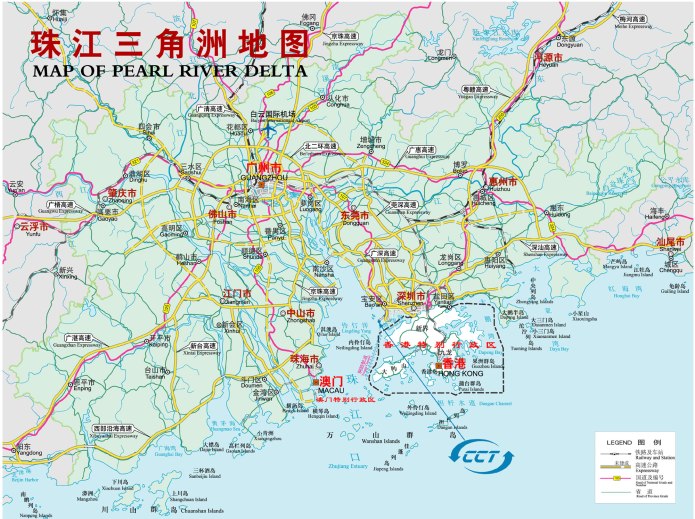
is that very unequal material living environments have to be made to look, well, equal. This is why the current Chinese government focus on growth rates, rather than actual GDP figures matter. With mandated growth rates, every city looks like they’re growing (more or less) equally, while others don’t look like they are stagnating. However, when the actual GDP figures for, let’s say, the Pearl River Delta cities are compared, what we see is that three cities–Hong Kong, Guangzhou, and Shenzhen–completely dominate the region, even as collectively the 9 PRD cities are estimated to account for 70% of Guangdong’s GDP (and only 30% of population). Moreover, given that sub provincial Shenzhen can’t (yet) officially have a higher GDP than provincial Guangzhou, we have know way of knowing if Shenzhen is in fact earning less than Guangzhou.
Provocation du jour: government growth rate targets directly impact a functionary’s ability to rise within administrative ranks, even as the business of Shenzhen remains, well, profitable business. Inquiring minds want to know: is this a contradiction between the people, or a meaningful crack between the government and its residents (居民)?
业绩 is calculated in terms of GDP percentages!!
I’ve been searching for 2014 GDP statistics for cities in the PRD. One would think that would be easy. But it’s not. The reason, I’ve discovered while jumping from city website to city website is that targets are set in terms of growth rates, rather than the actual GDP figure. In turn, government websites tend to publish growth percentages (to advertise that they’ve hit their targets), rather than rawer data. So, my a-ha moment du jour.

can shenzhen evolve from “suck it up theory” to creativity?
I have come to think of “theories” in Chinese political culture to function like guidelines to acceptable behavior. The difficulty for folks in Shenzhen arise from contradictions between extant theories and changing social condititions, or what might be called “double bind theory”; General Secretary Xi Jinping has tightened the space of critical thinking and debate, even as his government, especially Premier Li Keqiang is exhorting people to be creative. But there’s the rub; people need to take critical stances in order to create new solutions to entrenched problems and critical stances have been routinely discouraged throughout the Reform and Opening era, begging the question: can Shenzhen evolve from “suck it up theory” to creativity? Continue reading
 Shenzhen Noted