chinatowns

Today, I’m wondering about how the prejudices that contemporary China exports overlap with historical prejudices in the West, especially when we talk about “Chinatowns” or “traditional” and “rural” China.  In other words, what to make of the fact that Westerners continue to like Chinatowns (and urban villages), while China’s rising elite does not?

Yesterday, I ate lunch with Shenzhen friends at Hakkasan, a hip international Chinese-inspired chain (with amazing desserts) and then walked Chinatown, San Francisco. Before we separated, my northern Mainland friends (who had enjoyed the food) warned me that Chinatown was “just like Chaozhou in the 1960s”. The implication was not only that Chinatown was backward, but also that there wasn’t anything there to see or enjoy. Instead, they were interested in buying a home in Mission Bay, which was new and modern and, in many ways, just like Shenzhen albeit, “not as convenient”.

The historic link between Chinatown, San Francisco and other Guangdong settlements is explicit. The Kaiping watchtowers, for example, were not only built with monetary remittances from Overseas Chinese in San Francisco, but also with materials, techniques, and blueprints that were sent back home. In fact, there is a Kaiping Hometown Association on Washingtown St (开平侨网). I enjoyed my walk. But then again, I also like Shenzhen urban villages. I also appreciate informal forms of urbanization across Guangzhou, which nourishes dense settlements and lively commerce.

The fact that my friends drew attention to the “backwardness” of Chinatown, SF echoed similar warnings about urban villages, Shenzhen. In fact, explicit contrast either to neidi or locally to the urban villages predicates the celebration of modern Shenzhen. The difference hinges on the glorification of the wealthy and their tasteful lifestyles in contradistinction to the working poor and their traditional lifestyles. Of course, in practice, “tradition” glosses low-tech practices that enable the working poor to “make do” with less than their share of the goods their labor produced.

These past few years, Shenzhen has also become increasingly well known in the foreign media. It is no longer just a symbol of the government’s decision to reform and open the Maoist system, but also an example of the success of that decision. Today, Chinese no longer disparage Shenzhen as being backward, nor do they exhort me to go elsewhere to see the real China. Instead, new immigrants say how wonderful Shenzhen is and second generation residents are proud to say they come from Shenzhen. Indeed, they now claim it is the “best city” in China, and note that it is more livable than Beijing, Shanghai, or Guangzhou.

On the one hand, my friends’ determination to distinguish themselves from the residents of Chinatown, San Francisco as well as the fact that they did so via Chaozhou should give pause. After all, within Guangdong, Chaozhou is considered one of the largest homelands for Overseas Chinese as well as one of the most “traditional”. On the other hand, Western racism enabled colonialism abroad and ghettoization at home. Guangdong immigrants appropriated elements of these twinned processes to create neighborhoods in their hometowns, new and old. Similarly, migrant workers to Shenzhen take advantage of reform and opening policies to create lives in adverse conditions.

Inspirations from Chinatown, San Francisco and culinary delights, below:

This slideshow requires JavaScript.

轮侯制: economizing moralities

In the United States, we make an economic distinction between “needs” and “wants”. We teach children (here, here, and here, for example) to recognize and manage the difference between their needs and wants. Subsequently, we re-code these management skills in terms of individual ethics — good people recognize their needs and wants, and then make rational choices to live within their means. In contrast, bad people make irrational choices based on uncontrolled desires that lead to debt and bankruptcy.

e9ec64bb5bcb

The flip response — “one girl’s need is an aging man’s want” — to this statement merely confirms the underlying double bind of this economizing morality. In this financial literacy exercise, for example, only the social facts of suburban car culture, supermarkets, and fast food restaurants conspire to make white bread, bottled water, and a tent vacation “needs” in contrast to the “wants” of a bicycle and a pizza. What if our built environment depended on bikes for transportation? What if we were homeless and the best we could cobble together was a tent made of discarded plastic and corrugated steel? In these situations, the economizing morality is to recalibrate our personal needs and wants rather than to challenge the inequality that poses this choice as reflecting real world conditions.

All this to say: the economizing morality of individual needs and wants is the elementary school version of neoliberal ethics.

I’m thinking about individual needs and wants and neoliberal immorality for two interrelated reasons. At the level of urban planning, given the prime location of urban villages and the lack of developable plats in Shenzhen, the villages were targeted for redevelopment (or renovation — 更新 as a verb). In turn, the need for neighborhoods for the working poor has been recoded as the need for individuals with Shenzhen hukou to find affordable housing. A shift of hand, and the debate ceases to be about communities and becomes one of individual economies. Moreover, convenience, access to schools and social infrastructure, as well as economic opportunities are concomitantly transvalued as wants to be satisfied through economizing.

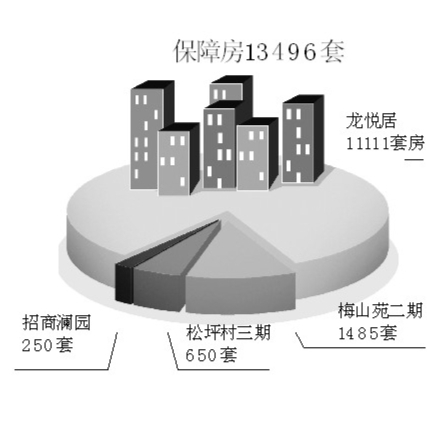
res01_attpic_briefOn January 31, 2013 for example, the Municipality made available 13,496 units of public housing. Of that total, all are located in the outer districts (guanwai) and the majority (11,111) are located in Longgang, roughly 35 kms from the city center. To allocate these units, Shenzhen will be testing what is known as the 轮侯制 or “revolving wait system”. Basically, this system entails meeting conditions, including hukou status, time in Shenzhen, and maximum income to apply for a residence. When any of these conditions change, the family has to move out of the unit, thus opening it for another. The family also has to find another place to live.

In Shenzhen, those opposed to urban renovation projects have been reminding the Municipality out that urban villages like Baishizhou already provide low-cost housing and small scale economic opportunities for working poor families. Moreover, the given the Municipality’s demographics 13,496 housing units are sufficient to absorb displaced populations only when those with hukou may apply. Point du jour: locating public housing far from urban centers only makes moral sense (cents!) in a world in which individual economizing ideologically justifies disrupting neighborhoods for the working poor in order to pave the way for developers. And yes, this is just more evidence that China and the United States really are the same country.

laying siege to the villages: lessons from shenzhen

An essay written for Open Democracy is now online. Here’s the introduction. Over the next few days, I will put up the sections on Nantou, Luohu-Dongmen, Xixiang, and Baishizhou.

Laying Siege to the Villages: Informal Urbanization in Shenzhen

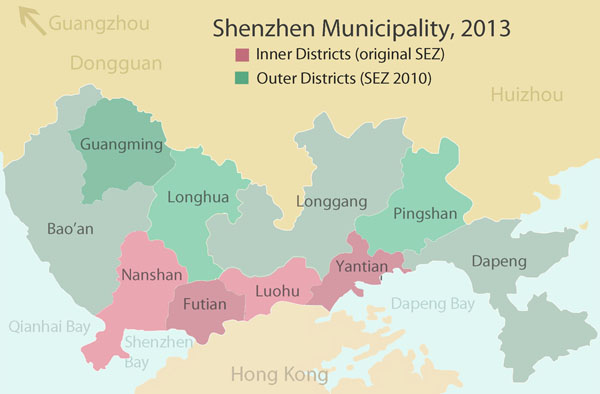
Although Shenzhen is famous for its “urban villages” or “villages in the city” (城中村 chengzhongcun), nevertheless, in 2004 Shenzhen became the first Chinese city without villages. Full stop. This fact bears repeating: legally, there are no villages in Shenzhen. As of 2007, Shenzhen Municipality had a five-tiered bureaucracy consisting of the municipality (市shi), districts (市区shiqu), new districts (新区 xinqu), sub-districts or streets (街道jiedao), and communities (社区shequ). Since 2010, the Districts have been known as the inner districts and outer districts, reflecting when they were incorporated into the Shenzhen Special Economic Zone (SEZ) (Map 1).

 Administrative_Divisions_of_Shenzhen_City

Under Mao, rural areas were China’s revolutionary heart and “villages surrounded the city (农村围绕城市)” was an explicit political, economic, and social strategy for revolutionary change. The Mandarin expression “surrounds (围绕)” can also be translated as “lays siege to”, highlighting the rural basis of the Chinese Revolution. Early Chinese Communists had followed the Russian example and entered cities to organize workers. However, when Nationalist forces led by Generalissimo Chiang Kai-shek violently suppressed Communist organizations in Chinese cities the Communists retreated to the countryside. Moreover, communists and local people identified colonial ports such as Hong Kong with the proliferation of traitors, parasitic merchants, and corrupt officials. Consequently, while Marx claimed that modern history was the urbanization of the countryside, the Chinese revolution aimed to re-occupy and purify the cities. Beginning in 1927 until the occupation of Beijing in 1949, the Communists organized rural resistance to both Japanese invaders and Nationalist hegemony, literally surrounding the cities with an estimated 5 million rural soldiers.

The establishment of Shenzhen signaled the beginning of a new era in Chinese history – “cities surround the villages (城市围绕农村)”, an expression which Shenzhen urban planners and architects have self-consciously used to describe urbanization in the city. Historically, there were legally constituted villages in Shenzhen. The present ambiguity over the status of villages and villagers is a result of contradictions between Maoist economic planning and post-Mao liberalization policies. Under Mao, the country was segregated into rural and urban areas. In rural areas, villages were designated production teams and organized into work brigades that were administered by communes. Communes had to meet agricultural production quotas that financed industrial urbanization and socialist welfare policies in cities, which were tellingly defined as “not-agrarian (非农feinong)”. Importantly, the hukou or household registration policy literally kept people in place – the allocation of food, housing, jobs, and social welfare took place through hukou status. Food and grain coupons were city-specific, for example, and a Shanghai meat coupon could not be legally exchanged in a neighboring city, let alone Beijing. In rural areas, however, communes and production brigades provided neither food coupons nor housing to members. Instead, brigade members produced their own food (usually what was leftover after production quotas had been met) and built their own homes or rural dormitories as they were known in the Maoist system.

In 1979, when the Guangdong Provincial Government elevated Bao’an County to Shenzhen Municipality, the area was rural, and the majority of its 300,000 residents had household registration in one of 21 communes, which were further organized into 207 production brigades. However, hukou status notwithstanding, the integration of brigades and teams had not been complete and members continued to identify with traditional village identities. Although the names of Shenzhen’s current districts were the names of ten of the larger communes, for example, with the exception of Guangming, they were also historically the names of large villages that had been the headquarters for communes. In 1980, the Central government further liberalized economic policy in Shenzhen by establishing the area that bordered Hong Kong as a Special Economic Zone (SEZ). This internal border was known as “the second line”, in contrast to the Sino-British border at Hong Kong or “the first line”. The re-designation legalized industrial manufacturing and foreign investment (primarily from Hong Kong) in the new SEZ. Outside the second line, Shenzhen Municipality established New Bao’an County, which was still legally rural and administered through collective institutions.

The elevation of Bao’an County to Shenzhen Municipality created an anomalous situation within Socialist China because the administrative division of Shenzhen into the SEZ and New Bao’an County only legalized new economic measures; it did not transfer traditional land rights from brigades and teams to the new municipal government. Instead, the first task of urban work units that came to the SEZ was to negotiate the equitable transfer of land rights from the collectives to the urban state apparatus. The goal was to insure that rural workers would continue to have space for housing and enough land to ensure agricultural livelihoods. And this is where historical village identities reasserted themselves. In theory, the urban work units negotiated with brigade and team leaders to transfer the administration of land from the rural to the urban sector of the state apparatus. In turn, the brigades and teams would continue to produce food for the new urban settlements. In practice, however, brigade and team leaders acted on behalf of their natal villages and co-villagers, asserting a pre-revolutionary social identity.

The legal slippage between collective identity within China’s rural state apparatus and collective identity through membership in a traditional village arose because although the Constitution and subsequent Land Law of 1986 stated that rural farmland belonged to the collective, neither document went so far as to define what a collective actually was in law. Indeed, the difference between rural and urban property rights has been the foundation for post-Mao reforms, first in Shenzhen and then throughout the country. In 1982, the amended Constitution formally outlined the different property rights under rural and urban government. According to Article 8 of the Chinese Constitution:

Rural people’s communes, agricultural producers’ co-operatives, and other forms of co- operative economy such as producers’ supply and marketing, credit and consumers co-operatives, belong to the sector of socialist economy under collective ownership by the working people. Working people who are members of rural economic collectives have the right, within the limits prescribed by law, to farm private plots of cropland and hilly land, engage in household sideline production and raise privately owned livestock. The various forms of co-operative economy in the cities and towns, such as those in the handicraft, industrial, building, transport, commercial and service trades, all belong to the sector of socialist economy under collective ownership by the working people. The state protects the lawful rights and interests of the urban and rural economic collectives and encourages, guides and helps the growth of the collective economy.[1]

In contrast, according to Article 10, land in cities is owned by the State:

Land in the rural and suburban areas is owned by collectives except for those portions which belong to the state in accordance with the law; house sites and private plots of cropland and hilly land are also owned by collectives. The state may in the public interest take over land for its use in accordance with the law. No organization or individual may appropriate, buy, sell or lease land, or unlawfully transfer land in other ways. All organizations and individuals who use land must make rational use of the land.[2]

The contradiction between the fact that villages no longer have legal status in Shenzhen and their traditional claims to land rights and social status – both of which are recognized by Shenzhen officials and residents – has constituted a serious political challenge for Shenzhen officials, who have viewed the villages as impediments to “normal (正常)” urbanization. Officials have defined “normal” urbanization with respect to the Shenzhen’s Comprehensive Urban Plan, which has already gone through four editions (1982, 1986, 1996, and 2010). In other words, “normal” urbanization has referred either to formal urbanization or informal urbanization that has secured legal recognition. In contrast, Shenzhen’s urban villages emerged informally as local residents not only built rental properties to house the city’s booming migrant population, but also developed corporate industrial parks, commercial recreational and entertainment centers, and shopping streets. As of January 2013, for example, it was estimated that half of Shenzhen’s 15 million registered inhabitants lived in the villages. Moreover, these densely inhabited settlements also provided the physical infrastructure that has sustained the city’s extensive grey economy, including piecework manufacturing, spas and massage parlors, and cheap consumer goods.

In Shenzhen, urban villages have been the architectural form through which migrants and low-status citizens have claimed rights to the city. Importantly, informal urbanization in the villages has occurred both in dialogue with and in opposition to formally planned urbanization. On the one hand, informal urbanization in Shenzhen urban villages has ameliorated many of the more serious manifestations of urban blight that plague other boomtowns. Unlike Brazilian favelas, for example, Shenzhen urban villages are not located at the edge of the city, but rather distributed throughout the entire city and many urban villages occupy prime real estate. Consequently, Shenzhen’s urban villages have been integrated into the city’s infrastructure grid and receive water, electricity, and also have access to cheap and convenient public transportation. Moreover, as Shenzhen has liberalized its hukou laws, urban villages have also been where migrants have access to social services, including schools and medical clinics. Thus, Shenzhen’s urban villages have provided informal solutions to boomtown conditions. On the other hand, the lack of formal legal status of urban villages and by extension the residents of urban villages has allowed the Municipality to ignore residents’ rights to the city via the convenience of centrally located low-income neighborhoods. In fact, the ambiguous status of urban villages became even more vexed in 2007, when the Shenzhen government initiated a plan to renovate urban villages. It has been widely assumed that the government promulgated the new plan in order to benefit from the real estate value of urban village settlements. Critically, the Municipality’s plans for urban renovation compensated original villagers while ignoring the resettlement needs of migrant residents. Thus, the status of at least half of Shenzhen’s population suddenly entered into public discourse as it has become apparent that although the urban villages resulted from informal practices, nevertheless, they have been the basis for the city’s boom.

Ruralization: The Ideology of Global Inequality

Each of the sections in this essay explores the social antagonisms that have emerged through the transformation of Bao’an County into Shenzhen Municipality via informal urbanization in the villages. The point is that Shenzhen’s so-called urban villages are in fact urban neighborhoods that grew out of previous rural settlements through rapid industrial urbanization. Nevertheless, the designation of “rural” or “village” still clings to these neighborhoods, making them the target of renovation projects and ongoing calls for upgrades. In turn, these calls justify razing neighborhoods and displacing the working poor with upper and upper middle class residential and commercial areas. Recently, Caiwuwei was razed and rebuilt as the KK 100 Mall, while Dachong was razed and as of 2013 a new development under construction. Hubei, the old commercial center in Luohu has been designated as the next major area to be razed, while in late 2012, the Shenzhen Government and Lujing Developers announced their intention to raze and rebuild Baishizhou as a centrally located luxury development.

In Shenzhen, ruralization is primarily an ideological practice through which neighborhoods for the working poor and low-income families have been created by denying the urbanity of these neighborhoods and their residents. In this practice, the city’s rural history is invoked to demonstrate that neighborhoods which grew out of villages are continuations of the village, rather than the results of informal urbanization. Indeed, there are few actual remains of Shenzhen’s rural past. Instead, the target of official rural renovation projects are in fact the informal housing and industrial parks that were built roughly between the mid 1980s through 2004/5, when the municipal government began actively preventing informal construction.

In addition, I have included annotated maps and photographs that illustrate the spatial and social forms of these different contradictions have taken. With respect to recent Chinese history, this level of specificity aims to make salient how Shenzhen enabled national leaders to reform Mao’s rural revolution. With respect to contemporary research on mega-cities, this essay draws attention to the ways in which architectural forms have facilitated neoliberal urbanisms that exclude the poor from desired futures.


[1] Constitution of the People’s Republic of China (adopted on December 4, 1982), accessed at http://english.people.com.cn/constitution/constitution.html on February 26, 2013.

[2] Ibid.

shenzhen beggars

Several days ago on the subway, a man approached me. His speech was slow, his eyes empty, and he showed me a ripped pocket where he claimed his money had been stolen. I asked him his story and he said he had been robbed and that he didn’t want to bother his parents. He said he had a job tomorrow and all he wanted to do was eat. After I gave him some money, he shuffled off the car at the next stop. My friend said that the beggar had targeted us, that he had watched me for several minutes, heard me speaking Mandarin and then decided to approach me. The implication, of course, was that I had been cheated, tricked into giving money to someone undeserving of that handout.

Here’s the rub: I don’t know what made him undeserving — the fact that he [may have] tricked me or the fact that he was working as a beggar, rather than at a “real” job, like part time journal editor, such as myself. I do know that I had a visceral response to my friend’s comment — I wanted to prove that I could tell the difference between those deserving and those undeserving of charity.

Financially, it wasn’t as if the money I gave him could actually buy all that much. As I pointed out to my friend, if I were to forego one 500 rmb meal a month, I could give 2 rmb to every beggar I encounter and still save money each month. What’s more, when I take the time to prepare a pocketful of 1 rmb coins and bills, giving to beggars is a straightforward opportunity to practice generosity in my daily life. So why the resistance to giving?

At the time my friend pointed out that I had probably been targeted, I felt ashamed and tried to defend myself. I argued that I would rather risk being tricked by 99 rather than missing the chance to help the one in need. But, I didn’t give enough to actually change the beggar’s life — only he could do that. In retrospect, I’m wondering about my responses –first to the beggar (I wanted to give) and then to my friend (I didn’t want to appear a dupe). I have realized that I made the encounter all about me, rather than trying to figure out what might be an appropriate response.

Almost twenty years now, I have watched the Shenzhen poor grow both relatively and absolutely poorer. On the one hand, most people in Shenzhen have access to jobs and living conditions that they would not have in neidi cities and rural areas. On the other hand, economic polarization grows as quickly as the city. And many businessmen complain that monthly factory wages have risen to “as much” as 2,500 rmb (approximately $US 400.00), which is less than the price of most high-end electronics. And this change has left moral confusion and self-doubt in its wake: what if there isn’t an appropriate response to poverty that is a result of the change? What if all that remains is witnessing the fallout, both socially and in one’s heart?

scale of gentrification, buji

Gentrification in Shenzhen not only means displacing the working poor, but also rescaling the city. In Buji, the process has just begun and thus the palatable violence of this transformation is more visible than it is in the inner districts, where neoliberal environments have a more polished veneer. The images below highlight the extent to which the construction of massive public infrastructure effectively isolates neighborhoods and privileges car-owners.

This slideshow requires JavaScript.

shenzhen publications

In the hope that they may be useful, I am uploading five academic papers from the dark ages of Shenzhen studies. Be aware: much has changed, although much has not. In chronological order:

1999: Path Breaking(on how gendered nationalism facilitated the construction of SZ)
2001: Becoming Hong Kong (on how Shenzhen emerged through globalizing urbanization)
2006: Cultural Supplement (on political power as a cultural value in contemporary SZ)
2006: Fox Talk (on the emergence of neo-liberal urban identities in SZ)
2008: Vexed Foundations (on cultural continuity in SZ urban villages)

more evidence that china and the usa really are the same country

Back in the day — and a good fifteen years ago it was — Shenzhen University gave me toilet paper and toothpaste,  economy sized bottles of shampoo and other necessities as part of my new year’s bonus. This year, they gave an impressively health conscious and self-consciously environmental package of whole grains, legumes, and two bottles of Spanish olive oil. In addition, they included a shopping cart that has a map of the university campus printed on its sack and two coffee cups. I used to think, “What the f—?” upon receiving a sleeve of 10 rolls of toilet paper. But now I’m happy to receive such plenty, especially because neither organic grains nor imported olive oil come cheap. Thus, it is perhaps worth noting that the economic conditions of the imagined university community have shifted into familiar territory. Shenzhen University teachers and staff imagine themselves to be and engage society as full on members of an enlightened, cosmopolitan middle class. And that’s point du jour:  our paths cross in the fantasy land of neoliberal desire because as a child of the Jersey suburbs, I still live there, no matter where my body might physically be located.

the shenzhen-guangdong model is xi jinping’s road to recovery!

.. and it’s official! Xi Jinping’s road to recovery is the neoliberal policies of Shenzhen and Guangdong.Yes, the first signal of whither Xi Jinping is pointing to Shekou, by way of the second of Shenzhen’s top ten concepts.

If CCTV is to believed everyone is enthusiastically studying the spirit of the 18th national people’s congress. Xi Jinping and friends have charted a road to recovery that sounds exactly like Yuan Geng, 1992, except of course in English, where the translations have missed the historical citation.

Xi Jinping, 2012: 空谈误国,实干兴邦 (Empty talk is useless, only hard work can achieve the revival of a nation).

Yuan Geng, 1992: 空谈误国,实干兴邦 (Empty talk endangers the nation, practical work brings prosperity).

Not surprisingly, Xi Jinping’s “it’s the economy” moment parallels Yuan Geng’s. Yuan Geng first decried empty talk in response to Beijing educators who claimed that Shekou youth were gold diggers (Shekou Storm 1988). First time round, empty talk actually supported alternative voices. However, Yuan Geng made empty talk an official Shekou slogan response as part of Deng Xiaoping’s 1992 Southern Tour in an effort to silence critics about the June 4th Incident, returning the focus of reform to economic growth. Second time round, empty talk seemed to mean “suck it up and get back to work”.

So here we are. Again. And inquiring minds want to know: is Xi JInping talking the talk of 1988 or the talk of 1992?

Personally, I’m thinking we’re still caught in the post 6.4 quagmire. Xi Jinping’s less talk, more action comes in the aftermath of the Bo Xilai incident and the demise of the Chongqing Model, which included the call for a return to collectivist economic policies a la Mao Zedong. Speculation du jour: Xi Jinping’s road to recovery is probably the continued silencing of progressive voices for social liberalization in favor of rising GDP, or the “steady at 7 (经济保7)” policy, a reference to China’s decision to continue to grow the GDP at 7% annually.

top ten concepts of shenzhen

On November 28, I participated in a symposium to celebrate the English language edition of Top Ten Concepts of Shenzhen (深圳十大观念 for Chinese i-pad version).

The production, organization and publication of the Top Ten have been very Shenzhen, so to speak. The Publishing House of Shenzhen Press Group (深圳报业集团出版社) created an online website, where people could vote for the slogans and campaigns that they though best represent the city’s history. These slogans and campaigns were then re-presented (re-issued?) as concepts that epitomize Shenzhen’s values and way of thinking. Thus, in his preface, Guangdong Provincial Committee Standing Member and Shenzhen Party Secretary, Wang Rong, “[T]he top 10 concepts are the concrete manifestation of the era’s zeitgeist and a vivid imprint of the reform and opening-up program.”

The ideological slippage from political slogans and campaigns to civic values and zeitgeist interests me because it points to Shenzhen’s simultaneously fraught and co-dependent relationship with Beijing. On the one hand, experimentation in Shekou and early Shenzhen legitimated ongoing policy debates in the Chinese capital. On the other hand, the Shenzhen model, specifically and the Guangdong model more generally continue to be at slight odds with the rest of the country. Specifically, Shenzhen continues to advocate a managerial approach to governance, promoting not simply business, but also entrepreneurship and a vibrant grassroots economy.

Two of the slogans did, in fact, challenge prevailing political currents and concomitant power structure. Yuan Geng provided the two most obvious examples — “Time is money, efficiency is life” (1981) and “Empty talk endangers the nation, practical work brings prosperity” (1992). The first was a clear challenge to the Maoist planned economy. The second not only expressed Shekou’s ongoing support of Reform policies, but also the industrial zone’s continued advocacy of talented young people with alternative ideas. The Top Ten discussion of “Empty talk” introduces the history of the Shekou Storm. At the time, Yuan Geng emphasized that while Beijing officials blathered on about ideology, Shekou youth were building the future. The decision to erect the “Empty talk” billboard in the aftermath of the June 4th Incident was especially telling because Shekou actively hired transferred hukou of intellectuals who had been sidelined for their support of students.

Nevertheless, thirty years later, those same slogans uncannily echo neo-liberal values throughout the world. “Time is money” quickly looses its oppositional potential when we remember that in Shenzhen, workers’ wages have not kept up with the price of housing; many white-collar workers are also unable to purchase homes. Likewise, “Empty talk” no longer seems  an effort to protect those with alternative ideas as it does the instruction to “suck it up”. It is therefore unsurprising that concepts 3-10 express the municipality’s ongoing efforts to promote neo-liberal neo-confucianism. More to the point, these concepts clearly resonate with Wang Yang’s call to deepen and extend neo-liberalism not only in Guangdong, but also throughout the rest of China.

I’m thinking that it is thus best to read the Top Ten as a list of double-edged swords. As political campaigns and slogans, the concepts reflect contemporaneous power games. “Shenzhen embraces the world”, for example, was a blatant attempt to justify outrageous spending on the 2011 Universiade, while “You’re a Shenzhener once you come” is the self-serving motto of the Shenzhen Volunteer Association; what exactly does it mean that everyone is a Shenzhener when less than 1/5 of the population has a Shenzhen hukou? However, when understood as exemplars of civic values and a city’s zeitgeist, the concepts illuminate cracks within the power structure and spaces for alternative practices, both in business and everyday life. Indeed, it would be wonderful if these slogans/values might in turn reshape Shenzhen’s neo-liberal juggernaut, creating spaces for legitimate political opposition and open debate on whither the next thirty years of reform.

The top ten concepts are: Time is money, efficiency is life; Empty talk endangers the nation, practical work brings prosperity; Dare to become the world’s first; Reform and innovation are the root and soul of Shenzhen; Let Shenzhen be respected for its enthusiasm for reading; Innovation encouraged and failure tolerated; Fulfilling the cultural rights of citizens; The fragrance of the rose lingers on the hand that gives; Shenzhen embraces the world; and You’re a Shenzhener once you come here.

China Daily and Shenzhen Daily coverage of the symposium online.

WoWorldly desires

Window of the World opened in 1984, on the auspicious day of 6.18 (June 18). Yesterday, I visited WoW with Constant Dullaart, one of the residents in this years OCT Art Residency. The featured image for this post is a snap of us in front of Niagara Falls.

This is the first time I’ve visited WoW since 1997, and was impressed by two of the new installations — a plane ride trip through the United States (installed 2004) and a toy train ride through mountainous Europe (June this year). The plane ride uses IMAX technology and moving seats to give the impression of flying coast to coast on a double wing plane. At each landmark, white Americans wave to visitors, yelling, “Welcome to the United States”; in watery areas, visitors are lightly spritzed with water. The toy train is less high-tech, but more popular with young children. According to one of the friendly staff members, these rides are part of plans to shift WoW entertainment from viewing miniature landscapes to interactive rides and activities; I’m thinking WoW goes Epcott.

I was struck not only by the yearning for elsewhere manifest in the WoW installations, but also by the continuing nostalgia for a particular kind of elite life. Tourism as an activity of early 20th century elites continues to shape built forms of this yearning. (Or perhaps we experience nostalgia in search of an object?) This neo-liberal appropriation of colonial forms of pleasure was also been reproduced at Shekou’s Seaworld, circa 1984, where the plaza houses western consumption in quaint buildings and the landlocked Shining Pearl.

Seaworld was one of the first efforts to materialize Chinese yearnings for the better (relentlessly global) life. Nevertheless, by the early 1990s, when WoW was built and developers put up European style estates (with appropriate tributes to Versailles excess), Shenzhen grappled to implement neo-liberal economic policies without neo-liberal political changes. The political-economy of both early Shekou and 1990s Shenzhen were reminiscent of early 20th century capitalism, when all sorts of material wealth began to appear, but only a few people were positioned to enjoy it. Or more to the point, perhaps, only a few elites had both the leisure and resources to enjoy it, including romantic alpine train rides and virtual plane rides on double wing planes a la the Wright brothers.

The fantasy life infusing representations of the early 20th century high life — the fashionable world — were a fixture of 1990s Shenzhen architecture. Seaworld and WoW, for example, were conceived and built in the post Tian’anmen era, when “European-style” housing estates were also popular, including OCTs upscale Portofino. In fact, throughout Shenzhen, but especially along Shennan Center Road, the mini-fascades that wrap WoW and Seaworld dreams have been enlarged in themed real estate developments, where many of Shenzhen’s solidly middling middle class still live and to which many migrants aspire.

Yesterday morning while waiting for Constant, I stood at the subway exit that is located beneath the Jiang Zemin inscribed glass pyramid and watched ticket scalpers approach tourists. The tourists spoke accented Mandarin, and had organized themselves into small groups of carefully dressed visitors. They examined the pamphlets, considered their options, and then opened their umbrellas to embark a rainy day of exploration. Those I later saw again within the park seemed to be enjoying themselves; I certainly enjoyed the toy train and virtual plane rides.

In recent years, of course, Shenzhen’s vision of the world has gone SciFi glassy — steeled if you will — against the imaginary onslaught of encounters with alien lives. However, that kind of elite consumption does not resonate with the same visceral pleasure of early 20th century elites enjoying both their traditional privileges and the mass produced delights of a new era. I’m trying to figure out why. Guess du jour: we want elite agency, but we want it as pleasure,in the play of tourism and leisurely meals, for example, rather than as the high stress, overwhelmed and overwhelming agency that seems to characterize elite life on the ninety-first story of a 21st century glass tower.

Postcards from my Alpine excursion, below:

This slideshow requires JavaScript.