Many of you have already read Eileen Chang’s (张爱玲) The Rice-Sprout Song and Naked Earth. I only came to them recently, an undergraduate degree in Chinese language and literature, notwithstanding. (I did read Love in a Fallen City!) Both The Rice-Sprout Song and Naked Earth are political novels (and ostensibly anti-Communist); both are based on true stories; both suggest how the institutionalization of revolution not only changed traditional landscapes, but also the emotional worlds of Chinese farmers and intellectuals (there is a sense in that the early cadres had already been transformed), and; both show compassion for the helplessness of individuals unprepared for the level of violence that the regime’s various movements would incite and possibly require, which is implied throughout the novels. To fall into the colloquialisms of my youth: “you can’t make an omelette without breaking a few eggs.”
Tag Archives: musing

patchwork shekou, 2016.10.28
New edges and older sections, urban tumescence overtakes low-lying hills and buries oceans. The strength of urban expansion, its righteous inevitability, shimmers and jiggles, impresses–even though eventually paths peter out and doors remain bolted.
Closed off closed out: enclosed.
This is not the city that I want. It is however the city that has shaped my dreams and fears, given form to what I think is possible, what I believe to be necessary. Continue reading

wither the craftsmen?
This past few days I’ve been in Changde, participating in the “Chance Encounter” Contemporary Arts Festival. Its the first of its kind in the city, and attempts to bridge between the city’s rich heritage of carpentry and stone-cutting with the capitalist juggernaut that has made its way to China’s so-called “third tier” cities.

baishizhou demolition: the rising cost of shenzhen dreaming
Yesterday, I heard this story: A 30-something farmer from Lanzhou came to Shenzhen in 2013 in order to make his fortune. He started out working for a relative in a Lanzhou Noodle Shop, and then after a few months decided to open his own noodle shop. After looking around for a suitable place, he decided to purchase the rental rights to a noodle shop in Baishizhou, on the western side of Shahe Road. The shop had been recently renovated and came with a hefty transfer fee—180,000 rmb with a high rent. But the man was enthusiastic. So he sold his homestead land (宅基地) as an initial investment and moved his family to Baishizhou, where they worked. Only his youngest son went to school, while his oldest didn’t go to high school so he could work in the shop. As the last of the buildings in the Shahe Industrial Park are being demolished, he is being forced out without any compensation and no way back home. Continue reading

shenzhen speed: nan’ao
I have this longing to believe that somehow what came before was less fragile and much less fleeting, more easily touched and grasped than is the present. The irony of this longing caught up with me in Nan’ao, where three generations of fishermen live side by side on a beach front urban village (that, yes, is scheduled for partial demolition and redevelopment). Continue reading
what i think i saw (in delhi)
A week in Delhi, thinking about globalizing urbanization and its proliferating urbanisms with the wonderful team at the Centre for Policy Research and colleague Fu Na from Shenzhen Center for Design. Currently, untangling so many thoughts about infrastructure, waste generation, generosity, desire and inequality, heat, color and spice, traveling impressions of china, gender, aggression, and the mental barbed wire necessary to construct “Delhi” out of a few days walking tour. This trip also has me noticing the stories that I notice, some documented, below.

finding samuel lowe…in shenzhen
How have our parents’ and grandparents’, and their parents’ and grandparents’ sojourns–some forced, some voluntary, and some taken on a whim–shaped the people we have become? It is a quintessentially American question, and yet it resonates in Shenzhen where almost everyone of the city’s 20 million people have migrated here from somewhere else. It also resonates because before the establishment of the Special Zone, emigration–rather than immigration, departure rather than arrival–informed family trajectories. Continue reading

Digging a Hole in China
This afternoon I had the pleasure of attending the opening of the Digging a Hole in China (事件的地貌) exhibition, curated by Venus Lau. the exhibition features a range of works that were produced from the mid-1990s forward, roughly a decade after the idea of land art had been picked up by Chinese artists and only a few years after Deng Xiaoping’s 1992 Southern Tour, where he confirmed that China would continue to liberalize its economy. The stated goal of the exhibition, which positions itself between China and the West is,
[T]o expose and analyze the discrepancies between this genre of work and ‘conventional’ land art understood in the Western-centric art historical context, thereby probing the potential of ‘land’–as a cultural and political concept–in artistic practice.

will 2016 be the year of culture?
December in Shenzhen is known as “Creative December”. The city has been officially promoting culture and creative industries since 2005, moving manufacturing to the outer districts, incubating start-ups, and funding creative spaces and so forth. Many of the large-scale, government promoted events during Creative December 2015 focused on history and memory and the scale of these imaginary formations. For those who often what to do on a weekend afternoon, this past December offered an embarrassment of choices in addition to the city sponsored Shenzhen-Hong Kong Biennale of Urbanism/ architecture and the Shenzhen Public Sculpture Exhibition, every single level of government and private art spaces sponsored large-scale cultural events that ranged from the first Kylin Dance Festival (in Longhua) to the Indie Animation Festival in Overseas Chinese Town. In addition, every weekend has been filled with lectures, workshops and salons. For those of us who work in culture—we paint or run galleries or act or produce plays or think about society and take critical photographs of changes in the land—December is the month when we present a year’s worth (or not) of endeavor to the public.
In January, before Shenzhen turns its gaze back to the problem of making an industry of culture—Culture, Inc, we begin rounds of New Year’s dining privately with friends and family, as well as formally with colleagues. During these meals, culture and Culture, Inc are discussed in tandem; there is a potentially large market for culture because everyone is vaguely dissatisfied and looking for spiritual forms of satisfaction that are also economically viable. Continue reading
bookish
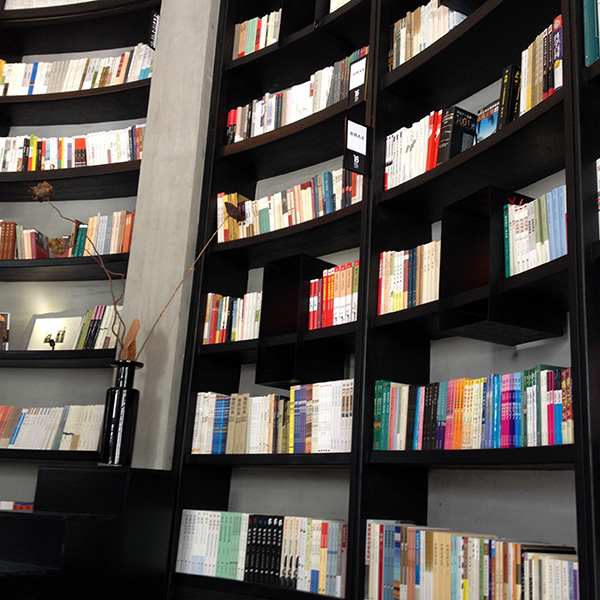
Shenzhen is a bookish city. Even a click over to the English language Alibaba site for “Book Printing in Shenzhen” suggests the extent of how many books are printed in the city. We are so awash in books that it is possible to use them instead of wallpaper when decorating. What’s more, many of my favorite cafes are not only decorated with books, but also serve as lending libraries via 青番茄, a Shenzhen based NGO. All you have to do is register online and then you are free to lend and return books at any of their almost 2,000 participating cafes in China. Continue reading
 Shenzhen Noted