my white wall compulsions: paint it black (I)

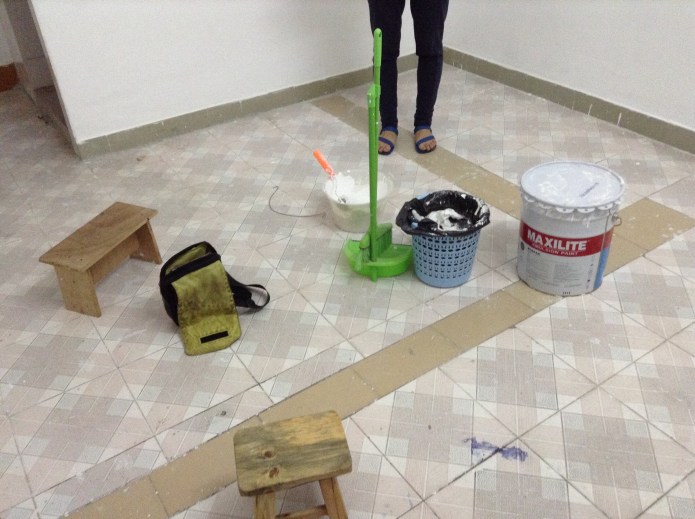
On Friday, October 3 at Handshake 302, we held the first salon for My White Wall Compulsions (墙迫症), “Paint It Black”.

The artist team for the first wall comprises Liu He (刘赫) and Wu Dan (吴丹), both under 25 and both curious about art and its possible articulations with and through society. Liu He is a second generation Shenzhener, whose parents came to build the SEZ before he was born. Wu Dan came to Shenzhen last year, a first generation migrant just out of college. During their first salon, Liu He talked about his anti-inspiration for “Paint It Black”.

This past summer, Liu He took time off from work to travel to some of the less travelled neidi cities. In one of the cities, he decided to take a job at a karaoke bar in order to see what it would be like to do day work (打工). He got a job as a procurer of Karaoke Bar princesses (and at the bar where he worked, hostesses who worked private rooms were so-called). The job included a three-day training session, in which the trainer was as enthusiastic and self-determined as a multi-level marketer. And in fact it turns out that procuring worked a lot like multi-level marketing–the more young, pretty women the procurers brought in, the more money they made.

Liu He left after a few days without recruiting any young women because “he couldn’t get past the moral issue”. Of the 30+ young men who had joined him for training, 12 decided to stay and work the job. Of that twelve, three were 16 years old. According to Liu He, the trainer insisted that once he stopped worrying about ethics, he could talk to pretty women and get rich. In fact, that seems to have been the point of the training: to overcome the young men’s repugnance to pimping and replace it with self-justifying desire for money and everything it buys.

The story ignited debate about what it means to leave one’s hometown and make one’s way in the world. There were two main positions, both pulsing with anger, sadness, and faintly, despair. The younger participants wanted a more honorable way of making a living, to live in such a way that they wouldn’t have to make the kind of choice that Liu He walked away from. The older participants, especially those who had worked their way out of a rural area, expressed that young people didn’t understand what was necessary in order to secure a better life for one’s children.

These two positions took a different relationship to the young pimps. The young people saw themselves and their choices in the decision to procure princesses. The older people saw the choices they had made so that their children would be protected from making those choices. No one saw themselves as a princess, a blind spot that not only hints at how gendered inequality shapes job opportunities in China, but also how difficult it is to truly see the most oppressed. After all, the young men’s decision to pimp or not to pimp still implied some kind of agency. It would have been more difficult to focus on the conditions that make young, rural women the cheapest and most convenient labor in manufacturing and service throughout the economy, even as women are markedly absent from positions of social influence and power.

Friday, October 10 at 19:00 the conversation continues when Liu He and Wu Dan present their finished wall.

This slideshow requires JavaScript.

白鼠笔记/Village Hack PDF!

After several months of hard work and time off for summer vacation, the 白薯笔记/Village Hack PDF is available for download. Wu Dan designed the layout, each of the hackers reflected on their experience, and many friends contributed images to make the PDF a wonderful introduction to Baishizhou lived otherwise. The village hack was about discovering possibilities, both one’s own and those of the urbanized village. Enjoy!

白鼠笔记

village hack: Tadeas

Tadeas had a lovely sharing, and his engagement with Baishizhou is fun and real. Honestly joyfully playfully real. He commented, for example, that the dark brought out all sorts of imaginary monosters, such as a ten meter snake and rats so sick they had gone bald. He then handed over the key to Huihui and Qiangqiang, who will partner up for their hack. Check out Tadeas’ colorful notes at 白鼠笔记/Village Hack. Below, impressions from the afternoon.

This slideshow requires JavaScript.

落地: mapping Chinese creativity

So a few brief thoughts about Innovation Week.

First, many young people want to make the world better. They inspire and encourage and constitute hope.

Second, organizers brought in musicians, dancers, and screened documentary films to round out the conversation.

Third, the idea of “smart cities” resonated. Last night at dinner, for example, friends from Dali and Yunnan told the same story–explosive housing and building construction coupled with spiraling rent increases (as much as 30% in Dali and 15% in Beijing) has meant that even the upper middle class is being pushed out of central city districts. And here’s the rub, these new and improved spaces are neither new or improved. So as in Shenzhen and Hong Kong and London, New York, LA and Tokyo, we’re looking at the ongoing construction of stratified cities which exclude young people and working class families from participating and sharing in what our societies consider to be “good”. So we need to build smarter, so to improve the quality of life of every resident. Here, Citymart’s commitment to connecting municipalities and social entrepreneurs inspires.

Fourth, Shenzhen was well represented. Three Shenzhen projects were recognized for creatively engaging a constantly shifting world. In addition to Handshake 302 (current project 白鼠笔记/ Village Hack), which was included in the segment on how art is helping us rethink the social, the Green Tomato In Library (青番茄) and the Vizdan (维吉达尼联合) projects were both recognized. Zhang Lijuan started Green Tomato in order to bring library resources into coffee shops, train stations, and other public spaces. Instead of borrowing a book from a library, members can borrow a book at their nearest coffee shop. Or, they can borrow a book at their point of departure and return it when they reach their destination. Liu Jingwen initiated Vizdan in order to open Chinese markets to Xinjiang communities. Many of these villages and towns are located on part of the Silk Road, reconnecting what socialist plans severed. Both Zhang Lijuan and Liu Jingwen are 30 something Shenzheners whose social innovations exemplify the way young Shenzhen is searching for ways to redefine the economy of special economics.

Finally, in his Keynote speech Ashoka CEO Felix Oldenburg reminded us that we may be entering a world in which change is the issue–the ability to compassionately create, respond to, and understand change may be the most important skill we teach our children.

revved up and ready…

Handshake 302 has been transformed into a dormitory for the Village Hack Artist Residency. Tomorrow, our first hacker Liu He moves in for a week of exploring architectural forms in Baishizhou. Below, impressions of the new room.

This slideshow requires JavaScript.

Handshake 302 “Village Hack” Artist Residency

The Handshake 302 “Village Hack” residency program invites artists, writers, scholars, and curious citizens to explore Baishizhou, a large, centrally located urban village in Shenzhen.

We’re calling this program “Village Hack” because we hope to encourage a fresh group of artists and scholars to take a new look at how Baishizhou lives and works and even plays.

Each resident asks and answers a simple question over the course of their one- or two-week stay in Handshake 302. For example, a Village Hacker might ask the question, “What do my neighbors do for fun?” or “Can I live in Baishizhou without air conditioning?” Each day, the “village hacker” post the results of their experiment on the group blog “白鼠笔记 / Village Hack”. The last day of their stay, the resident holds an open house, when friends and guests can learn see, hear, smell, touch and perhaps taste the results of hacking Baishizhou. The findings might be a series of photographs, a poem, or a reading of a stream of consciousness free write.

The initial period of the experiment is May through June. If you are interested in signing up for a one or two week residency, please contact me to discuss your particular hack.

We look forward to learning what your hack reveals about everyday life in Baishizhou!

paper crane 3 online!

And here’s the link, “Arrival Shenzhen”, episode 3 in the series.

paper crane tea #2 is online

For the curious. “So why do foreigners go to urban villages?” is online. Please check it out and grow the conversation about Baishizhou and why it matters. For all of us.

paper cranes

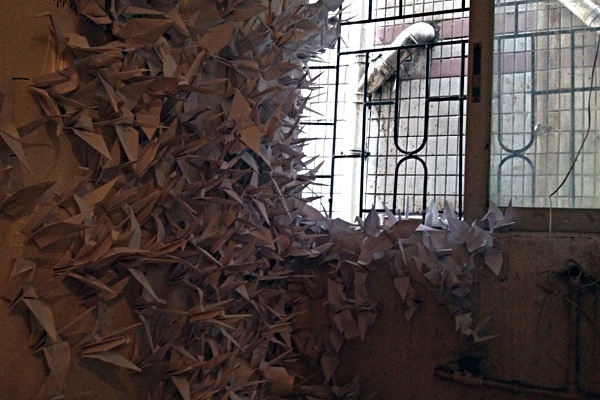
The inspiration for Paper Crane Tea came from Wan Yan, an architecture student by way of the fine arts. Below, her statement on the current installation at Handshake 302:

We’ve probably all heard about paper cranes; if you fold 1,000 they will take flight and help you realize your aspirations. Children believe this story, but for adults it is. Nothing more than a pipe dream. And that transition–from hope to resignation and simultaneously from ignorance to understanding–is the journey of a human heart.

The repetitive task that is folding 1,000 paper cranes symbolizes an important truth about being human. We are constantly repeating some task to achieve some goal; in order to graduate, we memorize and review coursework; to earn a living, we go to work from 9 to 5; to master a new skill, we practice, practice, practice. Each of these repetitions is like folding 1,000 paper cranes–it embodies the hope and determination necessary to realize a particular goal.

In an urban village handshake building, renters come and go, but the spirit that haunts each cramped rental unit remains–the recurring struggle to realize a dream. Indeed, achieving a a goal by diligently repeating he same activities is like folding one’s life in order to realize the crane of freedom. And there is something exuberantly childlike in that image. However, there is no unambiguous desire. In an era of heterogeneous values, different desires and ambitions will create fierce conflicts and mental confusion. Hope can be simple and even pure, but to realize an ambition requires unavoidable complexity and sufficient flexibility.

The first time I came to Handshake 302, in addition to feeling how cramped and narrow it was, I also thought about the repetitive suffering and struggles that every inhabitant would have to undergo in order to move into a “respectable” home. I also thought about how difficult it would be to find oneself (as the expression has it) in that vexed space between desire and it’s realization. But ultimately, each of us must inhabit that mental crucible where relentless economic and social pressure smelt perseverance, inner voices, and anxiety into “me”.

Handshake 302 is our stage, where members of Urban Village Special Forces perform stories of and about Baishizhou and it’s 140,000 residents. For some people, however, Handshake 302 symbolizes he cage they are trying to escape, or the long ago first stop on thei Shenzhen sojourn. In this space, 1,000 folded paper cranes take on new meanings, not only drawing our attention to what it means to be human, but also reminding us that we strive to achieve our humanity in specific contexts.

And photos of the Paper Cranes Fly installation at Handshake 302.

This slideshow requires JavaScript.

untrustworthy environs

The current Handshake 302 exhibit, Baishizhou Superhero has just finished its opening weekend. We’ve had good press, and people interested in the topic have sent out weixin‘s and weibo‘s to their circles. In fact, the exhibit is fun, and once people come into the space, they clearly enjoy taking pictures of themselves and friends as one of the heroes (curatorial statement, here). And there’s the rub: getting people into the space.

In fact, mobilizing our neighbors to visit the space has been an ongoing project. Yesterday, during the exhibit’s open hours I observed to a visiting friend that for many of Handshake’s neighbors crossing the threshold from observing in the hallway to participating in the exhibition is a huge step taken only after several hallway engagements. In reply, he gave a class and generational analysis that avoided the easy (and prevalent) stereotypes of “Chinese culture” or “national ethos (国情)”, focusing instead on the social cost of trust.

He opened an analysis with a joke about an old woman who was sitting next to the road. A young man is talking on the phone and she overhears him say, “Dad, purchase me 500,000 yuan insurance.” Without waiting for anymore information, the old woman picks up her stool and moves away from the roadside. The (literal) punchline? Accident insurance apparently covers up to 500,000 rmb in compensation and is more than enough to settle cases in which urbanites hit and cripple rural workers, while an old lady wouldn’t get enough to cover her legal expenses and hospital recovery.

Background to the joke: Chinese tort law addresses the question of compensation for injuries sustained in a car accident in terms of a simple equation: average annual salary of place times twenty years. For those older than sixty, one year is removed for each year older than sixty but younger than 75 (so the compensation rate for a 63-year-old would be times 17). Compensation for all people over the age of 75 is times 5. For children not yet one year old, the compensation is also times 5. . There is a published list of average salaries by place (Shenzhen list). In other words, the average salary for a city worker in Shenzhen is 40,741 and for a rural worker is 10,542. So the mean compensation for car accidents falls between 800,000 and 200,000. There is a more detailed list that includes salaried workers, but clearly, for the majority of China’s rural population, they won’t get more than 500, 000 before legal fees.

My friend’s point was simple: the poor can’t afford unexpected encounters and so their first response is one of self-preservation. The old lady didn’t know if the guy on the phone had a car, she didn’t know if he was talking to his father, she didn’t know if he was amusing himself. All she could know was that if he did have a car, 500,000 and wanted to run her over, he probably could. I countered that this was an open door and most had seen me over the past few months. “But,” my friend added, “it’s a closed, private space. Why take a risk for a photograph?”

My friend added that younger peoplewere more open to conversational exchanges with strangers. He said the most reticent were generation 70, but generation 80 and 90 were increasingly open to proactively talking with strangers. And in fact, the few people who have come to the space through weibo and weixin have been in their early 20s, or members of generation 90. He suggested that we should move the photo stand-in to one of the public squares because (1) people really would enjoy it and (2) they’d feel safe to enjoy it in an open place where there were many, many people.

Good — if sobering — advise. It also reminds me that we have had our best turn out when we organized a fair like environment in the Baishizhou public plaza. Consequently, our next goal is to move Superhero to the Baishizhou Culture Square.