shenzhen publications

In the hope that they may be useful, I am uploading five academic papers from the dark ages of Shenzhen studies. Be aware: much has changed, although much has not. In chronological order:

1999: Path Breaking(on how gendered nationalism facilitated the construction of SZ)
2001: Becoming Hong Kong (on how Shenzhen emerged through globalizing urbanization)
2006: Cultural Supplement (on political power as a cultural value in contemporary SZ)
2006: Fox Talk (on the emergence of neo-liberal urban identities in SZ)
2008: Vexed Foundations (on cultural continuity in SZ urban villages)

mama troll

The Mandarin expression for internet trolling — visiting sites, but not actually participating — is scuba diving or 潜水. Last night, I heard it used in the context of parental supervision. Apparently, there are mothers who have requested that their children give them their qq, we chat, and other social networking account passwords so that they can supervise them. The person describing the mother in question joked she was as “mama troll (潜水妈妈)”.

When I mentioned that I found this behavior highly disturbing, my friends responded that yes, it was a bit excessive, but what could you do? Children are an extension of their mothers, and if I didn’t understand this cultural root, I couldn’t understand Chinese mothers.

What’s more, another friend added, many of these mothers have nothing to do. They sit around and worry about who their husbands may or may not be seeing. They chat with friends and imagine all sorts of situations that their daughters might encounter. The most worrisome problem would be young love, especially because young love adversely affected grade point averages.

I then did another of my highly selective surveys, where I told this story to friends and cab drivers and the odd waitress to get their take. I asked if they thought it possible that a mother would go to such extremes? The 100% answer: yes. Most agreed that this kind of supervision was excessive. However, they pointed out that many mothers worry about their children, especially their daughters and so the concern was natural. Others remembered that when they were younger, their friends’ mothers might read their diaries for similar reasons.

I then asked why didn’t the children just sign up for another email or we chat account? Here the responses varied — maybe the children lived at home and their mothers paid for their cell phone and internet access; maybe the children always did what their mother asked them to do, and; maybe it was just easier to put up with the intrusive supervision than it was to set up independent accounts.

After all, another friend pointed out, as long as a child is living with her mother, her options are limited because sometimes teachers will request parents to increase supervision over a child. “It’s a conspiracy,” she then said half jokingly, “Teachers and mothers work together to make sure that children do what they should.”

mini-series plot recap (by country and episode length)

Television dramas remind us that love is cross-culturally a means of negotiating gender inequality, but that is expressed through culturally specific forms of unhappiness and resolution there of. My trip to Taiwan reminded me, however, that even within Chinese speaking communities, young lovers face different challenges. Below, a list of mini-series plot recaps by country and episode length based on my own television habits. As a general rule of thumb, two episodes of an Asian mini-series is the equivalent in length of one US American made for television movie. Also, in my plot recap, I first note the happy ending and then in parenthesis a sad story version. And yes, please add insight from your experience watching these pervasive and addictive forms of popular culture.

US American = boy meets girl, boy and girl have sex, a murder brings them closer together (or one of them may be the victim) in one made for television movie;

Japanese = boy meets girl, boy and girl fall in love, a suicide brings them closer together (or one or both commit suicide) in 12 episodes;

Korean = boy meets girl, boy and girl fall in love, inherited and usually unsuspected history between their parents brings them closer together (or results in them being separated for years that each stoically endures) in 16 or 20 episodes;

Taiwanese = boy meets girl, boy and girl fall in love, their mothers begin a battle that brings them closer together (or forces one or both of them to choose between their lover and their mother) in 30 to 40 episodes;

Mainland = boy meets girl, boy and girl are attracted to each other, they soon realize that together they can rule the country more justly (or together they can’t seize power because corruption is just too endemic) in 80 episodes.

Hair Washer Number 5

Her last name is Xu, but she insisted that I call her by her number, 5, Hair Washer Number 5. She called me Pretty Lady, or 美女 (meinv), a common form of address for women between the ages of 17 to mid 30s, but nothing I’ve ever been called. After I laughed and asked if I was truly a meinv, Xu explained that women like to be called pretty, and even when they were as old I was, to call them Auntie (阿姨 ayi) or Older Sister (大姐 dajie) might make them unhappy. I acknowledged how difficult it was to know how to address strangers, especially without an introduction.

Xu came to Shenzhen 3 years ago, when she was 15. She has been working in the beauty industry for two years now and took a job at this salon, which markets Korean style service and products because “For people without education, or money, or status,” she explained, “the only thing we can do is learn a skill and make our future ourselves.” She hopes to learn enough to someday open her own shop. She works 12 hours a day, 7 days a week, but says that once her trial period is up she will have one rest day a week.

As she kneaded my arm, Xu shyly asked, “What do you do when you’re upset?”

“I meditate and go for walks.”

She nodded slowly and then, eyes intently fixed on the skin of my inner arm, she told me that this afternoon at lunch she cried from weary exhaustion. Then her manager and several co-workers urged her to stop crying and toughen up, after all, if she didn’t learn to eat bitterness when she was so young, it would only get harder as she aged.

I asked if the crying helped.

“No, nothing’s changed.”

I fumbled to clarify, “I didn’t mean the question rhetorically. I just wanted to know if you felt better after you cried.”

She nodded her head once.

“Then cry,” I said, “and when you feel better, analyze your situation and figure out what to do next. You’ll make worse decisions when you’re tight and unhappy than you will after a good cry.”

She looked at me and then resumed kneading my other arm, adding softly when she finished, “Next time you come, ask for Number 5 and we can talk again.”

Humbled, I left the salon, hoping for the courage to return, ask for Number 5, and listen to her story.

The White Lady of Shiyan

Last week, I met Ye Enling, a 70-something Shiyan native. Mr. Ye worked in Overseas Chinese affairs for over twenty years, and his current interests include calligraphy, linguistics, architectural design, and social philosophy. Of note, Mr. Ye is a Hakka and has devoted much time and energy to promoting Hakka culture by collecting Shiyan mountain songs (石岩山歌), compiling vocabulary lists, recording Shiyan history, and composing essays on diverse topics. In fact, he has published three collections and a book of calligraphy.

Below, I have translated Mr. Ye’s retelling of The White Lady’s Temple on Yangtai Mountain (叶恩麟者《闲雅集》111-2页. Online Chinese versions, here and here). I find the story interesting because it places singing within the sentimental context of gendered yearnings, which continue to shape family life and personal desire. The fact that the story continues to circulate suggests that even if most Chinese professors have opted into modern academics and concomitant specialization, traditional intellectual life and knowledge production may be fading, but are nonetheless still kicking.

I also find the story interesting because when contrasted with Shenzhen’s contemporary arts or traditional culture fairs, the White Lady of Shiyan reveals the extent to which expressive creativity has been alienated from everyday life, an ongoing lament in modernist art. The living presence of this tradition dovetails with the Municipality’s ongoing promotion of Neo-Confucian mores as a strategy of governance. I had tended to think of Neo-Confucianism’s appeal in terms of an invented nostalgia for “good old days” sans hunger, warlords or opium. However, my meeting with Mr. Ye has me thinking that there may actually be a popular basis for Shenzhen’s decision to disseminate Confucian sayings at bus stops and other public places, cultural revolutions notwithstanding.

The actual content of the White Lady story is far more disturbing and has me thinking about structural analogies between the 1920s and contemporary Shenzhen. In Diary of a Madmen, which was published a mere ten years before the white lady’s story is said to have taken place,  Lu Xun gives a chilling representation of human desperation in which the only way to survive is to eat other people; the clearest Lu Xun overlap is, of course, Medicine. Similarly, today, we keep hearing stories of illegal transplants and the shady sourcing of human organs. Less than a hundred years separate workers of the south China diaspora from the neidi migration of workers to Shenzhen. And it seems that rumors of cannibalistic medical treatments continue to emerge out of the experience. Families are fractured, bodies broken, and loved ones vanish.

The White Lady’s Temple on Yangtai Mountain

All Shiyan elders remember that there was once a small temple on Yangtai Mountain and have passed on the following story about it.

In 1928, a Ye family lived in Shiyan Market. The man had gone to Indonesia and not returned. At the time, parents arranged marriages and in his absence he was married to another Ye. A year after their parents had organized the marriage, the wife prepared to go to Indonesia to be united with the husband she had never even seen. But the sea voyage was rough and the road long, and being afraid to travel alone, she looked for a companion. The Ye woman discovered that in another Shiyan village Liguang there was a white woman whose husband was also in Sanbaolong, Indonesia. The white woman was also preparing to join her husband. This white woman had skin the color of kneaded dough, with a hint of pink. No one knew if she had Caucasian blood or a skin disease. After so many years, we no longer know what her surname was or who her people were.

The white woman didn’t have a son and her husband had been overseas for many years. She decided to build a temple on Yangtai Mountain in order to pray for her husband’s safety abroad. While building the temple, she could also stand on the mountaintop and gaze toward Indonesia. It’s obvious how much she yearned for her husband! She said she would do it and she did. The white woman bought a load of bricks. Everyday, she shouldered four bundles of bricks on a carrying pole, and made the difficult trek from Liguang Village up Yangtai Mountain.

Whenever she paused to rest, she sang a mountain song in her beautiful, high-pitched voice, “Older Brother has drifted away on the sea, and hasn’t returned the years; I know the years of time and swallow them whole, no one understands how to open my heart. Standing beneath the mountaintop pines, tears, only tears. I have only one question of Heaven: When will my man return home? (阿哥出洋漂大海,三年五载不回来,线纱打结吞落肚,无人解得崖心开,崖在高山松树下,眼泪汗水落泪花,崖向苍天问句话,崖郎几时转屋家。)

When she reached the peak, she sang in a loud voice, “No one smokes these cigarettes, no seedlings growing in these fields. Younger sister dares climb these roads, younger sister dares view these skies” (无瘾唔食这支烟,无秧唔莳这块田,阿妹敢登这条路,阿妹敢看这重天。)

When the sun set in the west of the mountain, the hope of another day was extinguished. The white lady was deeply saddened and she cried while singing, “From dusk to dawn, I think of you, and my tears endlessly role down my cheeks, they water the mountain grass and drown the people below (黄昏想郎到明天,眼泪滴滴流不停,流到山上草变绿,流到山下浸死人).”

Her melancholy songs reverberated in the mountain valleys, startling birds and causing those who heard to cry. The white lady used her songs to relieve her yearning for her husband, and in this way, day after day, without any help she forced herself to shoulder the burden of bricks, ceramic tiles, lime, sand, and beams and carry them up the mountain. Only after bringing all the necessary materials did she hire a a builder. The temple was finally completed and although it was only several meters big, it brimmed with the white lady’s hard work, blood, sweat, and tears. The white lady also placed a censor and an idol in the temple. The first and fifteenth of every month, she climbed the mountain, undeterred by inclement weather, to pray to the gods and bow to Buddha, saying, “Every 15th or 16th the moon is full, I hope my heart is the same as my husband’s. I pray that the Lord of Heaven protects my husband, insuring that Older Brother makes a fortune (十五十六月光圆,崖同情郎心相连,崖求天公来保佑,保佑阿哥赚大钱).”

The white lady’s story spread throughout Shiyan, her spirit and will-power moving villagers, and many began climbing the mountain to see and burn incense. After many years, this place became rich with incense.

Later, the Ye woman received a letter from her husband saying that she should not go to Indonesia because he was returning to Tang Mountain. Accordingly, the Ye woman changed her plans and the white lady left alone for Indonesia. The white lady’s husband waited for months on the coast, but his wife had vanished without a trace and his heart was aflame with worry. He searched for her and finally got word that his wife suffered from motion sickness on the trip. As she thrashed unconscious, an evil person took advantage of the situation to kill her for her gallbladder because he had heard that white people’s gallbladders could be used for medicine. After removing her organ, he threw her body into the ocean. On hearing what had befallen his wife, the husband was overcome with grief.

To commemorate the white lady, the named the temple she had built “The White Lady’s Temple”. Unfortunately, during the Cultural Revolution, the temple was razed. Nevertheless, the moving love story of a devoted wife continues to be told.

stars in my coffee…

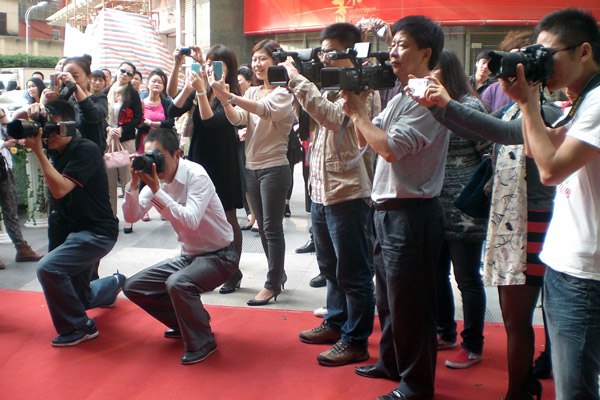
Shenzhen entrepreneurs enjoy big openings and Tuesday afternoon, I participated in the grand opening of Iris, a coffee shop located in the Hongxiang building, just off Hongling Road. I thought I had been invited to show my support for the owner’s new enterprise, but in fact had been invited as a special guest. Caveat: I’m not Hollywood red-carpet famous, but Shenzhen cultural circles somewhat well-known and happened to be free on Tuesday afternoon famous. Apparently, this friend of a friend of a friend is using cultural taste to brand the experience of drinking coffee there and all of the special guests were in some way related to cultural production in Shenzhen, especially writing and music. Continue reading

Not your cup of tea?

Ten of us were having dinner at a private style restaurant. Unlike mom and pop “family style” diners, which serve standardized fare at similar prices, a private style restaurant caters to the discerning rich, who have a good relationship with the owners. Trust and taste define this good relationship. Guests trust that the owner will provide quality tea, food, and service for a price that includes a “reasonable” profit. In turn, the owner trusts that these guests not only desire, but also can afford high quality teas, expertly brewed, seafood delicacies and soups adorned with beautifully shaped fungi. There is a menu, but it seems to be used for pedagogical purposes, including the health benefits of particular foods and herbs. Consequently, guests don’t order individual dishes, instead a meal’s host discusses a menu with the owner, who then plans the meal. The price of the meal is either set ahead of time (the host setting an upper limit, for example) or, if the guest returns regularly, the owner can plan a meal based on the number of guests. Special requests for imported seafood can be accommodated with 24-hour notice. Private style restaurants set the stage for intimate displays of taste and friendship. Sharing a meal of this quality, for example, enabled my friend both to demonstrate how much he cares for us (because the food is outstanding) and to show off how very good his good life is (because really, the food is that outstanding. And the tea. Wow.)

Bourdieu, of course, has reminded us that elites use aesthetic distinction or good taste to solidify class identity, arguing that cultivated predispositions to certain foods, music, and art enable us to recognize relative social status; we “like” that which is appropriate to our social position and “dislike” that which is not. Continue reading

rant on the state of shenzhen news

A journalist approached me for an interview on the topic, “送你一个好男人 (We’ll give you a good man)”. His newspaper is currently preparing special articles for International Women’s Day, next Thursday, March 8. I replied that my ideal man would have been a better topic for Valentine’s Day, when fantasy is given free reign and chocolate assumes its rightful place in the food chain. He responded that the newspaper was aiming for a “light” approach to women’s issues by collecting and retelling love stories. I’m presuming that the editorial moment will be to abstract those characteristics shared by good men the world over; my love story would be cross-culturally inspirational. So to speak.

The fact that newspapers are generating content for International Women’s Day isn’t surprising. In fact, making the ideal man the subject of Women’s Day reportage is an accurate reflection of the status of women and the terms of gender debate in Shenzhen. What’s more, I’m not even surprised that their story is gossip — the semiotic daisy chain that strings women and love and sex and gossip is so overdetermined that I’m moderating a roundtable on the relationship between gossip and architecture as part of my Women’s Day celebration. But here’s what I don’t get — why call me? Continue reading

汉奸 — notes on China’s gendered racism (and it lives just like gendered racism in the United States)

The bloggers at 乌有之乡 continue to push neo-Maoism to its logical extremes. Today, Feb 21, one of the hotter posts is 今日汉奸知多少. The keyword here is 汉奸, which can be translated as “traitor to one’s country”, but literally refers to “a person who betrays the Han people (背叛汉族的人).” Thus, the article title, which clumsily (albeit patriotically) alludes to Meng Haoran’s poem (春晓), might be literally translated as “Who Knows How Many Are Betraying the Han People Today? as well as figuratively as “Who Knows How Many Are Betraying China Today?”

The slippage between betraying the Han people and betraying the Chinese people is a key difference in contemporary critiques of what’s wrong with Mainland society, reminding us that racism continues to shape these debates. It bears mentioning that 汉奸 debates are eerily similar to White supremacist concerns with race traitors because yes, the talk gets just as ugly just as quickly and yes, the loudest voices in the debates are also men who embody an ideal racial type.

For example, Mu Chuan identifies those who are not only corrupt, but like Guo Jingyi whose corruption leads to the transfer of Chinese resources to foreign multinationals as being Han traitors. This seems rather straightforward enough. However, Mu Chuan also accuses intellectuals like Xiao Han (萧瀚), a lawyer and proponent of making Chinese legal system more democratic as being 汉奸.  Continue reading

B; it’s more than a letter, much less than love

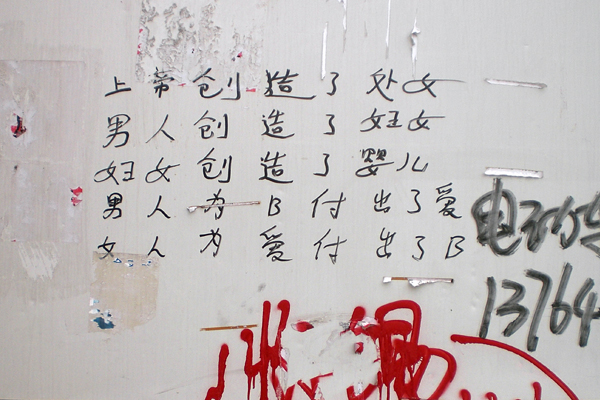
Couplets and rhymes circulate as text messages on Chinese cell phones and as scratched graffiti on walls. Although economic class and levels of education may separate texters from scratchers, nevertheless, the spirit of the message and the understanding of what it means to be human — especially and unfortunately about gender relations — is often the same.

The above poem reads:

God created virgins; men created women; women created babies; men give love to get cunt; women give cunts to give love.

Compare with earlier texts for a sense of how misogyny circulates in Shenzhen.