children’s baishizhou

As part of the Hanshake 302 program, Lora and Lihua have been running a theatre workshop at the Mingzhu culture station in Baishizhou. Workshop content has included games, narrative structure, and exploring Baishizhou. The children developed short pieces about their lives in a Baishizhou. A few observations:

1) Baishizhou (and other urban villages) are home to two generations of Shenzhen youth–the children of migrants and recent high school and college graduates who have migrated to the SEZ. The urbanized villages shelter Shenzhen’s future;

2) The young children have grown up in Baishizhou. They have improvised playgrounds and special places. Of note, they don’t actually know where Baishizhou’s boundaries are, and they have also figured out how to sneak into neighboring gated communities;

3) The children run relatively freely in Baishizhou. Unlike highly protected children in upscale communities, in Baishizhou the children mingle more widely and I am reminded of studies about US suburbs, where community friendships grew out of children’s play.

Today, we ran a dress rehearsal in Baishizhou. On Feb 23 at 2:30 pm we will bring Baishizhou children to perform at the Biennale Venue A. The performance will help us think through the question, what can we learn from the urban villages? Impressions of dress rehearsal, below.

This slideshow requires JavaScript.

crossroads: staged reading

So, yesterday afternoon we read “Crossroads” onstage at the Mizzou Jesse Wrench Memorial Auditorium. Despite snow days and ice and broken cars, the show went on and Fat Bird had a great time. “Crossroads” is an early play by Yang Qian that looks a the moral confusion and disfunction that have shaped and been shaped by Shenzhen boomtimes. Impressions, below:

This slideshow requires JavaScript.

revising the classics, or confucius encounters neoliberalism

Shenzhen parents worry about education — it’s quality, content, methods, and test results. Indeed, I have yet to meet a parent unwilling to spend several hours discussing their child’s education, while activists raise social problems in terms of education.

I have recently received a revisinist version of the childhood classic, “Kong Rong Shares a Pear“. The rewrite is fun and illustrates one of the ways in which the United States (as a symbol) has been put to work in contemporary Chinese debates about the contradiction between a society that values an integrated whole at the expense of individual desire and a society that values individual desire at the expense of social integration.

Kong Rong Shares a Pear

For thousands of years, the moral tale of “Kong Rong Shares His Pear” has been told, becoming the standard for parents who want to teach their children manners. But how do American kids think about this story? Below is a transcript from a class of American students who are studying Chinese. The students range from 8-12 years old.

Teacher: When he was young, Kong Rong was an exceptionally bright student. When he was four, he could already recite many poems. He was polite and courteous. One day, his father’s friend brought a box of pears to the family. His father asked Kong Rong to share the pears with his brothers. Kong Rong took the smallest pear for himself, and the shared the pears based on age rank, giving the largest pear to the oldest, the second largest pear to the second oldest and so on. As he distributed the pears he said, ” I’m the youngest, so I should eat the smallest pear.” His proud father heard him and asked, “But you’re older than your baby brother. Why didn’t you give him the smallest pear?” Kong Rong said, “I am older than him, so I should give it to him.”

What do you think of this story?

Student: Why did the father’s friend give the Kong family pears?

Teacher: they were a gift.

Student: If it was a gift, then all the pears would be good. Why were there obviously big pears and small pears? Why weren’t they all the same size?

Teacher: Ahhh…

Student: Now, if there were big pears and little pears, why did the father put all that responsibility on a four year old’s shoulders? What would have happened if Kong Rong had made a mistake? Would the father have taken back the pears and distributed them correctly?

Teacher: Ahhh…

Student: Why did everyone have to eat a pear? Couldn’t alone leave the pears and let those who wanted a pear choose for themselves?

Teacher: That might have been unfair.

Student: But Kong Rong didn’t necessarily distribute the pears in a just manner. All the brothers had to accept whatever pear Kong Rong decided to give them. Their right to choose was violated. The brother who received the largest pear might have been the brother who hated pears.

Teacher: That’s correct. This story is based on the premise that everyone likes pears.

Student: Why did Kong Rong give pears to the oldest first? If he was going to use age rank, why not start with the youngest?

Teacher: He was being polite.

Student: But after he took the smallest for himself, he didn’t give anyone else a chance to be polite. Why didn’t he give anyone else a opportunity to share pears?

Teacher: So what do you think about Kong Rong?

Student: I don’t like him. What he did wasn’t fair to others, taking away their right to choose and their chance to be polite. Kong Rong isn’t sincere.

Teacher: Why?

Student: This matter is internally contradictory. What if Kong Rong didn’t like pears, so he chose the smallest for himself? Nevertheless, his behavior earned praise? This is hypocritical. On the other hand, if he really liked pears, he should have said so. Otherwise, giving the biggest pears away wouldn’t have made him happy. When we like something we should bravely say so.

I also didn’t like his father.

Teacher: Why not?

Student: He didn’t take responsibility and asked a four year old to do something he couldn’t do. Also, he had no standards, he praised Kong Rong for being polite, but we’ve already seen that Kong Rong was disinterested in sharing the pears.

Teacher: Ahh…

Student: This was a bad story. It encourages subjective standards and praises one for violating democratic rights. This kind of twisted logic story praises a child for developing unhealthy psychology.

Teacher: So what do you think Kong Rong should have done?

Student: Put the pears on the table and let people who wanted to eat pears take what they wanted.

Postscript: From the perspective of an American student, a Confucian classic becomes a tale of twisted psychological motivations. Where do you think the problem lies?

the shenzhen school uniform

Apparently the Shenzhen school uniform is the talk of the national under 18 virtual community.

All Shenzhen public students wear the same uniform, regardless of the school they attend. On buses and in the subway, students either wear the elementary uniform or the high school uniform so one doesn’t know what school they attend, only that they attend. In fact, the Shenzhen school uniform is so recognizable that in the press and online it stands for the city’s youth. Thus, for example, the scandal of the youthful parents and their baby photo (from a tv series that admits high school students are having sex) as well as the explicit sexualization of Shenzhen little sisters in their school uniforms and a website for student couples to upload pictures of Shenzhen school uniform lovers.

Elsewhere in China commonality is marked by joining Party youth organizations because schools have their own recognizable uniforms. Cui Jian famously used the Young Pioneer red handkerchief to blindfold himself and in doing so evoked the trauma of a generation. In Shenzhen, the ubiquitous school uniform has taken on a similar generalizing function to the red handkerchief. However, instead of evoking a national identity, the school uniform symbolizes an explicitly Shenzhen childhood and teenhood.

I first heard about the national significance of the Shenzhen school uniform at a biennale forum. We old folks onstage were discussing if there was a common Shenzhen culture or civic identity. A student in the audience said there was. He mentioned that young people in Shenzhen have ideas and dreams that are shared, and also that these dreams and ambitions are different from the rest of the country. He then underscored his point by citing the omnipresence of the Shenzhen uniform both online and at Chinese universities. It seems that Shenzhen students continue to wear the dark blue sweatpants even after they get to college. Part of the charm, it seems, is that the uniform really is so ugly one grows to love it.

Back in the day, there was active debate both within and outside Shenzhen over how a civic identity might be created. Fortunately for us moldy oldies, the young people of the city have done it despite us. A selection of Shenzhen school uniform pictures, including a link to the highly popular digital comic book, Days When I Wore A Shenzhen School Uniform.

This slideshow requires JavaScript.

coming home to the liberal arts

This past week my friend’s daughter has been visiting liberal arts colleges and I have been tagging along, surprised by my sense of homecoming; these are my people.

I have lived and worked in Shenzhen close to twenty years. I continue to engage in anthropological research about the city and participate as a public intellectual both in Shenzhen and outside, in conversations about Shenzhen and what it teaches us about rural urbanization in the post Cold War era. I work with Fat Bird to produce theater and have recently joined friends to form CZC Special Forces, a group working to make art and performance in and around Shenzhen’s urban villages. Over the years, I have taught English, served as an acting principal, and done the odd bit of college counseling in Shenzhen schools. In short, the city and its residents have been good to me, helping me to craft an interesting and meaningful life.

Indeed, I feel at home in Shenzhen. I live in a late 1980s Shekou housing development, where child play and aunties and grandmas dance the yang ge’er. I know the bus and subway systems intimately. I have favorite restaurants and parks and walks. I appreciate the vast diversity of the city’s migrants and have learned to recognize (some of) the distinctions that matter to Shenzheners — accents, flavoring, and personality, for example. I navigate cross-border encounters, and have friends in Hong Kong and Guangzhou. In all practical senses, Shenzhen is home.

And yet.

Just a week of wandering a few liberal arts campuses and I am reminded of those stateside who also enabled me to live this life. Parents who believed that education was for life rather than strictly the first line on a resume; Chinese teachers who gave me the skills, understanding, and confidence to persist despite linguistic and cultural obstacles; anthropology professors and authors who not only helped me learn to think and consider what it means to be human, but also to value this very human impulse to reflect on our shared condition and its causes, possibilities, and challenges. All this to say that this trip I am realizing just how deeply my values and goals were shaped and nourished by the liberal arts tradition. Yes! the heart sings. This tradition is worth cherishing, and growing, and exporting.

Yet, again.

I also know what it takes for a Shenzhen family to be able to afford this education. I know the decisions and savings and evasions — moral, intellectual, and social — that make it possible to leap from Shenzhen to a liberal arts college campus. So this college visiting has been unremittingly bittersweet. I keep saying to my friend, “See, it is possible to create this kind of learning environment and raise outstanding human beings.” And she rightly reminds me, “Shenzhen people are still worried about securing their children’s economic future.” I pause because she is not wrong. Not only Shenzhen parents find $US 50,000 a year to be a daunting obstacle. American parents. Moroccan parents. Indian parents. Parents everywhere do because we are exporting liberal arts educations. And they cost. A lot. And even more when your family doesn’t earn petro-dollars, but instead earns real estate yuan.

Thought du jour: We need to find ways to realize these values in other, more accessible forms. I continue to believe that our liberal arts colleges and pedagogical values constitute an important contribution to humanity. I am haunted, however, by their obvious and subtle complicities with globalized inequalities. I live this contradiction everyday in Shenzhen, where the liberal arts — or another form of morally tolerant pedagogy and values — are needed, but where as an American, I often find myself so firmly placed on the “haves” side of the line that dialogue is difficult. Indeed, in the end, I end up listening more than speaking because I’m still searching for common ground. And this ground must take into account economic inequality and political aspirations if we are to move forward, together.

shenzhen and china’s left behind children

The Foreign Policy series “China’s Left Behind Children,” by freelance journalists Deborah Jian Lee and Sushma Subramanian followed the migrant worker Huang Dongyan, who left her daughter back home to work in Shenzhen. Her relationship with her daughter remains fraught and teeming with unsatisfied yearnings. In response, Huang, decided to raise her son in Shenzhen instead of leaving him in the countryside with his grandmother. The two articles are well worth reading, here and here. Of note is the continued relevance of hukou in the lives of migrant workers, especially with respect to receiving an education.

life lessons

Yesterday, my friend told me a story about how her sixth grade lost the role of Maria in a short skit based on The Sound of Music.

The sixth grade is preparing a graduation celebration that includes skits, songs, speaches, and food. Parents are organizing these events, including an English teacher who wrote the Sound of Music skit. Apparently, the English teacher intended that her daughter would play Maria. However, when the daughter declined, my friend’s daughter said, “Yes!” and started preparing.

Soon after, the English teacher’s daughter sought out my friend’s daughter and said that she wanted to play the role of Maria. My friend’s daughter asked what to do. On her interpretation, she had several options: (1) cede the role to her classmate; (2) ask the teacher to decide, or; (3) audition before the class and let their classmates decide. What my friend’s daughter understood clearly, was that if a teacher’s daughter wanted the role, then their homeroom teacher would take the role away from her and reassign it to the teacher’s daughter.

My friend comforted her daughter, saying that there would be many other opportunities to perform. However, her daughter was sad and so my friend asked me what I thought. I didn’t have to think. I said that it was perfectly natural for her daughter to be upset at such blatent injustice. My friend agreed, but added that in China this was how things happened. Sometimes you could spend more time and energy only to have your work denied or the glory taken away. I concurred, but asked if it was really necessary to learn such a lesson in elementary school.

And there’s the culturally interesting question: when and how do children learn the politics of everyday life?

I remember in high school having a teacher who took a dislike to me. Once when I was not in class (I don’t actually remember the reason), said teacher held a vote, asking students to decide whether or not I should be allowed to remain in class. I was voted out of the class. So, I went to the vice principal to mediate. When I sat down with that teacher, he chronicled what a horrible student I had been — talking in class, passing notes, and not attending. All true. Thus, when he finished speaking, he stood up to leave; clearly, he thought that sitting down with me was enough to demonstrate his good faith in the process.

I actually needed the vice principal to call that teacher back to the conversation, when I had a chance to mention that this teacher made inappropriate remarks about the girls in the class. I had started making snide comments and when he addressed me, I spoke back. Once I said this, the vice principal asked the teacher if their was any truth to my story. The teacher shrugged and then offered the following compromise: I could take a study hall during history class, but receive an “A” for my work. And what did I know? I didn’t turn to my parents, but accepted the deal, leaving the vice principal and history teacher to figure out their relationship, which had suddenly been complicated.

After I told how I was bought off, my friend nodded. She said that she would advocate for her daughter to keep her role. After all, these moments of injustice — in Chinese elementary schools and US American high schools — are learning moments. Unfortunately, we more often than not first learn and then unconciously teach the unequal politics of everyday life.

spizzwinks in shenzhen

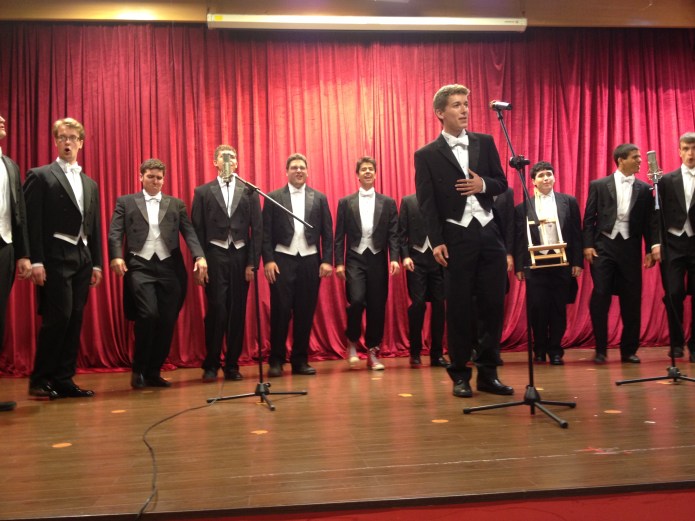
Just spent the past 2 and a half days tagging along with the Spizzwinks. They are all that. Energetic, generous with their smiles and attention, respectful, and talented. And yes, the Spizzwinks charmed and amazed three very different audiences at the Mass Arts Theater (群众艺术馆), Green Oasis School, and at the Dalang Culture Center (大浪文化馆), hopefully inspiring more people to sing and join choirs.

The hospitality of the Shenzhen hosts completed the exchange. In Shenzhen, friends arranged a large dumpling making banquet for the group, in addition to a delecious dim sum brunch before the GOS concert. In Dalang, we were taken to see a factory showroom, libraries that have been set up for workers and their families, as well as to meet the unicorn dance troupe. I was especially moved by the talent and passion of the Dalang Workers Youth Choir, whose members work during the day and practice two hours once a week. One of the troupe members works in a watch factory and handmade 17 watches, one for each Spizzwink.

This trip reminded me that successful cultural exchanges are everywhere the same: when we give all that we are, we all share in the joy.

Incomplete impressions, below.

This slideshow requires JavaScript.

what is the party’s benevolence?

In news broadcasts and interviews, old peasents frequently evoke “the Party’s benevolence (党恩)” to explain their lives. Young and hip urbanites hear these interviews as more evidence that old peasents are the dupes of corrupt officials. However, when I take the time to listen to an old peasent’s life history, it’s clear that more often than not, these peasents did benefit from the establishment of the People’s Republic.

Yesterday afternoon at the Dalang Culture Center, for example, I helped conducted interviews with Uncle Chen and Aunt Zhang for an oral history project. Both Uncle Chen and Aunt Zhang were both born into peasant families in 1930 and 1940, respectively. Auntie’s family owned three single-story houses, while Uncle had left home early because his family did not have room for him. Auntie mentioned that at the turn of the last century, her grandparents went to Singapore to work. Her mother was “brought home” as a child bride for her father. In contrast, Uncle did not mention his family except when asked about how poor his family had been, he remarked that two of his sisters had been sold to strangers, but where they ended up was unclear.

As a poor man, Uncle could not afford to marry. Instead, he went to find work in Hong Kong. In 1951, Uncle became sick and returned to his hometown, where he could recieve care. In 1952, although he had a sporadic education, Uncle was able to secure the documents necessary to join the first test for admission to the Bao’an Normal School. He passed the test and was admitted to an elementary school teachers program, which was located in the Nantou High School building. Teacher Chen emphasized the extent to which his current wellbeing was a result of the Party’s benevolence. He was assigned to teach at Langkou Elementary School, where he met Auntie.

As a young girl, Auntie stayed at home and helped her parents. However, when she was 10 years old, Auntie began attending Langkou elementary school because her father asked the school principal to allow her to bring her brother. 10 year-old Auntie strapped her brother to her back and attended classes. At lunch time she fed her brother a bottle of condensed milk that had been thinned with water. Several years later, she carried her sister to school. Altogether, Auntie carried her siblings for six years. At the end of elementary school, Auntie tested into middle school, where she studied elementary education. Auntie emphasized that her teachers like her because she was a good student. Moreover, her younger siblings were well-behaved and didn’t cry during classtime.

After Auntie graduated from middle school, she married Uncle, who was still teaching at the village school. Auntie’s mother exhorted her to marrie Uncle because he “could do anything”. Uncle could not give Auntie any presents for the marriage. However, he did have housing at the elementary school, where Auntie was also hired to teach first and third grade. The school was located near Auntie’s parents’ house. Auntie did not attribute any of her life history to the Party’s benevolence, but rather emphasized her family background and her mother’s words.

Implicit in Uncle and Auntie’s simple story were the gendered contours of rural poverty in South China, where one of the most important events of a lifetime was to continue family lines through marriage and children. Uncle and Aunt were born into South Chinese villages, where bringing in wives or selling out daughters was a common practice before 1949. However, they married 10 years after the establishment of the People’s Republic, when some policies had already restructured traditional social structures. Auntie married because her family could afford to give her an education, but not to keep her at home. In contrast, Uncle had delayed marriage until he could afford a family, which was a direct result of attending teaching school. He described that opportunity — and all that followed, a job, a house, and eventually a wife and children — as an expression of the Party’s benevolence.

2013 gaokao update

I find the gaokao process daunting: so many rounds of admissions, so many different variables — including hometown and quota requirements — to consider, so many practice tests and, in the end, so few points difference between students.

That said, the gaokao season began with registration (Dec 1-10, 2012), testing to estimate admission baselines, and has just completed mock exams (April 2-20). The mock exams give students, parents, and teachers an estimate of likely test scores, which can be compared to historic results in order to decide on which program to apply. We have entered the final phase of test preparation, during which time students take tests and refine their baseline estimates. On June 7 and 8. 36,633 students will sit for the exams in Shenzhen, unless, of course they have an abnormal pre-exam medical check-up. Students with physical ailments will be permited to take make-up exams on June 17-18.