shenzhen beggars

Several days ago on the subway, a man approached me. His speech was slow, his eyes empty, and he showed me a ripped pocket where he claimed his money had been stolen. I asked him his story and he said he had been robbed and that he didn’t want to bother his parents. He said he had a job tomorrow and all he wanted to do was eat. After I gave him some money, he shuffled off the car at the next stop. My friend said that the beggar had targeted us, that he had watched me for several minutes, heard me speaking Mandarin and then decided to approach me. The implication, of course, was that I had been cheated, tricked into giving money to someone undeserving of that handout.

Here’s the rub: I don’t know what made him undeserving — the fact that he [may have] tricked me or the fact that he was working as a beggar, rather than at a “real” job, like part time journal editor, such as myself. I do know that I had a visceral response to my friend’s comment — I wanted to prove that I could tell the difference between those deserving and those undeserving of charity.

Financially, it wasn’t as if the money I gave him could actually buy all that much. As I pointed out to my friend, if I were to forego one 500 rmb meal a month, I could give 2 rmb to every beggar I encounter and still save money each month. What’s more, when I take the time to prepare a pocketful of 1 rmb coins and bills, giving to beggars is a straightforward opportunity to practice generosity in my daily life. So why the resistance to giving?

At the time my friend pointed out that I had probably been targeted, I felt ashamed and tried to defend myself. I argued that I would rather risk being tricked by 99 rather than missing the chance to help the one in need. But, I didn’t give enough to actually change the beggar’s life — only he could do that. In retrospect, I’m wondering about my responses –first to the beggar (I wanted to give) and then to my friend (I didn’t want to appear a dupe). I have realized that I made the encounter all about me, rather than trying to figure out what might be an appropriate response.

Almost twenty years now, I have watched the Shenzhen poor grow both relatively and absolutely poorer. On the one hand, most people in Shenzhen have access to jobs and living conditions that they would not have in neidi cities and rural areas. On the other hand, economic polarization grows as quickly as the city. And many businessmen complain that monthly factory wages have risen to “as much” as 2,500 rmb (approximately $US 400.00), which is less than the price of most high-end electronics. And this change has left moral confusion and self-doubt in its wake: what if there isn’t an appropriate response to poverty that is a result of the change? What if all that remains is witnessing the fallout, both socially and in one’s heart?

double bind urbanization

At dinner last night a friend asked me, “If you had to choose between living in a 50 story building or an urban village walk-up, where would you live?”

This question illustrates the kind of double bind thinking that current debates about urban villages generate. As posed, the question compels us to choose between either high end futurism or unsanitary crowded settlements. But all too often the question itself becomes rhetorical justification for ignoring other examples of more successful urbanization. What’s more, the question also blinds us to what we can learn from the  tight organization and convenience of the villages, while using high tech knowledge and skills to imagine low-rise, more environmentally friendly settlements. Continue reading

the contempt factor

The other day, while showing a group of visitors the Goodbye, Urban Villages (再见,城中村) exhibition, one asked, “Well what will they do about it?” meaning what will the residents do to prevent the forced evictions?

He, from Western Europe, was grappling with the question of democracy (or not) in China. She, from Hong Kong answered saying, “They don’t do anything because they can’t. That’s what it’s like here.”

Our visitors seemed to have settled on a variant of the local intellectual script, A Hong Kong Resident Explains Shenzhen to a Westerner, so I found relief speaking with someone from Beijing.

He commented, “The artists in Shenzhen seem really pure.” I laughed and answered, “That’s because there’s no market for art in Shenzhen; it has to be a hobby (爱好) [literally something done from love].” He smiled, “All we have in Beijing are markets because everything’s for sale.”

As a group, we then moved on to the Kojève exhibition, which is a bit too pure art for my taste, but nevertheless provided enough common ground that the conversation turned to light and pleasant topics.

In retrospect, I have realized that what irritated me about the visitors’ response to Goodbye, Urban Villages was that it had been a variation on a constant theme — contempt for Shenzhen and by extension for those of us who live here.

Intellectual Westerners, who dabble in romance languages, but have never heard of Shenzhen will ask me, “Will you live here, forever?” the unsubtle emphasis underscoring the fact that migrants and their displaced families will not stop the united forces of government and state-owned real estate developers from razing the handshake homesteads, low end eateries, and improvised bicycle repair shops that flourish on the sidewalk. I understand that elsewhere these might appear as insurmountable contradictions, but… and here I pause rather than answer a question that has set me up either to defend what I clearly oppose or to agree with the unspoken contempt in the question. Instead, I point out that no one lives forever.

Likewise, young Hong Kong students who do not cross the border except to purchase books and older aunties who come for sauna and massage will ask me, “How can you live there, is it safe?” and then advise me to move to Hong Kong. Yet others lecture me on the truth about Shenzhen — it is dirty and corrupt and teeming with mafia types who cannot be arrested because they’re in cahoots with governments — this they have learned in Hong Kong newspapers and from their Hong Kong relatives. I understand that many of their foreign friends may have just recently heard of Shenzhen, but… and here I pause rather than answer a question that has set me up either to play the innocent foreigner abroad or to instruct Hong Kong Chinese on what it means to be Mainland Chinese. Instead, I point out that I am still alive.

And there’s the rub: These pauses are difficult to cultivate. On bad days, find myself skeptical of good intentions so poorly phrased that the tone of my response may range from biting to sarcastic, amplifying the contempt with my own. On good days, I treat these questions as possible moments of mutual enlightenment, taking this speech at face value: they do not know and want to learn. Most days, however, I turn pedantic and finish my sentences, trying to make my interlocutor see — not just the political mess and entrenched despair, but also to observe the efforts some are making, and the care that some have brought to what is a vast and tumultuous and often unimaginable transformation.

what i realized this june 4

On June 4, 1989, I was in Japan. That year, I had been diligently learning Japanese pronunciations for Chinese characters and memorizing [subject]-time-place-object-verb sentence patterns. The Chinese democracy movement, the call for transparent and clean governance, and the military crackdown came to me filtered through Japanese television because CNN was not yet global. Only after the fact would I learn about the two month build-up to the sight of tanks grinding through the Beijing streets. It took me years to understand the significance of Shenzhen reforms to inspiring the movement as well as how the crackdown unmade many of the political reforms, culminating in the 1992 Southern Tour, when Deng Xiaoping announced that economic liberalization would continue. Political liberalization would emerge piecemeal and in unexpected places, but no longer with the hopeful momentum of the early 80s.

Nevertheless, over the past years, I have noticed that my knowledge of events has been less important than the nitty gritty of everyday life in transforming June 4 into a meaningful symbol.

On Saturday, for example, I went to a coffee shop, where a man was lying on the ground, hands clawed, some kind of froth at his mouth, trembling. Two guards stood and another man sat, watching. I asked if an ambulance had been called. They answered, yes and I went into the coffee shop. Over twenty minutes later when I came out to look for someone, the man was still on the ground and no help to be seen. This time, I dialed 120 and connected with a dispatcher, asking a former student to explain what was happening. This decision disturbed the watchers who explained that the man was a thief and that he had faked a seizure when the guards had caught him. Moreover, according to the guards he frequently came by and stole things. The guards seemed less concerned about the man then they did about being seen not taking care of him. They stopped me from taking a picture and, when help did finally arrive, they kept repeating, “There’s nothing to see,” and pushed people away.

I left the coffee shop, came home, jumped online, and saw blog posts and articles on June 4, which caused me to make sense of the incident in larger, cultural terms. “China is a place where dissatisfaction with the regime or petty thievery can cost a human life,” I thought, “therefore people tend to be cynical and to ignore the suffering of strangers.” The coffee shop incident also allowed me to hear Chinese leaders repeating to other world leaders and journalists, “There’s nothing to be seen.” Consequently, my anger at the coffee shop guards grew into a nightlong bout of “what the fuck am I doing in China?” These were not happy or useful thoughts. Instead, as the anger cooled, I realized that I had argued with the guards about what should be done and our different values (them bad, me good). In retrospect, however, what is clear is that in actual practice our values were the same — we became increasingly angry with each other rather than wiping the froth at the man’s mouth or placing a pillow under his head.

This was not the first time that my sense of outrage has led me to fight with others rather than to comfort a suffering being. Consequently, June 4 this year, I listened to Pema Chodron‘s teaching on Shantideva’s The Way of the Bodhisattva in hope that by working with and through my anger, I will achieve something of the revolutionary patience necessary to change the world:

The hostile multitudes are vast as space –
What chance is there that all should be subdued?
Let but this angry mind be overthrown
And every foe is then and there destroyed.

WHERE ARE YOU FROM?

This afternoon, as I struggled out of a damp shirt in the yoga studio changing room, a woman turned to me and enthusiastically asked, “Where are you from?”

“Where are you from?” I countered, recognizing her as new to a studio, where I’ve been practicing for four years.

“Here,” she gestured generally behind her, “What about you?”

“Here, too,” I replied mirroring her gesture.

“I don’t believe you,” she challenged.

“That happens,” I admitted, “a lot.”

17 years into my Shenzhen sojourn, I am still trying to come to terms with my decision to live outside the United States because (a) I reside in a community that treats me as a just arrived guest and (b) my snail mail address notwithstanding, at times I’m not actually sure I left my homeland, and not always because the US and China function as each other’s neoliberal doppelganger. Instead, I abruptly realize the US is all in my head.

As a misplaced second grader in rural Wisconsin, I explored the library through weekly visits, where I maxed out my card (five books at a time) and convinced the librarian that yes, I could finish Bambi in a week and still get through another Nancy Drew or three. No, I would not be playing after school with “little friends”, I would be reading, but only if I had enough books. She laughed at my determination, but permitted me to borrow my limit and even sneak another mystery into my father’s check outs.

I fidgeted through high school classes, and when not lurking in the library, I stayed in the art room, painting and building “The Tommys,” a series of convoluted trees and meandering vines molded in clay and glazed in over-saturated complementary colors that repelled sustained appraisal. I remember arranging vivid magenta petals on a neon green trunk, and writing unreadable letters in yellow ink on purple paper — catch me if you can. When I launched from the Jersey suburbs into a Vermont college, I believed that a new place and a new people, a new life would satisfy my yearning; I studied Chinese language and literature convinced that once settled elsewhere, it would be HEA 24-7.

My early life wasn’t all teenage angst because my craving for distraction had an upside; I read deeply, broadly, and well. I cried each time Charlotte died, and then Old Yeller, was seriously confused by Fiver’s visions, and imagined myself taking on IT with Meg and, yes, I still read YA literature, most recently Hunger Games. I crushed on Oscar Wilde and his baroque fables, fell in love with Adrienne Rich and TS Eliot, H.D. and WH Auden. Emily Dickinson, Jane Austin, Willa Cather, Edith Warton, Louis de Bernieres, Salman Rushdie, Graham Greene, Dashiell Hammett, E. Annie Proulx. And although I started college bored by  Robert Frost’s plain simple, I have since realized that the moral conundrums which grip my heart also root me in his New England soil — Something there is that doesn’t love a wall…

And that’s point du jour. The literary sojourns that once enabled me to ignore shag carpeting and sod, encouraged me to have adventures, now remind me coming full circle doesn’t mean anything so pedestrian as showing up on a childhood front porch, not that I wouldn’t enjoy walking the lake to see how the neighborhood has changed. Instead, that brutal question shocked me into what I might have seen earlier if I interpreted my life with the same close attention I give to reading; perhaps my childhood dramas of displacement have compelled me into literal — rather than literary — exile, where I can confidently say, yes, yes, the stories are true.

goldfish

We have skipped Spring and gone directly to Summer. We eat outdoors and feed the monstrous goldfish. Shimmering, lovely, and oh so greedy — golden, molten, liquid carp. There’s a lesson in there, but you already know.

This slideshow requires JavaScript.

mapping ignorance

Was conversing friends about political succession since Mao and how to interpret reports coming out of Beijing and Guangzhou with respect to Shenzhen’s political status and symbolic valence within the national imaginary. Their 15 year old daughter was at the table, politely ignoring us, when someone mentioned Hua Guofeng (华国锋). She lifted her eyes and asked, “Who?”

Her father explained Mao’s appointed heir had been at the center of a political struggle with Deng Xiaoping to decide if China would continue Maoist policies or pursue reform. This struggle ended with a coup d’etat and the Sino-Vietnamese War as Deng Xiaoping gained political control by securing support of military leaders and high-ranking Party commissars. We then mused about the relationship between violence and political succession, even if indirectly, because Jiang Zemin (江泽民) only became Deng’s appointed successor in the aftermath of Tian’anmen and Zhao Ziyang‘s (赵紫阳) fall.

“Who?”

All this to say, that dinner I experienced a We Didn’t Start the Fire moment with post Cold War Chinese characteristics — recent history actually is this easily forgotten. Or more to the point, I realized (again!) the extent that what we know of recent history comes only as events disrupt our daily lives.  Continue reading

rant on the state of shenzhen news

A journalist approached me for an interview on the topic, “送你一个好男人 (We’ll give you a good man)”. His newspaper is currently preparing special articles for International Women’s Day, next Thursday, March 8. I replied that my ideal man would have been a better topic for Valentine’s Day, when fantasy is given free reign and chocolate assumes its rightful place in the food chain. He responded that the newspaper was aiming for a “light” approach to women’s issues by collecting and retelling love stories. I’m presuming that the editorial moment will be to abstract those characteristics shared by good men the world over; my love story would be cross-culturally inspirational. So to speak.

The fact that newspapers are generating content for International Women’s Day isn’t surprising. In fact, making the ideal man the subject of Women’s Day reportage is an accurate reflection of the status of women and the terms of gender debate in Shenzhen. What’s more, I’m not even surprised that their story is gossip — the semiotic daisy chain that strings women and love and sex and gossip is so overdetermined that I’m moderating a roundtable on the relationship between gossip and architecture as part of my Women’s Day celebration. But here’s what I don’t get — why call me? Continue reading

blooming schlumbergera

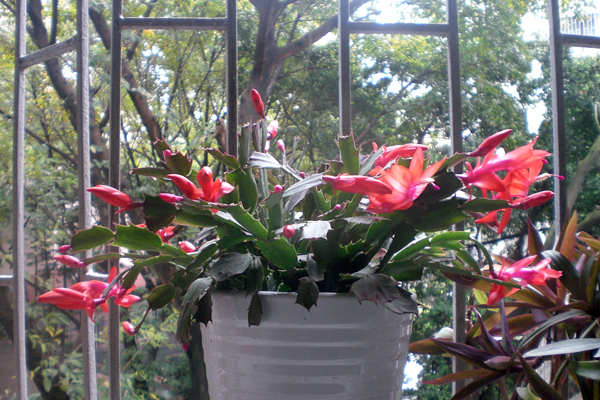
I knew it as a Christmas cactus, but our blooming cultivar is officially a member of the Schlumbergera genus, buckelyi group. Plant is thriving in muggy warmth of Shenzhen February. Of interest du jour, a brief search for instructions on how to keep said cactus happy also turned up the information that Schlumbergera is originally from eastern Brazil.

Apparently, Schlumbergera truncata was first cultivated in Europe by 1818 and S. russelliana was introduced in 1939. My S. buckleyi is a descendent of an 1852 deliberate cross of truncata and russelliana. Yes, the English plant crosser was surnamed Buckley. Schlumbergera had its 15 minutes and was cultivated in different colors for hothouse habitats, but by the early 20th century (a mere 50 years later!) it lost popularity and many of the breeds were lost. From the 1950s, breeding resumed in Europe and North America, which is also when S. buckleyi made recorded appearance in the Pacific colonies of Australia and New Zealand.

What I’m curious about is the history of South China traffic in houseplants. Clearly, schlumbergeras, which were named to commemorate Frédéric Schlumberger, a French cultivator of cacti didn’t jump across South America and then swim to Shenzhen on a pacific gyre. I’m assuming that an ancestor of my S. buckleyi came to Hong Kong through postwar British colonialism. But I’m not sure. After all, there were British concessions in Tianjin and Shanghai and I’m sure that one or two of the elites would have had hot houses. I’m thinking that if cacti survived a trip from Brazil to England, they could also have survived one from England to the Chinese coast. So, does anyone know interesting stories and / or books about household gardening practices that illuminate the tortured tracks of colonial homemaking abroad? If so, please let me know.

年30

We ate, we walked, and enjoyed flower market vestiges. May everyone have a wonderful Year of the Dragon!

This slideshow requires JavaScript.