tianmian celebrates 20 years of incorporation

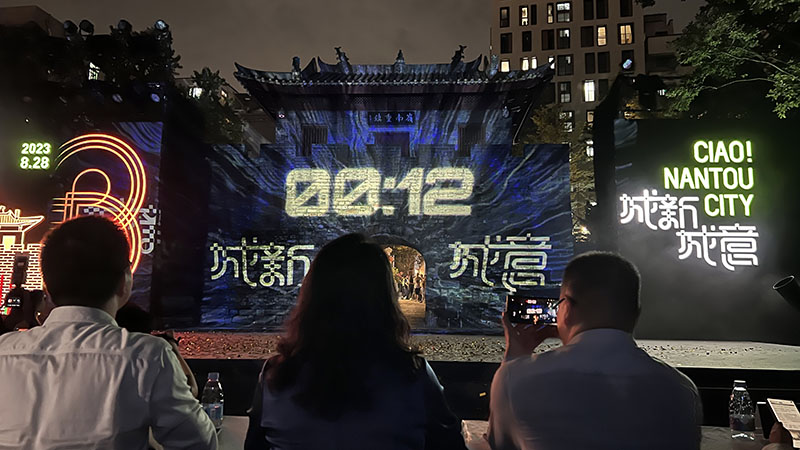
Yesterday evening, Tianmian Industries Ltd (田面实业股份有限公司) celebrated 20 years of incorporation, simultaneously confirming the group’s new status as a corporation and the corporation’s status as the continuation of Tianmian Village. The celebration achieved this sense of historic continuity through the sequencing of socialist and traditional customs, including the presentation of and speeches by Tianmian, Fuhua Precinct, and Futian District leaders, which was followed by singing and dancing performances, a demonstration of Bruce Lee style kongfu by one of Bruce Lee’s students, and pencai, a local specialty that is only eaten at collective ceremonies. The speeches and performances took place on a stage in the vip area, while two large LED screens had been set up throughout the common area so that guests could watch the entertainment while eating.

Another important ceremonial function was to demarcate borders both within Tianmian and between Tianmian and outside communities. The 137-table event occupied  most of the main road into the village (directly off Shennan Road) as well as adjacent public areas, dividing Tianmian into two sections: the ceremony area and the rest of the neighborhood. Importantly, only Tianmian Ltd has the authority to cordon off public areas for private ceremonies. The ceremony area itself was subdivided into a vip area for leaders, their families and guests and a common area for Tianmian stockholders, their families and guests. Tianmian guards prevented non-guests from passing the red cordons.

Rituals such as these and the concomitant right to occupy public space are perhaps why we continue to speak of Tianmian Village as a village. In point of fact, we were celebrating the dissolution of Tianmian Village and its reconstitution as Tianmian Ltd. In ritual terms, however, the celebration clearly established Tianmian Village as the host and hegemonic subject of this territory and Tianmian Ltd as the contemporary manifestation of the village. What’s more, throughout the evening the gaze of outsiders — many of whom live in Tianmian housing stock — reinforced the sense of Tianmian as a vibrant and recognizable collectivity.

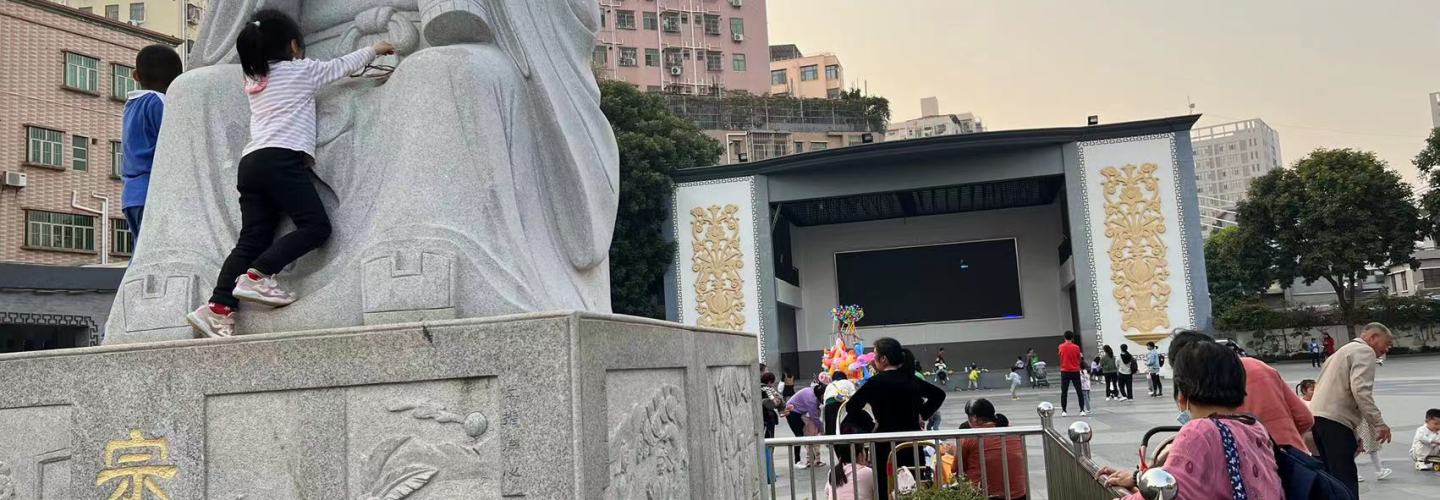
These rituals are particularly important in Tianmian because the corporation has not built traditional village buildings, such as an ancestral hall or a temple. In obvious contrast to Tianmian’s appropriation of public space, when larger village-corporations hold pencai ceremonies, they set their tables in designated village plazas that are surrounded by traditional buildings. In Xiasha, for example, the large village plaza includes an ancestral hall, a temple, a public theater, a traditional garden, and a path to the Xiasha Museum. Consequently, where Xiasha relies not only on ritual, but also on the built environment to reinforce communal solidarity, Tianmian’s village identity remains as such primarily through what is commonly called “non-material culture (非物质文化)”, or rituals.

It will be interesting to see, say in twenty or fifty years, how strong Tianmian’s sense of village solidarity remains and to compare that solidarity to that of a village like Xiasha, where the construction of village architecture sets the stage for village rituals. In other words, although Shenzhen has been seen as a laboratory for economic and social experimentation, we might specify further, and watch the ongoing reconstruction of traditional solidarities despite and within the maelstrom of modernization. Impressions from Tianmian’s 20th anniversary celebration, below.

This slideshow requires JavaScript.

masterplanning the future. or not.

I have an ambivalent relationship to academic conferences. On the one hand, I find them physically exhausting because structured to produce the largest amount of intellectual work in the most efficient way. Sadly, intellectual efficiency, like all forms of efficiency is a statistical concept that can only be represented through quantification. The success of an academic conference tends to be measured in numbers of participants, sessions, and published proceedings — measurements which effectively transform intellectuals into academic line workers and make conferences just another station in what might be described as toolpath control over knowledge production. Thus, I experience diminishing returns in a conference’s progression; early on, I am able to listen more actively and participate more fully simply because I’m rested and able to engage a diversity of theoretical positions and claims. In contrast, as the conference unfolds, I become physically tired and often find myself aware that my only contribution is the effort to engage a presenter’s work; I try to listen and understand.

On the other hand, I attend academic conferences because I yearn for intellectual conversations with people I do not meet in the general unfolding of my life. I have colleagues and friends in Shenzhen with whom I debate and discuss various issues. But in order to be inspired and challenged, or simply unsettled and honed, I need both the stability of familiar conversations and the jolt of unexpected encounters. Consequently, I continue to see old friends and opponents, while making new at conferences, which are by and large international and place me in proximity to scholars working both in and beyond Chinese borders. Thus, the conference format, especially when funded by academic and public institutions, offers opportunities to nurture and grow intellectually — precisely through intellectual companionship — both during and in the off time between stations sessions.

In other words, both the strengths and limits to Fordist knowledge production are relentlessly human; international conferences provide opportunities to be surprised and inspired outside the paths of everyday life, however, tired bodies can only do so much, even and especially when we are going through the privileged motions of academic conferencing.

On Oct 18-19, I had the pleasure of participating in the Masterplanning the Future Conference, which was organized and hosted by the Department of Architecture at the recently established Xi’an Jiaotong Liverpool University in the Suzhou Industrial Park. Organizers, Austin Williams and Theodoros Dounas’ attempted to address the inherent problems of academic conferences through a schedule, which started late enough in the morning and ended early enough in the evening to allow for conversations about and around the the question of high-speed development(s). Moreover, the conference structure attempted to open discussion to the widest possible audience, including a local audience for these ideas. On day one, for example, the public sessions raised general issues, their lay representations, and potential representatives, while on day two, the academic sessions provided more detailed analysis and examples of these issues. Finally, the conference itself was small enough to allow for participants to leave with a sense of the whole, satisfied that if someone were to ask me, “So, what was the conference about?” I could confidently answer, “English language efforts to come to terms with how China has shaped post Cold War thinking about and experience of urbanization. With a few divergences.”

That said, my interpretation of the point and purpose of the Conference differs importantly from the full title of the conference which was Masterplanning the Future: Modernism — East, West & Across the World. The aim to generalize at this scale meant that during sessions we inevitably stereotyped both ourselves and our interlocutors. All too often, the conversation reduced to statements that began with “The West this” or “China that”, rather than staying focused on more specific examples or standpoints that might allow for the negotiation of similarity and difference as shifting aspects of human experience, rather than as identifiable characteristics of mass populations. In this sense, the underlying assumptions of the academic sessions did not differ significantly from that of the public sessions, or even from a more general representation of China and The West at the university itself.

And there’s the rub: this tendency to stereotype distresses me not only because it seems intellectually dodgy, but also because it invariably reduces international relations and cross cultural understanding to semiotic match-making, in all senses of the term. Romancing the factory, so to speak. After all, the conference did take place in an industrial park, with an eye to global knowledge production and consumption.

Outside the XJTLU conference centered where we convened, for example, was a sculpture of a Tang lady and an English gentlemen playing polo (image below).

Both ride culturally appropriate horses and wear culturally appropriate costumes. Both the Tang Lady and English Gentlemen are stylized representations of a recognizable elite, which in turn represent English and Chinese cultures, while glossing internal hierarchy and inequality within the United Kingdom and People’s Republic of China; Tang Ladies and English Gentlemen may represent the current elite of each of these countries, but in no way do they represent the lives of contemporary workers. Moreover, while I’m willing to entertain the idea that contemporary Sino-British relations are simply a game played by elites from the PRC and UK, nevertheless, the gendering of this statue is itself so stereotypically neo-colonial that I don’t know where to begin my critique.

(But really, if we insist on representing international relations through figures of hetero-normative couples, might we not consider a male Chinese zither player and a female British mandolin player, aiming for musical harmony rather than competitive sportsmanship as a unifying metaphor of international intercourse?)

All this to say: I think that these stereotypical elites and their games continue to echo throughout cross cultural conversation because leisure is one of the predicates of meaningful conversation. Here I mean leisure in all senses of the word — as unstructured time, as non-productive time, as pleasurably engaged time and the resultant inspirations, solidarities, and new beginnings. We know that we need to play together in order to create more meaningful relationships and concomitant social orderings; children do it everyday and, unlike us adults, they do it well, creating community out of mud pies and whatever else is at hand. However, unless we restructure the inequalities built into contemporary chains of production and consumption, including cross cultural production and consumption of knowledge, we will remain nostalgic for forms of elite leisure that we cannot have experienced, even as we mistake this deluded nostalgia with the necessary realization of leisure in society.

Sigh.

2012 guangzhou triennial

Yesterday, I visited The Unseen, the GZ Triennial exhibition and spent a pleasant 1/2 day engaging the works of 61 artists from China and the world, including Korea, Russia, India, and Indonesia, a diversity of representation much larger than the usual “global” expositions.

Curators JIANG Jiehong and Jonathan WATKINS have selected works in which what is seen directs the viewer’s attention to what is not. Sometimes the unseen referent is concrete, like the crank that twists a rope in XIAO Yu’s piece of twisting rope, Popularity 1. Sometimes the absent referent is more ephemeral, like the possible corpses buried beneath KAN Xuan’s Millet Mounds (大谷子堆). Sometimes, the unseen is a clever joke – Tim Johnson’s never seen flying saucers, for example. Nevertheless, as a viewer engages more works, the accumulation of unseen referents blurs the artificial division between concrete and ephemeral references, directing the viewer’s imagination instead to the illusive yet invisible worlds in which objects can come to signify relentless social pressure, cultural continuity, and comic book fantasy. So yes, it’s worth making the trip to the Guangdong Museum of Art (广州市二沙岛烟雨路38号广东美术馆) to see what else is there.

The Unseen will run until December 16. Impressions, below.

This slideshow requires JavaScript.

the chief eats a fish

So a translation of a story making the rounds, again. The Chief Eats a Fish first appeared at the end of 2011 and keeps circulating. Fish, of course, is a common pun for “extra, or too much”. Of note are the different ways that each of his subordinates addresses Chief Yu and the way that puns function, making the social body out of different parts of the fish. Nevertheless the satire speaks for itself.

 The Chief (局长) Eats a Fish

The weekend had come and as was their custom, the work unit staff gathered to dine. According to Chief Yu this activity was “going deeply into the lowest levels of society (深入基层)” and the best shortcut for connecting with the masses.

Chief Yu loved to eat fish, which was of course on the menu. They had drunk three rounds of wine and five different dishes when the fish was served. The waitress knew Chief Yu and so she made sure that the fish head was directly facing him. Without waiting for anyone’s input, he immediately drank three cups of wine (fish head wine is a colloquialism which means “delicious wine”). When he had put down his wine cup, Chief Yu began to allocate the fish.

Chief Yu used his chopsticks to pluck out the fish’s eyeballs with practiced ease. He gave an eyeball each to the people on his left and right. He said, “this is known as the far-seeing eye. I hope the two of you will act in concert with me.”

The two vice-chiefs smiled and gave the Chief their heartfelt thanks, saying, “Chief Yu we will not let you down and will completely support the work you have begun.”

Chief Yu removed the fish skull and presented it to the Head of Accounting, saying, “this is known as the axial column. You are the key worker in our department so of course I’m giving it to you.”

The Head of account was surprised to be treated so well, but said, “Thanks, boss.”

Chief Yu gave the pretty mouth to his “young cousin”, saying, “The lips and the mouth rely on each other (唇齒相依)”, which is a traditional proverb to express the idea that two people cannot get along with each other.

The Chief’s “young cousin” shot him a flirty glance and said, “Thank you older brother Yu.”

Chief Yu gave the fishtail (wei 尾) to the office manager, making a pun on the expression, the committee takes responsibility (wei 委以重任). The office manager was completely grateful and said, “Thank you, elder.”

Chief Yu gave the fish stomach to the assistant (fu 副) head of the planning department, again making a pun, “this is called treating others with sincerity (推心置腹 – fu is also the character for stomach).” The assistant head dipped his head and replied formally, “Thank you Chief.”

Chief Yu gave the fins to the administrative director, saying “open your wings an fly. You are the nearest to our Chief and so will definitely go higher everyday.”

The administrative director a huge smile saying, “I hope that the Chief will give me the necessary support.

Chief Yu gave the fish buttocks (ding 腚) to the union chair and said, “If you hold the course, there will be happiness in the end (ding 定有後福).”

At the end of the allocation, all that was left was a picked over slab of meat. Chief Yu smiled bitterly and shook his head, saying, “I should probably take care of the leftovers, after all that’s what a Chief does.”

More Princeling drama: Guagua returns and possible public appearance by Bo Xilai

Yesterday, Epoch times reported that the FBI repatriated Bo Xilai and Gu Kailai’s son, Bo Guagua. Why should we care?

Before the 18th National People’s Congress opened, the Party had stripped Bo Xilai of his Party standing and his post, which is called “double removal (薄熙来双开)” and sentenced Gu Kailai to death, with a two-year probationary period. So one would think that the Congress would open and the folks at the top would get on with sentencing Bo Xilai and making official appointments. However, the 18th NPC has opened and we still don’t know what exactly is happening.

We can speculate, however, that with the repatriation of Guagua, apparently the United States has decided to help Hu Jintao and Xi Jinping do whatever it is they’re doing behind closed doors. It may be that Gu Kailai was actually poisoned, and Guagua needs to give evidence. It may also be that he knows something about his parents’ affairs. More importantly, whatever the legal reasons for dragging Guagau back home, the fact of his return seems to indicate that Hu Jintao and / or Xi Jinping have decided to break with Deng Xiaoping’s famous decision to spare Zhao Ziyang’s children from prosecution in the post Tian’anmen era.

Common wisdom holds that given the decision to deploy the military to squash the protests in 1989, Deng Xiaoping had no other option than placing Zhao Ziyang under house arrest. Nevertheless, he expressed his solidarity with his former protege by announcing that investigations into Tian’anmen would not include the children of prominent leaders. In fact, in the post-1989 era, Zhao Ziyang’s daughter, Wang Yannan (王雁南) has been active campaigning for the rehabilitation of her father and other leaders.

Deng Xiaoping’s decision to spare Zhao Ziyang’s four sons, let alone his wife and her family reflected a modern understanding of the family. Traditionally, when high-ranking officials were sentenced, the victims included “executing the nine branches of a lineage (灭门九族)”. Chinese kinship traditionally reckons lineage through the father-son relationship (agnatic descent-家族), but also distinguishes branches within the lineage through mother-daughter-and sister marriages (嫁). The nine kinship branches (九族) are:

  1. Father’s family, four kinship branches — self (kinship branches counted from eldest and other sons), married paternal aunts and cousins, married sisters and sisters’ children, married daughters and grandchildren;
  2. Mother’s family, three kinship branches — mother’s father’s family, mother’s mother’s family, and mother’s sister’s family;
  3. Wife’s family, two kinship branches — father-in-law’s family and mother-in-law’s family.

Obviously, contemporary Princeling court dramas are different from the Confucian first, second, third, and fourth wife scenarios a la Raise the Red Lantern (movie and book). This is why Bo Xilai’s first wife, Li Danyu could gossip with New York Times reporters about Bo-Gu family intrigue, while her and Bo’s eldest son Li Wangzhi can continue cattle farming. However, more colloquially, Guagua maybe be one of the implicated (株连) simply because his father has no other weakness and has yet to admit that he was wrong. After all, Gu Kailai did confess; Bo Xilai has made no public apologies or admissions of error.

Speculation du jour, if Princelings benefit from family connections, perhaps they can also be used against each other, especially against those like Bo Xilai, who might not otherwise bend. Bo Xilai will be sentenced in Guizhou, Guiyang. So to speculate even further, weibo has it, that on Monday, Oct 15, Bo Xilai will appear publicly in Guizhou, and inquiring minds want to know: how is this appearance connected to his younger son’s return?

the new face of shenzhen homelessness?

Yesterday evening, I walked from the Peninsula housing estate along Wanghai Road, which winds around the back of Shekou Mountain through a new section of reclaimed land. I passed the walled off and abandoned construction site in the bit of land that belongs to the military policy (武警) and paused to look at the remaining  fishing boats and tangled nets that hug the remaining bit of coast, before making a left onto Houhai Road. After 8 p.m., small trucks are permitted on Houhai Road, and a line of pick up trucks backed up from the new coastline all the way to Old Shekou Road at the Shekou Oil Depot. Dirt filled the open backs and floated into the air, as the trucks trundled into a new reclamation area. I also saw a family living in a van. The lettering on the outer body of the van announced small repairs, however, the sliding side door was opened to reveal a makeshift bed, a mother rocking a child, and a man fixing an appliance of some kind. It’s not uncommon for neidi wives and children to join working husbands on construction sites, however, this was the first time that I have seen the interior of a service car remodeled for family life. So it seems that Shenzhen’s homeless are paradoxically richer because they have a car and tools for making a living and yet more isolated because the more “traditional” — if I can use the term — Shenzhen homeless families squatted in tent settlements under lychee trees, or more recently have occupied the edges of the reclamation projects, which of course, is where my walk began.

luohu bridge: the bamboo curtain, literally

For many years, but especially during the Cold War, the Luohu Bridge was the narrow connection between China and the world — the bamboo curtain, literally. It is important to underscore the border’s Cold War status because during the colonial era, the Sino-British border was an open border. Indeed, it’s open status had made it an important refuge for Chinese intellectuals during the War against Japan. In fact, the border was not closed until 1950,when Great Britain agreed with US concerns that an influx of Chinese refugees and possible strikes threatened Hong Kong security. Not surprisingly, the border hardened as a result of the onset of the Korean War in June that same year.

In 1955, the Father of China’s space program, Qian Xuesen (钱学森) crossed the Luohu Bridge when he returned to China. Other important Overseas Chinese who returned to China by way of Luohu included mathematician Hua Luogeng (华罗庚), geologist Li Siguang (李四光), nuclear physicist Qian Sanqiang (钱三强), nuclear physicist Deng Jiaxian (邓稼先), and aerodynamics specialist Guo Yonghuai (郭永怀). Qian Xuesen’s life symbolizes how the US and China collaborated to militarize the border as the world shifted from British colonial to US hegemony. In 1935, Qian received a Boxer Rebellion Indemnity Scholarship to study mechanical engineering at MIT. He completed his doctoral studies at Caltech. In 1943, Qian and two others in the Caltech rocketry group drafted the first document to use the name Jet Propulsion Laboratory and included a proposal to develop missiles in response to Germany’s V-2 rocket. After WWII, the US Army commissioned Qian, giving him the rank of colonel. However, during his application for naturalization in 1949, he was accused of being a communist and he lost his security clearance in 1950. For the next five years, he lived under constant surveillance, until he was released to repatriate to China, where he helped China develop nuclear weapons, in addition to the country’s space program.

I mention all this history because episode 12 of The Great Transformation (沧海桑田深圳农村三十年) treats 30 years of development at the Luohu Bridge and Luohu Village (1980-2010) without mentioning the Cold War. Nevertheless, the military symbolism of the border is explicit. Images of Qian Xuesen observing the detonation of China’s first nuclear bomb open the episode. Then the episode cuts to “nine years earlier” when Qian crossed from Hong Kong into China by way of the Luohu Bridge. Then we see images of soldiers firing bayonets, and are told that the Sino-British border was established as a result of the 2nd Opium War, 1898. And then, in keeping with this military theme, we jump to images of the 1979 First Detonation, when China Merchants began construction on the Shekou Industrial Zone. All these guns going off and no mention of the Cold War. No explosions in Korea. Or Vietnam. Or ongoing war games in the Taiwan Straits. Instead, after the Shekou detonation, we cut directly to images of bulldozers flattening Luohu Mountain in order to put in the new railway station and infrastructure for the new Special Economic Zone.

Now, I understand the leap from the Opium War to Shekou is through China Merchants. I also understand the the one country two systems debate was rhetorically framed in terms of the end of colonialism. However, none of this explains why the Cold War was not mentioned in the brief introduction to the border. After all, Qian Xuesen and all the other Chinese scientists who returned from overseas did so in the context of the Cold War. To my knowledge, the history of that era, especially the pre- Lushan Conference history, is not sensitive, so there’s no reason not to mention it because the border was militarized during the Cold War and not during the colonial era.

Question du jour: does the general dampening of interest in Maoist history also mean that the Cold War is ignored? Or are we to understand Shenzhen history only in the context of the end to colonialism? And if so, does this mean that the Cold War will only end when Taiwan has been returned through another version of One Country, Two Systems?

foxconn + walmart = shenzhen, or globalization after mao

China Labor Watch has reported another Foxconn strike, this time at the Zhengzhou campus. According to the report, the shortage of iPhones led to increased demands on Foxconn workers, who were required to work over the holiday, for longer hours, at jobs that they did not have the skills to perform. Moreover, quality control inspectors also joined line workers in the strike for more reasonable work conditions. From the report:

(New York) China Labor Watch (CLW) announced that at 1:00PM on October 5 (Beijing time), a strike occurred at Foxconn’s Zhengzhou factory that, according to workers, involved three to four thousand production workers. In addition to demanding that workers work during the holiday, Foxconn raised overly strict demands on product quality without providing worker training for the corresponding skills. This led to workers turning out products that did not meet standards and ultimately put a tremendous amount of pressure on workers. Additionally, quality control inspectors fell into to conflicts with workers and were beat up multiple times by workers. Factory management turned a deaf ear to complaints about these conflicts and took no corrective measures. The result of both of these circumstances was a widespread work stoppage on the factory floor among workers and inspectors.

Ironically, on the same day, Salon dot com reported that workers at Wal-mart also went on strike for the first time in the company’s notoriously anti-union history. As at Foxconn, Wal-mart workers are striking in large part because they are being to asked to do the impossible — do the jobs of several people. From the article:

I’m excited, I’m nervous, I’m scared…” Pico Rivera Wal-Mart employee Evelin Cruz told Salon yesterday about her decision to join today’s strike. “But I think the time has come, so they take notice that these associates are tired of all the issues in the stores, all the management retaliating against you.” Rivera, a department manager, said her store is chronically understaffed: “They expect the work to be done, without having the people to do the job.

News of these two labor strikes resonate ironically in Shenzhen because Foxconn (鸿海科技集团) and Walmart were two of the first multi-nationals to benefit from Shenzhen’s establishment in 1979.

Foxconn has 13 factories in China, but its oldest and largest is the Shenzhen Longhua Campus, which has an estimated population of 250,000 workers and managerial staff. Moreover, the Shenzhen Campus is the location of Foxconn China’s headquarters and represents over 1/4 of the Company’s global workforce. Foxconn is the worlds largest contract provider of computer, communication and consumer electronics products. In addition to Apple, Foxconn partners with Acer Inc, Amazon, Cisco, Dell, Hewlett-Packard, Intel, Microsoft, Motorola, Nintendo, Nokia, Sony, Toshiba, and Vizio. In other words, Foxconn employees also make Kindles, PlayStations, and Xboxes in addition to iPhones, so if you’re using any kind of high-end electronic product — especially a smartphone — odds are it was made in one of Foxconn’s Chinese factories. Foxconn posted net profit of US$ 102.74 billion in 2011.

Similarly, as Walmart’s world buying headquarters, Shenzhen is a critical site in the multinational’s chains of production and consumption. Walmart reportedly sources 70% of its merchandise from China, and many of its earliest subcontractors were located in Shenzhen. Importantly, the level of worker exploitation at Foxconn Longhua and Zhengzhou cannot be understood outside the context of Walmart in China. With a global workforce of over 2 million people (or two Foxconns), Walmart is the world’s largest private employer and shapes daily life at the level of both supply and demand. By 2005, Walmart had become China’s sixth largest export market–just behind Germany–making it a larger trader partner than many countries. Indeed, Anita Chan argues that “When the two giants Walmart and China established a stable symbiotic relationsip at the turn of the millennium, and as Walmartization of the supply chain took root on Chinese soil, Walmart’s competitors had to use the same sourcing techniques to survive.” Walmart reported US$ 15.4 billion net revenue in 2011 (or roughly 15% of Foxconn’s net revenue for the same period).

As Walmart is to commercial products, so Foxconn is to high-end electronics. Given their global dominance in their respective niches, both companies are in a position to squeeze more labor out of their workers, demanding (as on Foxconn Zhengzhou’s iPhone 5 production lines) overtime work that effectively pushes wages down below even locally acceptable wage levels. Here, “forced overtime” can be understood in two ways. 1. As in Foxconn Zhengzhou, where workers are expected to put in extra hours to meet orders. And 2. as in South California Walmarts, where one worker does the job of several, so that even when working a “forty-hour” week, they may have put in 60 hours worth of labor.

Here’s the Shenzhen connection to new forms of labor exploitation. During the 1980s and through the 1990s, but especially during the pre-1992 Southern Tour years, Shenzhen business offered Chinese citizens an opportunity to opt out of the planned economy, in both cities and rural areas. The lure, of course, was a salary that was based on market demands, rather than fixed by the central government plan. Indeed, in 1988, the Shekou Tempest began when visiting Beijing officials accused local workers of being nothing more than gold diggers, who were motivated by greed, rather than by nobler sentiments, such as patriotism to modernize the national economy.

Shenzhen is not the first city to boom through low wage production. In fact, many of the earliest companies that set up factories in Shenzhen simply relocated from nearby Hong Kong and Taiwan. However, in retrospect, it is clear how small the 1970s Asian miracle actually was. With the establishment of Shenzhen, the world’s largest corporations suddenly had access to the world’s largest workforce — a workforce, moreover, that was trained, disciplined, and  eager to work for wages, making forced overtime a globally viable corporate strategy. Today, forced overtime has become one of the most effective means of labor management, not only because it results in higher profit margins, but also because exhausted workers are more docile.

Even as China debates pushing forward the Shenzhen model of production, it’s clear that this model has already gone global. Consequently, Shenzhen may be the key to understanding globalization in the post Mao era. In fact, Shenzhen has become the city that US Americans would recognize as “middle class” in both practice and ideology. Most residents are migrants, who came to Shenzhen to make their fortune. Moreover, they believe that individuals need to work hard in order to get ahead; Shenzhen espouses individual effort, transparency in business deals, and home ownership as simultaneously being the means and ends of the good society. As in the United States, Shenzhen residents talk on their iPhones while shopping at Walmart. As in the United States, this standard of living has not spread throughout the general population because it depends upon increasing levels of exploitation. Thus also as in the United States, now that the factories have moved to Zhengzhou and Vietnam, the squeezing of service industry labor has intensified, which leaves enquiring minds to wonder: when will workers in Shenzhen’s 12 Walmarts strike?

afternoon tea

Playing bridge at a late 80s teahouse in Shekou’s Sihai Park is a welcome alternative to hanging at a coffee chain or one of Shenzhen’s luxury teahouses, if for no other reason than because there is enough room between the tables to create a sense of privacy. For those interested in social history, however, the teahouse also provides visceral insight into how consumption standards have changed in Shenzhen. Nostalgic impressions, below:

This slideshow requires JavaScript.

the contempt factor

The other day, while showing a group of visitors the Goodbye, Urban Villages (再见,城中村) exhibition, one asked, “Well what will they do about it?” meaning what will the residents do to prevent the forced evictions?

He, from Western Europe, was grappling with the question of democracy (or not) in China. She, from Hong Kong answered saying, “They don’t do anything because they can’t. That’s what it’s like here.”

Our visitors seemed to have settled on a variant of the local intellectual script, A Hong Kong Resident Explains Shenzhen to a Westerner, so I found relief speaking with someone from Beijing.

He commented, “The artists in Shenzhen seem really pure.” I laughed and answered, “That’s because there’s no market for art in Shenzhen; it has to be a hobby (爱好) [literally something done from love].” He smiled, “All we have in Beijing are markets because everything’s for sale.”

As a group, we then moved on to the Kojève exhibition, which is a bit too pure art for my taste, but nevertheless provided enough common ground that the conversation turned to light and pleasant topics.

In retrospect, I have realized that what irritated me about the visitors’ response to Goodbye, Urban Villages was that it had been a variation on a constant theme — contempt for Shenzhen and by extension for those of us who live here.

Intellectual Westerners, who dabble in romance languages, but have never heard of Shenzhen will ask me, “Will you live here, forever?” the unsubtle emphasis underscoring the fact that migrants and their displaced families will not stop the united forces of government and state-owned real estate developers from razing the handshake homesteads, low end eateries, and improvised bicycle repair shops that flourish on the sidewalk. I understand that elsewhere these might appear as insurmountable contradictions, but… and here I pause rather than answer a question that has set me up either to defend what I clearly oppose or to agree with the unspoken contempt in the question. Instead, I point out that no one lives forever.

Likewise, young Hong Kong students who do not cross the border except to purchase books and older aunties who come for sauna and massage will ask me, “How can you live there, is it safe?” and then advise me to move to Hong Kong. Yet others lecture me on the truth about Shenzhen — it is dirty and corrupt and teeming with mafia types who cannot be arrested because they’re in cahoots with governments — this they have learned in Hong Kong newspapers and from their Hong Kong relatives. I understand that many of their foreign friends may have just recently heard of Shenzhen, but… and here I pause rather than answer a question that has set me up either to play the innocent foreigner abroad or to instruct Hong Kong Chinese on what it means to be Mainland Chinese. Instead, I point out that I am still alive.

And there’s the rub: These pauses are difficult to cultivate. On bad days, find myself skeptical of good intentions so poorly phrased that the tone of my response may range from biting to sarcastic, amplifying the contempt with my own. On good days, I treat these questions as possible moments of mutual enlightenment, taking this speech at face value: they do not know and want to learn. Most days, however, I turn pedantic and finish my sentences, trying to make my interlocutor see — not just the political mess and entrenched despair, but also to observe the efforts some are making, and the care that some have brought to what is a vast and tumultuous and often unimaginable transformation.