So, those who can afford to leave Shenzhen and escape the crazy, have. Many are hanging out in second homes in Dali, but others are young parents, who are enrolling their children in kindergartens in Dali.
Continue reading





So, those who can afford to leave Shenzhen and escape the crazy, have. Many are hanging out in second homes in Dali, but others are young parents, who are enrolling their children in kindergartens in Dali.
Continue reading
Inquiring minds want to know: what’s asymptomatic covid got do with anything anyway? More than you’d think, because during each day of mandatory covid testing chez SZ, one or two asymptomatic carriers have been discovered. In turn, everyone around them abruptly becoming “close contacts” of the disease and subject to lockdown. Not surprisingly, stories of absurd lockdowns circulate: A building was locked down when a plumber was fixing a toilet, so he’s spending fourteen days with the family that hired him. A mother organized a birthday party for her daughter and four friends, the building was locked down, and for the next fourteen days she was responsible for the care and feeding of five elementary schoolgirls. One man was finally able to leave his building, and while he was waiting to be tested, the neighborhood he was in was shut down and he couldn’t go home.
Continue readingA covid worker walks into a wet market…

It’s hard to know what’s happening in Shangsha, but stories are flying, people are being admonished not to spread rumors, and weibo accounts are being closed. This morning, Shangsha residents who had been locked in their buildings to prevent illegal exits and entries during quarantine were posting to Weibo, Douyin (Chinese Tik Tok), and We Chat, that their food wasn’t being delivered. They also claimed that people living in next door Xiasha were getting fat, eating five times a day (three meals, afternoon tea, and a late-night snack). The focus of ire for one building was their “nexus person (网格员)” who was responsible for food deliveries. Nexus persons are volunteers, who are navigate between administrative levels. Their job is to make sure that food and supplies delivered to a community are brought to the doors of the quarantined. However, this particular nexus person posted statements to the effect he couldn’t make deliveries because the people in charge wouldn’t let him do his job, despite tears and reminders of the people’s well-being. Then, abruptly, he posted he was quitting.
Continue reading
Borders are breached, daily. Breached despite guards, despite fences, despite and through raging anger, which accumulates like garbage, no longer hidden from sight. Stupid plastic bottles, we scream, 打!As if the bottle we threw away yesterday was the cause of our suffering.
Anyway, images from a Shenzhen, where some imagine themselves as under siege, and others find themselves working even harder (yes, the city is involuted) to keep the boat steady.
Continue reading
The 2022 Beijing Winter Olympics have come and gone with neither a bang, nor even a whisper. Whatever officials hoped to gain from the spectacle of Chinese athletes winning gold on snow and ice didn’t manifest. Even in my more nationalistic we chat groups, I saw few posts about the Olympics even during the games, and now that they’re over, no one has mentioned them. Instead, three topics obsess people across my we chat groups–the upsurge of Covid in Shenzhen, the Xuzhou mother, and the Russian invasion of the Ukraine. Moreover, as the above cartoon illustrates, how these issues are stitched together reveals social fault lines.
Continue reading
The image reads: The humble wishes of Shenzheners, be able to leave their offices, be able to go home, sleep through sunrise without being woken up by megaphones. It’s true, as omicron has spread throughout Shenzhen, the city has entered what has been called in groups as a “war time situation.” Where it is required to be tested four times over four consecutive days. If a case is discovered the building is closed with people in it (can’t leave their office), the residential area is closed (can’t return home), and larger areas, depending on the routes they have taken over the course of their infection, are also closed. And yes, they have woken people up in the middle of the night and herded them outside for compulsory testing. The shut downs in Futian have made people especially nervous and some report going to buy vegetables, but the stores are empty.
Today, I’m wondering about the relationship between Russia’s invasion of Ukraine and the abrupt turn to “war time” metaphors in Shenzhen. I’m not yet sure how to think about this juxtaposition, but I can’t be the only one wondering, who does this militaristic rhetoric serve and toward what ends? Is it to take our minds off the upcoming Two Meetings? Is it to get us used to talking about war time necessities? Is it to distract us from Xuzhou? Is it to deepen levels of control and surveillance in Shenzhen? All of the above? I’ll let you know my thoughts when I have some…

From February 4 to yesterday, February 23, 2022, 147 cross-border truck drivers have tested positive Covid-19. Cross-border truck drivers are key links both to maintaining Hong Kong’s fresh food supply and to exporting products from the PRD to the rest of the world via the port of Hong Kong. This means that the pandemic has not only made visible just how fragile the membrane between Mainland health (on the one side of the border) and Hong Kong nutrition (on the other side) is, but also how modern systems rely on the human body to function.
The cross-border delivery chain is managed by geographic section, rather than by truck. When a truck hauling a cross-border delivery arrives at a designated transfer site, a cross-border driver takes the wheel and the other driver is deployed to another pick-up. As most deliveries are from the mainland to Hong Kong, many of the drivers are based in Shenzhen. Consequently, Shenzhen has become responsible for maintaining a Covid Zero delivery chain, implementing the “three points one line 三点一线” protocol, which restricts the movement of drivers to three points (designated cross-border checkpoint, transfer station, quarantine hotel and their route). And yes, this is as restrictive as it sounds. And also yes, this protocol has been in place since the pandemic began in early 2020, which means many drivers haven’t been reunited with their families in two years, while others have quit in order to be with them. Not surprisingly, Mainland reports have emphasized the heroism of drivers who “will work as long as they can.”
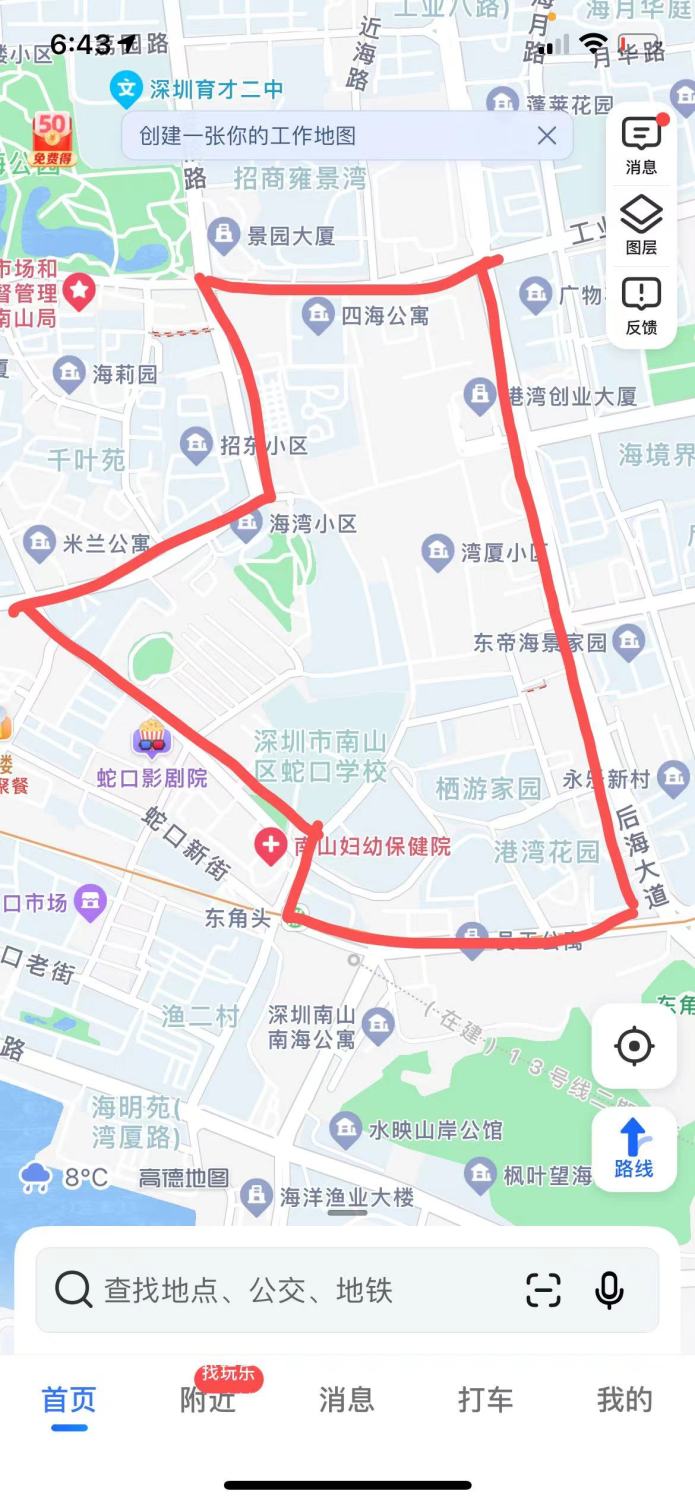
In order to achieve zero tolerance for covid (one way of translating current policy), but still keeping the city somewhat functioning, Shenzhen has been conducting mass covid tests. In order to enter government and official buildings (such as schools, which haven’t yet announced when they will reopen), it is necessary to show that one has had a negative test within the past 48-hours. When a positive is discovered, the case (and they are known as 病例), their immediate housemates, building, residential community, and nearby area are subject to immediate testing. Then depending on proximity to the case, flow to and from to a possible contact zone is or is not resumed. The above map shows that I am presently living half-a-street away from a possible contact zone in Shekou.
Continue reading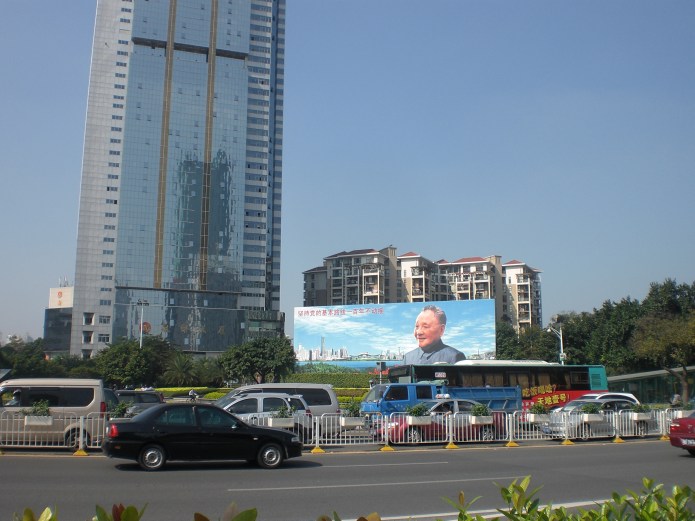
The architect of Reform and Opening Up, Deng Xiaoping died on February 19, 1997, 25 years ago. It was dank and rainy week. Shenzhen was still very much a manufacturing town, still very much under construction, and that day, very much taken by surprise. After all, commonsense du jour held that Shenzhen’s patron would hold on at least another three and a half months until midnight June 30, when he and troops from the People’s Liberation Army would march from Shenzhen across the Sino-British border into Hong Kong, signaling the formal transfer of the British colony back to China. But he didn’t make it. Instead, Shenzhen along with the rest of the country went into mourning. All Chinese television stations broadcast the 12-episode documentary, Deng Xiaoping, only interrupting archival footage and recorded memories to insert national, provincial and municipal news reports about how China, Guangdong and Shenzhen would continue the hard and necessary work of reforming and opening the county, province and city in his honor.
Continue reading Shenzhen Noted