

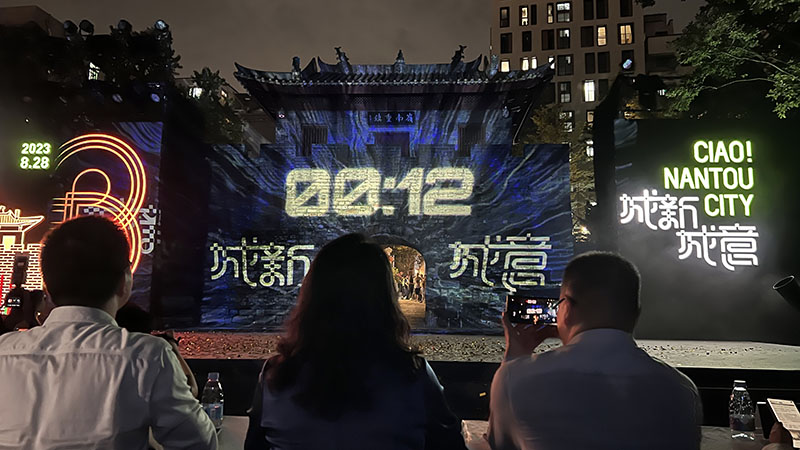

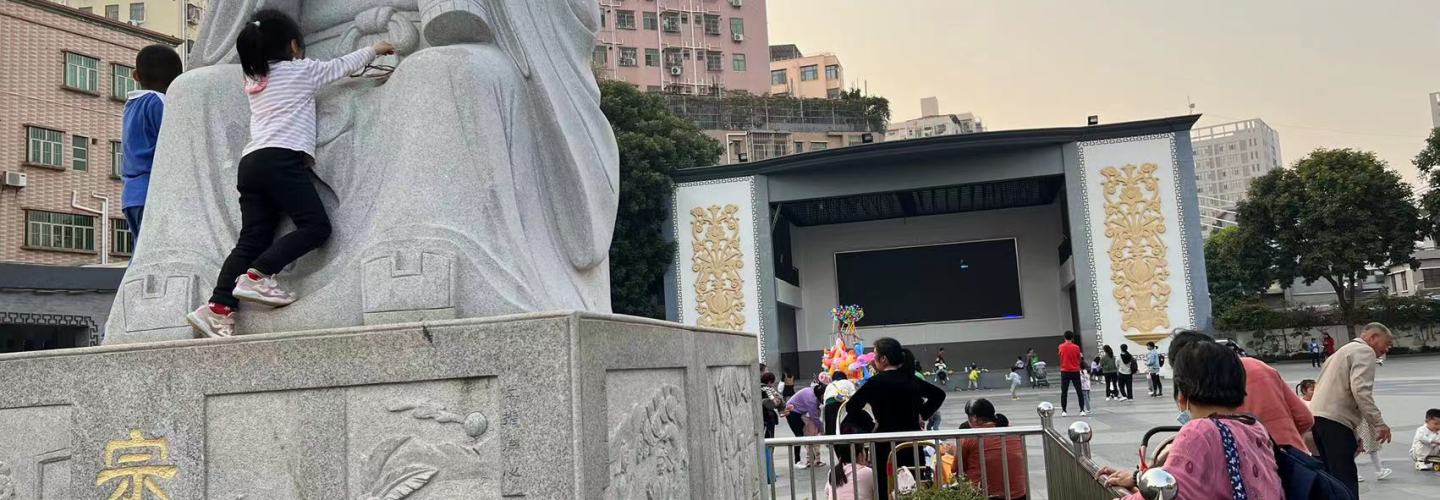
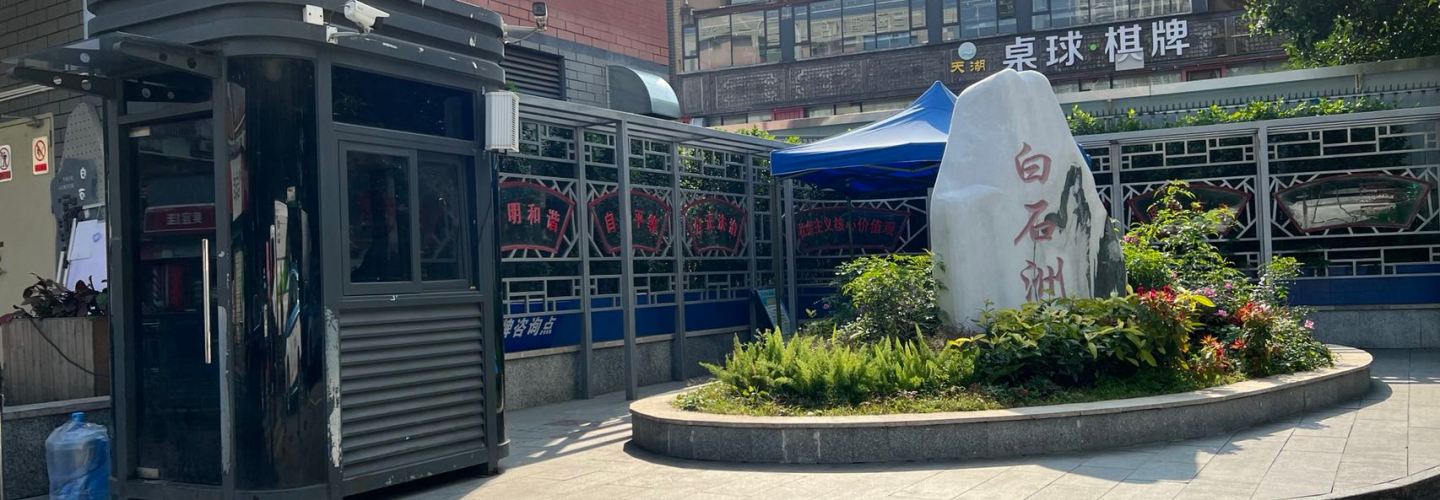

Yesterday, a member of Generation 80 took me to the beaches and mountains of Old Shekou, where he played as a child. He remembers swimming off small docks, crabbing on the dike that used separate the Naihai Hotel from the backwash of Delta waters, and biking safely along narrow, dirt roads. Little remains from his childhood. Even the broadcast tower from Broadcast Mountain has been razed and the remaining structures converted to an upscale Cantonese restaurant. Anyway, the area he used to bike, we cruised in his sports car. Impressions, below:
RIP – Steve Jobs and neoliberal immortality
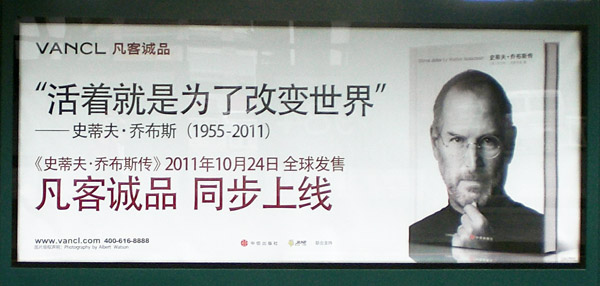
A recent advertisement for VANCL web quotes and shows a book about Steve Jobs. My first reaction was disgust: how is it possible to use someone’s death as a means of pushing goods? However, my random sampling of Chinese friends shows that there is another way of understanding this advertisement – social immortality or 不朽 (buxiu), which means that you continue to influence the world even after you have died. All agree, Steve Jobs achieved buxiu.
According to my friends, who don’t believe in an afterlife but do believe in continuing influence, Jobs achieved buxiu through three forms of social memory: 立功 (establish work),立言 (establish language),立德 (establish morality). 立 means to stand-up or to establish. 功 is a wonderfully rich character that has (at least) five meanings: merit, service, result, achievement, and accomplishment. 言 means language or speech and 德 refers to virtue. In other words, buxiu consists in setting up an institution, being cited, and setting moral standards. Steve Jobs’ accomplishment was to establish Apple, his speeches and citations now circulate on the internet and people learn from them, and his morality was to achieve brand confidence; Apple products are neither counterfeit nor substandard; their virtue as products is guaranteed quality.
Thus described, the kind of buxiu that Jobs has achieved seems classically neoliberal and begs all sorts of questions about how and why we are busy commodifying every aspect of our lives and afterlives. Indeed, we are clearly using economic metaphors to organize how we treat the living and the dead. How else to understand a world where trust can refer to forms of human relationship that have been structured by multi-generational financial arrangements? Consequently, talking about Steve Jobs and VANCL in Shenzhen reminded me of yet another cross-cultural capitalist truth; there’s as much honor and respect attached to VANCL’s use of Steve Jobs to promote online shopping, as there is when his American compatriots link the price of Apple stock to his passing.
productivity PK understanding
I have been having disturbing thoughts about compulsive productivity in the arts and academia, and yes, I know, Marx wrote eloquently about alienation, but it bears repeating: when we become cogs in whatever machine we find ourselves, we loose our humanity – our ability to empathize, to feel joy, to surrender to unhappiness, to accept responsibility for the consequences of our actions even though we cannot control how things will turn out. And that’s the rub: I keep thinking that if we gave ourselves time to ripen, our artistic and intellectual activities would bear rich harvest, rather than simply withering away as we scramble to complete the next assignment. Dust to dust, yes, but in good time.
Specifically, I’ve been wondering about how “accountability” is measured – a book every three years (tenure track jobs) or an artwork at the end of a residency (global AIR programs), and then, I recall that the words themselves show up the economic metaphors that strangle compassionate creativity. Account-able. Measure-able. Profit-able. As if our work was to make count-able objects, rather than to create more fully human lives.
Rant over.
pedestrian overpasses in the news!
If we take mega corridor roads (Binhe, Shennan, and Beihuan) as examples of urban planning in Shenzhen, the answer to the question, “Are we designing cities for people or cities for people with cars?” is “We’re designing the city for people with cars,” a frustrating thought even when I don’t have to use an overpass to cross the street. Nevertheless, Southern City Daily (南方都市报) reporter, Zhao Chongqiang (赵崇强) interviewed me about pedestrian overpasses and urban planning in Shenzhen, giving my favorite hobby horse a public airing, so I’m feeling the love (as my brother might say). Article, here.
how do we judge linguistic competence (in a foreign language)?
Yesterday, I played judge at a foreigners speak Mandarin competition. Contestants were judged on a prepared speech, fluency answering a question, and a performance of some traditional Chinese art. The contestants came from North America, Europe, Korea, and Japan and a variety of ages, ranging from two seven year old twins to folks in their late 40s, possibly early 50s.
What did I learn?
Short answer: Age and home culture matter in questions of linguistic competence in a foreign language. However, a pleasant personality and curiosity about one’s host culture will go a long way to buttressing linguistic incompetence.
Long answer: See short answer, above. Add elaborations, below: Continue reading
conditions of possibility – grassroots discourse at the wutongshan arts festival
The title of this post shouts “academic theorization”, but in fact, the post itself is far less ambitious. I’m simply speculating about what conditions we need to put in place in order to cultivate cross cultural discourse in and about places with vexed histories, like Wutong Mountain, Shenzhen.
Creating models and forums for cross cultural discussions in and about places with vexed histories is difficult. On the one hand, most of us are not familiar with the values and concerns that inform the ethos of another people; indeed, even when we are relatively knowledgable about cross cultural differences, often we do not share our interlocutor’s priorities. On the other hand, cultural groups are not monolithic entities, but rather vexed by class, gender, and regional differences, creating what Bhaktin called “heteroglossia” – a situation in which context (including history and culture and politics and economy and one’s interlocutor) is more important in determining the meaning of an utterance than is the text.
With the Wutongshan Arts Festival (梧桐山艺术节 – impressions above), organizers Gigi Leung and Michael Patte (founders of the riptide collective) aimed to generate conversations between village residents, local businesses (including Canyou), and artists who have moved there. The situation was clearly heteroglossic with both foreign and Chinese participants, who represented a range of different class backgrounds as well as different relationships to and with Wutong Mountain as well as Shenzhen. We came together to discuss future development in and of Wutong Mountain. Continue reading
2 days in guangzhou – impressions
chicken
What is the purpose of cross cultural art exchanges?
This has been a season of cross cultural art because I’m participating in the SZHK Biennale and have been translating for the OCAT International Artists Residency Program. I have had opportunities to talk with artists not only from the United States, but also Europe and heard questions and comments that are interestingly different from those of Western academics and business people, until recently my usual non-Chinese interlocutors.
Other than the fact that good, deep cross cultural artistic collaboration takes time and patience and a willingness to let go of preconceptions and even values, what have I learned?
Short answer: philosophically, we’re all of us still carrying way too much baggage and practically, translators are seriously underpaid for the work we do facilitating communication despite break downs therein.
Long answer: As a form of social praxis and value structure, art functions very differently in China and the West. I have written about these differences with respect to theater (here and here). Briefly, in the West, artistic praxis has been a means of overcoming four forms of capitalist alienation (as identified by Marx): Continue reading
Wutong Arts Festival, Oct 15-16

Join riptide collective this weekend and participate in the Wutong Arts Festival. Michael and Gigi do wonderful work showcasing alternative voices. Details and directions, here.
 Shenzhen Noted