Balancing Act: Notes on Translating for Future Relevance

Future Relevance / 明天,谁说了算? opened today. I translated the exhibition catalogue. Below, I’ve uploaded my thoughts (and translation of said thoughts) on the importance of learning to listen across unsaid assumptions, even when we don’t depend on a translator.

In our native languages, we speak with the expectation that we will be understood and if not, that misunderstandings can be easily fixed. Moreover, we often emphasize speaking as the sign of linguistic competence, rather than listening, reading, or writing, or more generally, an ability to navigate shared histories and cultural assumptions, political exigencies and economic conditions; in short, we take for granted all the unspoken social infrastructure that enables communication. Indeed, we are often so oblivious to the contexts of meaningful dialogue that cross-cultural exchanges often degenerate into fumbling searches for the “right word”.

Take for example a simple comparison of cultural associations with the English word, translation and its Mandarin counterpart, fanyi (翻译). Continue reading

意maging baishizhou

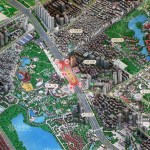
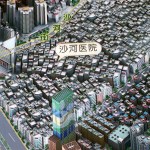
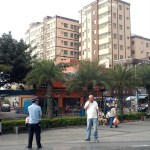
Three pictures of the northeastern corner of Baishizhou along Shennan Road. The map and detail are from a map in the Window of the World subway station, the third is a photo of the actual corner, taken from the plaza in front of 沙河世纪假日广场 (Shahe Century Holiday Plaza), the large landmark in the two maps. The contrast between the map and the territory interests me because it the ongoing (re)imagineering of Baishizhou in particular and Shenzhen more generally.

Baishizhou, as mentioned in earlier posts, is one of Shenzhen’s more “chaotic (乱)” urban villages. However, it occupies prime real estate – directly across from Window of the World and on the Line 1 Subway. Consequently, upgrading Baishizhou is an ongoing project and has included major real estate development. Tellingly, most information about Shahe Century Holiday Plaza real estate (herehere, and here, for example) emphasizes the subway convenience, views of Window of the World, and modern amenities, downplaying and often ignoring the Plaza’s neighbor, Baishizhou.

Continue reading

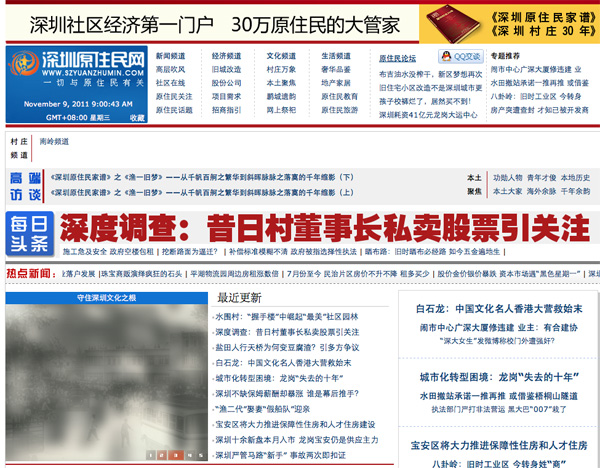
深圳原住民网 – what interests the locals?

Much has been said about Shenzhen’s urban villages (城中村). Indeed I’ve made something of a career out of talking about rural urbanization and the like. However, I’ve now stumbled upon the 深圳原住民网 (Shenzhen Original Inhabitants’ Web) and it provides all sorts of information about village histories, concerns, and their understanding of what matters in contemporary Shenzhen.

I look forward to translating posts in the future and finding out more about who’s not only running the website, but also brought villagers together under a common title “original inhabitants”. Previously, most villagers represented themselves as from a particular village, rather than having anything in common with original inhabitants from other villages. So, another interesting layer added to the amalgamation that is Shenzhen identity.

That said, I’m wondering how extensively District governments are participating in maintaining and developing content for the website precisely because they are the one’s responsible for implementing old village renovation projects. Indeed, old village renovation projects partner District governments, a village corporation, and a major real estate developer to “modernize” the area in keeping with Shenzhen’s recent efforts to promote its image as a hip, modern, and international city.

Exhibit Opening

Exhibition of 6th OCAT International Art Residency– Future Relevance

“2011深圳•香港城市\建筑双城双年展”外围展

Organizer: OCT Contemporary Art Terminal of He Xiangning Art Museum

Program Manager: Wang Jing

Program Assistants: Marry Ann O’ Donnell (USA),Xu Yuntao

Curator: Paula Orrell (UK )

Artists: Frank Havermans (NL), Nika Oblak & Primoz Novak (SI), Thomas Adebahr (DE)

Opening: 5:00 pm Nov 11, 2011

Dates: Nov 11, 2011 to Jan 8, 2012

Venue: Northeast side of B10, Northern OCT LOFT, Overseas Chinese Town, Nanshan District, Shenzhen

Please join us for the opening!

perfect partnerships

The past few days, I have overheard friends comment that the spouse of a mutual friend isn’t in friend’s league. Admittedly, knocking a friend’s significant other is common enough cross-culturally, so inquiring minds might be wondering why I glommed to these moments of snark. Short answer: because I finally realized something about the social arrangements of family businesses. And yes, the social organization of these relationships seems universally neoliberal, even if (or because?) the evaluations of the roles that different spouses play varies in interesting (and gets read as) cultural difference.

Chinese power couples have an interesting division of social labor; one usually works human relationships and the other usually takes care of business. Continue reading

the modern woman. . . what can’t she do?

more fun with cellphone couplets, this time about the skills of the modern woman:

现代女性“十项全能”:上得了厅堂,下得了厨房;写得了代码,查得出异常;杀得了木马,翻得了围墙;开得起好车,买得起新房;斗得过二奶,打得过流氓。

The Modern Woman’s “Ten abilities”: She can entertain guests and cook up a storm; she can write a computer program and ferret out irregularities; she can kill viral Trojan horses and scamper over the firewall; she can drive a good car and buy a new house; she can take on a second wife and defeat a hooligan.

Generation 70

Shenzhen seems suddenly filled with creative people. In part, this may be the biennale and the cultural business that has been generated. In part, it may also be the upcoming Nanshan Fringe Festival. However, in large part its also due to the fact that generation 70 is now actively making decisions about how they want to live and contribute.

Shenzhen’s current “30-something” group, Generation 70 (70后) is an interesting cohort because they are clearly not residually socialist in the manner of Generation 60 (60后), but neither do they belong to the Rich Second Generation (富二代), even when they are the second generation of their family to live in Shenzhen. Instead, Generation 70 were raised to be respectable members of the middle class, have professional careers, and move China forward in solid, sober fashion. However, after graduating from college, getting that job, and starting their one-child-families, many members of Generation 70 have found themselves bored with the lives that their parents and grandparents and spouses and friends expect them to live.

Started by two members of Generation 70, ATU观筑 exemplifies the creative second career choices that some of Shenzhen’s 30-somethings are making. ATU观筑 is a non-proffit institution that organizes salons, workshops, and public education courses to debate the meaning and direction of urbanization and urbanity in Shenzhen. The directors are 30-something and the creative team is in their mid-20s. They dress fashionably, enjoy art, and want to contribute to a more vibrant society. They speak English, travel abroad, and think of transforming Shenzhen in terms of environmental and progressive values; in short, the folks at ATU观筑, like other creative 30-somethings throughout the city and the country may be the crest of a distinctly modern and Chinese wave of creativity that many – Chinese and foreigners – have been waiting to arrive since Reform and Opening began just over thirty years ago.

yes, we’re grumbling . . . (about recent web closings and what not)

It’s been a while since I’ve translated a text message, but as those at the Center scramble for power and internet access became extremely dodgy three days ago, text messaging has become more a more reliable source of information. Sigh. Indeed, the long text that follows speaks to the dissatisfaction and resignation that often creeps into daily conversations; it certainly hints at the extent to which non-compliance and minor sabotage may characterize administrative and business life throughout Shenzhen, and Shenzhen I’m told, is one of the “easiest” places in China to achieve one’s goals in the public sphere.

中国特色“解决”大观

领导问题靠书记解决,政治问题靠经济解决,外交问题靠呼吁解决,军事问题靠和平解决,党外问题靠党内解决,思考问题靠忽悠解决,道德问题靠运动解决,文化问题靠管制解决,市场问题靠行政解决,亏空问题靠印钞解决,社会问题靠城管解决,面子问题靠盛会解决,建设问题靠强拆解决,生育问题靠计划解决,前途问题靠拼爹解决,致富问题靠中彩解决,医疗问题靠伪劣解决,饮食问题靠掺假解决,办学问题靠排污解决,科技问题靠山寨解决,学术问题靠剽窃解决,明星问题靠上床解决,军衔问题靠唱歌解决,公安问题靠黑道解决,升职问题靠买官解决,反腐问题靠贪官解决,股市问题靠圈钱解决,舆论问题靠封锁解决,疑虑问题靠“我信”解决,和谐问题靠糊弄解决,民意靠对付解决。。。保持联系靠短信解决!

Principles of “resolving the issue” Chinese style

The Secretary resolves leaders’ problems, the economy resolves political problems, appeal [to others] to resolve foreign relations, peace resolves military problems, the Party resolves non-Party problems, scams resolve problems of understanding, political movements resolve moral problems, supervision resolves cultural problems, policy implementation resolves market problems, printing money resolves the debt problem, municipal administration resolves social problems, banquets resolve face problems, forced razing resolves construction problems, planning resolves birth problems, “my father is more important than your father” resolves future problems [qiantu puns “road” and “future direction”], the lottery resolves problems of getting rich, low quality resolves the medical situation, adulteration resolves food and drink problems, discharging waste water resolves education problems, shanzhai production resolves science and technology problems, plagiarism resolves education problems, sleeping together resolves movie star problems, singing songs resolves military rank problems, gangsters resolve public safety problems, buying a political appointment resolves promotion problems, corrupt officials resolve anti-corruption problems, expropriation resolves stock market problems, blocking the internet resolves public opinion problems, “I believe” testimonials resolve doubts, muddying the waters resolves harmonious society problems, weapons of the weak resolve problems of realizing the people’s will. . . and to resolve problems of staying in touch, let’s text!

Jiujie / Nantou / Xin’an Old Town

Years ago, I published becoming hong kong, razing baoan, preserving xin’an, an academic paper on urbanization as the ideology informing the construction of the Shenzhen SEZ. Part of that paper included an analysis of Nanshan District’s decision to create a walking museum at Nantou, the County Seat of Xin’an from the Ming Dynasty until the CCP moved it to Caiwuwei, in Shenzhen Market. The museum didn’t survive into 1998 and Nantou settled back into urban village life – migrant workers renting space in handshake buildings, small scale manufacturing taking place both at home and in low tech factories, and bustling streets of vendors, shops, and open air markets.

Yesterday, I walked Nantou and discovered Universiade traces. The roads that connected the buildings in the walking museum had been paved with grey bricks and the buildings abutting those streets (well all two of them) had been given “traditional” facelifts – a faux grey brick facade and eves. Moreover, the museum buildings have been reopened to the public! So the universiade upgrade of Nantou included Shenzhen’s ongoing push to open small museums in the urban villages.

Here’s the rub: Houses and streets beyond the scope of the museum remain as they were. Also, the gate god, which used to inhabit the old Ming gate to the city has been removed. All that remains of that living tradition are two holes on either side of the gate, where incense has been stuffed in. And yes, that’s an upgraded pedestrian overpass at the entrance to what remains of the walled city. Impressions of revamped and still unvamped Nantou, below.

This slideshow requires JavaScript.

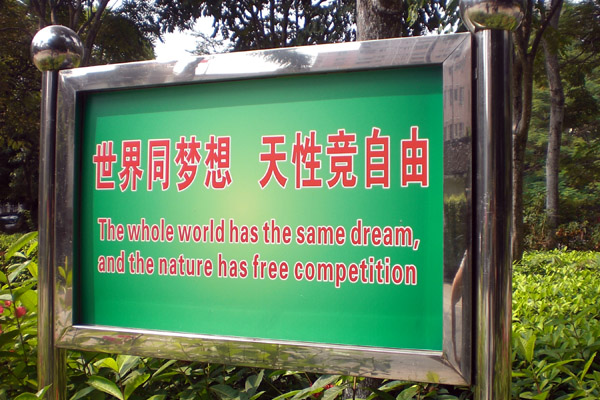
Translation question: 天性竟自由

I’m having difficulty figuring out what this sign actually means. Clearly, the English is off. My sense of the Chinese, however, is to attribute all sorts of neoliberal interpretations to the line 天性竟自由; no matter how I cut it, I come up with a slice of economic pie. Nevertheless, I recognize that there are important nuances even within forms of neoliberal essentialism. Hence my question: How would you translate this sign? Please share translation and rational.