nationalism despite the state

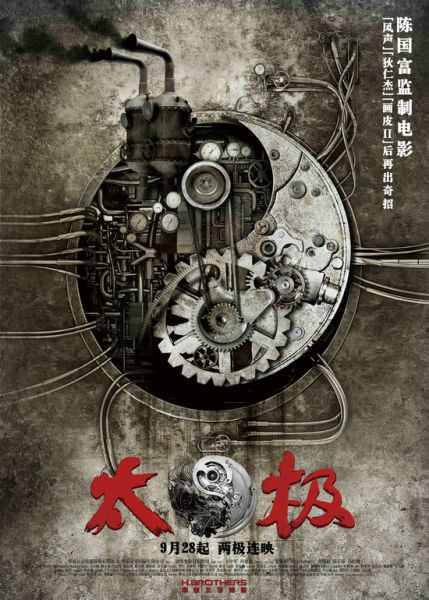
Steampunk + kung fu + colonialism + the Qing Dynasty = Tai Chi 1: Start At Zero (太极1:从零开始).

The plot is simple and the pace full-throttled. There is a village, where kung fu is treasured and passed down from generation to generation, but only to village members — no sharing traditional culture. There are masters who fly through the air and defeat mechanical trojan horses, which bring railway tracks and seductive foreign women. There is a phoney foreignor, who betrays his village and first love to redeem his personal honor. There is a latent hero, who learns kung fu despite the village’s prohibition against teaching outsiders, shuts down the trojan horse despite ignorance about things mechanical, and marries the village kung fu beauty despite being unconscious. All in 90 minutes of whirling feet and spinning hands, punctuated by moments of sudden stillness and insight into what happens to human hearts when forced into a corner. Continue reading

as shenzhen razes: the baishizhou urban renewal plan online

Shenzhen developer, Lvgem Group (绿景集团) has uploaded a video of the Urban Renewal Plan for the Five Shahe Villages in Baishizhou (白石洲沙河五村旧改专项规划).

Wow. Just wow. And not in the good way.

The current built environment of roughly 580,000 square meters will increase 10-fold, to 5.5 million square meters.

The argument for razing the current settlement and replacing it with high, high rises and skyscrapers is that Baishizhou villagers live in grungy unpleasant conditions that need to be upgraded. The proposed solution is for the developers will work with villagers in order to bring them into the urbanization process.

In a nutshell,  the problem is that the video conflates the idea of “villagers” with the ruralized current residents of Baishizhou. There will be a resettlement area for “villagers”, but who counts as a villager? The actual population of Baishizhou is over 140,000, of which 120,000 do not have Shenzhen hukou. So, inquiring minds want to know: is the plan calling for ten times the space to house the 20,000 residents who do have hukou? Or does “villager” only refer to the actual members of the five villages, which means we’re talking about less than 2,000 people with resettlement rights. And if that’s the case, who will live in all this new, upgraded, hyper-modern space after the current residents have been forced to leave?

A quick visit to 58 net reveals how cheap housing in Baishizhou is relative to the surrounding area. In fact, many young office workers and professionals from neighboring Science and Technology Park (科技园) also live in Baishizhou as to designers and creative talents who work in the OCT Loft. Providing this class with livable (宜居) housing is an ongoing Shenzhen concern. Indeed, there is now an official plaque for hanging on a rental building which confirms a building’s livability.

It is estimated that over half Shenzhen’s population live in the villages, which account for roughly 10% of the area’s land. Arguably, the villages are the city, while high end housing estates and neighborhoods might be thought as wealthy suburbs, with lovely gardens and huge tracks of private spaces. Consequently, the question of who actually belongs to an “urban village” is the social, political, economic question because as Jonathan Bach has argued, the villages have been the incubators where (some of) Shenzhen’s migrant workers transform themselves into urbanites and potentially citizens.

As Shenzhen razes. Stay tuned.
Boom! Shenzhen Greedy Snake Video

Boom! Shenzhen is now online. Zhang Xueshi and Wang Lechi give us the 90 second version of Shenzhen history. Enjoy!

Here’s the youku version, which includes music@

南岭村:even after death our ashes won’t return…

Episode 4 of the Transformation of Shenzhen Villages focuses on Nanling Village, which became famous throughout the country as the “争气村 (hardworking village)”.

Nanling’s [Shenzhen] story begins in 1979 with the last mass exodus of Baoan economic refugees to Hong Kong. That day, Shaxi Brigade [Nanling’s collective predecessor] Vice Secretary Zhang Weiji came home to discover that his wife had joined several hundred other villagers who had decided to make the run for Hong Kong. Zhang Weiji went to the border and called for his wife and fellow villagers to return home with him. One of the runners looked over his shoulder and shouted, “Even after I’m dead my ashes won’t return to this place.” In the end, 50 villagers and his wife returned with Zhang Weiji to what had become another of Baoan’s ghost villages. The secretary vowed to transform Nanling into a village where people would stay and live out decent lives. Over the next decade, Nanling became one of China’s most important symbols of Reform and Opening as a means of achieving rural urbanization. Indeed, both Jiang Zemin and Hu Jintao have visited the village on inspection tours to promote and confirm Nanling as a model for other village urbanization projects.

Continue reading

The Fishing Village that Became a World Symbol: 渔民村

So, I have been catching up on the Shenzhen documentary, 沧海桑田:深圳村庄30年. After setting the historic stage with rural poverty and economic immigration / cold war defection (episode 1) and then national policy (episode 2), the documentary turns to specific villages both to illustrate general trends in SEZ history and to introduce the players. So today, 渔民村 (Yumin Village – episode 3), at the heart of the earliest reforms.

Yumin Village has an important place in both national Chinese and local Shenzhen symbolic geography for three reasons, but most importantly for revealing the prejudices built into the landscape, locally, nationally, and internationally. Continue reading

Breaking the Ice

So, episode 2 of 沧海桑田 is 破冰. What was the ice and how was it broken? A few notes, below.

Episode 2 begins with shots of thick ice on the Huai river, the narrator metaphorically speaking about the frozen space between two shores. Not only an obvious (and simultaneous) reference to the Sino-British border (on either side of the Shenzhen river) and the Taiwan Straits, but also a description of how the planned economy made the lives of Anhui farmers difficult. A relevant reminder: the reforms initiated in Shenzhen began with Wan Li (万里)’s efforts to liberalize agrarian production in a part of the country where it does snow. Continue reading

the vast unknown…

Another happy introduction. Good friend and musician, Robert Copeland composed the theme music for the 2011 Shenzhen International Fringe Festival. Yang Qian and I wrote the lyrics. Yes, the theme is sci-fi. Yes, that’s Fringe GaGa and 艺穗 DaDa to you. Sing along, here; lyrics below. Continue reading

Fat Bird Trailer

A new Fat Bird trailer is online, please view.

New Fat Bird online

videos of recent fat bird productions, 519 Happy Academy, Worm Hole, and particle-wave performance workshop are now online!

food-scape updates, closure

Closure on the foodscape project. Last Wedensday, Sept 16, 19:30 at the Hong Kong Arts Centre, mccmcreations hosted a book launch for foodscape, the book. The book is on sale at the Bookshop of said Arts Centre. Please stop by, puruse, and buy a book!

Also, Milan Buttner completed Inter-view, his 30-minute exploration of inter-cultural exchange and multi-lingualism during the project. Click, view, and enjoy!