the second line: nantou checkpoint to zhongshan park

Walked with Emma Ma and her father, Mike along Shenzhen’s northern loop expressway (北环大道) from the Nantou Checkpoint to the northern entrance of Zhongshan Park. Our path followed the remains of the second line (二线), the boundary that once divided Shenzhen into the SEZ and New Bao’an County. Cobbled together out of debris and plastic poster banners, a makeshift tent settlement hovers atop the obsolescent wall and a border guard platform falls apart. A section of the former border zone has been converted to a logistics depot for the Nanshan Oil company. Ironic, of course. Across the street in Zhongshan Park, the Ming Dynasty remains of the Nantou City wall have been designated cultural heritage. Impressions of the second line, below.

This slideshow requires JavaScript.

Jilong Village ruins

In the ongoing rush to raze urban villages, vestiges of the actual old villages have suddenly assumed an almost mythic aura and handshakes seem classically urbane. The latest example? Remnants of Jilong Village, one of the four neighborhood/ villages that constitute Huanggang (the other three are Shangwei, Xiawei, and Huanggang New Villages) are currently being renovated in the shaded grove next to Huanggang Plaza and now flicker with ancient promise. As close as half a year ago, migrant workers rented these decaying row houses; now, visions of a Huanggang Xintiande dance in my head. A few pictures, below.

This slideshow requires JavaScript.

Shuiwei’s New Park: Commemorating Reform and Ancestor Zhuangzi

As part of its ongoing upgrades, Shuiwei has finished a small park dedicated to Zhuangzi. In fact, the village traces its genealogy back to the famous philosopher; according to the plaque, the village’s founder Zhuang Sen (庄森) was born into the 48th generation of Zhuangzi descendants. The commemoration, like others throughout Shenzhen villages, links the establishment of the village with its Reform era rejuvenation.

This slideshow requires JavaScript.

先祖立村六百载,幸福小康颂党恩,围昌万年是祈愿,和谐共荣新家园,改革开放越千秋,庄氏族系倍兴旺,水环四壁换新颜。承先启后永向前。

Our founder established the village 600 years ago, for happiness and prosperity we praise the Party’s magnanimity,

Our prayer is that our compound thrives 10,000 years, harmony, co-prosperity, a new homestead,

Reform and Opening surpasses 1,000 autumns, the Zhuang family descendants to flourish,

The moat and old walls have been replaced. We connect past and future generations, eternally going forward.

Xiasha: What continues and what fades away

Yesterday, I met Chen Hong (陈宏), executive producer of the Shenzhen Villages documentary mini-series (桑海桑田:深圳村庄三十年) and was gifted my own set of DVDs and associated book! No longer dependent on the odd youku upload, I can now finish my review of episode 5, The Background of Xiasha (下沙背景).

The opening begins with the last Song Emperor fleeing the Yuan. His grave, of course is in Chiwan, but it turns out, over 800 years ago, Xiasha villagers met the imperial refugee and his ragtag army with large casseroles of chicken, seafood, pork, and vegetables or pencai (盆菜) as they are known in Shenzhen. The mini-series narrator solemnly intones that although the Emperor died before his ninth birthday, the pencai tradition lives on in Xiasha Village.  Continue reading

Thoughts on Shenzhen’s New New Districts: Longhua and Dapeng

This past week, when the Center brought the country’s 3,300 provincial, municipal, and county members of the Politics and Law Committee (政法委) to Beijing to learn “what to do and how to do it,” they did so to strengthen top-down unity, or the line from the Center (中央) to the “local (地方)”. Party control of the Politics and Law Committee means that it directly controls the writing of laws, their interpretation, and enforcement. As far as we know, Zhou Yong “Noodle Master” Kang remains the Chair of the National Committee. We hypothesize that Hu Jintao was critical to making the decision to convene a Politics and Law Committee meeting and what would be taught there. Ergo, we are waiting to see whose line actual becomes the standard that will be brought back to Local governments, like Shenzhen.

How does this administrative apparatus shape the possibility of progressive social transformation in Shenzhen?

One way to answer the question is to think of all the districting and redistricting and micro-districting and statutory planning that create what the Municipality spins as Shenzhen’s “Industry First” as ways of side-stepping Center intervention and oversight by giving investors in hi-tech manufacturing, logistics, finance, and cultural industry preferential policies without any kind of political reform. Continue reading

stars in my coffee…

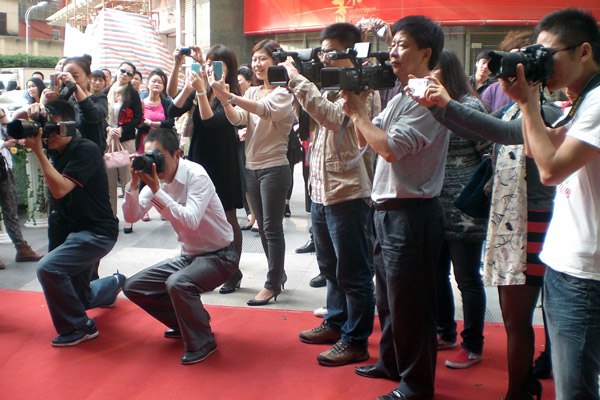
Shenzhen entrepreneurs enjoy big openings and Tuesday afternoon, I participated in the grand opening of Iris, a coffee shop located in the Hongxiang building, just off Hongling Road. I thought I had been invited to show my support for the owner’s new enterprise, but in fact had been invited as a special guest. Caveat: I’m not Hollywood red-carpet famous, but Shenzhen cultural circles somewhat well-known and happened to be free on Tuesday afternoon famous. Apparently, this friend of a friend of a friend is using cultural taste to brand the experience of drinking coffee there and all of the special guests were in some way related to cultural production in Shenzhen, especially writing and music. Continue reading

connect the dots: kk through caiwuwei to songyuan

Walked a stretch of Old Shenzhen yesterday, winding along shaded boulevards past work unit housing, 90s upgrades, and remnants of Caiwuwei finally arriving at the KK 100. Should you wish to retrace my steps, head north through the Caiwuwei entrance just behind Shenzhen’s latest landmark.

This slideshow requires JavaScript.

Consuming power — Xi’an snacks

Power, its cultural incarnations, and subsequent transvaluations fascinate me. How we work with and through inequality defines us not only as an identifiable people, but also as a moral community. I understand the scholarly imperative to be discovering who, what, where, why, when, and how our appetites and assumptions, our attachments and defilements inform and transform shared worlds. That said, my interest in power tends toward the practical; I like knowing when I should pick up the tab and when silence is not a sign of respect, but a sin of omission. Continue reading

afternoon sunlight, central, hk

Walked the hills of Central today. Remembered that afternoon sunlight does all sorts of good. Thought that narrow streets and winding hills ameliorate the effects of looming skyscrapers. Enjoyed.

This slideshow requires JavaScript.

power and authority in a chinese high school

Last night I heard a fifteen year old girl ask the rhetorical question, “Why are some suited to be a leader and others aren’t?” She had been comparing a teacher and a vice principal, both from her school. Apparently, the teacher had treated her badly and the vice principal had treated her well. Her disparaging remark neatly summarized a common understanding of power — people who treat others well deserve to be leaders. Implicit, of course, was the assumption that those who don’t treat others well don’t deserve to be leaders.

The question vexed me. On the one hand, she was correct to note the difference between authority and power as styles of leadership. The vice principal had helped her, which confirmed the legitimacy or the authority of his position. In contrast, the teacher had coerced her to do something she didn’t want to do. Coercion falls pretty unambiguously into the deployment of power category. On the other hand, these were not isolated events. They took place within a fraught social network in which the reason she had sought out her teacher and the vice principal came into play. At this level, both the teacher’s and the vice principal’s actions make sense. Continue reading